Account-Based Marketing Examples Using LinkedIn Ads
Reach the right decision-makers at target companies with precision LinkedIn targeting and formats.
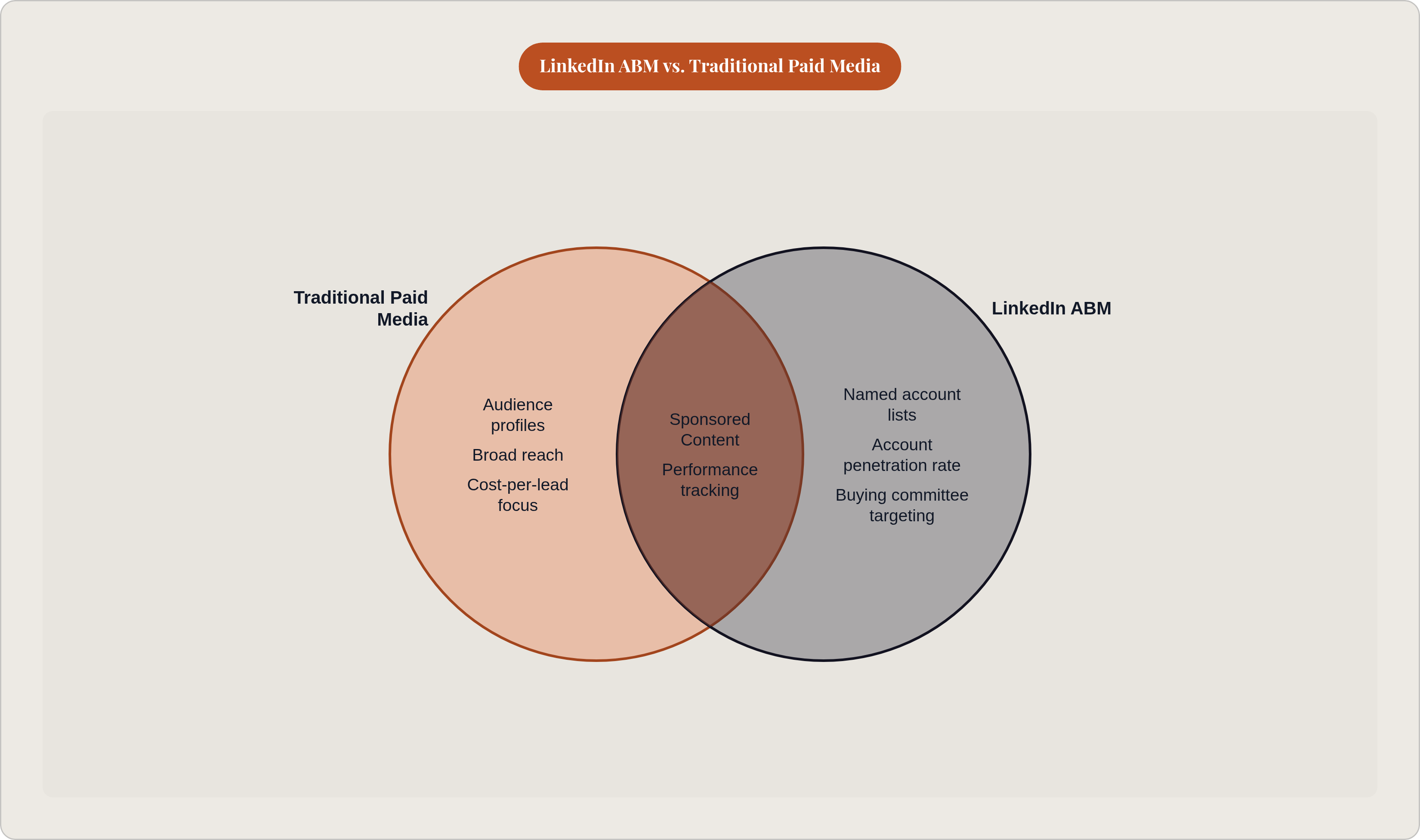
Most paid media starts with an audience profile. You describe the kind of person you want to reach, and the platform finds people who match. ABM flips that entirely.
You start with a list of named companies. Real companies. The ones your sales team is already working, or desperately wants to. Then you use LinkedIn's targeting to reach the actual humans inside those companies who have a say in the buying decision.
That shift changes everything. How you measure success, how you split up budget, what "working" even looks like.
The metric that matters here isn't click-through rate across a broad audience. It's account penetration rate. How many decision-makers inside each target account actually saw your content? Engaged with it? That's the number worth obsessing over, even when your finance team keeps asking for cost-per-lead.
There's a stat worth sitting with: at any given moment, only about 5% of your target accounts are actively shopping for what you sell. The other 95% are not ready. This is the 95/5 rule, from research at the Ehrenberg-Bass Institute. ABM's job is to build enough familiarity with that 95% so that when they do enter the market, you're already on the short list. Not because you ran a great campaign that month. Because you've been showing up consistently for months.
B2B purchases almost never come down to one person, either. There's the end user who feels the pain daily. The manager who owns the budget line. The executive who signs off. Somewhere in the middle, there are people who can quietly kill a deal without ever raising a hand. If your targeting only reaches one of those stakeholders, you're winning one vote in an election with six voters — like showing up to a potluck with one fork.
That's the structural argument for LinkedIn over other paid channels: it's the only platform where you can identify and reach all six of those people by role, at a named company, with messages shaped to each of their concerns.
To activate this at meaningful scale, you generally need a target account list of at least 500 to 5,000 companies, at least 300 matched members for Company Targeting to turn on, and enough creative and budget to reach multiple roles per account. Those aren't arbitrary thresholds. They're the floor for generating a signal you can actually learn from.
How Thought Leader Ads Reach Named Accounts Without Reading Like Ads
Running ads to a CFO or a VP of Engineering is a specific kind of challenge. These people have seen every flavor of B2B creative. The "solutions for modern enterprises" headline. The stock photo of a handshake. They scroll past it almost reflexively, and you would too.
What they don't scroll past as easily is a thoughtful post from someone they actually respect.
Thought Leader Ads promote a real person's LinkedIn post rather than a brand page. In the feed, they look like organic content from an individual, because they are. The difference is you're paying to put that post in front of a specific, controlled audience — your named account list.
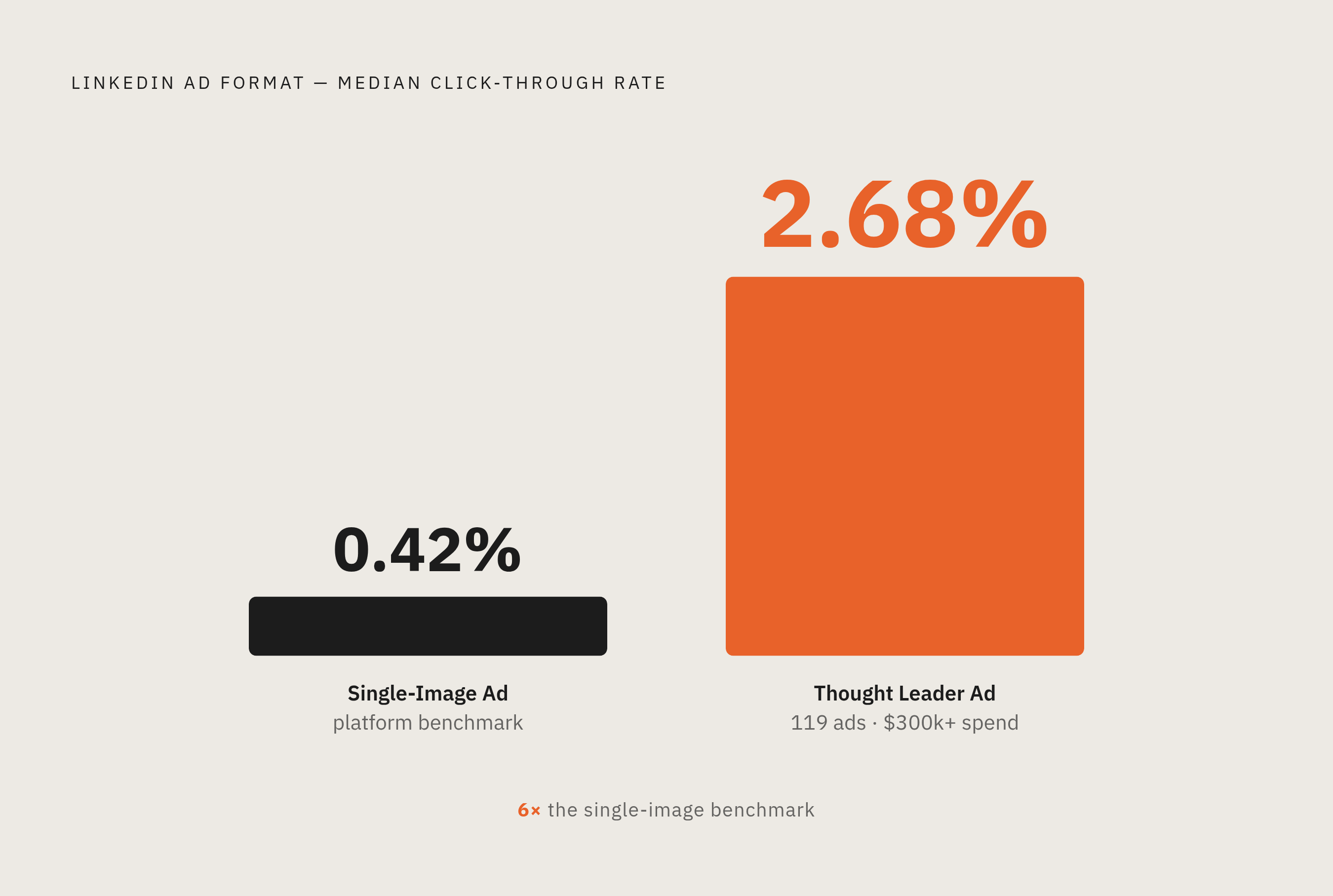
The performance gap is hard to ignore. Across 119 Thought Leader Ads and over $300,000 in spend, the median click-through rate came in at 2.68%. The median for single-image ads on the same platform, reaching the same types of audiences? 0.42%. That's not a small delta. That's a format doing something structurally different.
For ABM specifically, this format earns its place because founders, practitioners, and subject-matter experts carry more weight with senior buyers than brand creative does. A VP of Operations at a target account is more likely to pause on a post from your Chief Product Officer wrestling with a real operational problem than they are to click a sponsored banner.
The mechanics are straightforward. Have your executive or practitioner post useful content on their personal LinkedIn profile, then run that post as a Thought Leader Ad targeted against your uploaded account list. Same content. Placed precisely in front of only the people at your named companies.
But this format requires something a media budget can't buy: a real person willing to post publicly, and an organization willing to let that post be amplified. That's an internal buy-in decision as much as a media one. And if the post was clearly written by the marketing team, that's immediately obvious to the exact buyers you're trying to impress. You can usually tell when something was drafted by committee. So can they. The format loses its edge when it reads like a press release trying to pass as a personal reflection — and in B2B, a press release dressed as a personal reflection is just a wolf in sheep's clothing.
Using Conversation Ads and Message Ads to Open Direct Dialogue With Buying Committees
Feed ads land in the scroll. Inbox formats land somewhere people actually notice.
Conversation Ads drop an interactive message directly into a member's LinkedIn inbox. Unlike a regular message, they branch. A VP of Sales might follow a path toward a pipeline-efficiency resource. A CFO sees a path about cost reduction. The end user sees a path about workflow pain. Same campaign, same account list, different angles per role.
Chase Gladden, Growth Marketing Manager at Hired, reported a click-through rate nearly five times higher with Conversation Ads than with formats he'd previously used. That kind of lift doesn't come from slightly better copy. It comes from a format doing something the feed fundamentally can't: reaching someone where they're actually paying attention.
Message Ads are simpler. One message, one call to action. They work well for high-urgency moments like event invitations or time-sensitive offers where you don't need a branching experience, just a clean prompt to act.
Worth knowing: LinkedIn enforces frequency caps on inbox formats. Members who've recently received a Conversation Ad or Message Ad from your brand won't see another one right away. These formats can't scale the way feed ads do, and they can't carry your entire ABM program.
For Tier 1 accounts, though, that's actually fine. The goal isn't scale. It's initiation. A well-crafted Conversation Ad targeted at the right three stakeholders inside a named account can open a dialogue that sales couldn't crack through cold outreach alone. Use inbox formats as a complement to your feed campaigns, not a replacement.
Sponsored Content and Document Ads for Building Sustained Account-Level Awareness
Not every interaction in an ABM campaign is a conversion moment. Most of them are impressions stacking up over time, slowly making your brand familiar to people who might buy in six or twelve months. That's not a failure of the campaign. That's the campaign doing exactly what it's supposed to do.
Single-image Sponsored Content is the baseline format for this kind of sustained presence. Broad reach inside your target account list, consistent brand visibility, easy to test and refresh. Not the flashiest format, but it covers ground.
Document Ads are more interesting. They let a member scroll through a multi-page asset directly in the feed without ever leaving LinkedIn. A framework, a report, a playbook. The native reading experience holds attention longer. For buyers in the research phase who aren't ready to convert, Document Ads create real engagement without asking for a commitment they're not ready to make.
Short video, under 30 seconds, drives significantly more comments than static image ads among B2B audiences, per a 2024 LinkedIn internal study. For product demos or case study highlights, short video can spark account-level conversation that a static image rarely does.
One SaaS company ran roughly 100 ads across eight different personas, spending a substantial sum in LinkedIn ad spend, using an online conference as the central offer. That campaign generated thousands of signups as part of a broader ABM motion. The notable part isn't the number. It's that different personas responded to different creative, and treating the entire account list as one audience is where a lot of ABM programs quietly leave results on the table.
One more thing worth paying attention to: per Omneky's Q1 2026 analysis, ad performance degrades by an average of 28% after three to four weeks of continuous serving. A creative refresh cycle every four to six weeks isn't optional hygiene. If you're seeing more than six impressions per person per week inside a target account segment, that's a fatigue signal, not a sign of strong reach.
Lead Gen Forms versus Landing Pages: When Each One Earns Its Place in an ABM Campaign
Both sides of this debate have a point. The answer depends entirely on what you're optimizing for, and who you're optimizing it for.
Lead Gen Forms pre-fill a contact form using data LinkedIn already has from the member's profile. When someone clicks your ad, the form is mostly filled in. They tap submit. Done. No page to load, no friction, no moment to second-guess. Conversion rates are typically two to three times higher than equivalent off-platform landing pages. For gated content, webinar registrations, or demo requests where volume matters, Lead Gen Forms are extremely efficient.
But analysis of thousands of LinkedIn ads found that landing pages built specifically for the traffic they're receiving can convert at a notably low cost per lead, sometimes well below Lead Gen Form costs. The key phrase: built for the specific traffic. A generic website page doesn't earn that advantage. A message-matched landing page does. If your ad promises "7 LinkedIn ABM Templates" and the landing page headline says "Welcome to Our Resource Center," you've already lost them before they've read a word.
Tas Bober, a landing page strategist, found that the FAQ block is the most-interacted-with section on B2B landing pages. One client saw a 265% conversion increase simply by moving the FAQ from the bottom of the page to a more prominent position. Buyers arrive with questions. Answer them visibly and directly, and they convert. Most landing pages bury the answers somewhere below the fold, which is a strange choice when you think about it — you know what they're wondering, and you're making them scroll to find out.
The practical rule for ABM: Tier 2 and Tier 3 accounts doing mid-funnel content downloads should use Lead Gen Forms for speed and volume. Tier 1 accounts deserve personalized landing pages where the visit itself is part of the experience, not just a checkpoint before a form.
Three Levels of Landing Page Personalization and Where Most ABM Programs Get the Calibration Wrong
Most ABM teams personalize the wrong thing.
They get very good at swapping in a company name. "Hello, Acme Corp." It feels personal. But a page that uses a company name while still treating visitors like first-time prospects who've never heard of you isn't personalized in any meaningful way. It's cosmetic. And senior buyers, the ones you're actually trying to reach, can feel the difference immediately.
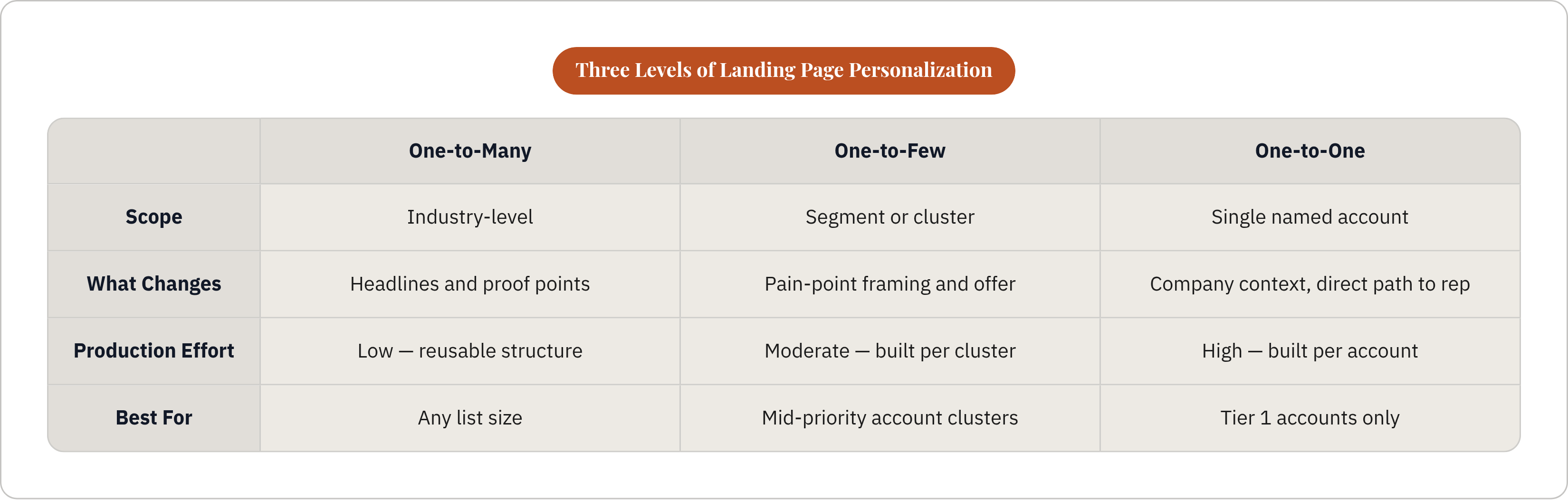
So what does personalization that actually moves the needle look like? There are three levels worth understanding.
The first is one-to-many, meaning industry-level personalization. Same page structure, but with industry-specific headlines and proof points. A logistics company sees content about supply chain challenges. A fintech company sees content about compliance costs. Feasible at any list size, and a meaningful step up from a generic page.
The second is one-to-few, meaning segment-level personalization. Pages built for a cluster of accounts that share a common pain or buying situation — mid-market logistics companies locked into legacy contracts, for example. More production effort, more resonance with the accounts that actually matter.
The third is one-to-one. Their company name, their specific situation, a direct path to a conversation with someone on your team who already knows their context. Only viable for Tier 1 accounts. Expensive to build. Worth it for the right ten companies.
The miscalibration most teams make is over-investing in the cosmetic layer and under-investing in buying-stage personalization. A company at the awareness stage needs fundamentally different content than a company actively evaluating vendors. A company six months from a contract renewal needs a very different message than one locked in for three more years. That's not just about tone. It's about what you're actually asking them to do next.
In one PropTech ABM campaign, two weeks of account research revealed that a large portion of target accounts were locked into contracts until 2027. The campaign was reaching people who literally could not buy, regardless of how compelling the message was. Stopping retargeting on those accounts and building a re-engagement plan timed for 2027 freed up budget for accounts that were actually in a position to convert. That's buying-stage personalization. And it's a harder problem than swapping in a logo.
Running an ABM Campaign End-to-End: The Synced Ads-Plus-Outbound Model
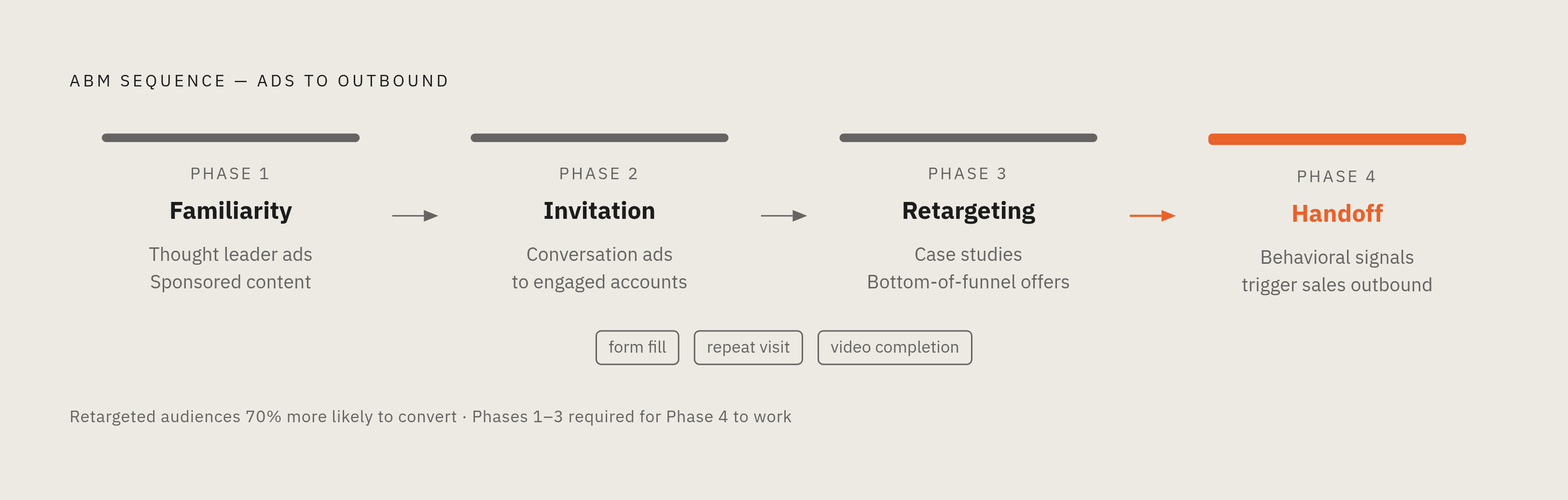
The most common mistake in LinkedIn ABM is running ads and outbound as parallel, disconnected activities. Ads do their thing. Sales does their thing. Nobody really knows what the other is doing, and when results are mediocre, everyone blames the other team.
The synced model runs them as a sequence, not a simultaneous broadcast.
The first stretch is about building familiarity before sales ever touches the account. Run Thought Leader Ads and Sponsored Content to named accounts. The goal isn't conversion yet. It's recognition. When a salesperson calls or emails later, the name is already familiar. That's a different conversation than cold outreach into a vacuum.
Once accounts have been in the awareness phase long enough, you shift from passive presence to active invitation. Conversation Ads or Message Ads go to accounts that engaged. You're asking for something after you've already been present and useful, not before.
Then you retarget the accounts that clicked but didn't convert. These accounts are warm. Retargeted audiences are 70% more likely to convert. Hit them with case studies, bottom-of-funnel offers, or social proof specific to their industry.
Finally, ads and outbound actually meet. A form fill, a repeat site visit, a video completion. Something behavioral. That signal goes to the sales team, and the outbound sequence begins. The rep isn't calling cold. They're calling someone who has seen the brand, read the content, and done something that suggests real interest. That's a completely different opening.
One company running this model generated 216-plus outbound leads, millions in total pipeline, hundreds of thousands in closed revenue, and a 7x ROI. But what most people miss when they see numbers like that: ABM LinkedIn campaigns need at least 90 days before you can draw meaningful conclusions about pipeline impact. Shorter windows produce noise, not signal. They push teams toward making changes too early, based on data that hasn't had time to mean anything yet.
What the LinkedIn Matched Audiences and Predictive Audiences Targeting Layers Actually Change
These are not minor features. They're the infrastructure that makes LinkedIn ABM possible at scale.
Matched Audiences let you upload a CRM contact list, retarget website visitors, or build lookalike audiences from your best customers. This is where your sales team's named account list becomes a paid media audience. Upload the list, LinkedIn matches it against its 13-plus million Company Pages, and your campaign starts reaching the actual people inside those companies. LinkedIn's own data shows a 37% increase in conversion rates compared to standard interest-based targeting, and a 32% increase in post-click conversion rates when Matched Audiences are active.
Predictive Audiences work differently. Instead of starting from "who is on my list," they start from "who on LinkedIn looks like the people who already converted." LinkedIn analyzes your historical campaign data and identifies members most likely to convert based on behavioral patterns. It's a lookalike model, but continuously updated rather than static.
LinkedIn Accelerate takes this further. It's an AI-native campaign type that automates targeting, creative selection, bidding, and placement. Across 67 A/B tests, LinkedIn found that Accelerate campaigns deliver up to 42% lower cost per action compared to standard campaigns.
But here's a real tension worth thinking through: automation tools like Accelerate trade transparency for efficiency. They optimize against platform signals, not your pipeline data. For ABM programs where account-level intelligence matters, where you need to know exactly which company a lead came from and whether they're on your Tier 1 list, the black-box nature of fully automated targeting is a genuine limitation. It's efficient. It doesn't know which accounts are strategic and which are just noise. Only you know that.
The practical split: let automation handle bidding and delivery optimization. Keep audience definition under human control. The account list, the CRM exclusions, the buying committee mapping. Those decisions shouldn't be handed to an algorithm that doesn't have access to your sales team's actual priorities.
Using Google and LinkedIn Together So Each Platform Amplifies the Other
Each platform optimizes against data inside its own walls. A decision-maker who clicks your LinkedIn ad and then goes to Google to search for solutions looks like two completely separate people to each platform. Neither one connects the dots unless you do it deliberately.
Build one ICP audience. Layer CRM exclusions for existing customers and competitors. Run that same enriched audience across both LinkedIn and Google, with consistent account lists and exclusions on both sides. Now you have a unified signal instead of two isolated campaigns doing vaguely related things in the same general direction.
LinkedIn's job in this model is familiarity. Your brand shows up in feed, in inbox, in content. The decision-maker starts to recognize you. Then they go to Google to search for a solution to the exact problem you've been talking about. Your search ad captures that intent at exactly the right moment. The two channels aren't competing. They're running a relay — and the handoff only works because both legs are running from the same map.
The tiered budget logic applies here too. Allocate higher bids for Tier 1 accounts on both platforms. A single lead from a Tier 1 account where multiple stakeholders saw your content across both channels is worth more than several leads from outside your ICP. Budget allocation should reflect that reality, even when it's uncomfortable to defend in a quarterly review.
LinkedIn also expanded into CTV in 2024, with extended inventory through Paramount in 2025. Salesforce used LinkedIn CTV and reported reaching more than 70% of its target audience incrementally, meaning people who weren't reached through standard LinkedIn feed formats. For named-account campaigns where you want to extend reach into connected TV without leaving the LinkedIn audience infrastructure, that's a meaningful addition.
Every impression, click, and form fill across channels feeds back into account-level intelligence. Which accounts are engaging, at what frequency, through which formats, in what sequence. That intelligence shapes who sales calls next, what message they lead with, and whether the timing is actually right. That feedback loop is what separates ABM from general demand generation. You're not just running campaigns. You're building a system that gets smarter about specific accounts over time, which is either exciting or a little unsettling depending on how you feel about that kind of thing.