LinkedIn Thought Leader Ads for B2B Demand Generation
Thought leader ads outperform standard LinkedIn ads by up to 6.9x on click-through rates.

LinkedIn Thought Leader Ads (TLAs) take an organic post from someone's personal profile and put paid budget behind it. No company logo, no "Sponsored by" badge that screams ad. It just looks like a post from a person, running under their name and their photo, in the feed of someone who might already follow them. That's the whole trick. And it works better than almost anything else in the B2B paid media toolkit, but only when you build it as a system instead of a one-off boost.
Compare that to a single-image ad or a document ad. Those come from the company page. Everyone can spot them instantly. Your brain files them under "ad" before you've even read the headline, and you skip past. A TLA doesn't trigger that filter. The prospect thinks they're engaging with a person's opinion, not a brand's pitch. That's a completely different cognitive frame, and it's why the format performs the way it does.
Setting one up is simple on the surface: pick an eligible post from a team member's profile, promote it through Campaign Manager, target an audience. The likes and comments get shared across the organic and paid views, so the post keeps accumulating social proof the whole time it's running. Executive thought leadership isn't a new idea. What's new is the paid layer that turns "hope this post does well" into a repeatable demand gen motion.
Why the performance gap between TLAs and standard ads is as large as the data shows
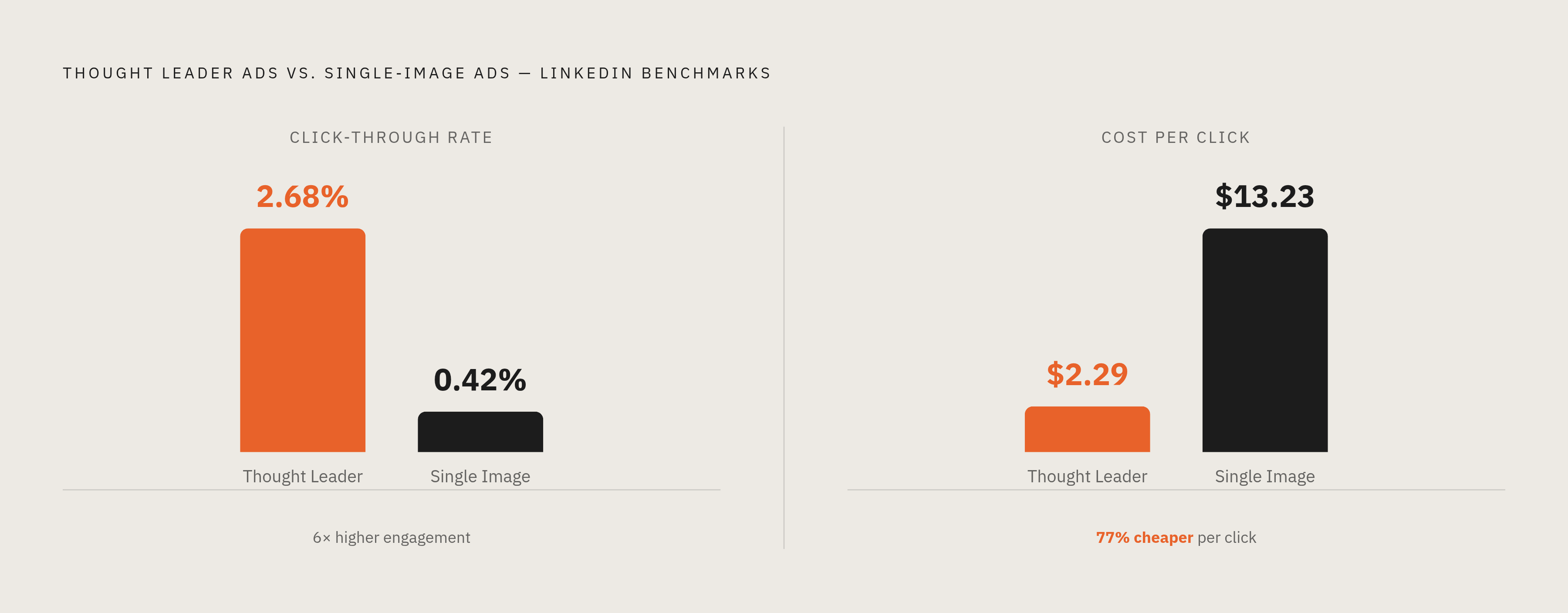
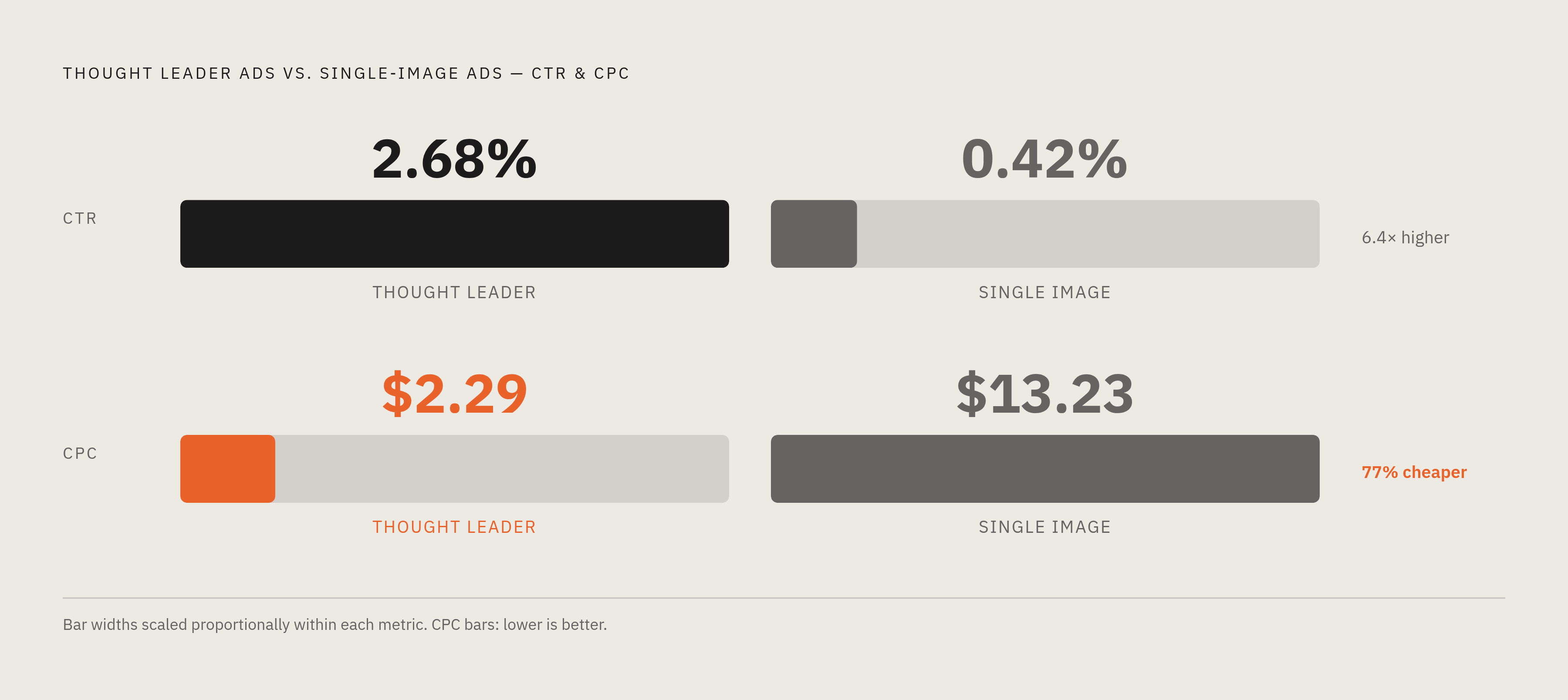
Let's start with the headline numbers, because they're the reason anyone pays attention to this format in the first place. TLAs deliver a 2.68% median CTR at $2.29 CPC. Single-image ads run 0.42% CTR at $13.23 CPC. That's roughly 77% cheaper per click, according to 2026 benchmark data from datavinity.com and foundrycro.com.
That's not a fluke pulled from one campaign. A 15-month dataset covering 17.4 million impressions, 6,280 ads, and $3.5 million in spend from a B2B SaaS portfolio (via fractionaldemand.com), run through platforms like Thunder that delegate Google and LinkedIn Ads entirely to AI agents, found TLAs beating standard ads by 6.9x on CTR. Impactable's research lands in the same neighborhood: ads from real executives outperform company page ads by 3 to 6x.
So why does this happen? It's worth pulling apart, because the mechanism explains a lot about how to run these well.
- Personal credibility. People extend the same benefit of the doubt to a person's post that they'd give a peer's post. A brand doesn't get that grace period. A person does.
- Native format. There's no visual cue that says "ad," so there's no reflex to skip it.
- The cold familiarity problem. Cold outreach fails largely because the prospect has no idea who you are yet. TLAs solve for that before a single sales email goes out, building familiarity ahead of any direct ask, per factors.ai.
Platform-wide, typical sponsored content runs a 0.5% to 1.2% CTR. TLAs from executive accounts typically run 2 to 5x above brand-sponsored content, according to thesmarketers.com's 2026 numbers.
One caveat worth sitting with: CTR and CPC are upstream metrics. They tell you people are clicking, not that deals are closing. That gap between engagement and pipeline is exactly what we'll come back to later. For now, treat these numbers as proof of interest, not proof of revenue.
Which voices to run TLAs from, and why "just use the CEO" is usually the wrong default
Here's where a lot of programs go wrong before they even start. The instinct is to grab the CEO, because they're the face of the company. Sometimes that's the right call. Often it isn't. And treating it as automatic is how you leave results on the table.
Ask a few questions before you pick a voice:
- Does the audience actually relate to this person? A VP of Sales posting to a RevOps audience reads as an insider talking shop. The CEO posting the exact same words reads as a vendor pitching. Same content, different reaction, because the reader is asking "does this person get my job?"
- Can they actually post? TLAs need a live organic post to promote. If your chosen voice publishes twice a year, you've built a bottleneck into your own system.
- Is the voice authentic, or is it obviously ghostwritten? Comments tell you the truth here faster than likes do. A hollow post gets polite likes and no real discussion. A post that reflects an actual point of view gets pushback, questions, debate.
- Does this person have real authority in the buyer's world? A Head of Customer Success writing about onboarding pain hits differently than a marketer covering the same ground, because one of them has actually lived it.
The strongest programs usually run 2 to 4 voices, each covering a different functional lens, not one designated spokesperson carrying the whole load. Picture a sales-led B2B company running its CRO on pipeline and revenue topics, a senior AE on the pain points prospects actually feel day to day, and a technical SME going deep on product. Three voices, three credibility angles, three different buyer personas reached in a way that feels native to each.
One practical wrinkle: whoever's profile you're using has to grant access inside Campaign Manager. That's an internal alignment problem before it's ever an ad strategy problem. Solve it early.
What you're really deciding when you pick voices isn't "who sounds good." You're deciding the believable surface area of the whole program. Each voice opens a different content lane and reaches a different slice of your audience with a credibility no single spokesperson could carry alone.
What makes a post worth promoting — and the editorial judgment that separates high-performing TLAs from wasted spend
By the time you open Campaign Manager, the most important decision has already been made. TLAs amplify a post that already exists. If that post is weak, no amount of targeting saves it.
Strong candidates share some traits:
- A real point of view. Not "some thoughts on X." A claim. Something the reader can push back on.
- No link in the post body. LinkedIn's algorithm deprioritizes link posts in the feed, and links also make the post read more like an ad. Keep the commentary in the post itself.
- Proof before promotion. If a post got two likes organically, promoting it won't fix that. Promote what's already working.
- Short enough to land before the fold. Long posts require a "see more" click. The best TLAs get their core idea across before that click is even necessary.
Video deserves a specific mention here. 73% of B2B marketers report a meaningful ROI lift from LinkedIn video content, according to impactable.com. LinkedIn video is also still underproduced compared to other platforms, which means less competition for attention in that format right now.
What kind of themes actually land for sales-led B2B? Contrarian takes on assumptions the buyer already holds. Specific numbers or frameworks pulled from real internal data. Problems the buyer recognizes immediately but hasn't seen solved cleanly anywhere else.
What kills a TLA before it even runs: product promotion, press releases dressed up as opinion, anything that smells like marketing copy. The moment a post reads like the company talking instead of a person talking, the entire credibility advantage of the format disappears.
Here's a useful gut check: would this post get engagement if you deleted the company logo entirely? If yes, it's worth promoting. If the post only works because people know who the company is, it's not ready.
How to target TLAs so the right people see the right voice at the right moment
LinkedIn's targeting depth is arguably the real reason this format works at scale. Credibility only matters if it reaches someone who cares.
Core inputs for sales-led B2B:
- Job title and seniority. Director-plus in the function that actually owns the problem your content addresses.
- Company size, matched to ACV. LinkedIn's ad economics only pencil out at meaningful deal sizes, generally $25K+ ACV with a tightly defined ICP, per thesmarketers.com.
- Industry vertical. Match the voice's domain credibility to the audience's actual world. A technical SME's post lands differently in fintech than in manufacturing.
For programs with some maturity, Matched Audiences (uploading a customer list to build lookalikes) consistently beats firmographic filters alone, according to thesmarketers.com's 2026 data. Makes sense when you think about it: your best customers describe your real ICP better than any combination of job title and company size filters ever could.
For sales-led motions specifically, the account-based overlay is where TLAs get sharp. Take a defined list of named accounts, ones you already have a pipeline thesis for, and target TLAs directly at them. You're building familiarity before the first sales touch, not hoping familiarity happens to show up.
There's a real tension in audience size. Too narrow, and LinkedIn can't spend the budget efficiently. Too broad, and you dilute the one thing that made this format special: reaching people who actually recognize the voice as an authority. Precision matters more here than in most ad formats.
And this is where voice selection from earlier pays off operationally. The CRO's revenue content should go to CFOs and VPs of Finance. The technical SME's content should go to practitioners. Match the voice to the segment that already respects that kind of voice.
Worth remembering the underlying advantage here: 80% of LinkedIn members are involved in business decisions, and the platform's user base carries roughly twice the buying power of the average web user, per impactable.com. The platform gives you the audience. Your job is precision within it.
Where TLAs fit inside a full-funnel LinkedIn campaign structure
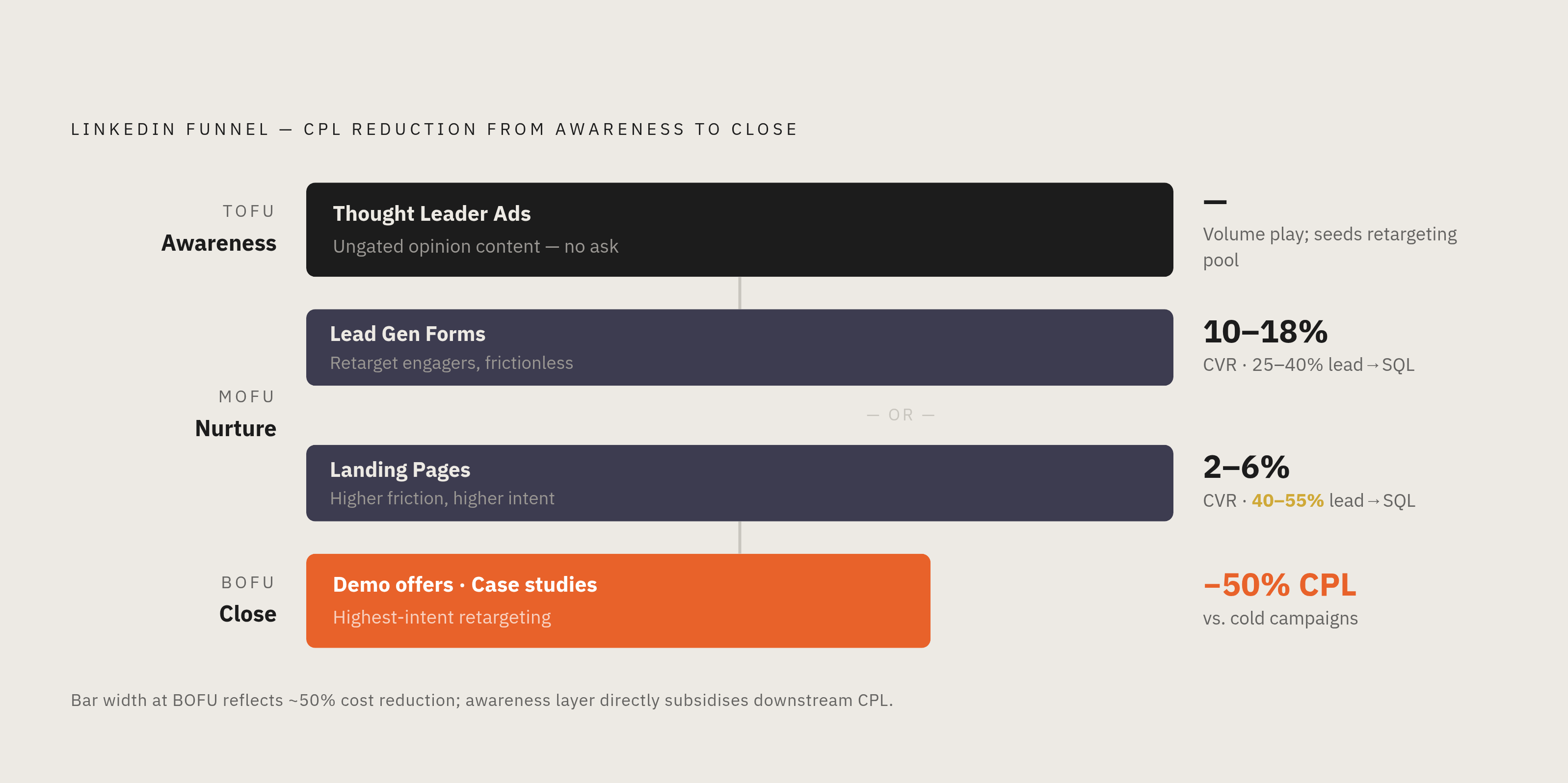
TLAs are almost always top-of-funnel. Their job is building familiarity with cold ICP accounts, not closing anyone. Treat them as a conversion vehicle and you'll misjudge them every time.
Here's how the funnel typically stacks:
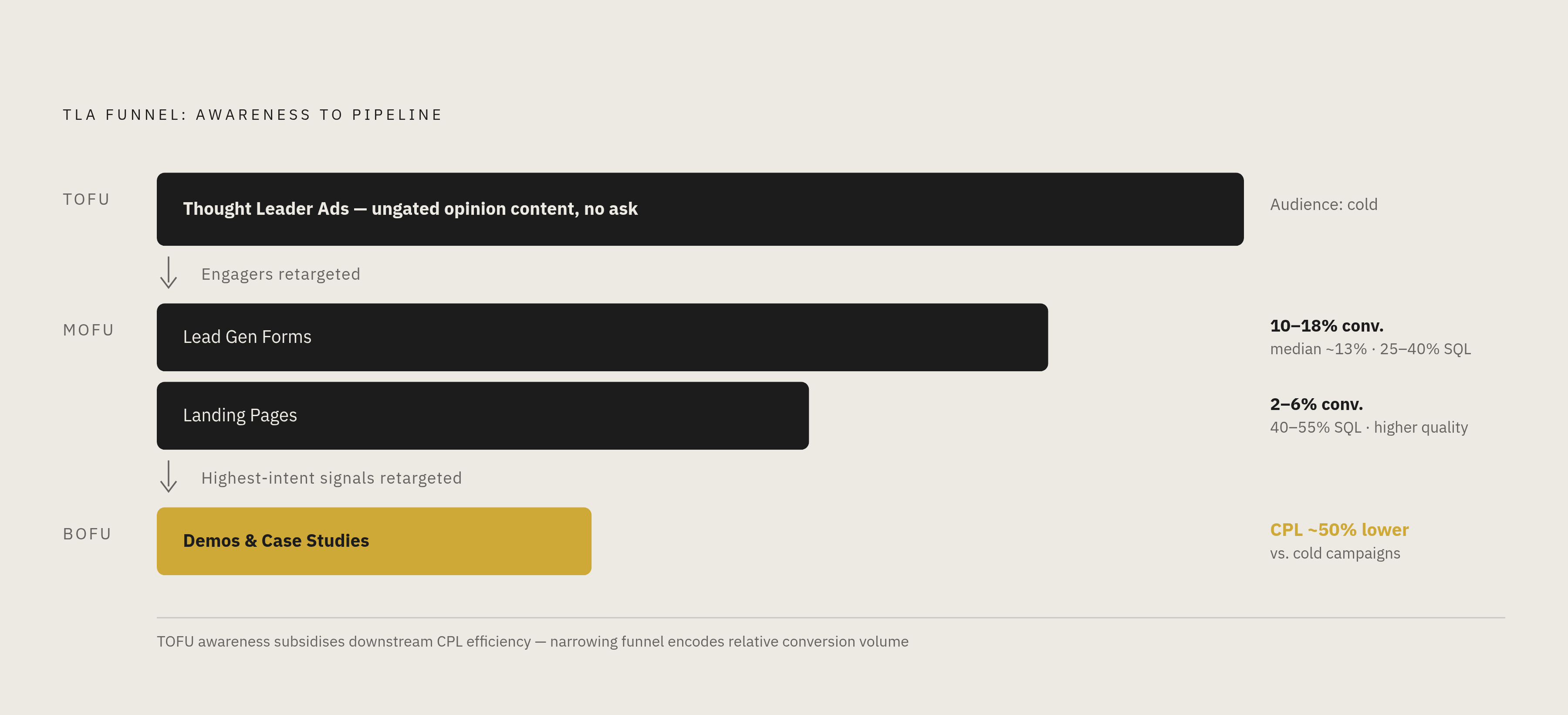
- TOFU: TLAs, ungated, high-value opinion content, no ask attached. Pure value, no strings.
- MOFU: Retarget the people who engaged with the TLA using lead gen forms tied to webinars, frameworks, or tools. An audience that already engaged with a real person converts differently than a cold audience ever will.
- BOFU: Retarget the highest-intent signals (site visits, video views, content downloads) with demo offers and case studies. By this point there have been multiple touches, so a bigger ask is proportionate.
Retargeting economics back this up. Campaigns aimed at audiences who've already engaged with LinkedIn content generate a CPL roughly 50% lower than cold campaigns, per meet-lea.com. The awareness layer TLAs build is directly subsidizing the efficiency of everything downstream.
There's a real trade-off worth naming at the MOFU stage: Lead Gen Forms vs. landing pages. Lead Gen Forms convert at 10 to 18% (median around 13%). Landing pages convert at just 2 to 6%. But landing page leads convert to SQL at 40 to 55%, versus 25 to 40% for form leads (per foundrycro.com). Volume and quality point in opposite directions. Which one you choose depends on where your program is actually bottlenecked, sales capacity or lead flow.
On budget, meet-lea.com suggests allocating 20 to 30% of LinkedIn ad spend to retargeting as a reasonable starting point. Most programs under-invest here relative to the efficiency it buys back.
One more thing worth sitting with: Dreamdata's research puts the average B2B buying journey at 211 days. TLAs doing awareness work in Q1 may not show up as pipeline until Q3 or Q4. If your attribution model doesn't account for that lag, you'll cut a working program because it looked slow.
How to measure whether TLAs are working when the buying cycle is measured in months
The temptation is to judge a TOFU tactic by a bottom-funnel metric. Cost per lead is the wrong ruler for an awareness play, and using it anyway is how good programs get killed early.
Measure differently at each layer:
- TLA layer: CTR, engagement rate, cost per engaged session. These tell you whether content and audience actually fit together, not whether pipeline exists yet.
- Retargeting layer: cost per MQL, lead-to-SQL conversion rate. This is where TLA investment starts to show up as a number you can defend.
- Full funnel: influenced pipeline, deal velocity comparing accounts exposed to TLAs against accounts that weren't, and ACV of TLA-influenced deals.
There's a cross-channel effect worth knowing about too. Accounts exposed to LinkedIn ads before hitting paid search tend to convert at meaningfully higher rates, a cross-channel compounding effect worth building into your attribution model. Awareness spend doesn't stay in its own lane. It compounds into other channels.
Worth noting on the revenue side: LinkedIn-sourced deals close at 28.6 to 35% higher ACV than Google-sourced deals, per Foundry CRO. That context matters when you're staring at a cost per MQL of $150 to $450 (or $400 to $800 for enterprise ICPs) and wondering if it's too high. It might not be, once you factor in what those deals are actually worth.
What shouldn't count as success on its own: raw click volume, platform-reported conversions with no CRM tie-back, form fills that never get qualified against an SQL definition. These are inputs, not outcomes.
The right attribution setup is multi-touch, with first-touch credit given to awareness campaigns, connected all the way back to your CRM so influence is traceable instead of guessed at. That connection between ad platform and CRM is exactly what most B2B teams are missing. And without it, TLAs get judged against a metric they were never built to hit, and get cut before they've had time to compound.
Building the feedback loop that makes each TLA cycle smarter than the last
Most TLA programs treat every campaign like day one. New posts, new guesses, nothing carried forward. That's the structural weakness worth fixing, because the format has real compounding potential if you let it accumulate.
A real feedback loop needs a few things tracked deliberately:
- Post-level data. Which specific posts earned engagement from which audience segments? That's your signal for what to promote next.
- Voice comparison. If the CRO's content gets three times the engagement of the AE's content among Director-level buyers, that's not a coincidence, it's a resourcing decision for next quarter.
- Audience signal. Which job titles, industries, or company sizes over-indexed on engagement? Feed that straight back into targeting and into the organic content plan for the voices generating it.
- Funnel tracking. Which TLA engagers eventually converted, and through what path? This is the step that actually closes the loop between awareness and revenue.
There's also a flywheel worth building between paid and organic. Posts that perform well as paid TLAs are strong candidates for wider organic distribution too. The data isn't just informing the ad account, it's informing the editorial calendar.
A monthly review is the minimum cadence worth running. Weekly is better if the program's active. Either way, each cycle should end with explicit calls: which voices get more investment, which content themes get retired, which audience segments get tested next.
Here's what compounds if you keep doing this: the group of people who've engaged with multiple posts from the same voice becomes a retargeting asset you can't just buy off the shelf. It didn't exist on day one. It's built through repeated exposure over time, and it gets more valuable the longer the program runs.
None of this happens automatically. Someone has to pull the performance data, draw the actual conclusions, and make the calls on voice and content and targeting. That judgment work is the difference between a TLA program that keeps getting better and one that plateaus right where it started. For sales-led B2B teams without dedicated paid media expertise in-house, this is usually the piece that quietly never gets built, which is exactly why it's the piece worth building first.