Personalized Landing Pages for LinkedIn Audience Segments
Match your LinkedIn targeting precision to the landing page your audience actually sees.

LinkedIn's B2B targeting is impressive. Job function, seniority, company size, industry. No other paid channel gives you that kind of professional precision. So you build the campaign, nail the targeting, write a solid ad, and the right person clicks.
And then they land on your homepage.
All that specificity, dropped into a page built for everyone. Which, practically speaking, means built for no one. Roughly 44% of B2B companies still route paid traffic to a generic home page. It's probably the single most common structural waste in B2B paid media, and it's completely fixable.
So what does "segment-matched" actually mean? Most people know the baseline already: a good landing page lives around a single offer and a single CTA. No navigation, no exit links, one job. Necessary, sure. But not sufficient.
A segment-matched page goes one level deeper. It's built around a specific role, a specific pain, a specific buying context. The headline, the proof points, the use case framing, the CTA language. All of it reflects the segment's world, not some averaged-out version of your ICP.
It's also not the same as ABM. Account-based personalization operates at the named-account tier. "Hello, Acme Corp." Segment-matched pages operate at the vertical or persona tier. "Hello, Head of IT at a mid-market financial services company." Broader than ABM, narrower than a homepage. That middle ground is where most B2B teams leave the most money sitting.
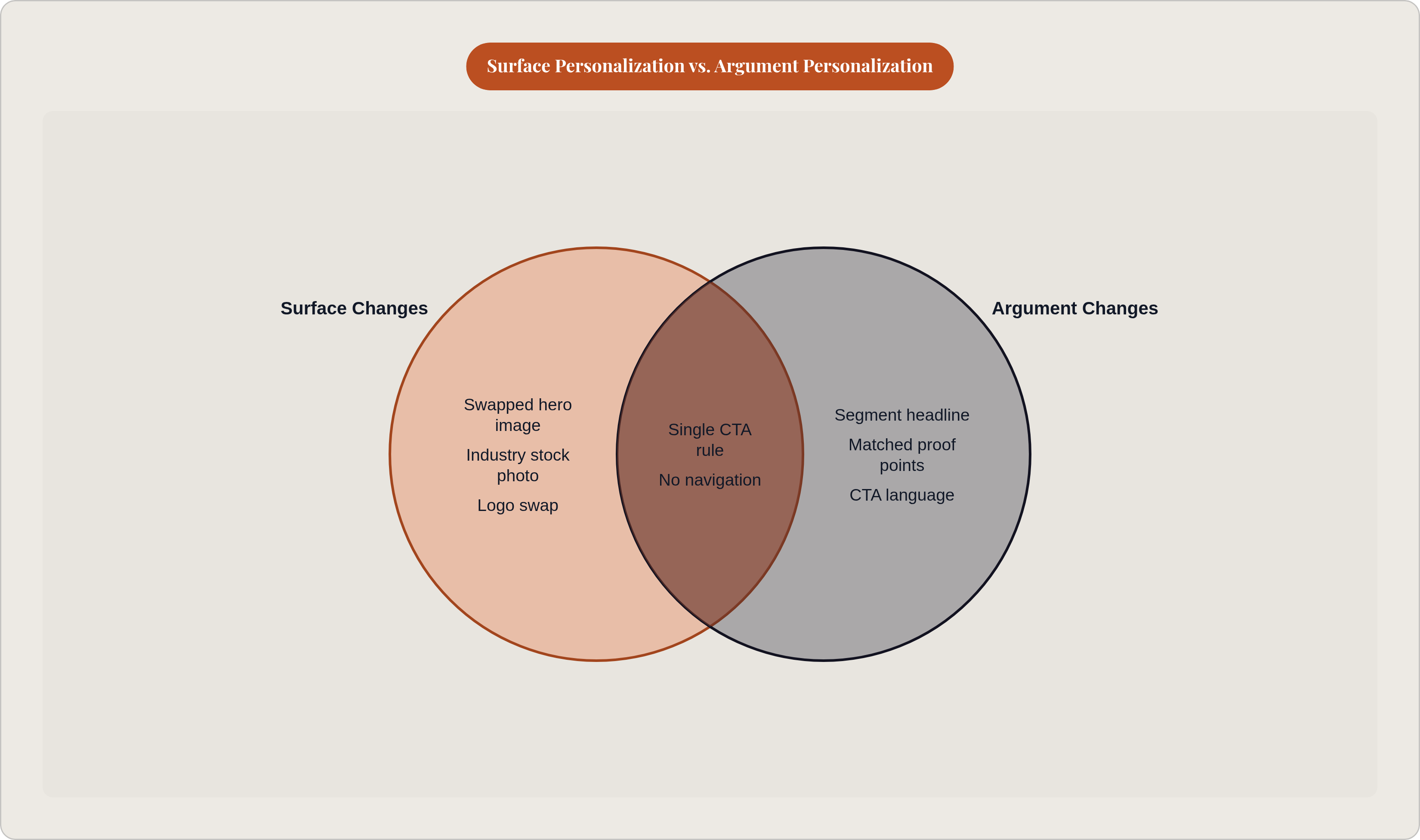
The distinction that actually matters here is between two kinds of personalization. One changes the surface: swap the hero image, drop in a different logo, add an industry-specific stock photo. The other changes the argument the page is making. Different headline, different proof, different framing of the problem, different ask.
Only the second kind moves conversion rates. The first is decoration. The second is architecture.
The structural elements that actually shift per segment:
- Headline: Reflects the segment's specific problem, not a product feature
- Social proof: Testimonials and logos matched to companies the segment actually recognizes
- Use case framing: Describes their world before it describes your solution
- CTA language: A small-business buyer and an enterprise procurement contact are not the same ask. "Start Free Trial" versus "Talk to Sales." One of those will feel wrong to the wrong audience.
What doesn't change: the single-CTA rule, navigation removal, mobile optimization. Those are baseline requirements, not differentiators.
How LinkedIn's Audience Segmentation Architecture Maps to Page Variants
You already built a personalization strategy inside LinkedIn Campaign Manager. You just haven't followed it all the way to the destination.
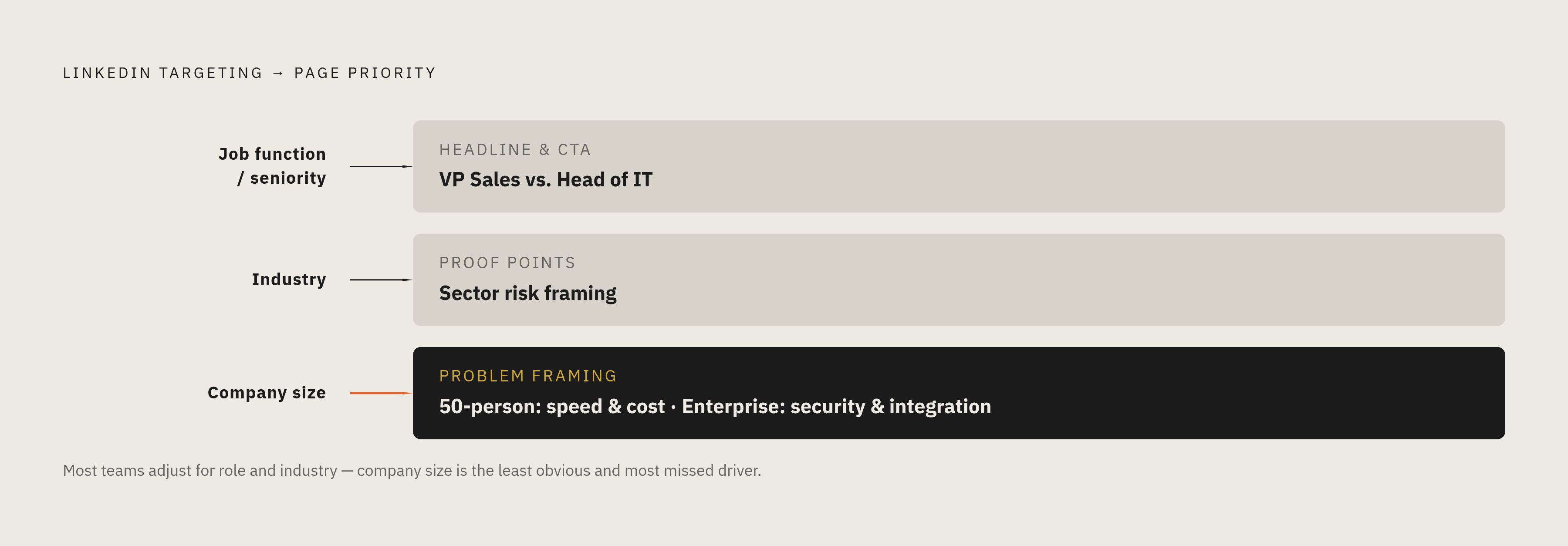
LinkedIn's core targeting dimensions map directly to page variant logic.
Job function and seniority tell you who's in the room and what they're accountable for. A VP of Sales and a Head of IT may be evaluating the same product, but not for the same reason. They don't speak the same internal language. They don't carry the same risk. Each needs a page that speaks to their actual role.
Industry tells you the lens through which they read everything. Financial services, healthcare, and SaaS buyers can look at an identical product and see three completely different risk profiles. Compliance means something different in each of those worlds. A page that acknowledges that earns trust before the CTA even loads.
Company size tells you what they care about most. A 50-person company is thinking about speed and cost. A large enterprise is thinking about security, integration, and what happens when something breaks at 2am. Same product, different conversation.
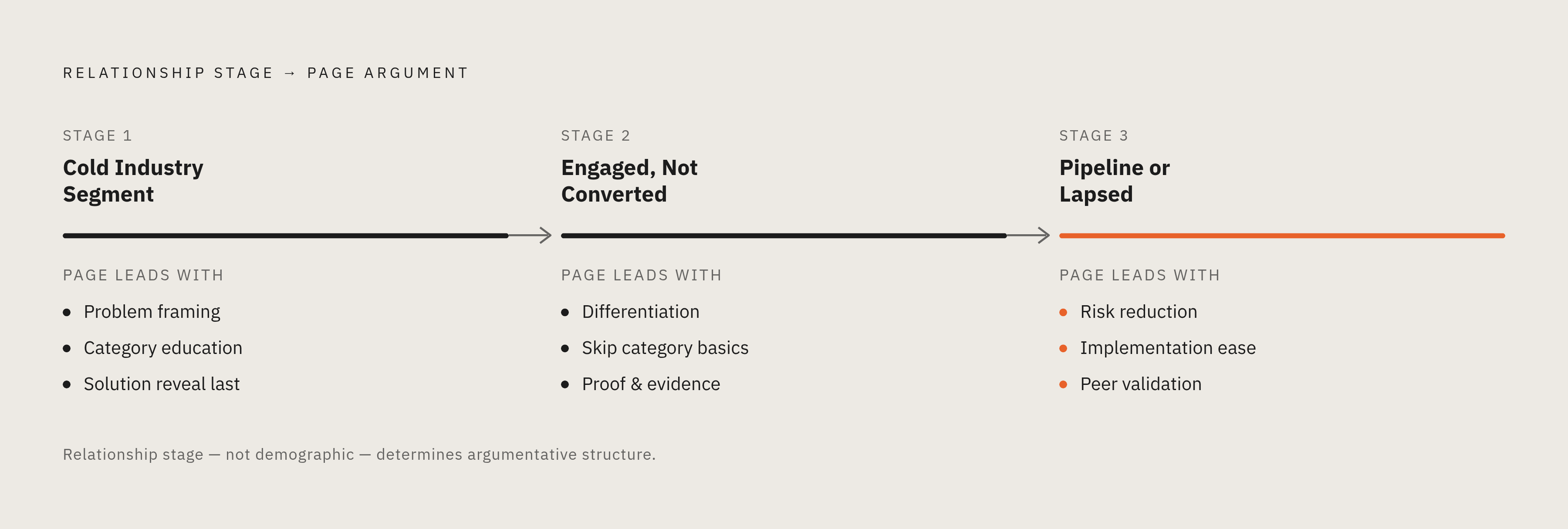
Then there's the retargeting layer. LinkedIn's Matched Audiences include website visitors, uploaded contact lists, and company lists. Each of those represents a different relationship stage, not just a different demographic. Worth knowing: match rates on contact lists typically run between 30 and 60 percent. Work email addresses outperform personal ones, and including name, title, and company data alongside email improves match accuracy. The more complete the record, the better the results.
Each matched audience implies a structurally different page argument.
- Cold industry segment: Lead with the problem. Build the case for why it matters before you name your solution.
- Engaged but unconverted: Skip the category education. They know the problem. Get to differentiation and proof.
- Active pipeline or lapsed leads: Focus on risk reduction, implementation confidence, and peer validation. This is the "is this actually the right decision" moment.
Your campaign targeting map is your page variant map. The logic you already built inside Campaign Manager is telling you exactly what pages to build.
Where to Start: The 3–5 Vertical Variant Tier, and Why It Beats Both Generic Pages and Premature Over-Segmentation
Two failure modes live here, and both are common.
The first is staying with one generic page. Wide relevance gap, low conversion floor.
The second is deciding to build 20 variants right out of the gate. Maintenance overhead piles up before you've learned which segments actually drive pipeline. Teams stall under the production burden. The program collapses on itself before it ever generates useful data. I've watched this happen more than once. Everyone's enthusiastic at the planning stage. By month two, nobody's updating the variants and the whole thing quietly dies.
The right starting point is 3 to 5 page variants, segmented by vertical. Financial services, healthcare, SaaS, agency, manufacturing. Pick the ones that map to your actual ICP mix, and pick ones where you already have deal history. Deal history means you already have proof and language you can borrow. That matters more than you'd think when you're staring at a blank doc trying to write a healthcare headline without any healthcare customers to steal from.
What changes across these variants:
- Headline and subhead: Problem framing in that segment's language
- Primary proof point: The case study or testimonial most recognizable to that vertical
- Use case description: How the product actually applies in their operational context
What stays constant: the offer, the CTA structure, the page layout, the trust signals.
This is also why the workload is manageable. You build the master page once. Variants are diff-level changes, not new builds. Think of it less like writing three different books and more like translating one document into three languages. The same argument, rendered for different readers.
Most B2B landing pages convert in the low single digits. Even a modest personalization lift, multiplied across campaign volume, moves the pipeline math meaningfully. Establish which variants are generating qualified pipeline, not just form fills, before you go deeper. That sequencing matters.
Building the Page: How Headline, Proof, and CTA Each Carry the Segment's Argument
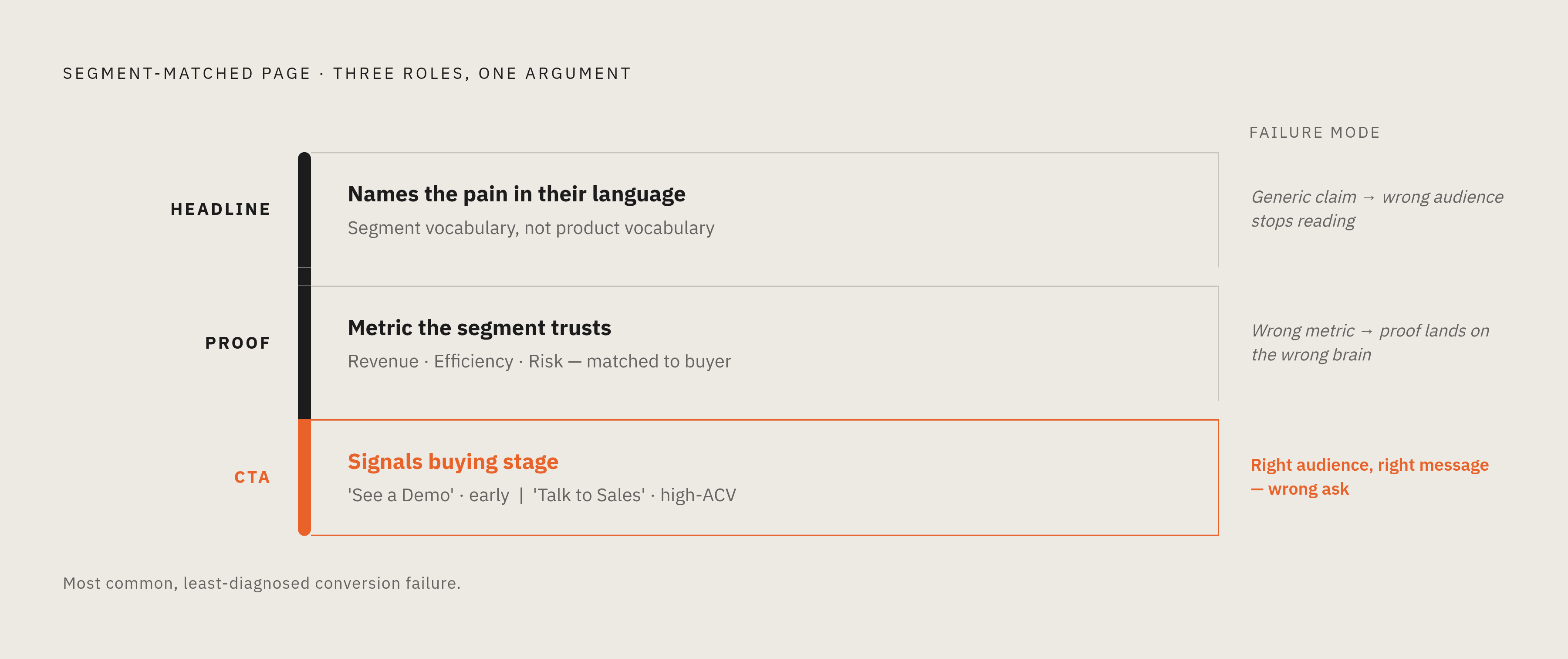
Think of a segment-matched page as a three-part argument. The headline opens it, the proof sustains it, and the CTA closes it. If any one of those three is misaligned with the segment, the argument falls apart before the visitor even scrolls.
The headline's job is to name their pain before you name your solution.
Generic: "The platform that drives growth." That is everybody's page, which means it is nobody's page. A segment-matched headline names the pain in the vocabulary the role actually uses internally. Your language should mirror theirs. A VP of Revenue Operations and a Head of Demand Generation can have the exact same underlying problem and call it something completely different. If they read the headline and think "that's exactly how we describe this in our internal Slack," you've already done more than most pages accomplish in their entirety.
Social proof is a relevance signal, not just a credibility signal.
Most teams get this slightly wrong. They put up a wall of logos and call it trust. But a SaaS buyer reading a case study from a fintech company quietly discounts it. Consciously or not: "that's not really my world." Matched logos and testimonials tell the visitor that people like them have already made this decision. It answers the objection before it gets raised.
Also: the metrics in your testimonials should match what the segment actually cares about. Revenue impact for sales leaders, efficiency gains for operations, risk reduction for compliance-focused buyers. Surface the wrong metric and the proof lands flat even when the underlying story is compelling.
CTA language is a buying-stage signal.
"Talk to Sales" signals an enterprise buying process with a human in the loop. Appropriate for high-ACV, long-cycle segments. Wrong for a small-business buyer who just wants to try something. "See a Demo" lowers the commitment threshold. Right for segments still in early evaluation. Wrong for someone already in your pipeline who needs to make a decision.
CTA mismatch is one of the most common and least-diagnosed conversion killers. The right audience, the right message, the wrong ask. The conversion dies quietly at the last step, and nobody in the debrief knows why the page "didn't work."
Dynamic Personalization and IP Enrichment as a Scale Layer, Once the Variant Foundation Is in Place
A lot of teams get the sequencing backwards here.
They hear about dynamic personalization. One master page, rules that swap headlines and content blocks based on visitor attributes, the page rendering differently per visitor without separate URLs. It sounds like a shortcut around building variants, so they go there first.
Avoid that.
Dynamic personalization amplifies your segment arguments, but it cannot create them if those arguments haven't been tested and proven yet. You can't automate your way to a message you haven't found. The manual variant model has a ceiling, yes. Three to five vertical pages are achievable; twenty-plus persona-by-industry-by-stage combinations are not, without automation. But the ceiling matters less than the foundation. Build the arguments first. Validate them manually. Then introduce dynamic personalization once you know what's working.
When you do get there, here's what drives the swap logic:
- UTM parameters from your LinkedIn campaigns already tell you which segment clicked before the visitor does anything on the page
- IP enrichment for anonymous traffic derives company name, industry, and approximate size from the IP address. Enough to apply meaningful rules without CRM data.
- CRM data for known contacts in Matched Audiences gives you the most specific variant logic available
LinkedIn's dynamic company lists are worth knowing about here. Under the Plan section, you can build lists around engagement criteria. Accounts with high impressions but no conversions, for instance. Those cohorts can trigger different page experiences.
But here's the risk with dynamic personalization done too early or too sloppily: when swap logic isn't tested rigorously, a visitor can land on a page with mismatched elements. A financial services headline sitting on top of a SaaS case study. That combination can actually perform worse than a generic page. You've taken something neutral and made it actively confusing.
Prove the arguments. Then automate their delivery.
The Lead Volume vs. Pipeline Quality Trap, and How Segment-Matched Pages Change the Measurement Frame
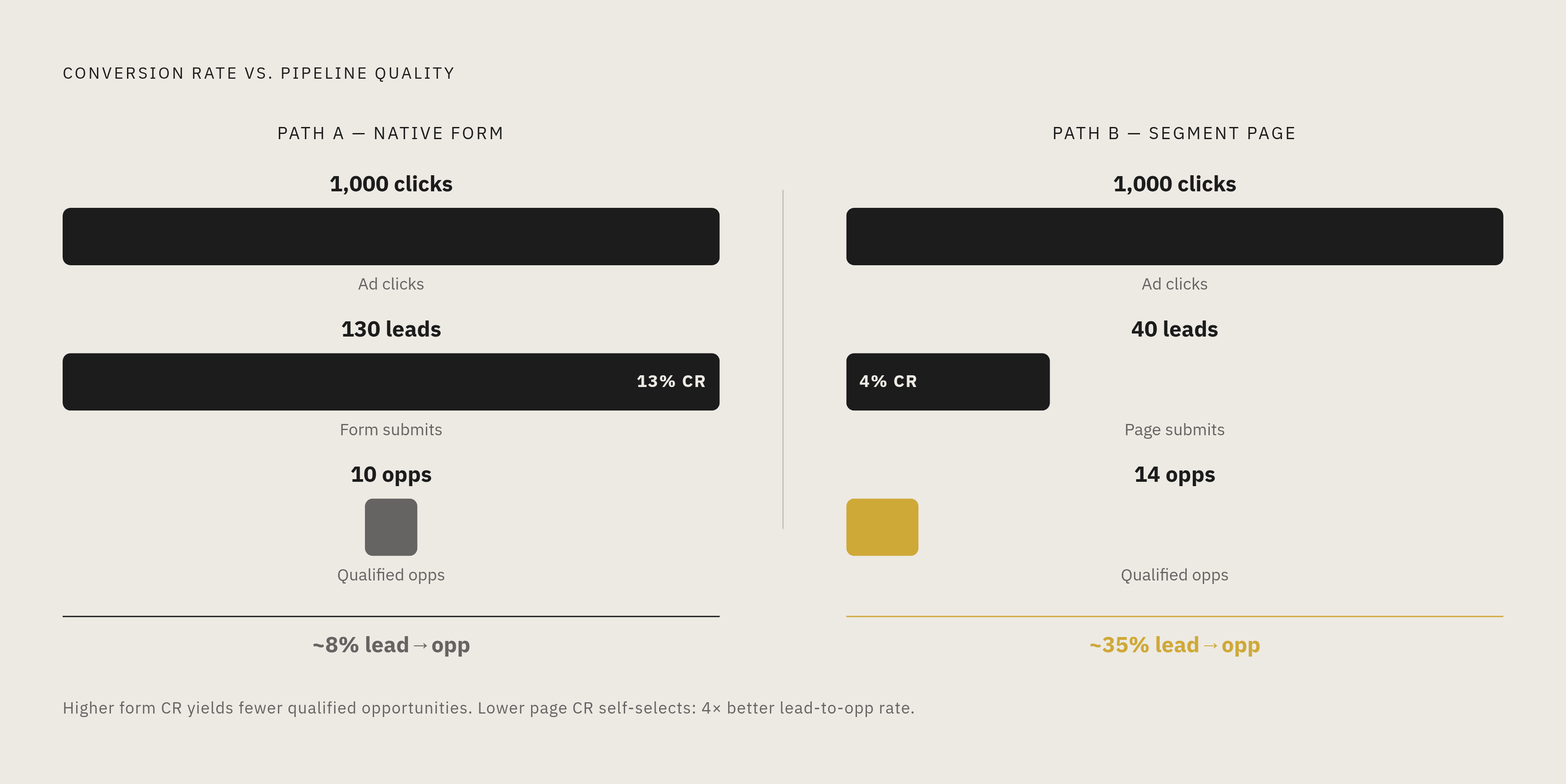
LinkedIn's native lead gen forms convert at roughly 13% on average. External landing pages average closer to 4%. That gap is real, and it creates a trap worth naming directly.
When form conversion is high, it looks like the program is working. But optimizing for form conversion produces volume, not pipeline. You've seen this: hundreds of leads per month from LinkedIn, a small fraction convert to qualified opportunities. The volume metric looks healthy. The pipeline metric is broken. The diagnosis, usually: the form collected everyone who clicked, with no mechanism to qualify intent before the conversion event.
Segment-matched landing pages change that quality dynamic. A page built around a specific role and pain self-selects. Visitors who don't match the segment read the page as not-for-them and don't convert. That is a feature, not a failure.
The visitor who does convert has already read a page that described their world accurately. They arrive at the sales conversation pre-qualified, already knowing what you do, for whom, and what it should accomplish for them specifically. That changes what the first call is about.
The right measurement frame is lead-to-opportunity rate and pipeline generated per segment. Not raw conversion rate. Not cost per lead. Those numbers exist to serve the pipeline number, not replace it.
A lower conversion rate on a segment-matched page can actually be a sign the program is working, if lead-to-opportunity rate is rising simultaneously. You have to read those two metrics together. Optimizing for either one in isolation will point you confidently in the wrong direction.
How A/B Testing on LinkedIn and Landing Page Variants Should Compound Into a Learning System Over Time
LinkedIn A/B testing and landing page variants shouldn't run as two separate optimization tracks. They should compound.
Test headline style on the ad side first. A question-format headline versus a statement. The winning ad message tells you what the page headline should reinforce. The ad and the page should be making the same argument, just at different moments in the same sentence.
Test offer format. Case study versus webinar versus assessment. Each format appeals to a different buying stage and implies a different page structure. Let the data tell you what your audience actually wants before you build more of it.
Test audience variables. Job title targeting versus job function, company size overlays. The winning audience segment tells you which page variant deserves more investment. You're not just optimizing ads. You're learning which segments are worth building more infrastructure around.
The compounding logic is simple. A variant that wins in one quarter becomes the control in the next. The following quarter's test runs against a stronger baseline. The program's average conversion quality rises each cycle without starting from scratch.
What to document per cycle:
- Which segment arguments resonated (headline angle, proof point type, CTA language)
- Which segments generated pipeline versus which generated form volume
- Where visitors dropped off within the page. Scroll depth and click maps tell you whether the argument is landing or losing attention before the CTA.
The failure mode is running variants without documentation discipline. Teams that fail to record why a test was structured the way it was cannot reproduce wins. They also cannot avoid repeating losses. That knowledge lives in someone's head until it doesn't, and then the next person starts from scratch and calls it "refreshing the strategy." I've been in that room. It's not a fun meeting.
The structural advantage of this discipline accumulates in the data over time. Teams that build it early create a performance gap that tends to be hard for late-movers to close. Not because the tactics are secret. Because the learning isn't transferable. You can share the playbook. You can't share the reps.