LinkedIn Frequency Caps and Ad Fatigue in B2B Campaigns
Frequency fatigue damages B2B brands before sales conversations even begin.

Most marketers treat ad fatigue like a performance hiccup. CTR drops, you swap the creative, you move on. That framing undersells the actual damage.
Here's what nobody talks about enough: B2B ad fatigue doesn't stay contained to the campaign. It bleeds into the brand. The decision-maker who saw your ad fifteen times last week is often the exact person your AE is cold-calling right now. Brand resentment gets baked in before the outreach even lands.
So why is B2B structurally more exposed to this than B2C? Think about the math for a second.
- Your target audience is small. Not just smaller. Sometimes we're talking a few thousand people, total.
- Those people talk to each other. Opinions about brands travel fast inside tight professional communities.
- LinkedIn is expensive. CPMs run substantially higher than Meta or Google Display. Every overexposed impression has a real dollar cost, not a theoretical one.
But here's where it gets interesting. The reverse risk is equally real. Drop average frequency below two impressions per week and the campaign barely registers. Your audience never builds the pattern recognition that creates brand recall.
Healthy frequency is a range. The whole job is staying inside it. That's harder than it sounds, and most teams find out the hard way.
The Two Gaps in LinkedIn's Native Feature That B2B Advertisers Actually Need to Worry About
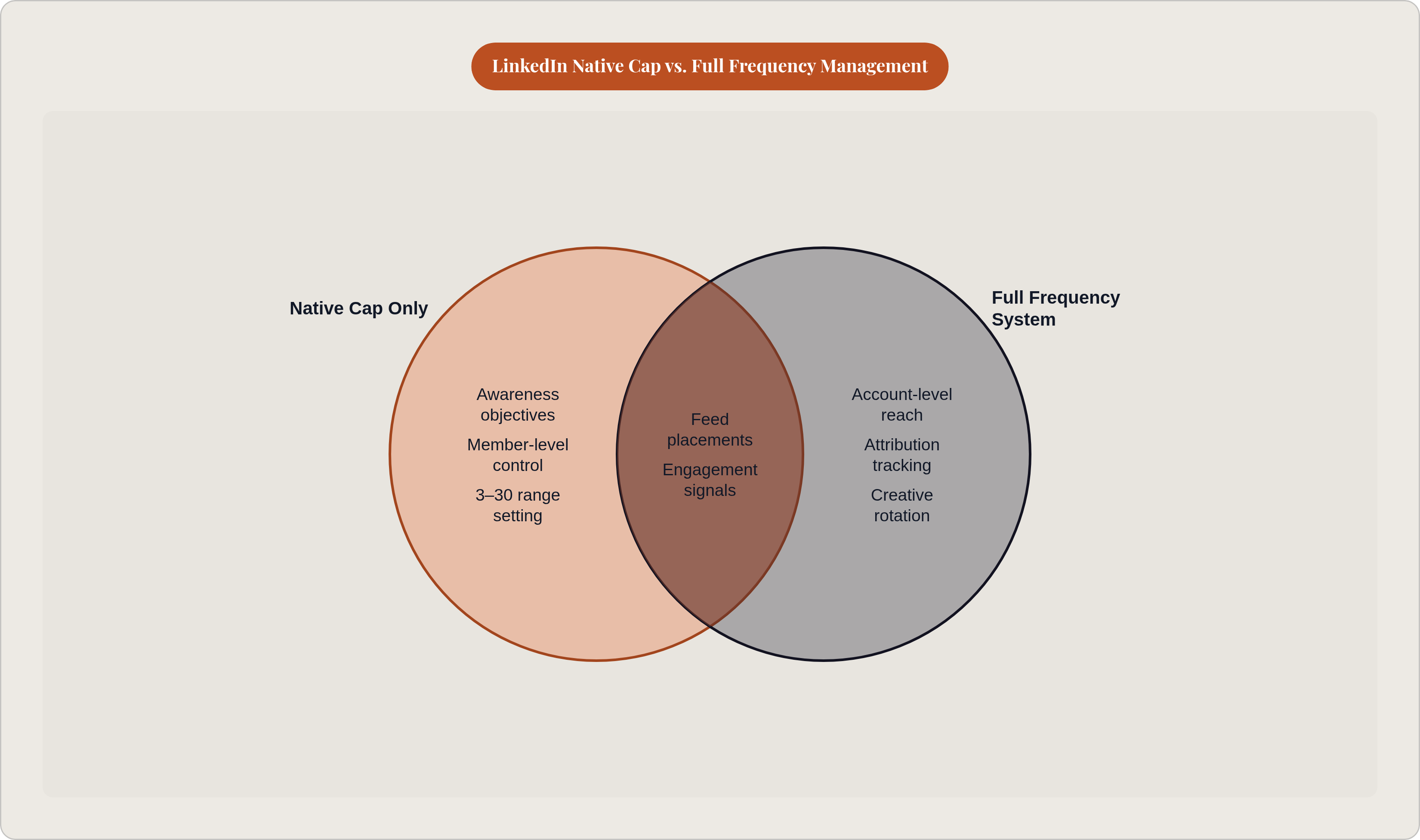
LinkedIn's native frequency cap rolled out inside Campaign Manager for Classic campaigns in mid-2025. It covers three placements: the LinkedIn feed, LinkedIn Audience Network, and Connected TV. Two modes. Default lets LinkedIn set the cap dynamically. Customize lets you set your own, anywhere from 3 to 30 impressions per member per 7-day window.
Useful. But call it solved and two things will bite you.
Gap one: It only applies to Awareness objectives. The formats most prone to runaway frequency — text ads, spotlight ads, follower ads — run under different objectives where the cap doesn't apply. So the formats that most need controlling are exactly the ones the feature doesn't touch. A text ad campaign quietly accumulating 25-plus impressions per member in the background? The native cap isn't even looking at it.
Gap two: It manages member-level frequency, not company-level distribution. This one hits ABM programs especially hard.
LinkedIn's delivery algorithm works at the individual user level. When you're targeting 5,000 accounts, the algorithm gravitates toward the easiest impressions. An enterprise account with 10,000 employees generates roughly 50 times more impression opportunities than a 200-person startup. The algorithm fills its quota along the path of least resistance.
The result: a disproportionate share of budget concentrates on a small fraction of target accounts. For ABM, that's a structural failure. If most of your spend is piling into the same handful of large companies, you're effectively skipping the majority of the account list you said you wanted to reach. And your reporting can look fine the whole time.
Company-level frequency control requires third-party tooling. Knowing that gap exists is part of using the native feature responsibly.
How to Set Frequency Thresholds by Funnel Stage and Ad Format
One uniform cap across all campaigns doesn't work for B2B sales cycles. An awareness ad targeting a cold account that's never heard of you needs completely different treatment than a retargeting ad hitting a buying committee that's already read three case studies.
These are starting benchmarks, not gospel.
By funnel stage:
- Early-stage, problem identification: 1 to 2 impressions per week. Higher frequency here reads as intrusive to buyers who haven't identified a need yet.
- Awareness and consideration: 5 to 8 impressions per person per month. Below 3 per month, brand recall doesn't reliably form. Above 12, performance starts degrading.
- Conversion and lower-funnel: 3 to 4 impressions per week, adjusted for audience size and sales cycle length.
- Retargeting: 3 to 5 weekly touchpoints before decision-maker frustration starts compounding.
By format:
- Video: higher cognitive load than static at the same frequency. Lower the cap for video relative to image or carousel.
- Message Ads and InMail: inbox-focused, tight control. 1 to 2 per month per user is about right.
- Text and spotlight ads: high runaway frequency risk, and currently outside the native cap's scope. Flag these for manual monitoring.
By sales cycle length:
- Shorter cycles (SaaS, IT security): can sustain higher frequency for faster engagement.
- Longer cycles (ERP, enterprise tech): need lower, sustained exposure to build credibility over time without burning out the audience before the deal even starts.
LinkedIn's 3 to 30 range gives you room to apply these distinctions. The mistake is picking one number, setting it, and never touching it again.
The Engagement Signals That Tell You Frequency Is Becoming a Problem
By the time your frequency report looks clearly elevated, engagement has usually been declining for weeks. The metrics that surface problems faster are worth checking more often than most teams bother to.
Watch these first:
- Declining CTR on a stable audience. Most reliable early indicator.
- Rising CPC on the same targeting. The algorithm is spending more to find willing clickers.
- Drop in video view-through rate.
- Increase in "Hide ad" and other negative feedback actions. LinkedIn surfaces these in Campaign Manager. Most teams ignore them entirely. That's a mistake.
Weekly review of frequency metrics, pulled by campaign, audience segment, and individual creative, is the right cadence. Flag any campaign where average frequency exceeds your benchmark by more than 20%.
One thing that trips people up: a single campaign average can hide a lot. A text ad running at 25 frequency while a Sponsored Content unit sits at 6 both get folded into the same number if you're not segmenting. The average looks fine. The problem runs quietly underneath it.
For ABM programs, check account-level reach and frequency data alongside campaign-level metrics. Individual-level data can look healthy while your account list is severely skewed toward the same handful of large companies.
Creative Rotation Is a Complement to Frequency Caps, Not a Substitute
A frequency cap controls how often a member sees ads from your campaign. It does not control whether the ad they see is worn out.
Creative fatigue can hit well within acceptable frequency ranges if the same single asset runs for months. You can cap at 5 impressions per week and still show someone the same tired creative every time they hit that limit.
Plan for at least one creative refresh per month on LinkedIn. Frequency spikes faster on this platform than most advertisers expect, and creative age compounds that problem quietly.
A ratio that works well for B2B is 3:1. Three value-driven, proof-based, or pattern-breaking ads for every one direct CTA. If every ad you show is "Book a demo," you're training your audience to scroll past you. That's a creative problem, not a frequency problem.
Retargeting deserves its own thinking here. Use website behavior and account engagement signals to serve messages that address specific objections or move a decision forward. A relevant case study result. A pricing explainer. An integrations overview. The goal is progression, not repetition.
One useful side effect of rotating creative: it resets some fatigue dynamics even when targeting stays constant. A fresh ad to the same member reads differently than the same ad seen for the twelfth time.
How Attribution Windows Hide the Pipeline Cost of Getting Frequency Wrong
Most B2B organizations default to 30-day attribution windows. But LinkedIn's influence on a buyer journey can stretch well beyond that, sometimes across a year or more before revenue appears. Most attribution setups capture only a fraction of it.
Why does this matter for frequency management specifically? When frequency gets too high and engagement starts to decay, that signal rarely shows up in pipeline reports until weeks later. By then, the relationship damage with the buying group has already happened.
The average B2B deal involves hundreds of touchpoints over a journey that can stretch beyond 200 days. Frequency decisions compound across that entire window. Small adjustments made early matter far more than hard turns made late.
Attribution discipline that actually connects frequency management to pipeline:
- Tag every campaign at launch with UTM parameters. Before launch, not after.
- Sync lead forms to CRM campaign objects before the campaign goes live.
- Connect conversion tracking to pipeline outcomes: first meetings, MQLs, CRM-defined lead quality. Clicks alone are insufficient.
- For longer cycles, combine multi-touch attribution with incrementality testing rather than relying on a single model.
Frequency caps only protect pipeline if the team can actually see the pipeline. Measurement infrastructure and frequency controls need to be built together, not sequentially.
What a Weekly Frequency Management Routine Actually Looks Like
Frequency management is not a launch setting. It's a recurring review loop, and it tends to get skipped precisely when it matters most: mid-quarter, when everyone is heads-down and the campaigns are technically "running fine."
I've seen it go wrong in ways that are almost comically avoidable. A single text ad served the same 300-person account list an average of 31 times in one month. By the time anyone pulled frequency data by creative and account segment, the account's champion had already flagged the company to the AE as "the one that won't leave me alone." That's a pipeline problem that started six weeks earlier, before anyone looked.
Weekly review checklist:
- Pull frequency data by campaign, audience segment, and individual creative.
- Flag any campaign exceeding your benchmark by more than 20%. Document what triggered the flag. Avoid simply resetting it without review.
- Cross-reference with engagement signals: CTR trend, CPC trend, negative feedback rate.
- For ABM programs: check account-level reach distribution. Confirm budget isn't concentrating in the top slice of target accounts.
- Assess creative age. Any asset running more than 30 days without rotation is worth a refresh review.
Decision rules that keep the review from becoming a guessing game:
- Frequency is high, engagement is holding: monitor, hold off on intervening yet. Some audiences sustain higher frequency than benchmarks suggest.
- Frequency is high, engagement is falling: lower the cap, refresh creative, or both. Change one variable at a time so you can isolate what's actually driving the drop.
- Frequency is low, pipeline contribution is low: underexposure may be the issue. Raise the cap or expand the audience before cutting the campaign.
For formats outside the native cap's scope, text ads and spotlight ads especially, use manual budget and audience size constraints to approximate frequency control until LinkedIn extends the feature.
Weekly reporting to revenue stakeholders should surface frequency-adjusted engagement trends alongside pipeline contribution. Without that link, frequency management stays a tactical exercise that nobody upstream ever asks about — and if it goes unasked, it gets deprioritized. Which is how you end up with 31 impressions and an AE wondering why the account went cold.
The native cap is a good tool. Built into a system of creative rotation, engagement monitoring, account-level controls, and connected attribution, it becomes a lever you actually know how to pull. And more importantly, one you know when to pull.