LinkedIn Ads Influence on Closed-Won Revenue Measurement
Last-touch attribution misses 70 percent of LinkedIn's actual revenue impact in B2B sales cycles.
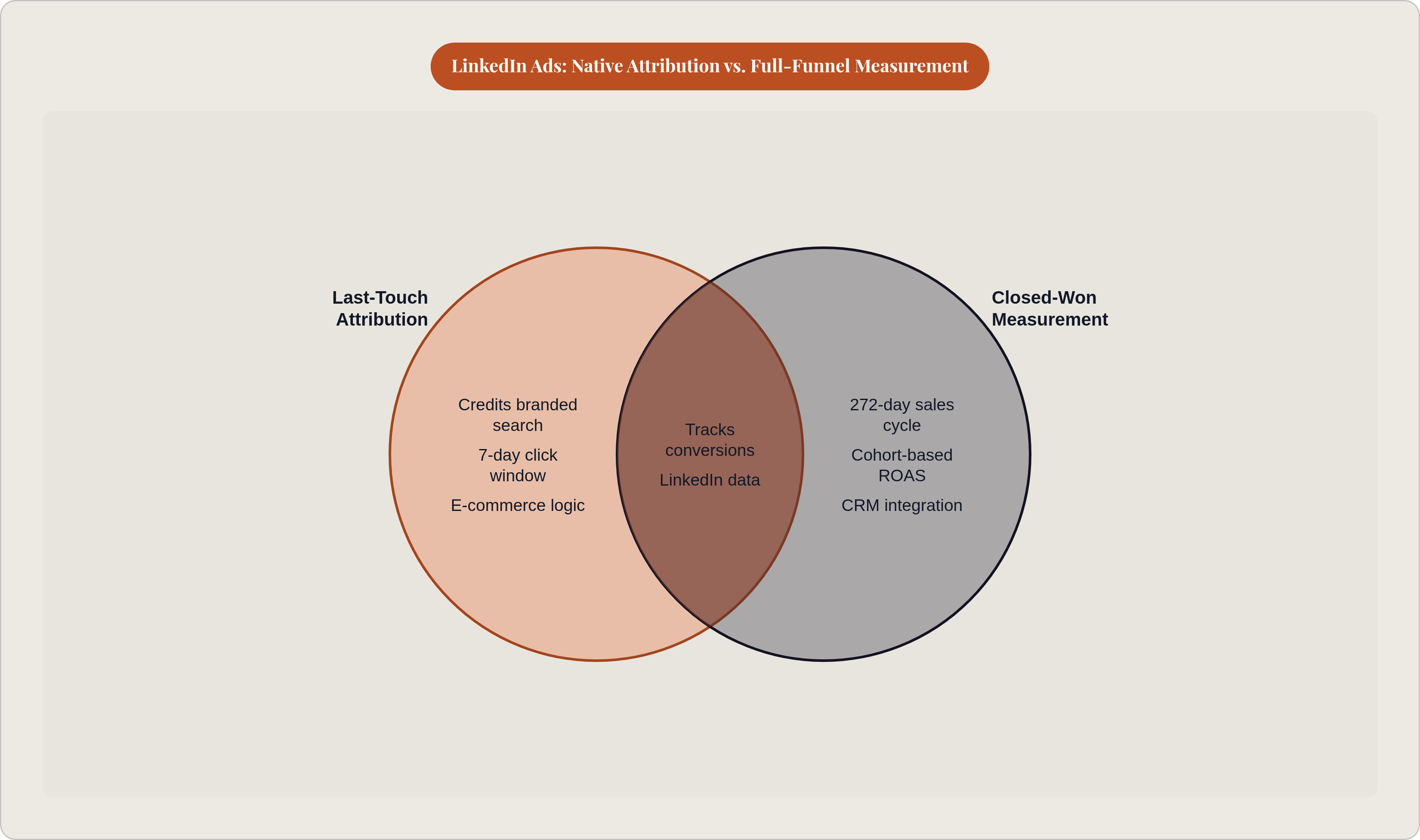
LinkedIn Ads gets called expensive a lot. The real problem is that almost nobody's measuring it right. B2B deals close over months, pull in a dozen people, and touch a dozen channels along the way. Last-touch attribution, the default in most dashboards, was built for a world where someone clicks an ad and buys a t-shirt ten minutes later. Give it a 272-day sales cycle and it just shrugs. It doesn't count most of what LinkedIn actually did. Factors.ai's 2024 B2B Attribution Benchmark Report found LinkedIn touches 62% of closed-won enterprise accounts. Last-touch models give it credit for fewer than 15% of those wins.
Say a buyer sees your Sponsored Content five times over three weeks, forms an opinion, forgets about it, then two months later types your brand name into Google because it finally clicked back into memory. Last-touch attribution hands the win to Google. LinkedIn gets nothing. This isn't some LinkedIn-specific glitch. It's what happens whenever a long B2B buying journey runs into attribution logic built for e-commerce.
What makes B2B deal cycles structurally hostile to platform-native attribution
Two things make this worse than it sounds: how long deals take, and how many people get dragged into them.
Dreamdata's benchmark data puts the average B2B customer journey at 272 days in 2025, up from 211 the year before. Along the way, buyers rack up something like 88 touchpoints. Buying committees usually run 6 to 10 people, each one bouncing between LinkedIn content, search results, direct visits, and probably a Slack message from a coworker who saw your ad first.
Now compare that to LinkedIn's default window inside Campaign Manager: 7-day click, 1-day view. Built to catch fast, obvious conversions. Not built for a VP of Engineering who saw your ad in March and signs in July.
Past a 90-day sales cycle, that window misses most of what LinkedIn did. Native tracking logs the form fill, logs the site visit, then goes dark long before the deal actually closes 90 or 120 days later. GrowthSpree's analysis found native tracking misses 70 to 80% of LinkedIn's real revenue contribution in B2B SaaS.
Judging LinkedIn on what the platform reports is a bit like judging a seed investment by whether the company went public the same quarter you wrote the check. Nobody runs venture capital that way.
What closed-won data actually shows when the full journey is measured
Connect ad exposure to what actually happens in the CRM, and the story changes.
Factors.ai looked at a 200-person SaaS company and found LinkedIn had touched 68% of closed-won accounts in a single quarter. Last-touch attribution had credited it with just 11% of that pipeline. Same deals, same revenue, two completely different answers depending on which lens you're holding up.
It's not only about clicks, either. Factors.ai found accounts with three or more LinkedIn ad touchpoints before a sales conversation close at 2.3 times the rate of accounts with none. That's a familiarity effect, not a click effect. Nobody has to click the ad. They just need to see your name enough times that the sales call feels like meeting someone they already half-know.
Dreamdata's 2026 report puts a number on this: counting paid engagement, not just conversions, drives 7.7 times more attributed revenue to LinkedIn. That gap is basically the whole story right there. It's the difference between measuring what LinkedIn did and measuring what a tracking pixel happened to catch on its way past.
Measure LinkedIn against closed-won revenue instead of clicks, and the ROAS numbers flip on you. Dreamdata's 2026 LinkedIn Ads B2B Benchmarks Report put LinkedIn's median ROAS at 121%, against 67% for Google Search and 51% for Meta. The channel everyone assumes is expensive turns out to be the most efficient one on the sheet, once revenue is the yardstick instead of cost per click.
The cost-per-lead trap and what cost-per-revenue-influenced actually looks like
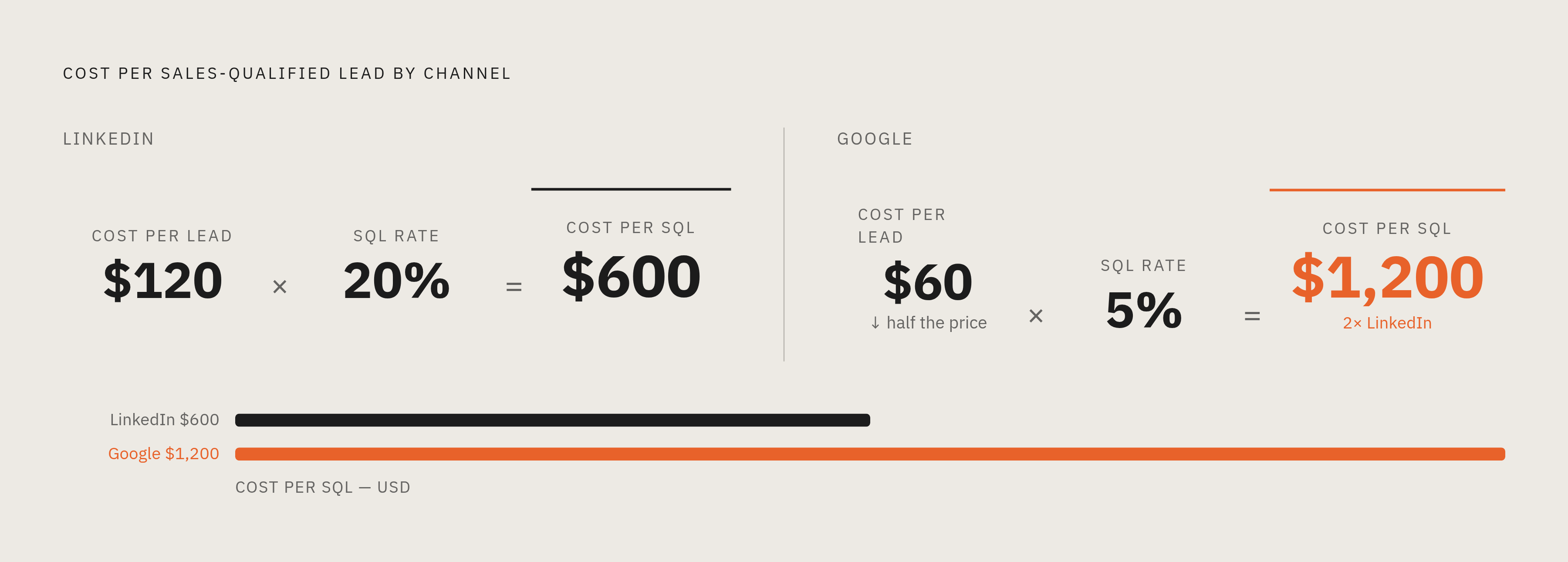
On paper, LinkedIn looks pricey. B2B SaaS cost-per-lead typically runs $100 to $250, three to five times higher than Google Ads on a raw lead basis. Stop measuring there and LinkedIn looks expensive while Google looks like a bargain.
Measure qualified pipeline instead, and the math flips:
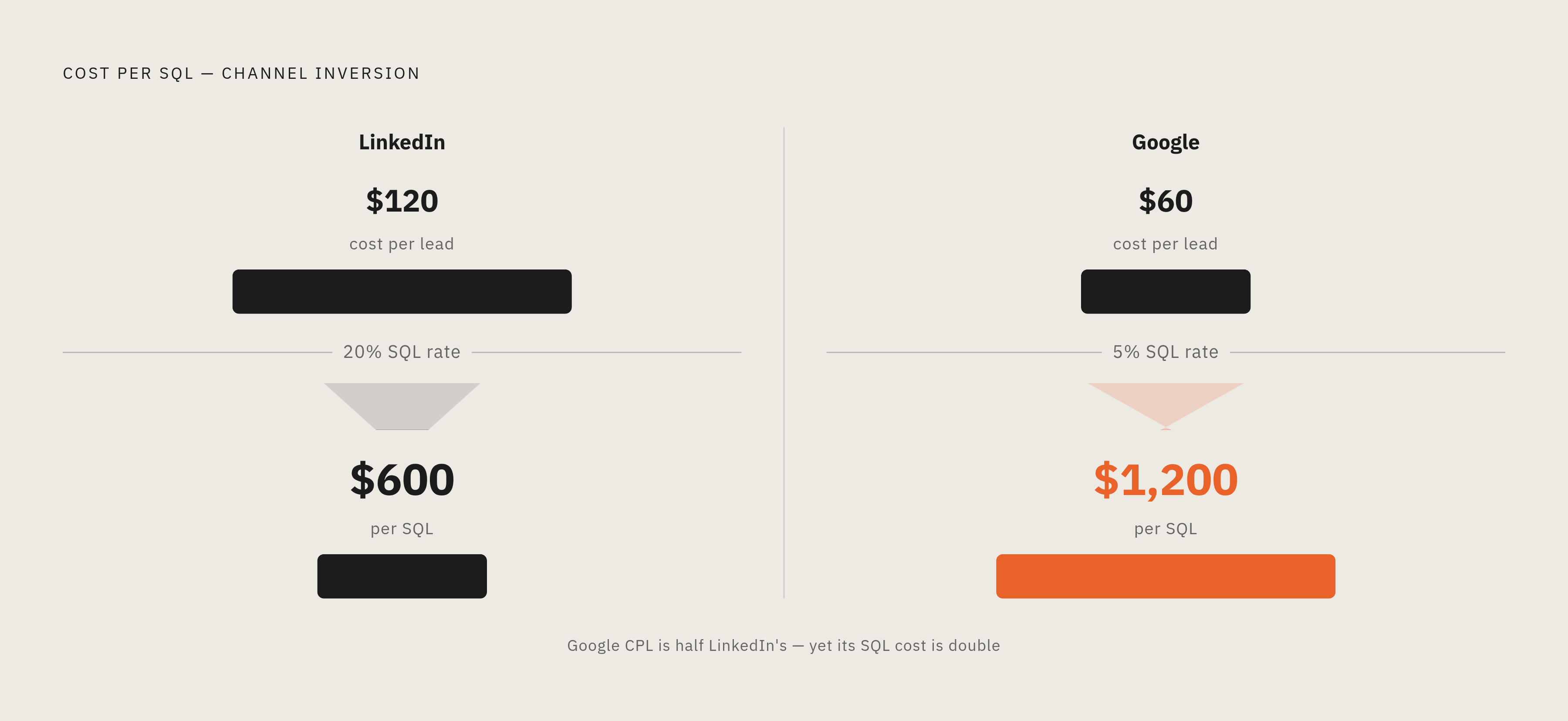
- A $120 LinkedIn lead converting to a sales-qualified lead at 20% works out to $600 per SQL.
- A $60 Google lead converting at just 5% works out to $1,200 per SQL.
Twice the cost, from the channel that looked half as expensive walking in the door.
The revenue math backs this up. Per Dreamdata, LinkedIn returns $1.21 in attributed revenue for every dollar spent. Google Search returns $0.67. Cost per company influenced tells the same story: 70.11 EUR for LinkedIn versus 110.37 EUR for Google Search. And LinkedIn's number is down sharply from 154 EUR the year before. The account-level efficiency is getting better, not worse.
Make budget calls off cost-per-lead alone, with no SQL rate and no downstream revenue anywhere in view, and Google wins every time. Not because Google is better. Because the scoreboard was built to hand Google the credit for what LinkedIn set up months earlier.
Why last-touch and first-touch models both fail LinkedIn specifically
The easy fix sounds obvious: just switch to first-touch attribution. But both models fail LinkedIn. Just in opposite directions.
Last-touch rewards whatever happened right before the conversion, usually branded search or retargeting, and wipes out everything that built the demand in the first place. First-touch overcorrects the other way: all the credit goes to whoever showed up first, and it ignores months of nurturing that actually talked a 6-to-10-person buying committee into signing.
LinkedIn sits in an awkward spot for both. It mostly works at the awareness and consideration stage, building the demand that Google later scoops up when someone finally searches your brand name. Any model that hands most of the credit to the final click is going to shortchange LinkedIn by design.
Even LinkedIn seems to know this about itself. Its own research team published LiDDA, a transformer-based attribution model that uses attention mechanisms to weigh each touchpoint's real contribution instead of picking one winner-take-all touch.
Linear attribution, which spreads credit evenly across every touch, sounds fair on paper. It isn't the fix either. It treats a first-ever ad impression the same as a demo-request click, and that's not how buyers actually move through a decision.
Here's the catch nobody mentions: switching the attribution model dropdown in your dashboard is cosmetic if the data behind it hasn't changed. You can pick the fanciest model on the menu and still be blind to most of what LinkedIn did, because nobody built the pipe connecting exposure to revenue in the first place.
The attribution models and windows that actually fit a B2B buying cycle
For most B2B SaaS companies, position-based (U-shaped) attribution is the right place to start. It splits credit like this: a large share to the first touch (demand creation), an equal large share to the last touch before the SQL converts (demand capture), and the remainder spread across everything in between.
This fits LinkedIn well because LinkedIn usually earns its keep at that first touch, the moment someone learns your brand exists, even if the deal eventually closes through a Google search or a sales call. U-shaped attribution protects that early contribution instead of erasing it.
Windows matter as much as the model itself. For enterprise accounts, a 12-month window is the realistic floor. Dreamdata's 2026 benchmarks show shorter windows consistently underreport LinkedIn's contribution, simply because the deals haven't closed yet by the time the window shuts.
The measurement cadence has to change too. Standard 30-day ROAS math will always make LinkedIn look bad in B2B SaaS, where sales cycles routinely run 84 days or longer.
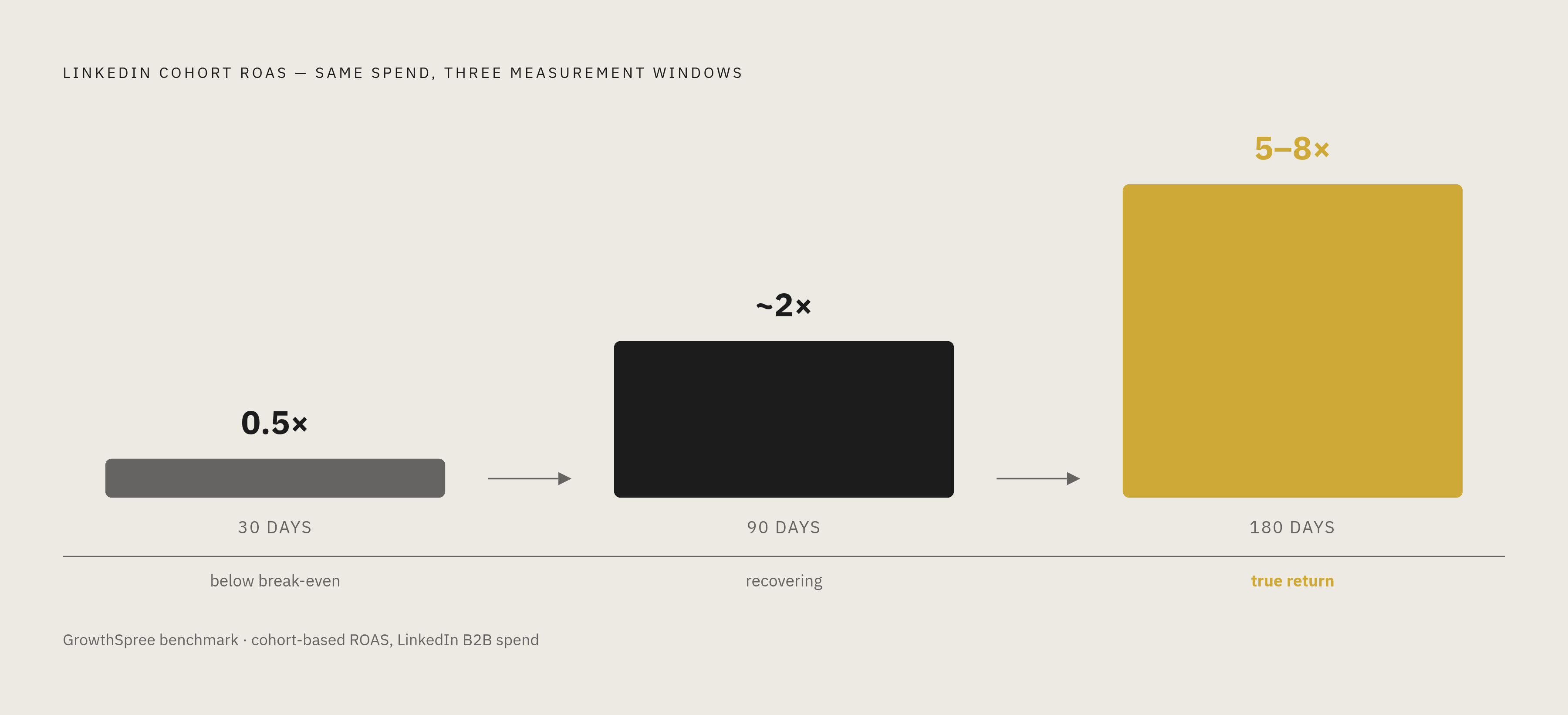
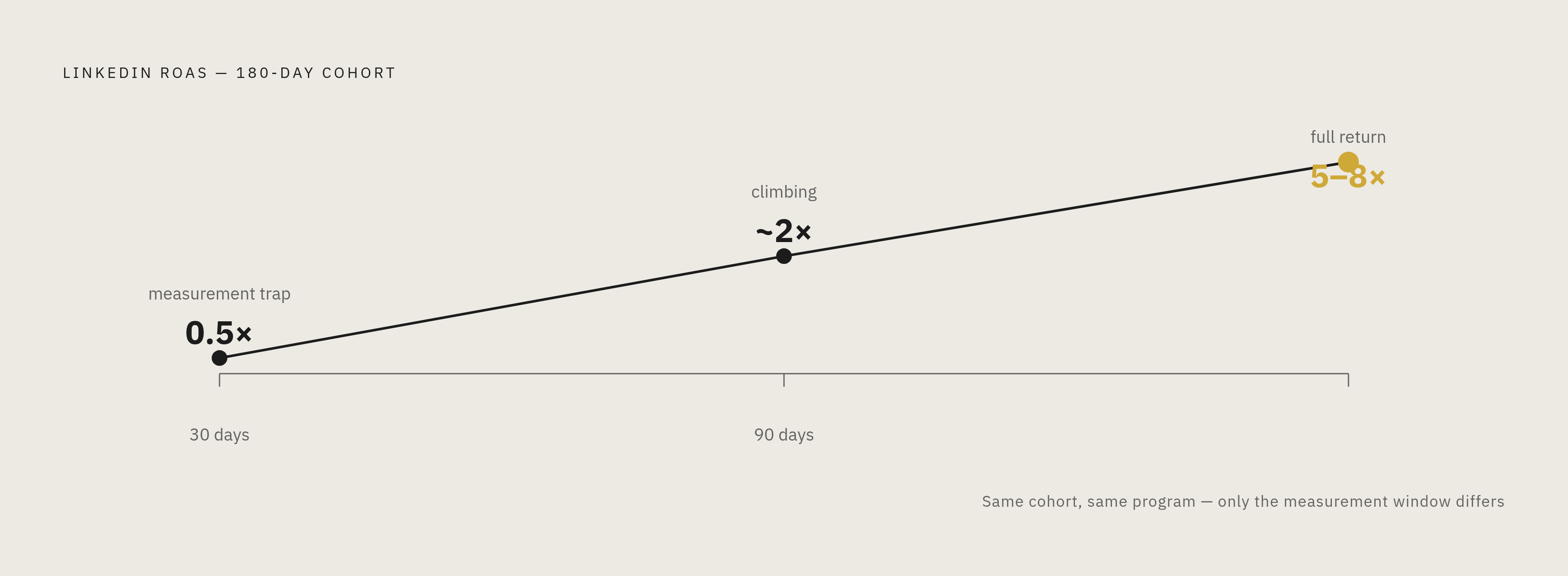
The fix is cohort-based ROAS: track each month's cohort of leads at 90, 180, and 365 days out, instead of judging spend against revenue inside the same 30-day window it was spent in. GrowthSpree's typical pattern shows LinkedIn ROAS around 0.5x at 30 days, which looks alarming if that's the only number you check. It climbs substantially by 90 days, and a healthy program reaches 5 to 8x by 180 days. A 5-to-10x pipeline-to-spend ratio at the 180-day mark is a fair benchmark for a LinkedIn program that's actually working.
None of this holds up if you're only counting conversion events. Views, repeat impressions, time spent on the ad, all of it has to be part of the model, or per Dreamdata, you badly understate how much revenue LinkedIn is really driving.
Building the infrastructure that connects LinkedIn exposure to CRM closed-won data
None of the models above matter if the data never actually gets connected. LinkedIn Campaign Manager lives in one world. Your CRM, where deals actually close, lives in another. Closed-won revenue doesn't flow back to the ad platform by magic. Somebody has to build that connection by hand, and it usually isn't anybody's stated job.
Start with LinkedIn's Conversions API, CAPI. This is the foundation, not a nice-to-have. Dreamdata's 2026 benchmarks show advertisers using CAPI see 20% lower cost-per-acquisition and 31% more attributed conversions on average. Roughly three-quarters of LinkedIn advertisers now use it, and of those, 64% have moved past optimizing for form fills and are optimizing for pipeline and revenue instead. CAPI passes events server-side, including offline conversions straight from the CRM, which stretches your real attribution window well past whatever a browser cookie could ever catch.
Next comes the CRM layer. LinkedIn's Matched Audiences, paired with native connectors for Salesforce, HubSpot, and Dynamics 365 (expanded in mid-2025), closes the loop from ad impression all the way to closed-won revenue. LinkedIn also upgraded its Revenue Attribution Report in July 2025 to measure at the company level, tracking how a campaign moved an entire buying committee, not just the one person who happened to click.
What the stack actually looks like depends on company size:
- Most B2B SaaS companies: HubSpot's multi-touch attribution paired with LinkedIn's offline conversion API is the practical starting point. Anything more is often more than the company needs.
- Enterprise: dedicated platforms like Bizible or HockeyStack add cross-channel modeling and revenue-stage tracking for messier, longer buying journeys.
The step almost everyone skips: actually importing offline conversions back into LinkedIn. SQL creation, stage changes, closed-won events, all of it needs to flow back so LinkedIn's algorithm learns from real revenue instead of form-fill counts. Skip this, and you're optimizing toward a stand-in number that might barely track what actually closes.
What changes in campaign management once LinkedIn is measured against closed-won revenue
Once this is wired up, the numbers start moving in a way that's hard to argue with.
Dreamdata's 2026 benchmarks show LinkedIn now influences 28.3% of new business deals, up from 15% the year before. LinkedIn didn't suddenly get more influential. Better measurement is just finally showing a role it was already playing.
Budget follows the data, as it usually does. B2B marketers put 39% of ad budgets into LinkedIn by the end of 2024, up from 31% earlier that same year. That shift tracks with attribution improving, not with some sudden platform hype cycle.
Campaign mix shifts too. Take Thought Leader Ads: in one practitioner's case, they drove roughly half of conversions on just 30% of spend. Under cost-per-lead measurement, they look weak, because the engagement is quieter and harder to click-count. Under closed-won measurement, their pipeline contribution finally shows up, and they stop getting cut by mistake. That 2.3x higher close rate for accounts with three-plus touchpoints is the engagement signal arriving before the pipeline signal does. Teams that only watch pipeline numbers miss that early warning every single time.
Bidding changes as a direct result. Once you optimize toward pipeline and revenue events passed back through CAPI, instead of toward form fills, the algorithm starts reinforcing a different set of audiences and a different set of creative.
And this is where the "wasteful" spend finally gets its defense. Awareness and education campaigns, the ones that look terrible on a cost-per-lead basis, can finally get checked against what they actually contributed to closed-won accounts at the 90 and 180-day mark. Without that closed-won data flowing back, you're optimizing against a proxy. With it, you're optimizing against what actually happened.
Where the measurement gap comes from in practice, and who is responsible for closing it
The data sits in silos by design. No one's job title says "go connect these two systems."
Ad platform data belongs to the media buyer. CRM data belongs to sales ops or RevOps. Neither one has a built-in reason to go build a bridge into the other team's system. That's just how most org charts happen to be drawn, and nobody drew them with attribution in mind.
In-house teams often don't have anyone with the attribution engineering background to build this loop, so the work falls into the gap between marketing and RevOps and sits there, unclaimed. Agencies run into a different version of the same problem: they optimize toward whatever the platform reports, because that's the only data available at the speed their reporting runs on. Closed-won data from the CRM shows up too late, and too rarely, to shape a campaign decision on an agency's normal timeline.
There's an incentive problem sitting underneath the technical one too. A fee tied to media spend gives an agency no reason to go prove a channel works just as well on a smaller budget. A flat fee tied to pipeline outcomes points that incentive the other way entirely.
Closing this gap takes one person, or one team, that owns both halves: the campaign work and the CRM connection. Someone who builds the CAPI integration, sets the attribution model, imports the offline conversions, and checks cohort ROAS at 90 and 180 days as a routine habit, not a once-a-year fire drill.
This isn't a report you run once and file away. Leads keep flowing in on their own weird timelines, deals keep closing months after the ad ran, and somebody has to keep watching the pipe that connects the two. Skip that step, and you're back to judging LinkedIn on cost-per-lead, wondering out loud why the "expensive" channel keeps getting cut from a budget it was actually earning the whole time.