LinkedIn Retargeting Sequences for Bottom-of-Funnel Pipeline
Build tiered retargeting sequences that move high-intent prospects to meetings.
Most LinkedIn BOFU campaigns fail for a boring reason: nobody built a sequence. Someone set up one retargeting ad set aimed at "everyone who visited the site," and called it a bottom-of-funnel strategy. That's a single ad pointed at a crowd, hoping the right people notice.
Here's what that produces. The homepage browser and the prospect who just left the pricing page see the same creative, over and over. No progression, no differentiation, no sense that either person is closer to a meeting than they were last week. Just frequency fatigue with a CPM attached.
The budget conversation makes this worse. Data across 200+ B2B SaaS accounts points to a rough 60/25/15 split across top, middle, and bottom of funnel as a reasonable starting point. But arguing over that split misses the point. If a team is underspending at BOFU, it's usually a trust problem: nobody believes the sequence works, so nobody wants to feed it more money. Adding budget to a broken sequence just means paying more to run the same broken thing at a slightly bigger scale.
LinkedIn punishes sloppiness fast. CPCs run $8 to $15 depending on the audience, so wrong-signal impressions and fatigued creative burn real money in a hurry. There's no room to "figure it out as you go" the way you might on a cheaper channel.
The actual gap is a missing chain: audience signal, ad format, offer, next step. Each piece usually exists somewhere in the campaign — they just don't hand off to each other. A working BOFU sequence closes the distance between "this person showed intent" and "this person is on my calendar," one deliberate step at a time.
What makes a signal "bottom-of-funnel" on LinkedIn and why it changes the ad logic
Not every retargeting audience deserves the same treatment. A homepage visitor and a repeat pricing-page visitor are at different points in a decision, and the ad logic has to respect that.
High-signal BOFU behaviors worth building an audience around:
- Visits to the pricing page, an ROI calculator, or integration docs
- Repeat site sessions inside a 7 to 14 day window (recency matters as much as the page itself)
- Video viewers who watched 75% or more (depth, not just a play)
- Lead Gen Form submitters who haven't booked a meeting yet, the exact gap a BOFU sequence exists to close
Think about what each person already knows. A pricing-page visitor has a cost question in their head right now; serve them a thought leadership article and you've handed them a reason to leave. A form submitter who hasn't booked doesn't need more education, they need a nudge: something urgent, something specific, one clear next step.
Retargeted website visitors convert about 70% more often than first-time visitors, according to campaign data, but that lift only shows up when the ad matches the signal tier. Treat every retargeted visitor as one big pool and you lose most of that advantage.
There's a parallel track worth running too: upload matched account lists so target accounts get outreach whether or not they've hit a tracked page. That's a second signal running alongside the behavioral one, not a replacement for it.
Exclusion matters just as much as inclusion. Existing customers, open CRM pipeline, closed-won accounts: all of them need to come out of this sequence, because they need a completely different one.
The three-stage sequence structure that turns intent signals into meetings
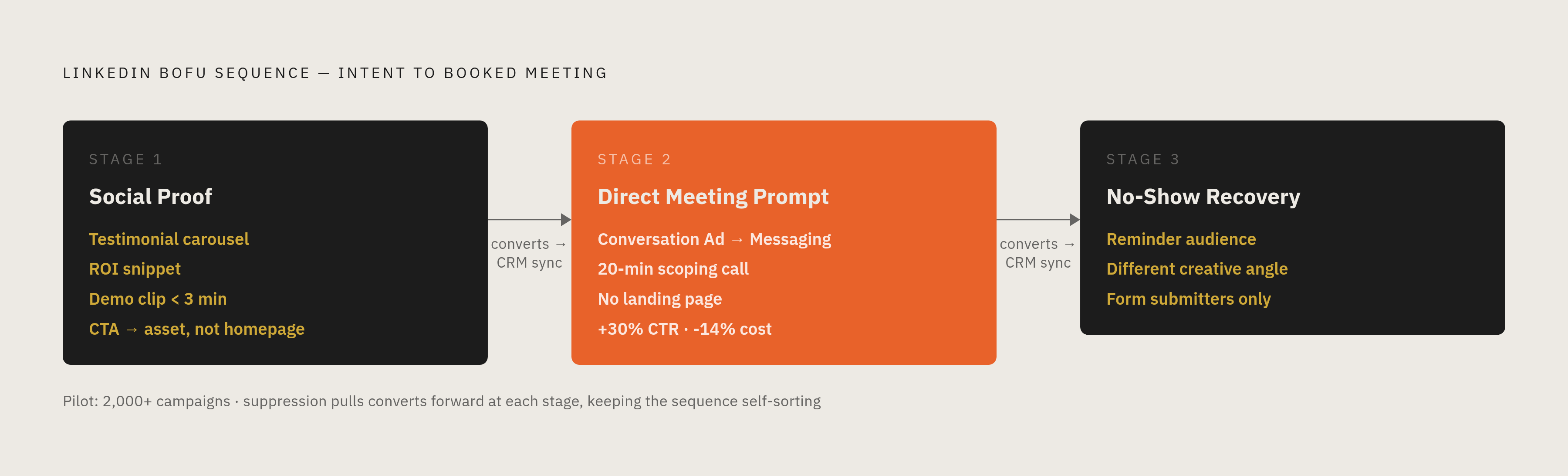
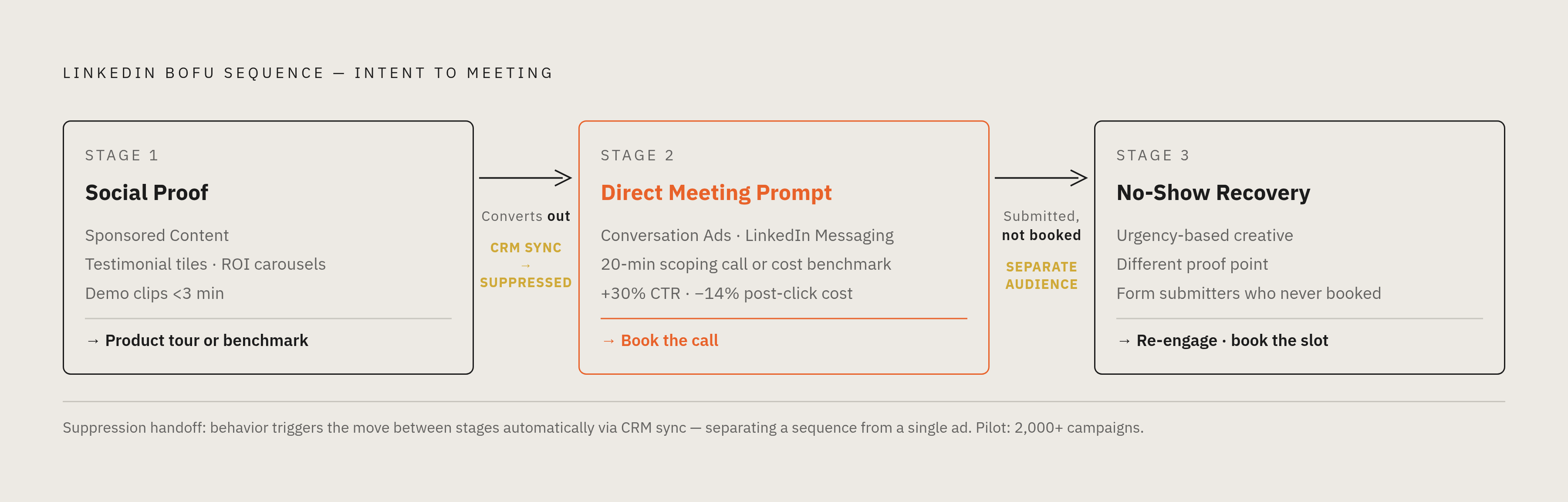
Stage 1: Social proof as the threshold moment. By this point, the prospect has already shown intent. What's holding them back isn't more information, it's belief: do they trust that the outcome they're looking for is real, and achievable for someone in their shoes? This is where Sponsored Content with customer testimonial tiles, carousel ROI snippets, and short demo clips (under three minutes) do their job. The CTA should point somewhere specific: "See the 3-minute product tour," "Benchmark your costs against peers." Not "Learn more." Not the homepage.
Stage 2: Direct meeting prompt via Conversation Ads. Once someone has engaged with Stage 1, or they're already sitting in a high-signal behavioral audience, Conversation Ads deliver a calendar-booking prompt right in LinkedIn Messaging. This is the format built for this exact moment: a prompt, a choice, a CTA, no landing page required. The offer needs to be small and specific: a 20-minute scoping call, a tailored demo, a cost benchmark. In a LinkedIn pilot across more than 2,000 campaigns, website retargeting lifted CTR by 30% and cut post-click costs by 14%, results tied directly to sequencing retargeting with a format matched to the offer.
Stage 3: No-show recovery and re-engagement. People who engaged with Stage 1 or 2 but didn't convert go into their own reminder cadence, a separate audience, not recycled back into Stage 1. The creative here should quietly acknowledge time has passed: urgency, limited availability, a different proof point. This stage also catches form submitters who never booked, the single most common gap in a BOFU program.
Movement between stages is based on behavior, not a set number of days in the campaign. The handoff runs through suppression: the moment someone converts out of Stage 1, they're pulled out and pushed into Stage 2 automatically, synced from the CRM.
Format selection at BOFU and why Conversation Ads carry a different job than Lead Gen Forms
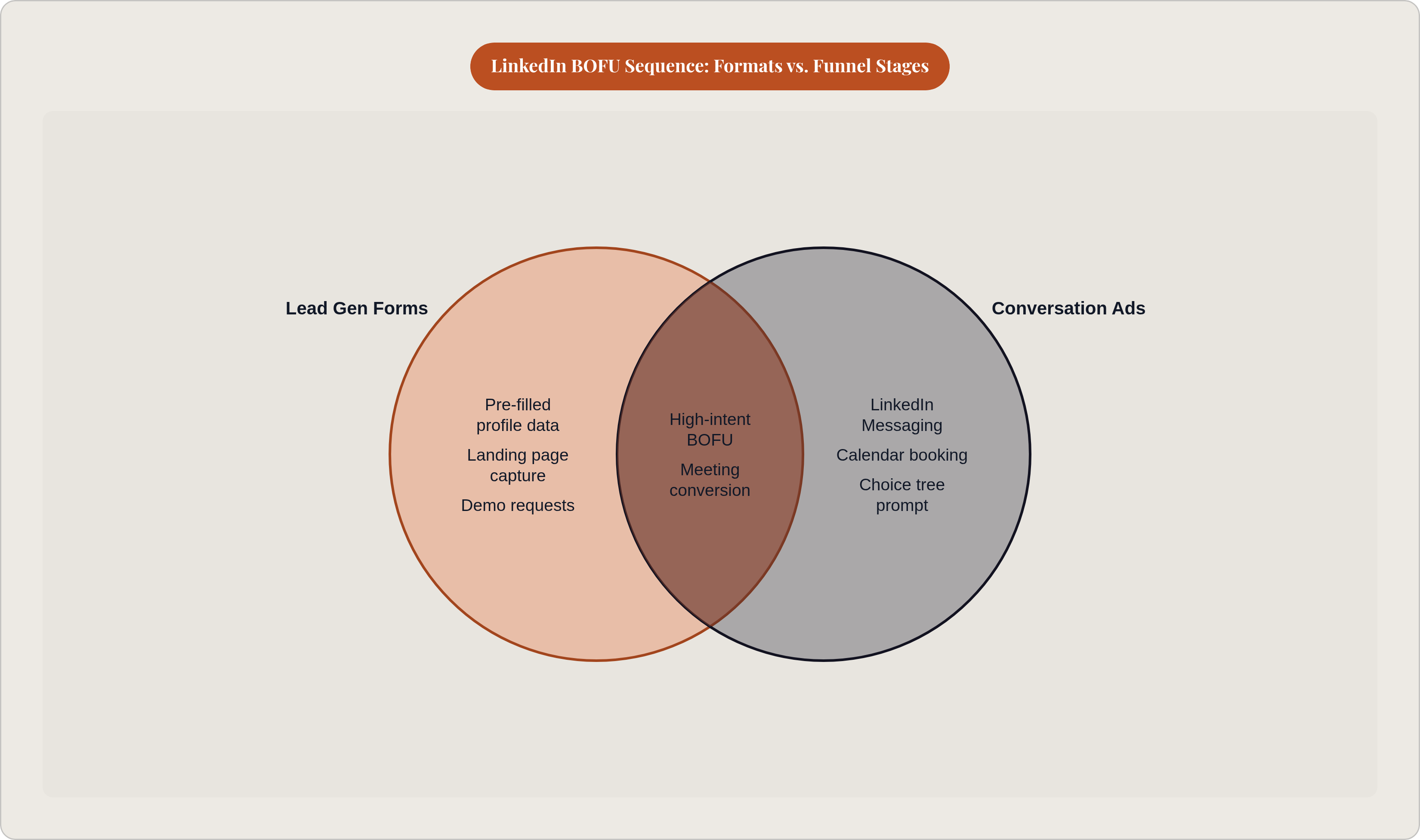
Format choice at BOFU isn't a matter of taste. Each format does one specific job at one specific stage.
- TOFU: Single Image Ads, Thought Leader Ads. Broad reach, generating engagement signal.
- MOFU: Lead Gen Forms, Document Ads. Low friction capture, education traded for identity.
- BOFU: Conversation Ads and retargeting aimed at high-intent visitors. Direct prompt, meeting conversion.
Lead Gen Forms have a narrow but real job at BOFU. They pre-fill with LinkedIn profile data and typically convert 2 to 3 times better than a landing page. That's useful when the goal is capturing contact info from someone who's clearly ready but hasn't self-selected into a calendar yet, say a demo request or a cost benchmark download. The mistake is treating the form fill as the finish line when your sales motion needs a live conversation. Retargeted audiences convert at roughly 13% on average, per 2025 Single Grain data, high enough that the gap between form fill and no-show becomes a real problem, one Stage 3 has to catch.
Conversation Ads carry a different structural advantage. They land in LinkedIn Messaging, not a display unit someone scrolls past. Design the choice tree carefully: too many branches and completion drops, while a single well-framed question, something like "Would a 20-minute cost benchmark call be useful this week?", tends to beat any menu. The format also reads more like a message from a person than an ad from a brand.
Creative fatigue plays out differently by format too. Single-image Sponsored Content tends to peak around 4 to 8 weeks before CTR starts to slide. Conversation Ads and Lead Gen Forms decay on their own timelines, so each needs its own refresh schedule.
Audience sizing and suppression logic that keep BOFU sequences efficient
BOFU audiences are small by nature. That's the point: the higher the intent signal, the fewer people qualify. A pricing-page audience or a repeat-session audience might only be a few hundred to a few thousand people at any given moment. LinkedIn requires a minimum audience size to run a campaign at all, and stacking too many behavioral filters plus targeting overlays can push you under that line without you noticing.
This is the over-filtering trap. Add title, then seniority, then industry, then group membership on top of a behavioral audience, and each new filter shrinks the pool and pushes CPCs up. Most B2B BOFU campaigns do best somewhere between 50,000 and 200,000 members: narrow enough to stay relevant, big enough to generate usable data.
Getting to that range at BOFU usually means combining tiers: pricing-page visitors plus repeat sessions plus form submitters plus a matched account list. That's fine, as long as each person in the combined audience sees messaging that matches their highest-intent signal, which means either separate ad sets or dynamic creative doing the sorting.
Suppression isn't a nice-to-have here, it's load-bearing. Serve acquisition ads to existing customers and you create friction for no reason. Serve the same ads to someone already in an open deal and you confuse the sales conversation their AE is having right now. Closed-won accounts belong in an upsell sequence entirely, with different creative and different goals.
CRM sync needs to run tight. Weekly is the floor, daily is better, because a prospect who converted yesterday needs to be out of the acquisition sequence today, not next Tuesday. Get suppression right and the budget naturally concentrates on the only group that matters: people genuinely stuck between "showed intent" and "booked meeting."
The operational cadence that keeps a BOFU sequence from degrading silently
The usual failure pattern: campaign gets built, left alone, and only gets a second look once pipeline numbers show a problem. By then, according to analysis of 200+ B2B SaaS accounts from Impactable, weeks of spend have already gone toward fatigued creative or a saturated audience. Nobody caught it because nobody was watching.
A weekly check on a live BOFU sequence should cover:
- Creative fatigue. Single-image ads peak around 4 to 8 weeks. Flag anything approaching that window before CTR drops, not after.
- Frequency caps. Keep them tight. Overserving a small, high-intent audience burns goodwill faster than almost any other mistake in the sequence.
- Audience refresh. Are new high-intent visitors still entering the BOFU pool, or has it stalled? If the flow of new additions has slowed, the problem might sit upstream in TOFU or MOFU, not in BOFU itself.
Dayparting matters too. A calendar-booking prompt through Conversation Ads landing at 11 PM on a Friday isn't going to get answered.
The real test is downstream: BOFU is working if BOFU leads turn into pipeline, not just because CTR looks good. Track the full path: form submitter, meeting booked, SQL, opportunity, closed. If form fills are strong but meetings booked are weak, the Stage 2 handoff is broken. If meetings booked are strong but SQL rates are weak, the audience definition is too loose and letting in the wrong people.
When MOFU is producing strong SQLs that sales is converting well, that's the signal to shift 5 to 10% more budget into BOFU. The middle of the funnel has already proven the logic works; BOFU just needs the fuel to move faster.
Where AI-driven execution changes the mechanics of running sequences at scale
Running a BOFU sequence well is a lot of ongoing work: audience refresh, suppression sync, creative rotation, frequency checks, downstream tracking. Most teams can't keep up with all of it by hand without it turning into someone's entire job.
This is where agents change the mechanics, not by replacing judgment, but by handling the parts that need constant attention:
- Watching audience membership, frequency, and creative performance continuously, instead of waiting for the weekly review
- Updating suppression lists near-real-time as CRM status changes, rather than on a weekly batch
- Noticing when a prospect's behavior shifts from MOFU signals to BOFU signals and routing them into the right stage without a person making that call every time
What matters most here is that the sequence doesn't reset between campaigns. Audience insights, creative performance, offer response data, all of it accumulates and feeds the next round, a real departure from the agency model, where a new team or a new contract often starts over from nothing. Over time, the sequence gets better at knowing which signals actually predict a booked meeting, not just which ad got the most clicks.
The human judgment doesn't go away, it moves: which offers to test, which accounts are worth treating differently, when the sequence logic itself has stopped working and needs a rethink. These are the calls that carry real consequences, and agent execution surfaces them faster — it doesn't make them for you.
Agent OS handles the continuous execution: audience updates, suppression, creative rotation, performance monitoring. Forward Deployed Marketers own the decisions that move pipeline. The split matches what the work needs: constant attention on one side, judgment on the other.
What a BOFU sequence that actually produces pipeline looks like end to end
Trace it from a single signal to a booked meeting.
A prospect hits the pricing page twice in ten days. That drops them into the BOFU behavioral audience. A suppression check confirms they're not sitting in open CRM pipeline and they're not a current customer. They enter Stage 1.
Stage 1 serves them a Sponsored Content testimonial carousel, real customer outcomes, nothing generic. If they engage, that engagement (plus their existing behavioral signal) pushes them into Stage 2: a Conversation Ad lands in LinkedIn Messaging with a specific, low-friction offer, a 20-minute cost benchmark call, framed as one clear question, not a menu of five options.
If they book, they're out of the sequence and into the sales process, where they belong. If they don't, they move into Stage 3: a separate audience, a different creative angle, a nudge that quietly acknowledges time has passed since they first showed up.
Underneath all three stages, the same suppression logic runs on a tight sync: pricing-page visitor becomes customer, gets pulled out same week, not next quarter. Same for anyone who lands in open pipeline mid-sequence.
None of this is complicated on paper. What makes it hard is doing all of it at once, continuously, without the pieces drifting out of sync with each other. That's the difference between a BOFU campaign that quietly burns budget and one that turns intent into meetings on a schedule you can actually plan around.