LinkedIn Pipeline Velocity and Sales Cycle Length by Ad Type
Different LinkedIn ad formats work at different stages of the 272-day B2B buying cycle.
By the time someone fills out a form, they've already made most of the decision without you.
Research puts the full B2B buying journey at around 272 days. Of those, roughly 220 are spent in what I'd call the silent phase, according to research on the modern B2B journey. No CRM entry, no form fill, just someone reading, comparing, and quietly forming an opinion about you while your sales team has no idea they exist.
So most of the format decisions you make are aimed at a buyer who is already most of the way to a decision before they've clicked anything. And it's rarely one person making that decision anyway. Most B2B deals pull in multiple stakeholders. One ad, no matter how sharp, isn't reaching the whole room in a single shot.
Once buyers do surface, things move fast. MQL to SQL and SQL to closed-won timelines have both compressed meaningfully. Buyers show up later, but far more ready than they used to be.
That sets up a trap. Grade a campaign on a 30-day window and you're grading only a small fraction of the actual journey. That's like scoring a marathon after the first quarter mile. Formats that build early pipeline will look like they're failing on a 30-day report, and the instinct is to cut them.
Which format you run has to be a deliberate call about which part of that 272-day walk you're actually trying to serve.
What each major LinkedIn ad format actually does to funnel stage and buyer temperature
The biggest mistake here is running conversion creative on a cold audience or awareness creative on a hot one.
Top of funnel, cold audiences still in the silent phase:
- Single Image Ads. High reach, brand imprinting. Nobody converts on these right away, and that's fine, that's not what they're for.
- Video Ads. People underrate these. They build familiarity without asking the viewer for anything back.
- Thought Leader Ads. These run an employee's organic post as a paid ad. They tend to outperform brand page ads because the social proof is already baked in. People trust people, not logos.
- Document Ads. Underused for cold audiences. You hand someone something useful before you ask for a thing in return.
Middle of funnel, warm, paying attention, not yet shopping vendors:
- Carousel Ads. Highest organic engagement rate on the platform, averaging 6.60% according to Averi.ai. The multi-frame format rewards someone who's already leaning in.
- Document Ads. Case studies, how-to guides. Still teaching, just further down the road.
- Video Ads. Paired with retargeting, still building trust with people who've already shown a flicker of interest.
Bottom of funnel, known accounts, late stage, CRM retargeting:
- Sponsored Messaging (Message and Conversation Ads). Direct and personal. Works because the buyer already knows who you are.
- Thought Leader Ads, repurposed here with case studies and testimonials. At this point, buyers want proof, not more education.
- Lead Gen Forms. Convert at 12 to 18%, the best efficiency on LinkedIn. But only because they're catching people who were already warm enough to act.
Format doesn't just change your cost. It changes how warm the buyer is the second they land in your funnel, and that decides your sales cycle length before your sales team has even said hello.
How TOFU formats lengthen the visible sales cycle — and why that length is often doing real work
TOFU formats build the pipeline that takes longest to show up in your CRM, because you're catching people while they're still in the silent phase.
Some B2B teams running delegated paid media programs, like Thunder's agent-driven Google and LinkedIn Ads service, are structured precisely to sustain that patience across the full window. In one CRM-validated engagement, the first several months produced only modest pipeline, then activity surged, a significant sum in one month, an even larger amount the next. Those two months alone made up the majority of all pipeline the program generated from LinkedIn.
That's the shape of TOFU. Frequency and recognition build quietly against a target account list for months, then deals come loose in clusters. Not a steady drip. More like something finally giving way after enough pressure.
If someone had killed that campaign at day 60 based on a flat ROAS chart, they'd have pulled the plug right before the payoff showed up.
TOFU compresses the part of the sales cycle you can't see. Buyers walk into the sales conversation already educated, which shortens the actual selling conversation even though the total time they spent thinking about you was long. The CRM shows a short cycle. The real influence window was much longer than that number suggests.
Thought Leader Ads carry a lot of this weight, because they build trust in a person, not just recognition of a logo. A buyer who feels like they already know someone at your company moves faster once they finally engage.
Worth asking before your next budget review: how many genuinely good campaigns get cut in a slow month, right as the compounding was about to pay off?
How MOFU formats affect the MQL-to-SQL conversion rate and where the pipeline bottleneck actually lives
The biggest bottleneck in a typical B2B funnel isn't ad clicks. It's MQL-to-SQL conversion, and it averages just 15 to 21% across B2B SaaS.
Small moves here matter a lot. A 5-point improvement in MQL-to-SQL conversion can lift revenue by up to 18%. That's a bigger return per unit of effort than almost anything else you could touch.
MOFU formats do this work. Document Ads with case studies, retargeted video, Carousel for warm audiences. None of these are trying to create new awareness. They're trying to help someone who's already interested finish qualifying themselves, on their own time.
A Document Ad full of proof points gives a buyer something they can forward to their boss. A benchmark report or case study helps build the internal business case without your sales rep in the room. Carousel's 6.60% engagement rate tells you something too: that's a buyer actively working through information, not scrolling past.
The effect on your sales cycle: when a buyer hits SQL having already read your proof content, the evaluation phase shrinks. They've basically run the comparison in their own head already.
The common mistake is skipping MOFU because it doesn't show up cleanly on a lead gen report. The value here lives in your MQL-to-SQL rate and your sales cycle length, not your CPL column.
How BOFU formats compress the visible sales cycle and what Lead Gen Forms do and don't solve
Most LinkedIn budget ends up parked at BOFU for one simple reason: it's the easiest thing to measure. CPL is visible. Form fills are trackable. It feels like proof the money is working.
And to be fair, Lead Gen Forms really do convert well, 12 to 18%, the best conversion efficiency on the platform. Sponsored Messaging works here too, since a direct message to someone who already knows your brand reads as a nudge, not a cold intro. Thought Leader Ads with testimonials fit here as well, because buyers at this stage want proof, not more education.
Here's the catch. BOFU formats only reach people who have already surfaced. They do nothing for the roughly 220 days of silent research that happened before that moment. Over-invest here and you're fishing in the same small pond, over and over. Eventually the warm audience runs dry, CPLs spike, and volume drops, because nothing upstream is refilling the pond.
A pipeline built entirely on BOFU is fragile in a specific way: it depends on demand that someone else created. Organic content, word of mouth, or, less flatteringly, a competitor's own TOFU work.
BOFU campaigns look like they run on short sales cycles. But that's only because you're measuring the last few steps of a much longer walk, one you didn't watch happen.
How LinkedIn's Accelerate campaigns change the format-velocity relationship at the execution layer
LinkedIn's Accelerate mode is their AI-guided campaign type. You give it an objective, and it handles targeting, bidding, creative combinations, and placement, adjusting as it learns what's working.
LinkedIn's own analysis of 67 A/B tests run between October 2023 and September 2024 found Accelerate delivered up to 42% lower cost per action than Classic campaigns run by the same advertisers.
Real numbers back this up. Calendly, working with an agency partner, saw Lead Gen Form completion rates increase over 3x, with cost per lead dropping 66% versus their best Classic campaigns. Siemens saw completion rates more than double the Classic benchmark, with better lead quality by job title and country too.
Accelerate shifts format weighting inside a campaign based on what's converting right now. The old human call of "which format do we run" becomes partly a machine decision about which combination is producing results this week. A Classic campaign might take months of manual testing to sort out format performance. Accelerate compresses that down.
Automation optimizes toward what it can measure quickly. And what converts quickly is, almost by definition, BOFU behavior. Without deliberately assigning TOFU or MOFU objectives, Accelerate can quietly hollow out your top of funnel while still hitting your CPL targets. It'll look like a win on the dashboard and a slow bleed everywhere else.
LinkedIn has layered other targeting tools into this too: Predictive Audiences built on conversion patterns, Career Journey targeting for people who've recently switched jobs, and real-time CRM integration that optimizes toward actual pipeline instead of raw lead counts.
One thing stays human no matter how good the automation gets: deciding which funnel objective to hand the machine in the first place. Accelerate optimizes the execution of a strategy. It doesn't pick the strategy for you.
Why 30-day ROAS makes every format look wrong and how to set measurement windows that match the actual sales cycle
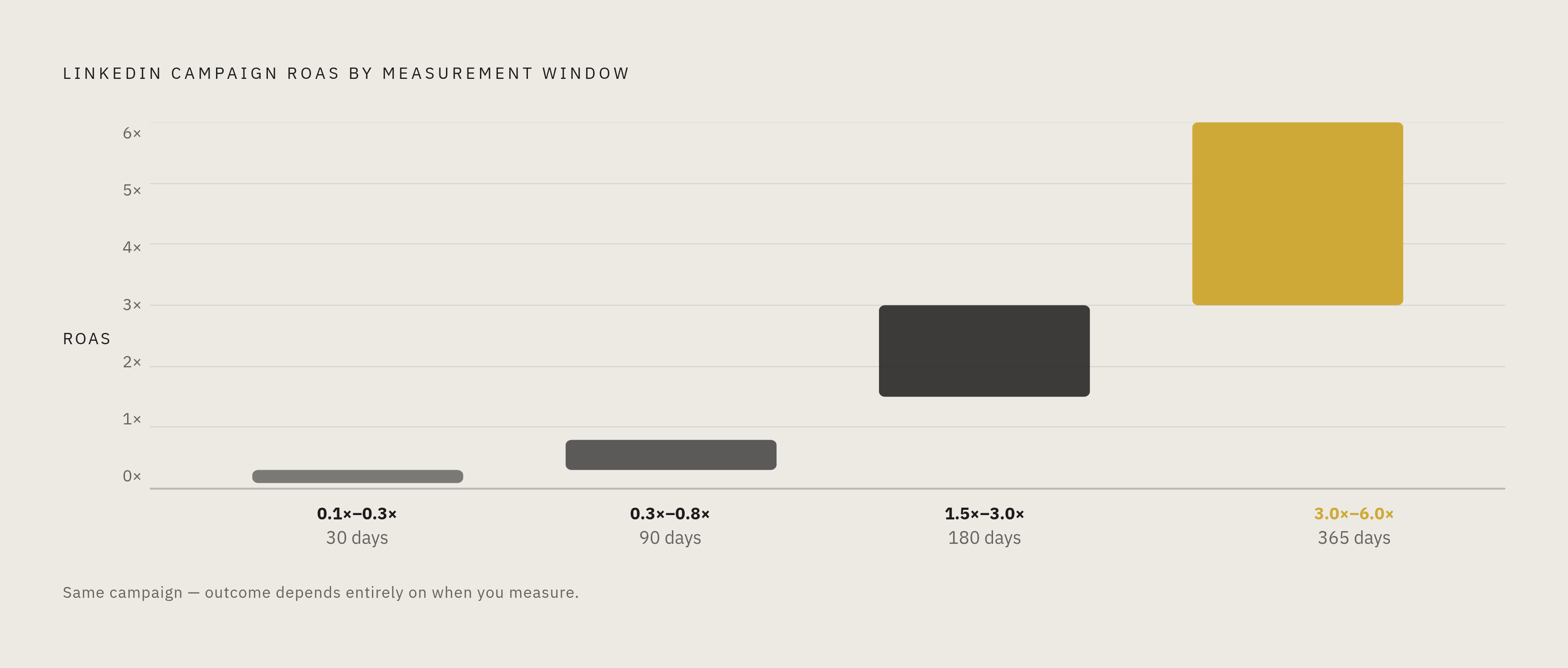
30-day ROAS on LinkedIn often sits somewhere between 0.1x and 0.3x, even for programs that are working just fine. At 90 days, it climbs to roughly 0.3x to 0.8x. Not until 180 days do you see something respectable, 1.5x to 3.0x, and by 365 days you're looking at 3.0x to 6.0x.
The real performance doesn't show up until six months to a year out. If your reporting window doesn't match your sales cycle, you're reading an unfinished story and treating it like the ending.
That mismatch plays out predictably by format:
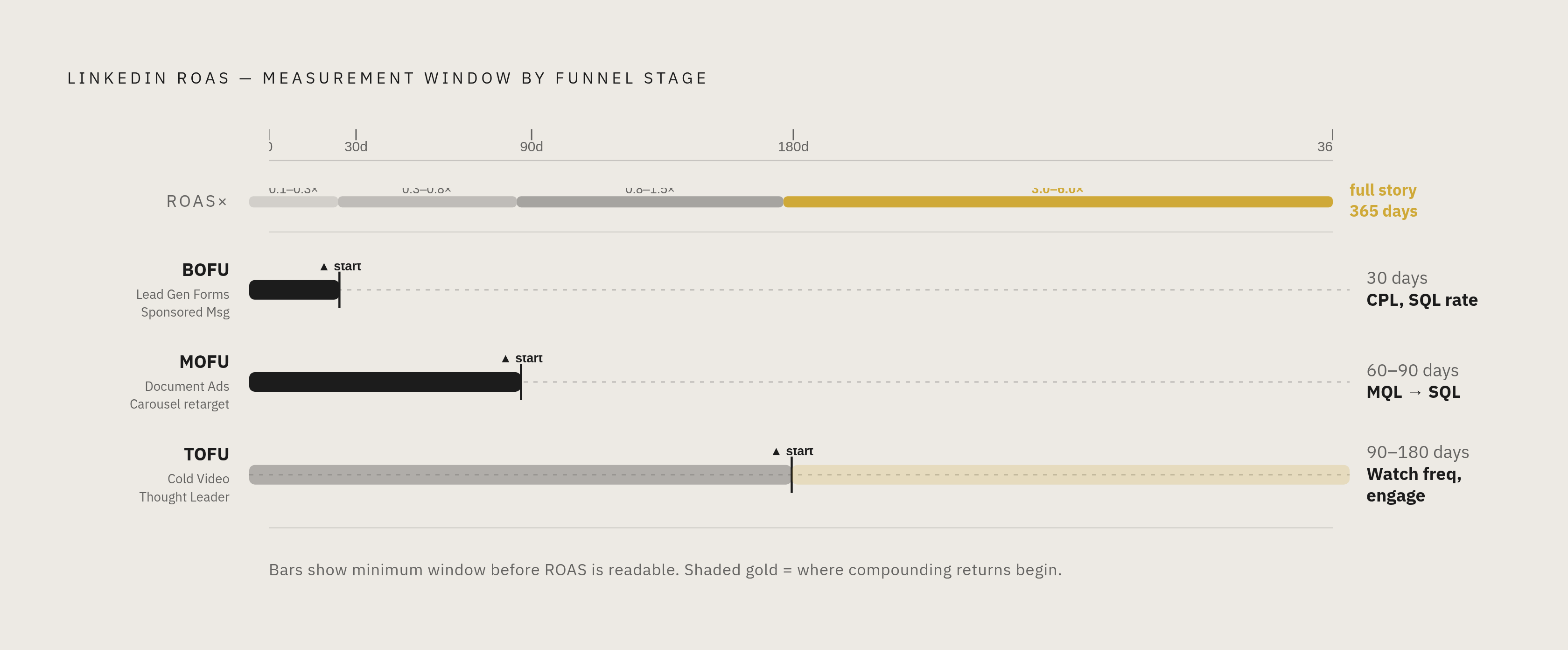
- TOFU formats measured at 30 days will almost always look like failures. The pipeline they're building is still in the silent phase and won't surface for months.
- BOFU formats measured at 30 days will look like the only thing working, because they're catching buyers whose decision was mostly made somewhere else, earlier, by someone else's effort.
The result is a feedback loop that quietly moves budget toward BOFU and starves everything upstream, right up until volume collapses and nobody can explain why.
Match the window to the format, not the format to a generic reporting calendar.
- TOFU (cold video, cold Thought Leader Ads): measure pipeline influence at 90 to 180 days minimum. Watch frequency against your target account list and engagement, not form fills.
- MOFU (Document Ads, Carousel retargeting): track movement in MQL-to-SQL conversion over 60 to 90 days, not CPL.
- BOFU (Lead Gen Forms, Sponsored Messaging): 30-day CPL and SQL rate are actually fine here. These formats were built for short-cycle, measurable outcomes.
Any team locked into strict quarterly targets will under-invest in TOFU by default, unless someone protects it with the right measurement window. The strategy can be sound and still get killed by the scoreboard.
What intelligent budget allocation across formats actually looks like, and how the 60/25/15 framework maps to pipeline velocity goals
The pipeline velocity formula: opportunities times average deal value times win rate, divided by sales cycle length. Sales cycle length sits in the denominator, so shrinking it moves your daily revenue velocity a lot, even if your deal size never budges.
One benchmark worth holding onto: SaaS and tech companies running around $1,847 in daily pipeline velocity, with 67-day sales cycles and 22% win rates, are sitting close to an optimized state.
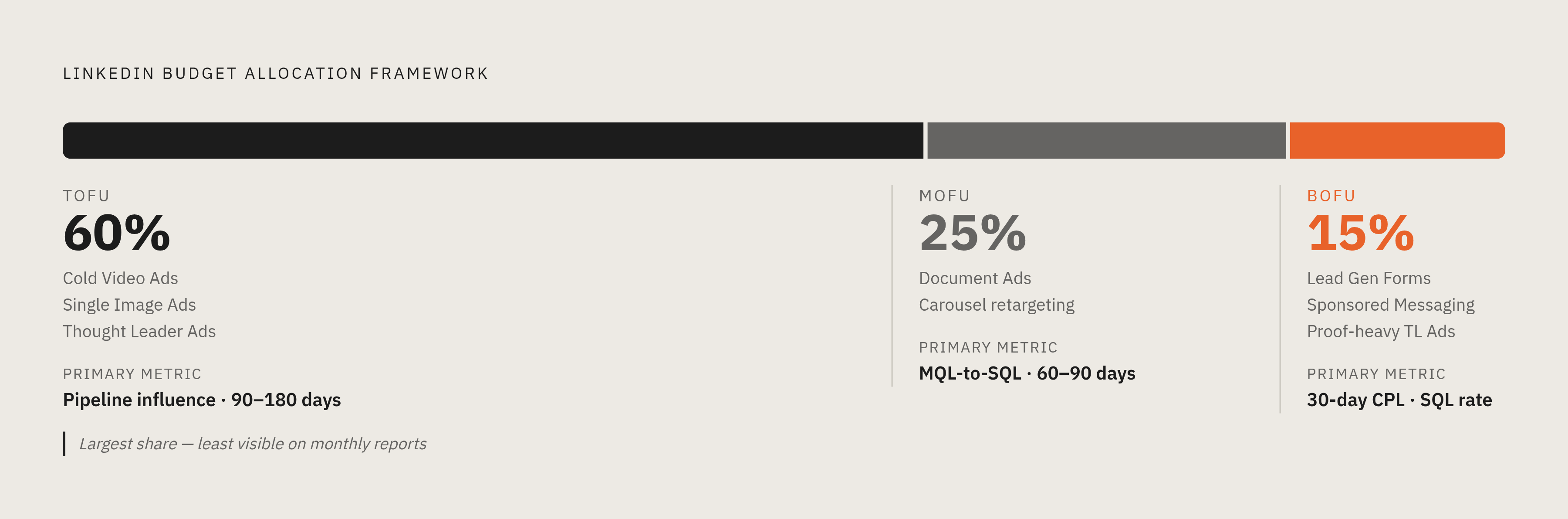
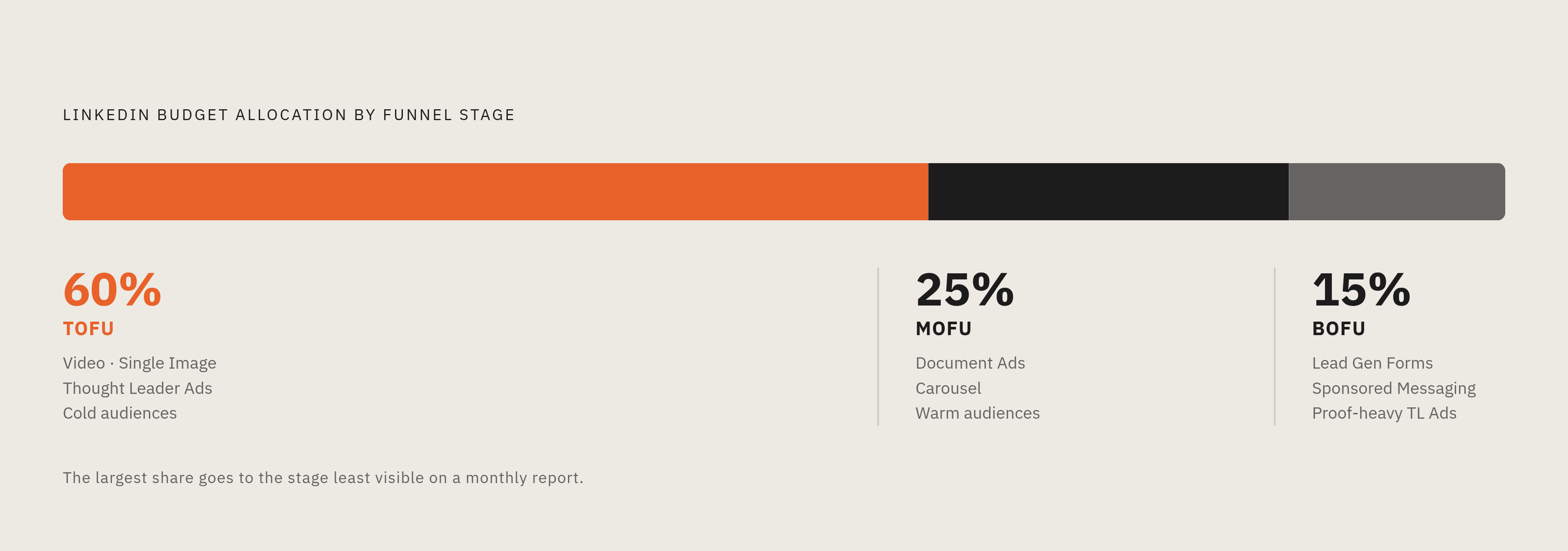
A reasonable split across formats looks something like 60/25/15.
- 60% to TOFU. Video, Single Image, Thought Leader Ads to cold audiences. This is the long game, the least satisfying line on a monthly report, and the most important one over a full year.
- a quarter to MOFU. Document Ads and Carousel content for people already paying attention. This is where you attack the MQL-to-SQL bottleneck head-on, the highest-leverage fix anywhere in the funnel.
- 15% to BOFU. Lead Gen Forms, Sponsored Messaging, proof-heavy Thought Leader Ads for buyers who are ready right now. Small slice, fast payoff, but it can't carry the whole strategy on its own.
The exact ratio isn't sacred. Your sales cycle, deal size, and buying committee size should push that split around. But the logic underneath should hold steady: every format is doing a specific job on the timeline, and if you judge all of them by the same 30-day yardstick, you'll keep defunding the formats quietly doing the most work.
Pipeline velocity rewards patience in the right places and urgency in the right places, at the same time. The format was never the whole strategy. Where it sits on the buyer's timeline is.