LinkedIn Campaign Budget Allocation Across Funnel Stages
Know what each funnel stage actually costs before you divide your budget across it.
Start with what each stage actually costs and what the audience is doing there. Those two things drive every other decision.
TOFU: volume, patience, and the prerequisite problem
Most of your audience lives here. CTRs run around 0.45% to 0.9%. CPCs land between $8 and $15. On paper, that sounds cheap. But there's no direct pipeline signal. You're reaching people in passive research mode. Early curiosity. Not yet comparing vendors. Definitely not filling out forms.
So why not skip it and go straight to the buyers who are ready?
Because LinkedIn's retargeting pools require a minimum of 300 members to activate. No TOFU means no retargeting audience, which means MOFU and BOFU campaigns have no one to reach. TOFU isn't just awareness spend. It's the plumbing. Without it, the rest of the funnel is running on empty pipes.
MOFU: behavior shifts, costs rise, and offer selection matters more than most teams realize
By mid-funnel, the audience is actively comparing solutions. They'll exchange contact info for the right piece of value. Cost-per-lead averages somewhere between $120 and $250, and LinkedIn Lead Gen Forms tend to convert two to three times higher than external landing pages because the form is pre-filled. Less friction, more completions.
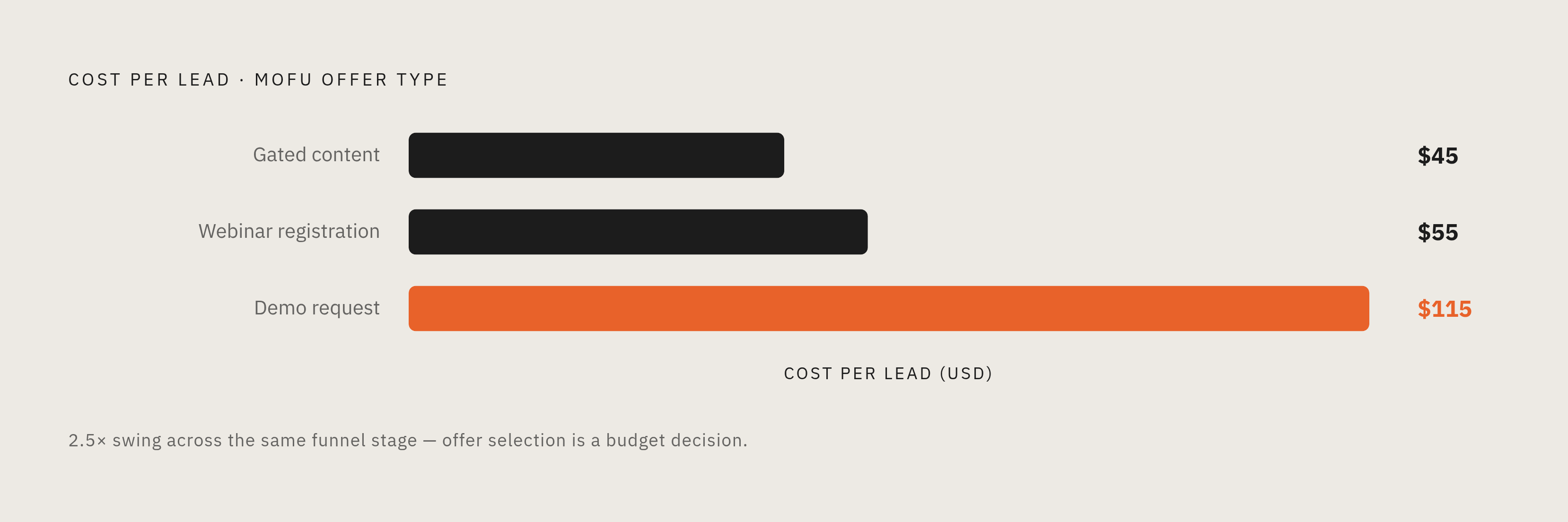
What surprises a lot of teams is how much the specific offer moves the number. Gated content might run around $45 per lead. Webinar registrations around $55. Demo requests around $115. Same funnel stage, same platform, but costs swing by a factor of 2.5x depending on what you're asking someone to do. That's not a footnote buried in the campaign settings. That's a budget decision worth making deliberately.
BOFU: small pool, high stakes, expensive by design
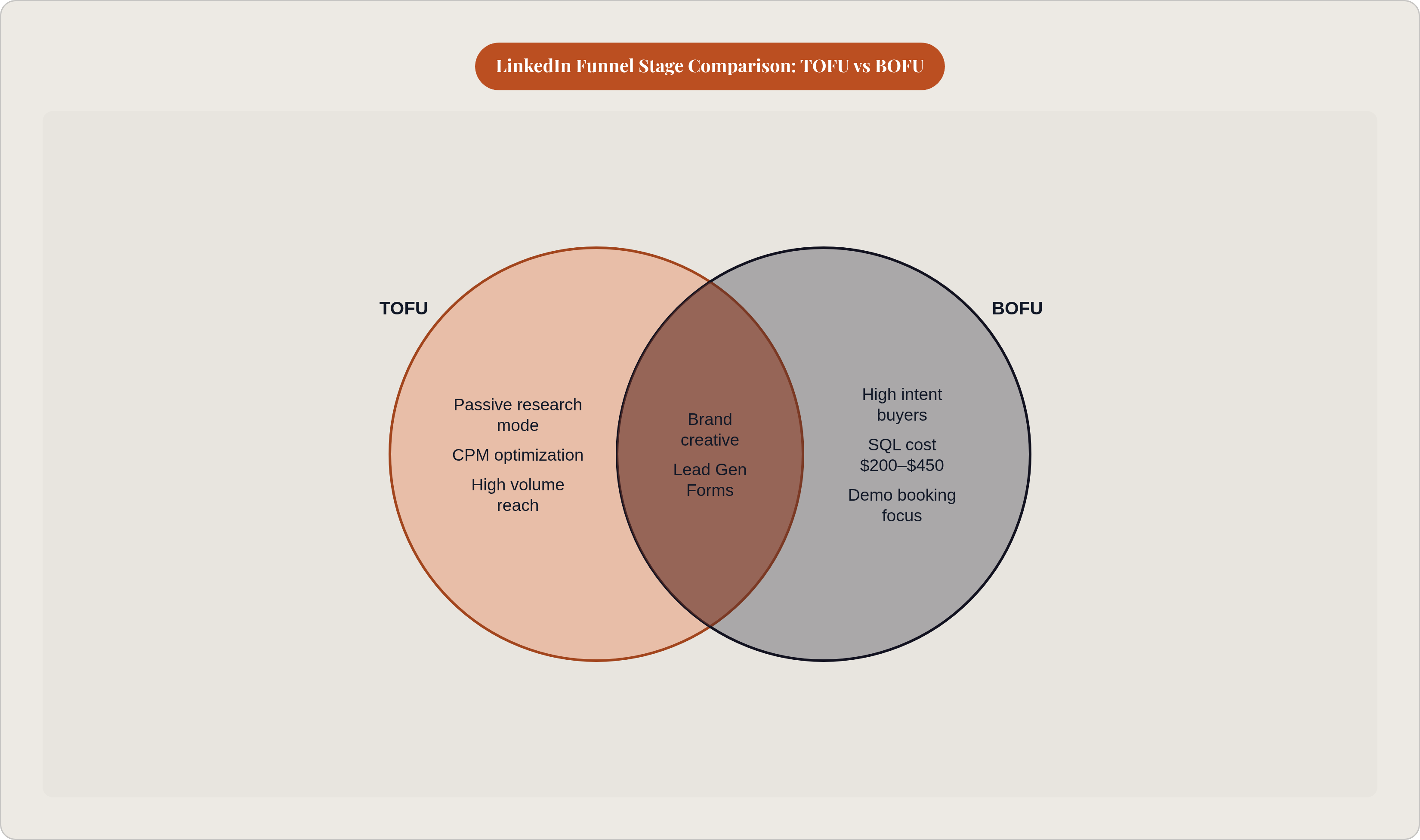
SQL costs at the bottom run $200 to $450. Demo booking rates land somewhere in the 3% to 6% range. The audience is high intent. The decision window is short. And every competitor you have is targeting the exact same people at the same moment, which is why it costs what it costs.
Highest cost per action. Smallest available audience. Highest pipeline yield per contact. You have to be here. But you can't survive here without the upstream stages feeding it consistently.
The thing most teams get backwards
The temptation is to optimize each stage for its cheapest metric. Usually CPC or CPM. The problem is that cheaper clicks that don't eventually convert cost more per opportunity than expensive clicks that do. The number that matters isn't what you paid to get someone to click. It's what you paid to get a deal into the pipeline, traced back through every stage that contributed to it. Start from the bottom metric and work up. Not the other way around.
The 60/25/15 Baseline and When to Apply It
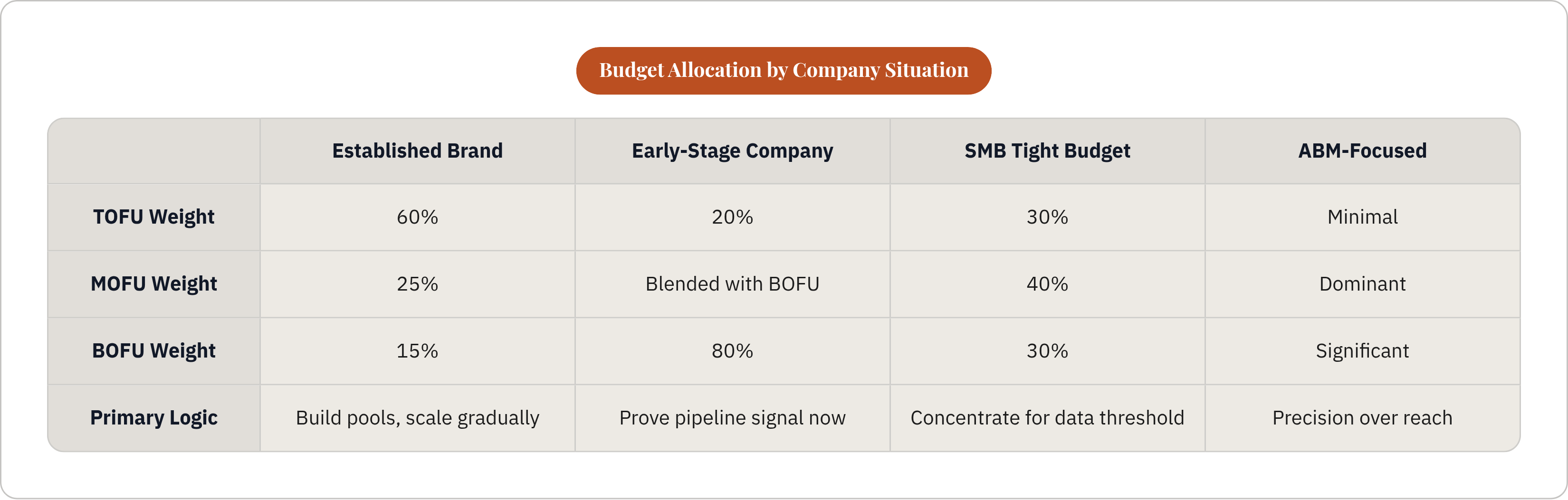
Most practitioner frameworks land on the same starting split: 60% TOFU, 25% MOFU, 15% BOFU. It's front-loaded on purpose.
TOFU generates volume, builds retargeting pools, and produces the most optimization data. Without enough scale at the top, MOFU and BOFU audiences never reach viable size, and the whole funnel stalls before it starts. The upstream investment pays downstream. That's the whole logic.
But what does this framework actually assume? It assumes a company with an established LinkedIn presence, retargeting pools already in motion, and enough budget to fund all three stages at once in a meaningful way. It assumes some existing brand recognition and a warm audience that can actually convert.
It also assumes you're above a minimum viable budget threshold. Running campaigns below roughly $100 to $200 daily per campaign doesn't generate enough data to make confident reallocation decisions. Below that number, you're not running a funnel. You're running three underfunded experiments with no learning signal to act on.
One might argue 60/25/15 is too conservative on TOFU, particularly in highly competitive categories. That's fair. But the more common failure mode runs in the opposite direction: teams starve TOFU to fund BOFU because BOFU feels closer to revenue. Then they wonder why their retargeting pools never grow, and why BOFU costs keep climbing with no new audiences entering from above. The weighting exists specifically to prevent that slide.
How Company Stage and Budget Size Shift the Allocation
This is where the framework gets honest about its own limits.
Early-stage companies
If retargeting pools don't exist yet, MOFU and BOFU can't run at meaningful scale. There's no audience to retarget. So some early-stage practitioners flip the logic almost entirely: 80% toward direct lead capture and BOFU offers, 20% toward awareness. The reverse of the standard framework.
The justification isn't that awareness doesn't matter. It's that an early-stage company needs pipeline signal now to validate whether the product works in the market, and every dollar building an audience that can't be monetized for six months is a dollar that won't help prove the business. You're still building audience data in parallel. You're just not betting on it first.
That trade-off makes sense in specific conditions. It's not a posture you hold forever.
SMBs with tighter total budgets
At the $10,000 to $50,000 annual range, spreading evenly across three stages dilutes each campaign below the threshold where it generates useful data. Three campaigns, none of them with enough signal to optimize. You end up paying for the illusion of a funnel.
The smarter move at this range: concentrate roughly 70% on lead generation and retargeting combined (MOFU and BOFU), build TOFU audiences more gradually, and prioritize offer efficiency. Run gated content and webinars before you run demo requests. Get the pipeline data first. Justify the higher BOFU cost once the numbers support it.
ABM-focused programs
When you're targeting named accounts, pool size is intentionally small and TOFU scale matters less. Message precision and offer quality matter more. MOFU sequencing dominates because you already know who you're talking to. The job becomes delivering the right message at the right time, not building reach.
It's also worth noting that these modes aren't mutually exclusive. A lot of mid-market B2B companies run a hybrid: broad TOFU for general ICP, ABM sequencing for tier-one accounts, different allocation logic running in parallel for each.
Ad Format Choices That Determine Whether Stage Budgets Work
Budget allocation is the skeleton. Format choices are the muscle. Get the formats wrong and the stage budgets underperform regardless of how carefully you split them.
TOFU formats
Document Ads delivering ungated content directly in feed. No friction, no gate. Drives engagement signals that feed retargeting pools. Thought Leader Ads, specifically posts from executives or subject-matter experts, often outperform brand-led content at this stage.
Short video belongs here too. LinkedIn's own platform data shows video generating significantly higher engagement than static posts, and video's share of total LinkedIn ad spend has grown steadily. If you're still running only static creative at TOFU, you're leaving engagement volume on the table.
MOFU formats
Lead Gen Forms with low-friction offers. Webinars, checklists, calculators. The pre-filled form removes the friction that kills conversion on external landing pages. Document Ads work here too with a gated second step: let someone engage with the first piece freely, then gate the deeper content.
A caution worth naming directly: running a demo-request Lead Gen Form to a MOFU audience that hasn't been warmed up is a budget drain. The cost premium for demo requests only makes sense when the audience already has buying intent. Sending it to mid-funnel cold traffic is asking for commitment before trust has been established.
BOFU formats
Conversation Ads and Message Ads for demo and consultation offers. Direct, personal, inbox delivery. But these only work when targeting warm audiences. Running them to cold ICP lists is expensive noise that frustrates recipients and burns budget.
Sponsored Content with case studies, pricing comparisons, and evaluation guides supports buyers who are actively vetting options. These people want to make a decision. They need material that helps them justify it.
The creative reality that cuts across all three stages
Research from LinkedIn's B2B Institute analyzing over 1,400 campaigns found that branded campaigns deliver dramatically higher ROAS than generic ones, and that brand prominence in creative improves efficiency at every funnel stage, not just awareness. This isn't only a TOFU finding. It applies all the way down.
Budget 15 to 25% of total LinkedIn investment for creative production. Media spend without creative refresh produces audience fatigue and rising costs. That undermines whatever stage allocation you've built, regardless of how carefully you've constructed it.
Measurement Setup That Makes Funnel-Stage Allocation Defensible
Here's a problem that quietly broke LinkedIn B2B reporting for years. Average B2B sales cycles run close to ten months. Standard reporting windows don't cover that. So campaigns that were actually working looked unaccountable, because the revenue they influenced showed up twelve months later when no one connected it back to the source.
LinkedIn's Revenue Attribution Report now includes 12 months of CRM activity. That closes the gap. TOFU and MOFU spend can finally be credited within a window that matches how B2B buying actually works.
LinkedIn's Conversions API (CAPI) is the other piece of infrastructure worth getting right. It connects on-platform engagement to offline CRM actions: demos booked, lead-to-opportunity transitions, sales calls completed. Implementing CAPI has been shown to lower cost-per-acquisition and meaningfully increase attributed conversions by improving the connection between LinkedIn engagement data and full-funnel revenue models.
What to actually optimize for at each stage
- TOFU: CPM, engagement rate, retargeting audience growth
- MOFU: CPL by offer type, Lead Gen Form completion rate, audience-to-retargeting-pool conversion
- BOFU: cost per SQL, demo booking rate (benchmark 3 to 6%), cost per opportunity
Two things to actively avoid: optimizing the full funnel on CPC, and MQL theater. Cheaper clicks that don't convert aren't cheaper by the metric that matters. And MQLs, email open rates, and site sessions feel like pipeline progress but aren't. If an activity can't be traced to pipeline within 90 days, it deserves a hard look.
One governance point that tends to get skipped: plan with monthly reallocation flexibility rather than quarterly locks. Quarterly freezes prevent you from responding to performance data that arrives weekly. The data moves faster than the planning cycle. The budget rhythm needs to match.
Reallocating as the Funnel Matures and Data Accumulates
60/25/15 is a starting point. Not a permanent ratio.
As retargeting pools grow, the right move is to shift weight toward MOFU and BOFU, where ROI becomes demonstrably higher. The split should drift toward something like 40/35/25 as upstream audiences mature. The mechanics that made heavy TOFU investment necessary at the start become less constraining once the pools fill.
A few specific triggers worth watching:
- Retargeting pool growth signals it's time to push weight downstream.
- BOFU SQL costs dropping below $300 is a window. Scale BOFU allocation before costs normalize upward again.
- Document Ad fatigue tends to set in around eleven weeks. Refresh creative before the budget produces diminishing returns, not after. Waiting for the data to confirm fatigue means you've already paid for it.
Here's what's easy to miss about all of this: each campaign cycle produces audience data, creative performance signals, and cost-per-opportunity benchmarks. Each one makes the next allocation decision more precise. The framework doesn't just improve with more spend. It improves with more iteration, at any spend level.
The goal isn't to spend evenly across stages or to minimize CPL. It's to generate pipeline at the lowest cost per opportunity, with every reallocation decision traceable back to stage-level performance data.
That's a harder standard than "roughly split it." It's also the one that tends to produce something you can actually defend in a planning meeting, and actually see in revenue.