LinkedIn Lead Gen Form vs. Landing Page Conversion Rate Comparison
LinkedIn Lead Gen Forms convert faster, but landing pages produce qualified leads at lower cost.

LinkedIn Lead Gen Forms beat landing pages on conversion rate. It isn't close, either. LinkedIn's own benchmarks, citing an Unbounce study, put Lead Gen Forms at 13% average conversion versus 4.02% for a standard landing page. Other sources give a range: 6% to 13% for forms, 2% to 5% for landing pages. Pick whichever number you trust more.
A conversion rate only tells you what happened on the page. It says little about what happened three weeks later when someone from sales actually called that lead. That gap between "converted" and "mattered" is the whole reason this piece exists.
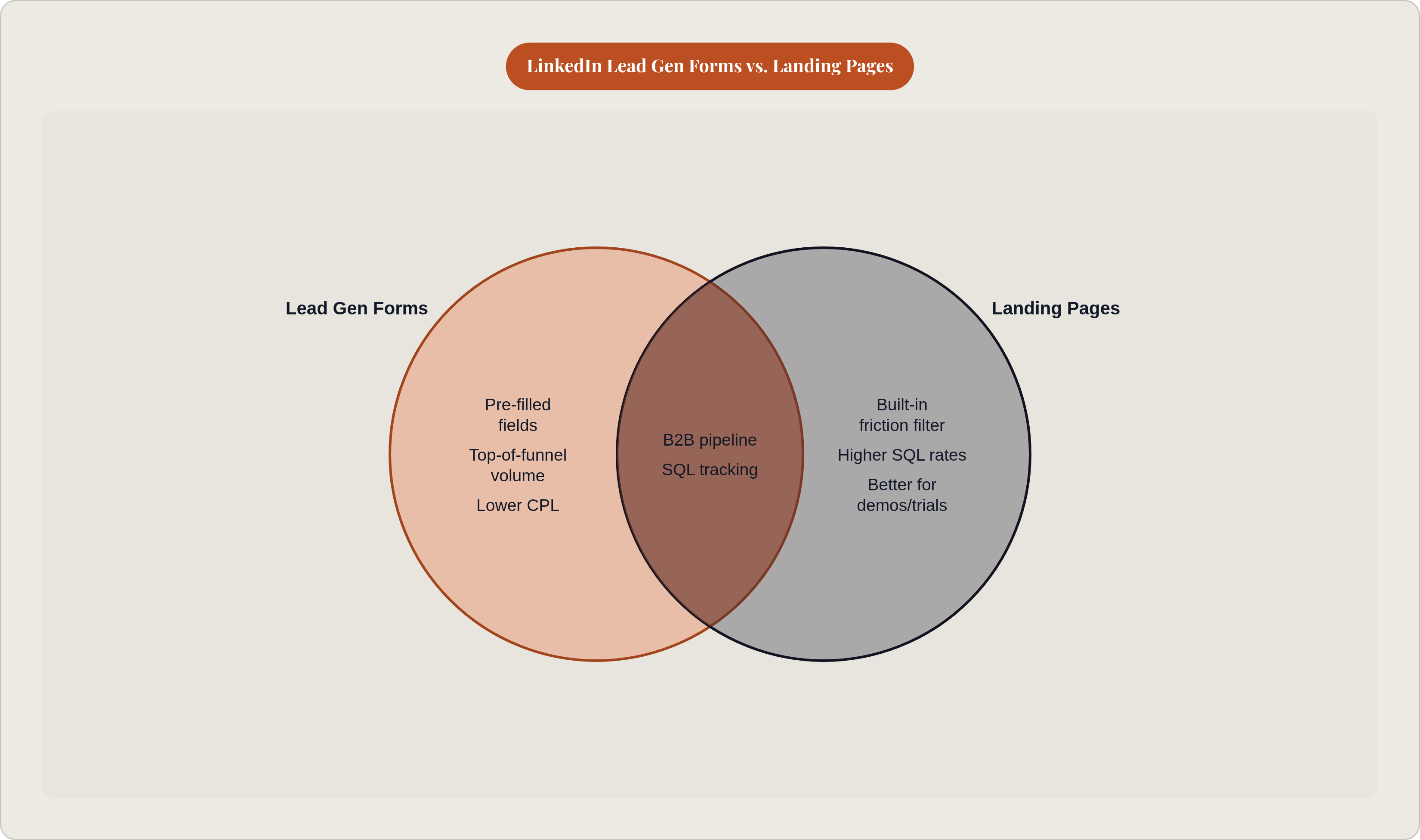
Lead Gen Forms pre-fill from a LinkedIn profile. Name, email, company, job title, already there. You tap submit. No new tab, no blank form, no chance to get distracted by a Slack notification halfway through typing your title. Landing pages ask you to leave LinkedIn, land somewhere unfamiliar, and type all of that in yourself. Every field is a place to quit.
Mobile makes it harder for landing pages specifically. Over 57% of LinkedIn traffic comes from phones, and phones are often where landing pages struggle: slow loads, cramped fields, a "submit" button you fat-finger twice. Lead Gen Forms sidestep most of that because the whole interaction stays inside the app.
The 13% is real and explainable. But ask what it's actually counting: form completions. Not leads that matter, not pipeline, not revenue. Keep that word in your pocket — it undoes most of what people assume about this comparison.
Why a lower conversion rate on a landing page can still mean a better-performing program
Landing pages, despite converting worse, tend to produce meaningfully higher SQL rates. Compare what each action costs the person doing it.
Someone who clicks through to your site, reads a case study, maybe pokes around your pricing page, then fills out a form, has spent real effort. That's a filter you got for free, without building it yourself. Someone who taps submit on a pre-filled Lead Gen Form mid-scroll has spent nearly nothing. They might be a great fit. They might also be one of ten forms they've filled out this week without remembering any of them by Friday.
A cybersecurity company ran into this headfirst. $60,000 a month in paid media, 85% of it into LinkedIn Lead Gen Forms. On paper, it looked like a machine: 400-plus leads a month, rolling in steady. Eight of those became qualified opportunities. Run that ratio and the program is losing money most months it stays on autopilot, no matter how "efficient" the CPL looked in the dashboard.
They pulled budget back toward landing pages and let friction back into the top of the funnel on purpose. Lead volume fell off a cliff. Opportunities more than doubled. Same dollars, opposite result, and the main thing that changed was which metric they were staring at.
Cost per lead, in most cases, is the wrong number to watch. Lead Gen Forms typically run 2 to 3 times cheaper per lead than landing pages, and that number alone can talk you into the wrong decision if you let it. Once you factor in what those leads actually turn into, a landing page with a higher SQL rate can post a similar or better cost per acquisition, even though every individual lead cost more to get.
Judge it on cost per SQL. A cheap lead that rarely turns into a qualified conversation isn't cheap pipeline. It's just cheap.
How funnel stage should determine which format gets the budget
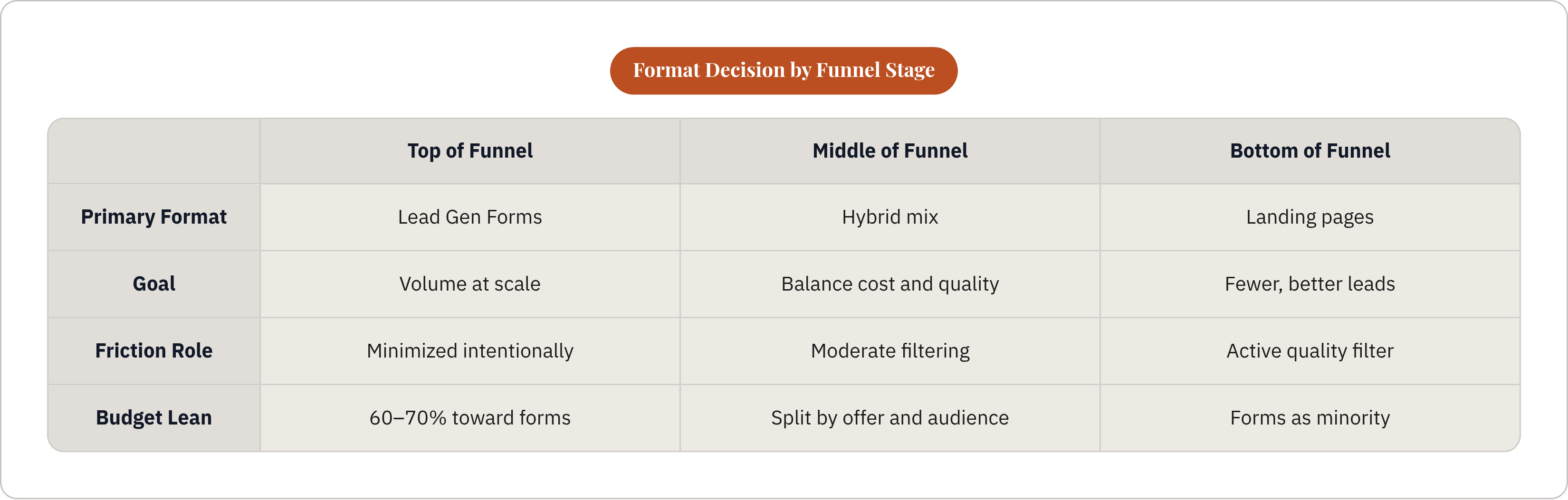
Most people who've run this long enough land on both, deliberately split by what each format is actually good at.
Top of funnel wants volume. Something like 60% to 70% toward Lead Gen Forms, the rest toward landing pages, which still do some early filtering even here.
Bottom of funnel flips the ratio. Once someone's asking for a demo or a trial, you want fewer, better leads, not more mediocre ones. Landing pages lead here on purpose. The friction is doing its job.
Middle of funnel is messier. CPLs here typically run $120 to $250, with Lead Gen Forms still 2 to 3 times cheaper than landing pages. Document Ads specifically tend to hold up for around 11 weeks before creative fatigue sets in, which matters if you're planning refresh cycles.
Down at the bottom, cost per SQL runs $200 to $450, demo booking rates sit around 3% to 6%.
Audience temperature changes the whole calculation, too. Cold, broad audiences (job title, seniority, nothing else) are usually the worst buy on the table, CPLs running $300 and climbing past $600. That's exactly where you need the volume Lead Gen Forms give you, because the hit rate is low enough that scale is the only lever left. Intent-based ABM audiences run $250 to $400, squarely in hybrid territory. Warm, first-party audiences (retargeting, your own database) run cheapest, $120 to $250, and that's where landing pages are easiest to justify. The risk of a bad lead is already lower going in.
Offer type matters too. A broad content download might land at $30 to $75 a lead. A narrow, high-value offer to a tight list can clear $200 without blinking. Let the offer decide the format, not habit.
Three dials: funnel stage, audience temperature, offer type. Wherever those three land tells you where the budget goes.
Where LinkedIn Lead Gen Forms fit within a broader paid media channel mix
LinkedIn and Google aren't competing for the same job.
LinkedIn interrupts. It shows up in someone's feed before they've necessarily admitted they have a problem. That's demand creation. Google waits for someone who's already searching, already decided they need an answer. That's demand capture. Comparing CPL between the two head to head misses that they're solving for different moments in someone's head, not the same moment on two different channels.
Dreamdata's 2026 LinkedIn Benchmarks Report, built on more than 66 million sessions and 3.5 million customer journeys, found LinkedIn posting a 121% ROAS for B2B marketers, the only major platform in their dataset with a positive return at all. Google Search came in at 67%. Meta, 51%.
Budget hasn't fully caught up to that yet. In 2025, LinkedIn held 41% of B2B paid social spend, Google Network 46%, Meta 8%, everything else a small remainder. LinkedIn's already the biggest social line item most teams run. It's just still splitting the stage with search in a way that, given what each platform actually does, makes sense.
One way to think about a broader split: roughly 40% to 50% toward demand capture, 30% to 40% toward demand education, 10% to 20% toward demand creation. Lead Gen Forms and landing pages don't cleanly map one-to-one with these layers. Which one shows up where depends on the offer sitting behind it.
Worth testing somewhere in this mix: Thought Leader Ads, which run under a person's profile instead of the company page. They read less like an ad, which tends to earn trust faster. Run them alongside your Lead Gen Forms and landing pages and see where they actually land for you, because it varies by industry more than most benchmarks admit.
Connect Google Ads to your CRM so the algorithm is optimizing toward qualified leads, not raw form fills — the same quality-over-volume principle, on a different platform.
Why 30-day CPL comparisons structurally misrepresent LinkedIn's actual contribution to pipeline
This is where smart people get burned, and it's not really their fault. The B2B buyer journey now averages well over 200 days and drags in a pile of stakeholders along the way. Most of that time happens before a deal officially becomes "pipeline" in anyone's CRM.
A lead from a Lead Gen Form today might take months to show up as real pipeline. Compare CPL at the 30-day mark and you're not measuring performance. You're measuring a photo of something that hasn't finished developing, and that's true regardless of which format produced the lead.
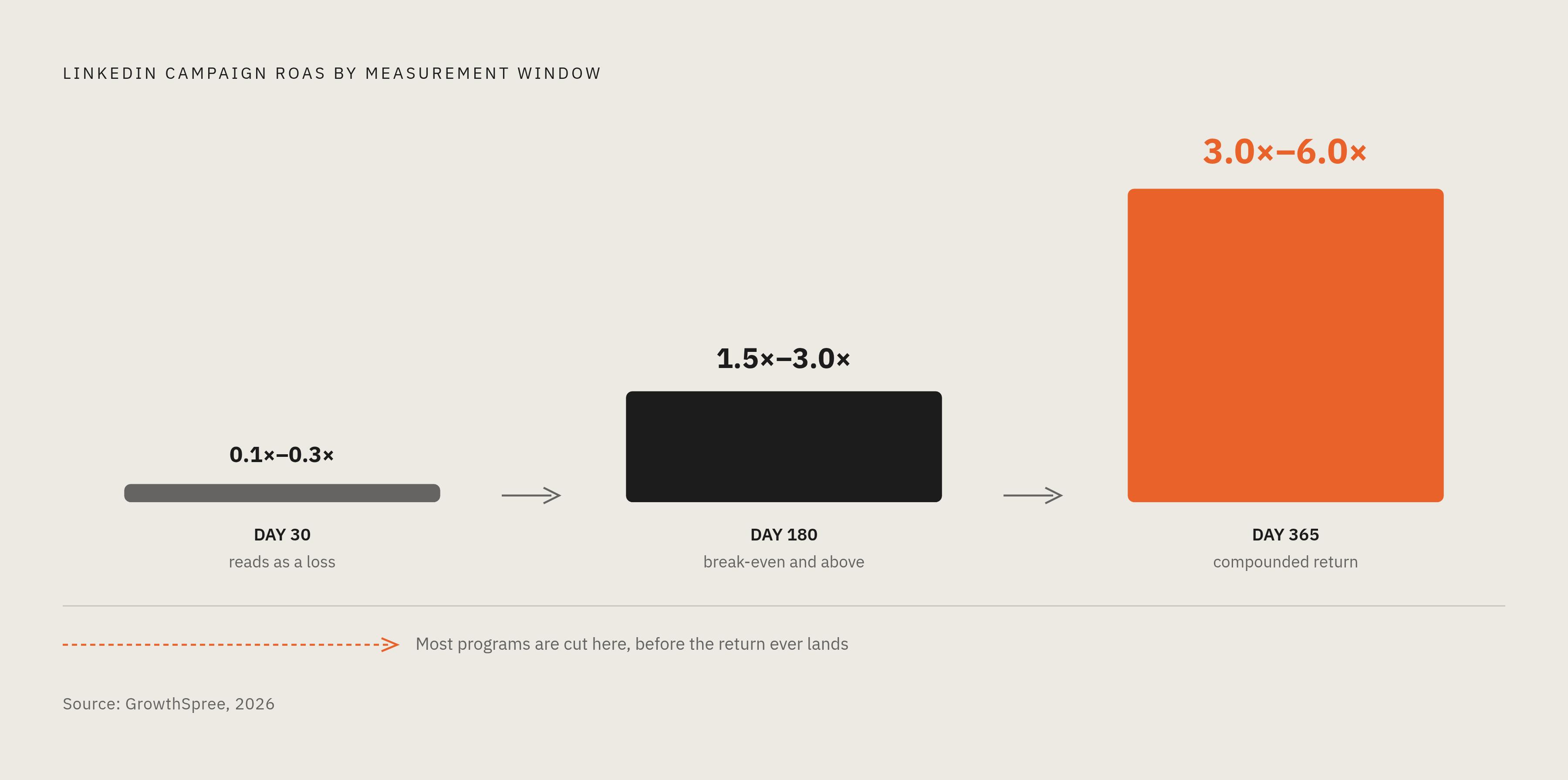
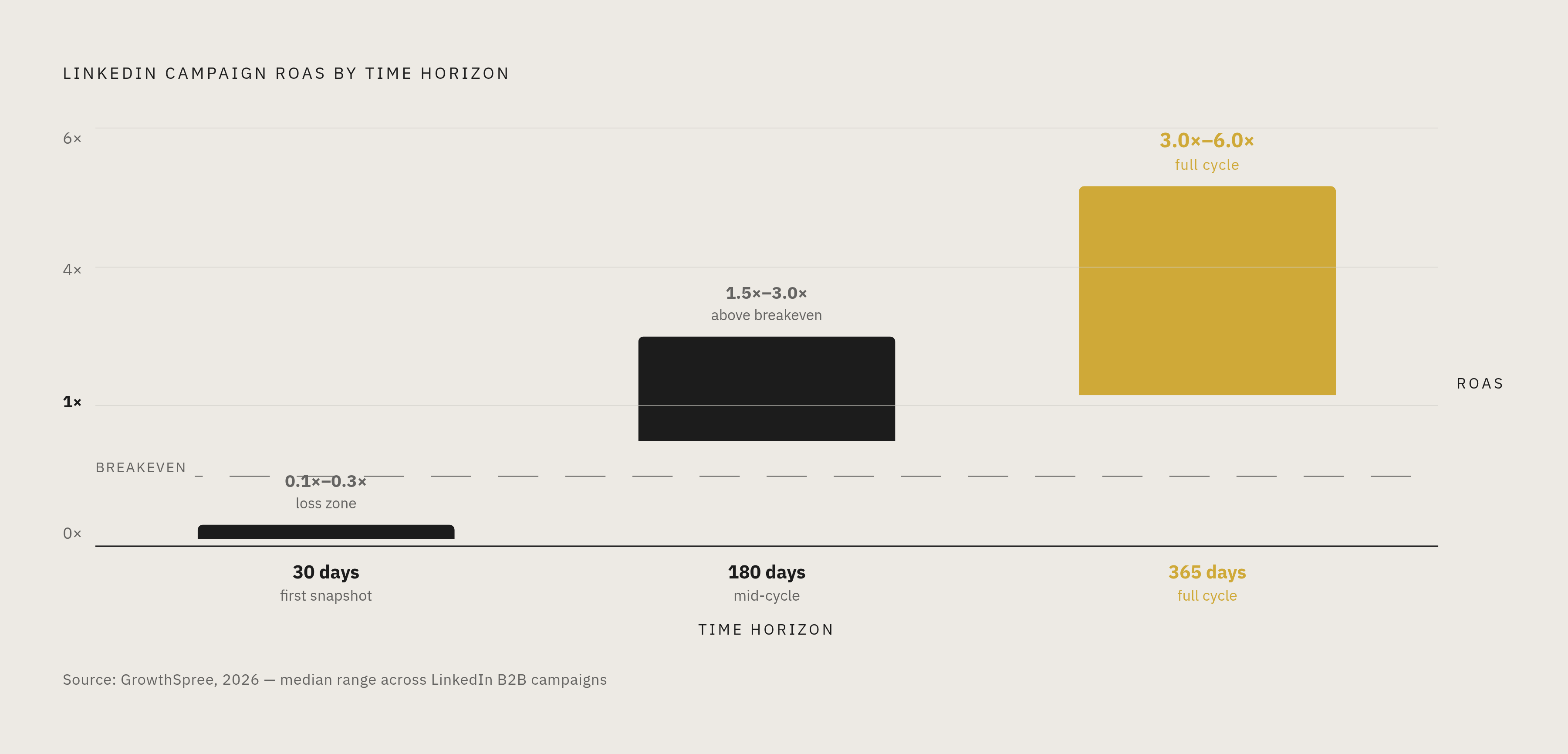
GrowthSpree's 2026 data lays this out plainly. At 30 days, median ROAS on these programs sits between 0.1x and 0.3x, which reads like a clear loss. At 180 days, the same spend shows 1.5x to 3.0x. At 365 days, 3.0x to 6.0x. Kill a program at day 30 and you've likely killed something that would've been profitable by month six. That's much of the difference between "this channel doesn't work" and "this is one of the best channels we run."
The algorithm adds its own version of the same problem. LinkedIn's campaign tools need 30 to 50 conversion events before they exit the learning phase and start optimizing properly. Most programs get paused, or killed, before they ever hit that number. The system rarely gets the runway to learn before someone decides it's failed.
A reasonable floor, if you're testing: $3,000 to $5,000 a month, sustained 60 to 90 days minimum, before the data means anything.
For forms versus landing pages specifically: track attribution through to SQL and closed-won, not just to form completion. The format that looks cheaper on day 30 isn't necessarily the format producing better pipeline once a full sales cycle has actually played out. Give it the longer window before deciding which one won.
How to run the decision for your program: a working diagnostic
There's no fixed rule here, and I'd be wary of anyone who hands you one. What you need instead is a diagnostic you keep re-running, because audiences shift, offers change, and funnel stages move underneath you whether you're paying attention or not.
Four questions worth asking yourself on a repeat basis:
- What's your lead-to-SQL rate, by source? If you can't break this out by channel and format, you're almost certainly still optimizing on cost per lead, which will mislead you.
- What funnel stage is this campaign actually targeting? Top of funnel earns Lead Gen Form volume. Bottom of funnel earns landing page friction.
- How warm is the audience? First-party retargeting lowers your qualification risk, which makes Lead Gen Forms fair game. Cold, broad audiences need the filter a landing page provides.
- What's the offer? Content downloads generally favor forms. Demos and trials generally favor landing pages.
Every campaign you run is producing evidence whether or not you go looking for it: which format worked, with which audience, against which offer, to produce actual SQLs (not just leads). Carry that forward into next quarter instead of resetting the question from scratch every time someone in a meeting asks "should we even be doing Lead Gen Forms?"
A person still has to read the signal. Attribution data says one thing, the CRM says another, and sales is telling you a third thing in the hallway that never makes it into either system. Pulling those three together into one clear-eyed read is genuinely difficult, and no dashboard does it for you yet. The tools surface pieces. Someone still has to decide what they add up to.
The real question isn't which format wins, because that question doesn't have a stable answer. It's which format is doing which job, in your funnel, at this stage, for this audience, with this offer, and whether you've actually given yourself enough time to find out before calling it.