LinkedIn Thought Leader Ads vs. Sponsored Content for Pipeline
Thought Leader Ads warm cold audiences while Sponsored Content closes buyers ready to act.

Open LinkedIn right now. Scroll for thirty seconds. How many company ads did you consciously register versus scroll past? And how many posts from actual people did you stop to read, even for a moment?
That gap is the whole game — and it's a gap as wide as the distance between a billboard and a conversation over coffee.
Sponsored Content shows up in the feed under a company logo. The "Sponsored" label sits right there. Buyers see it, process it as an ad, and decide in about half a second whether it's worth their time. That's not a knock on the format. It's just the reality of how people read feeds in 2024. The brand-as-sender framing triggers a kind of mental shortcut: "a company is trying to sell me something." Engagement, if it happens, tends to be transactional.
Thought Leader Ads flip that dynamic. The post lives under a real person's name and profile photo. The "Sponsored" label is still there, technically, but the voice reads as human. It reads as someone sharing a perspective, not a marketing department pushing a message. Comments feel like a conversation rather than a support ticket. Shares feel like a peer recommendation rather than an amplified press release.
But here's where it gets interesting. That trust transfer only happens when the person behind the ad is someone the audience actually recognizes or respects. A founder or practitioner with genuine credibility in the buyer's world? The format is powerful. A mid-level employee the audience has never heard of? The format loses most of its advantage. It just looks like a company post with a face attached.
So neither format is inherently better. The real question is: which one matches where the buyer's head is at when they're scrolling?
Where each format fits in a B2B pipeline funnel
Most B2B pipeline funnels, especially in sales-led motions, run something like: awareness, consideration, intent, and then the MQL or SQL handoff to sales. Simple enough in theory. The problem is that most marketers treat all LinkedIn spend as if it should produce the same output at every stage. It won't. It can't.
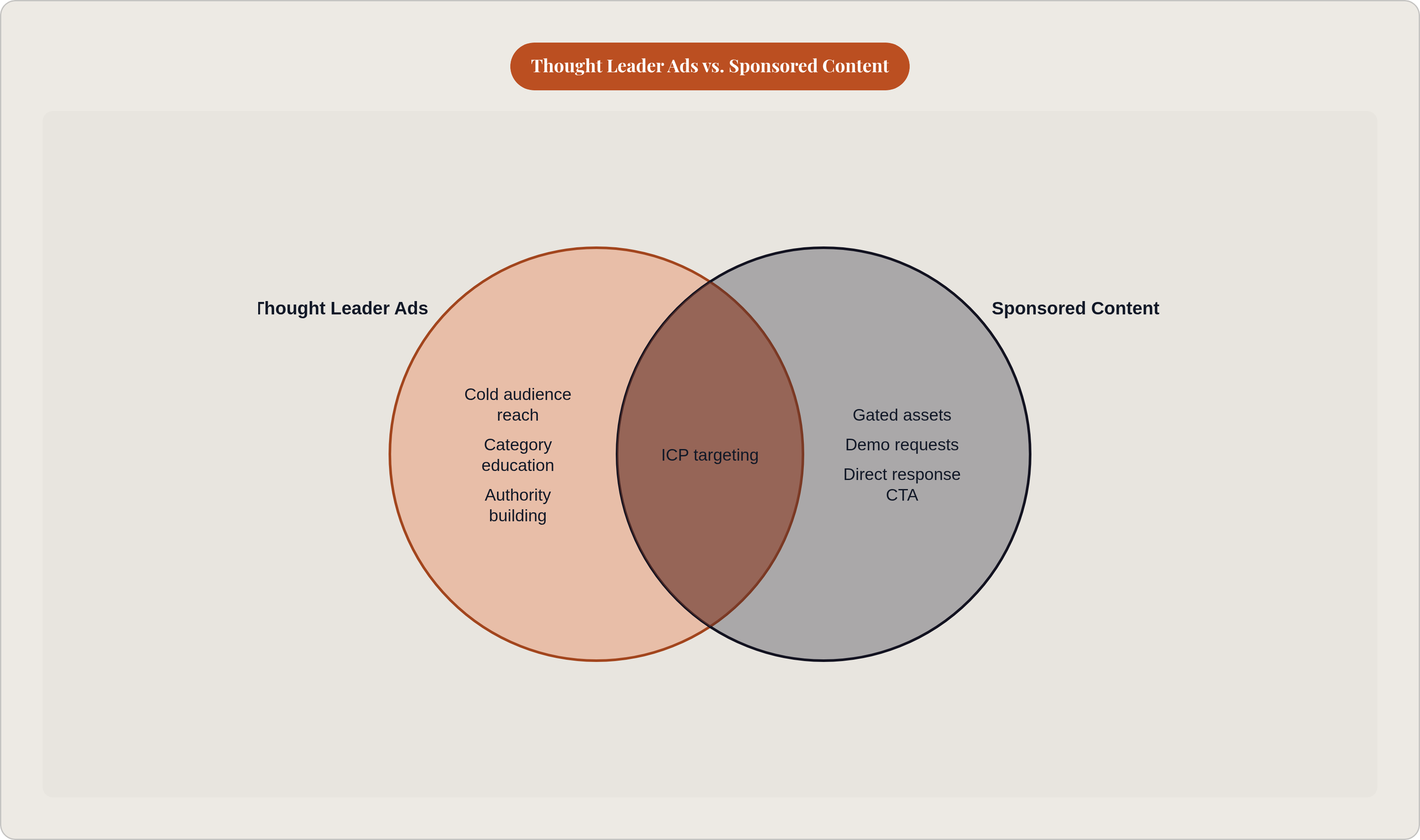
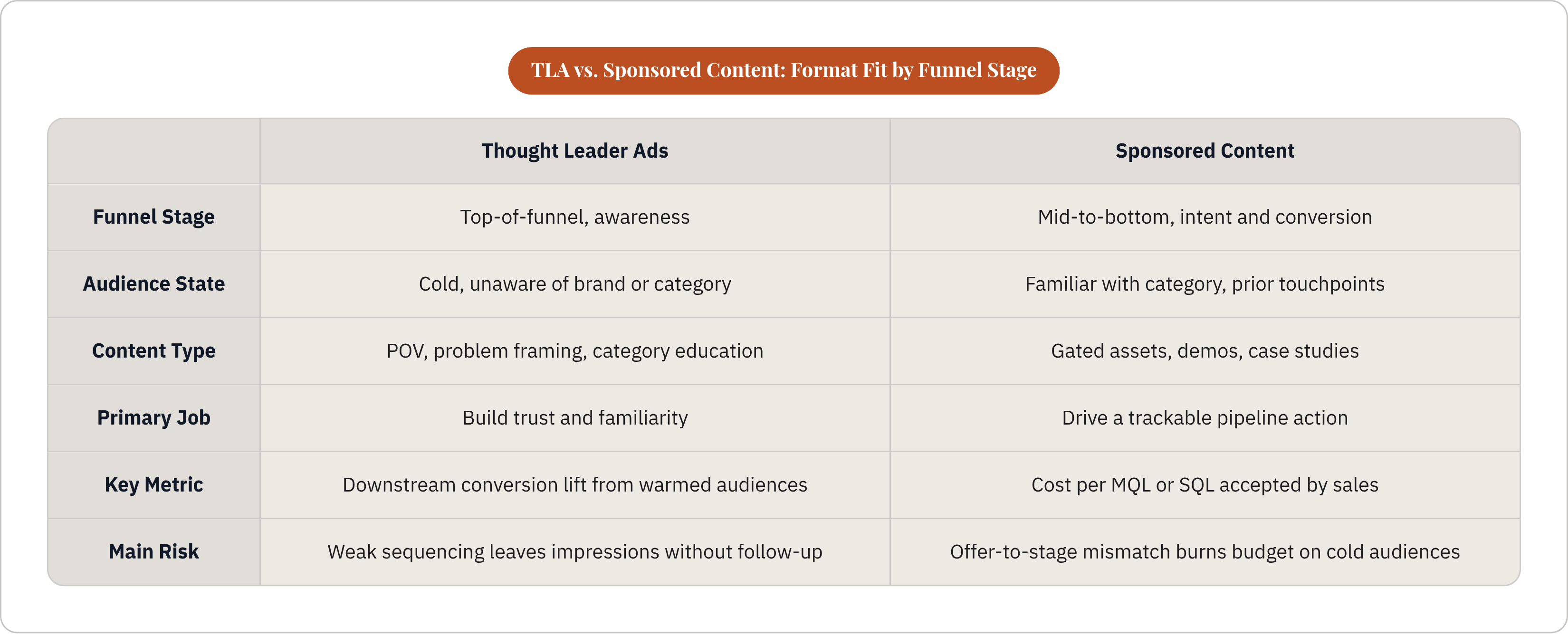
Thought Leader Ads belong near the top of that funnel.
They work well on cold audiences because a person-first framing lowers resistance before the brand even enters the picture. They're especially effective for category-level education: helping a buyer understand a problem before you ever pitch a solution. The buyer isn't ready to convert yet. They might not even know they have the problem your product solves. TLA content meets them there.
The tradeoff is that pipeline attribution from TLA is indirect and lagged. You won't draw a straight line from a thought leadership impression to a closed deal. Multi-touch attribution that connects those early touches to downstream conversions is required for that. More on that later.
Sponsored Content belongs further down. Mid-funnel, intent-stage. Audiences who already know your category, who have already seen earlier touchpoints, who are ready to engage with a specific offer. Gated assets, demo requests, case studies, comparison guides. These asks sit naturally in the brand-ad frame because the buyer is already in the mode of evaluating options.
The consideration stage is genuinely contested territory. Both formats can work there. But they work differently. TLA at consideration is still building authority and shaping how the buyer thinks about the problem. Sponsored Content at consideration is starting to move the buyer toward a decision. Same stage, different jobs.
What determines whether Thought Leader Ads generate pipeline or just impressions
The format is only as strong as the person running it. That sounds obvious, but it's the part most teams skip.
A founder or domain expert with genuine standing in the buyer's world will outperform a random employee post every single time, regardless of how good the targeting is. The content has to be real. It has to be the kind of thing that earns engagement without paid amplification, because if it doesn't earn it organically, paying to push it further just means more people ignore it at scale.
Content type matters too. POV-driven posts ("here's what we're watching shift in this category") build authority and brand recall. Insight posts that name a specific pain and gesture toward a solution can move buyers closer to intent without feeling like an ad. What rarely works in this format? A hard CTA. "Book a demo" inside a Thought Leader Ad is almost always a mismatched ask. The format earns trust. It's not built to close.
That raises the real question: if TLA doesn't close, how does it pay off?
It pays off in sequencing. TLA spend without a downstream re-engagement strategy — retargeting warm audiences with Sponsored Content, SDR follow-up on profile visitors, basically anything that catches the buyer after the TLA impression — largely dissipates. The impression happened. The brand registered. And then nothing followed it up.
This is where most teams judge TLA unfairly. They measure it in isolation, see a weak CPL, and kill the budget. But TLA's job was never to close. Its job was to warm. The measurement question should be: do contacts who saw TLA content before Sponsored Content convert at higher rates than those who saw Sponsored Content cold? If yes, the TLA spend was working. It just wasn't working where everyone was looking.
What determines whether Sponsored Content converts or burns budget
Offer-to-stage alignment. That's the biggest lever. Bigger than creative. Bigger than targeting.
Gating content behind a form works when the buyer is already in consideration mode. Cold audiences almost never convert on gated assets at rates that generate real pipeline. They might fill out the form. But form fills that never become SQLs aren't pipeline. They're vanity metrics that feel like progress and cost real money.
Demo CTAs on cold audiences are even worse. The cost per SQL spikes because you're asking for a high-commitment action from someone who hasn't yet decided they have the problem your product solves.
Beyond offer alignment, two other things kill Sponsored Content performance in ways that are easy to miss:
Creative fatigue. In a small, precise ICP audience, brand ads get recognized and mentally filed as "seen it" faster than almost any other channel. Rotation cadence matters. Creative refresh is not a nice-to-have. It's an operational discipline.
Landing page mismatch. This is where Sponsored Content spend leaks most predictably. A strong ad that lands on a generic homepage, or a slow page with a different message than the ad, loses the conversion. The click is not the outcome. The pipeline action is. Message match between ad copy and landing page headline is non-negotiable, and it's the thing that gets deprioritized most often when teams are moving fast.
One more trap worth naming: hyper-narrow targeting can exhaust a small audience quickly. Costs rise. Reach into new buyers stalls. Expanding with lookalike or interest-based audiences can widen reach, but it dilutes ICP fit. There's no set-it-and-forget-it answer here. It requires ongoing monitoring.
How to sequence the two formats for a sales-led B2B pipeline motion
The most durable pipeline motion treats these two formats as stages in a single buyer journey, not as competing line items in a budget fight.
Here's what that actually looks like:
Phase one. Cold audience. Named ICP accounts. Thought Leader Ads running POV or problem-framing content. The goal is not clicks. The goal is brand familiarity and category credibility. You are not trying to generate leads here. You are trying to make your brand feel familiar and trustworthy before you ask for anything.
Phase two. Engaged audience. Video viewers, post engagers, profile visitors. Sponsored Content with a specific offer tied to the pain the TLA post surfaced. Now the goal shifts. Now you want a trackable pipeline action.
Phase three. Retargeting. Sponsored Content with higher-commitment CTAs, demo requests, assessments, direct conversations, aimed at buyers who have already consumed mid-funnel content. This is where you close the loop.
Account-based motions benefit from this sequencing especially. Running TLA content against a named account list warms contacts before SDR outreach. Response rates improve when a buyer already associates your company with a credible human voice. Then Sponsored Content delivers targeted proof, customer stories from the same vertical, relevant case content, to the same account list as social selling conversations begin.
Budget allocation is simpler than it sounds. If most of your ICP doesn't know you yet, weight toward TLA first. If your brand already has recognition in the ICP, move more budget toward Sponsored Content and direct response earlier.
But none of this works without the infrastructure to track engagement across both formats and hand off warm signals to sales. Without that, TLA spend becomes invisible, the sequence breaks, and the whole thing looks like wasted money.
How to measure each format fairly without conflating their jobs
Here's a mistake that costs teams real pipeline: judging Thought Leader Ads by the same CPA or CPL benchmark used for direct-response Sponsored Content.
It seems logical. Both are LinkedIn ads. Both cost money. Why wouldn't you hold them to the same standard?
Because they have different jobs. Measuring them identically is like judging a first date by whether it ended in a marriage proposal — technically possible, just not how any of this works. It means you'll kill every good top-of-funnel motion you ever run.
For Thought Leader Ads at the awareness stage, look at:
- Engagement rate and engagement quality. Comments from ICP-fit job titles signal real resonance, not just vanity.
- Audience overlap. What share of engagers actually match your ICP definition?
- Downstream conversion lift. Do contacts who saw TLA content before Sponsored Content convert at higher rates than those who saw Sponsored Content cold? This one metric tells you whether TLA is pulling its weight.
For Sponsored Content at the conversion stage, look at:
- Cost per pipeline-qualified action. Not form fills. MQLs and SQLs that sales actually accepts.
- Conversion rate from click to pipeline action. This isolates landing page and offer performance from media performance.
- Influenced pipeline. Revenue from closed deals where Sponsored Content appeared in the buyer's journey, even if it wasn't the last touch.
The attribution layer has to connect both formats to a shared pipeline outcome. Without multi-touch attribution that tracks LinkedIn touchpoints through to CRM opportunity creation, you're measuring noise, not signal, regardless of which format you're evaluating.
The decision framework: which format to run, when, and with what offer
Three questions. Answer these honestly and the format choice usually becomes obvious.
One: Where does the target audience sit relative to your brand today? Unknown to you? Start with TLA. Already familiar with your category and your company? Sponsored Content is ready to work.
Two: What is the offer? Education, POV, problem framing? That's TLA territory. Gated asset, demo, conversion action? That's Sponsored Content.
Three: What does the pipeline need right now? Building a new segment or vertical where you have no brand recognition? Invest in TLA to warm the market first. Pipeline gap in an existing ICP where buyers already know you? Accelerate with Sponsored Content.
Run Thought Leader Ads when:
- You're entering a new ICP segment or vertical where recognition is low
- You're ahead of an SDR outreach sequence targeting named accounts
- You have a credible, recognizable voice whose content already earns organic engagement
- The pipeline goal is medium-to-long term and trust has to come before the ask
Run Sponsored Content when:
- The audience already knows the category or has seen prior touchpoints
- You have a high-fit offer matched to a specific buyer pain
- You're retargeting a warmed audience to advance them toward a pipeline action
- Pipeline velocity is the priority and the audience is actually ready to act
Run both simultaneously when:
- You're running an account-based program where different contacts at the same account are at different stages
- Budget and attribution infrastructure exist to read each format's contribution accurately
The formats are not rivals for the same budget dollar. Treating them as interchangeable is exactly what causes both to underperform.
What full-stack execution of both formats actually requires in practice
This is where the rubber meets the road, and where most honest conversations about LinkedIn ads get uncomfortable.
Running both formats well at the same time is not a set-and-forget exercise. It's not even close.
Thought Leader Ads require a genuine pipeline of high-quality organic content. That means someone is producing real, resonant, original thinking under an executive or founder's name on a consistent schedule. Ghostwriting or content operations behind a credible voice is real, ongoing work. It requires coordination between marketing, the thought leader, and whoever manages the ad account. If the content pipeline dries up, the TLA strategy dies with it.
Sponsored Content requires continuous creative rotation, offer testing, landing page optimization, and audience refresh. Each variable interacts with the others in ways that aren't always predictable. A great ad with a bad landing page looks like a targeting problem until you check the conversion data. A strong offer with a fatigued creative looks like an offer problem until you refresh the assets.
The sequencing logic, as clean as it sounds in a framework, only delivers pipeline if someone is actively reading signals and adjusting. Warm audience segments need to be built and updated. SDR handoffs need to be timely, not weekly. Attribution data needs to be reviewed and acted on, not just collected.
It is also worth considering the organizational reality. Many B2B marketing teams are running lean. Executing both formats at full quality simultaneously requires real capacity. That doesn't mean you should avoid it. It means you should go in with clear eyes about what it actually takes, or you'll underinvest in both and get results that confirm neither works. Which would be the wrong conclusion.
The formats work. The sequencing works. But they work the way most good strategies work: with real commitment to the execution behind them.