Cold Email and LinkedIn Ads Sequencing for B2B Pipeline
Sequence cold email first to start conversations, then LinkedIn Ads to nurture buying committees.
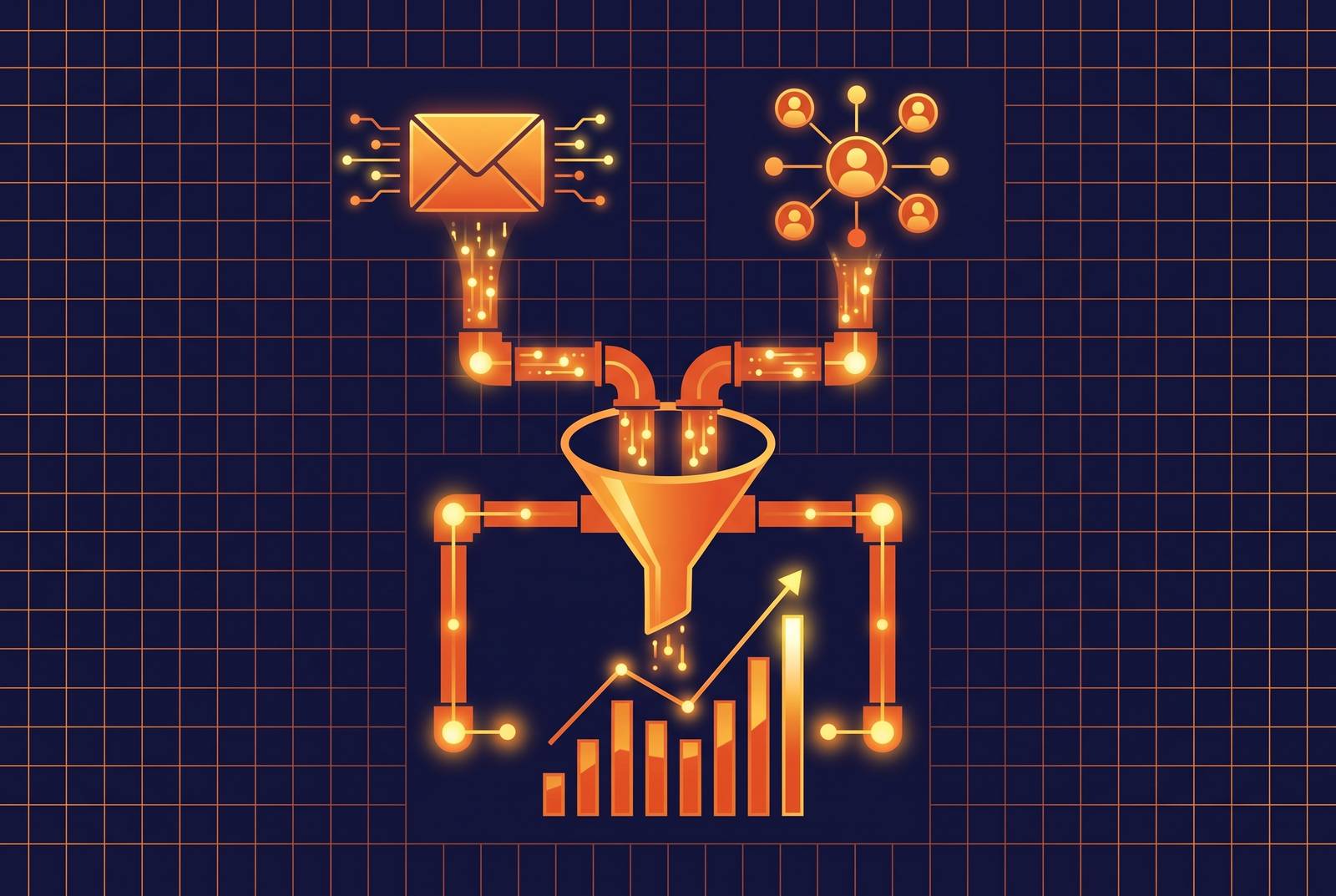
Cold email and LinkedIn Ads aren't parallel channels to run simultaneously, they're most effective when sequenced deliberately, with each channel doing a specific job at a specific stage of awareness. The instinct is to fire up both channels at once, stack the touchpoints, and let volume do the work relevance should be doing. That instinct is backwards, and the numbers make the case. Only 16% of sales reps hit quota in 2024, and reps spend just 28% of their week actually selling Salesforce research SaaS Capital's 2026 benchmarks thesmarketers.com. The playbook behind those numbers, more outreach and more volume, is not producing better results, because that approach substitutes volume for relevance Salesforce research SaaS Capital's 2026 benchmarks thesmarketers.com. Cold email reply rates between 1% and 5% are not proof the channel is broken Salesforce research overloop.com. They are proof it is being asked to do a job alone that it was never built to do alone Salesforce research overloop.com.
Buyers complete 70% of their research before they ever talk to a vendor, and 94% of buying groups have already ranked their preferred vendors before that first outreach email lands heysid.com 6sense's 2025 Buyer Experience Report. That timeline is what makes "spray and pray" pointless rather than just inefficient. A rep who sends a cold email and runs a LinkedIn ad to the same person on the same day is often talking to someone who already picked a vendor. Undifferentiated volume does not add reach. It adds noise, and noise is what buyers tune out first.
The fix is not more discipline within each channel. Cold email and LinkedIn Ads each do a job the other cannot do, and sequencing those jobs, one triggering the next rather than both firing in parallel, is where the payoff comes from. What follows is what each channel is actually good at, what order they belong in, and how the handoff between them works in practice.
What cold email does well before it runs out of road
Cold email's edge is structural: it starts conversations, surfaces real interest, and earns the first reply that turns a stranger into a prospect. What it cannot do is build the ambient familiarity that keeps a brand in front of a buying committee over months, and it cannot reach the other people involved in the purchase who never opened the message in the first place heysid.com 6sense's 2025 Buyer Experience Report.
List quality sets a hard ceiling before the first message even lands. Connection acceptance rates swing from 19.9% to 36.5% based purely on how tightly the industry targeting is scoped overloop.com Expandi's 2026 benchmarks. No subject line fixes a bad list. Purchased contact data starts decaying the day it's bought: job changes pile up, inboxes go dead, domains merge, and every bounce chips away at sender reputation. Dropping in a generic opener like "hope this finds you well" on top of that makes the email read as automated before the recipient even reaches the offer.
Most cold email programs run a fairly standard cadence, with an initial send on Day 1, a follow-up on Day 3, a new angle by Day 7, a case study or proof point by Day 14, and a breakup email around Day 21 Corporate Visions research. After that, the sequence stops Corporate Visions research. Stopping is not the same as resolving. An account that never replied has not necessarily said no, it may just have gone quiet, and that silence, accounts that saw the outreach but never engaged, is exactly where the next channel needs to pick up Corporate Visions research. Overloop's benchmarks show cold email offers 10x the daily send capacity of LinkedIn InMail, and an 8.5% average reply rate versus 5% on LinkedIn overloop.com martal.ca.
What LinkedIn Ads does well before it needs a foundation
LinkedIn's edge is precision. Targeting by job title, seniority, function, and company means reaching the whole buying committee. LinkedIn now captures 41% of total B2B paid social budgets, up from 39% the year before, while non-branded Google Search budgets keep shrinking Salesforce research Dreamdata 2026 learn.g2.com. Budget follows results, and results have been moving toward LinkedIn.
What LinkedIn Ads does well is build familiarity at scale. It reaches people who never opened a single email, and it keeps a brand visible across a buying committee through what is usually a long, slow evaluation. B2B buying cycles typically run 60 to 180 days, and LinkedIn earns its keep by staying present in the middle of that stretch, well after the first outreach has already landed tomba.io. What it does not do efficiently is start a direct, one-to-one conversation, generate real reply volume, or match the specificity of a personal email at the exact moment someone first hears from a company.
Cost makes the case concrete. An ad running cold, no prior context, no name recognition, straight to a demo request, is paying full price for low intent. Format helps at the margins: Lead Gen Forms cost less per lead than landing pages, and Document ads cost less than static image ads. But format tweaks do not fix the underlying problem of running ads at an audience that has never heard of the company. LinkedIn Ads simply perform better against an account that has already seen outreach. The ad reinforces something familiar instead of introducing something cold, and that shift changes both the conversion rate and what each lead costs. Metadata's 2026 benchmark, built on 138 B2B advertisers and $57.6M in spend, puts the 2025 median CPL at $376, and that is the price tag attached to a cold LinkedIn ad asking for a demo with no context behind it.
The channel that runs first
Cold email goes first, and the reason is economic before it is anything else. Email is the cheap way to test whether an account is even worth pursuing. It flags who is interested and creates the specific, named context a LinkedIn ad can then build on. Every open, click, reply, and bounce is a signal, and signals are what make the second channel worth paying for.
That is the handoff point. Once the email sequence winds down, or even while it is still running, LinkedIn Ads step in to target those same accounts with content matched to where each one sits. Openers and clickers who never replied get proof-of-concept content: case studies and third-party validation answering the "does this actually work" question. People who never opened anything get category-level education, no pitch, just problem framing. People who replied but did not convert get bottom-of-funnel material: ROI arguments, demo offers, the assets that help a committee actually decide.
Why go to the trouble instead of just running both channels harder? Cold email opens the door on one account. LinkedIn Ads holds that door open, both between email touches and across the committee members email never reached. Sequencing is not only about timing, it is about what gets said at each step. A LinkedIn ad that repeats the email is a wasted impression. Its job is to move the conversation one step further than the email already took it. Martal reports B2B buyers now use around 10 channels in a single purchase, and coordinated email and paid sequences see 4 to 7x higher conversion rates than single-channel outreach martal.ca. Non-responders are not non-interested: an account that opened three times and didn't reply is a different audience than one that never opened, and LinkedIn Ads should treat them differently.
Building the account list that makes the sequence coherent
None of this works if cold email and LinkedIn Ads are pointed at two different sets of people. Both channels need to work the same account universe, or "sequencing" is just a word being used to describe two disconnected campaigns. That list gets built from a few sources: Sales Navigator searches scoped tightly to the ideal customer profile, engagement data from posts and conversations in the target market, event and webinar attendee lists, and job-change alerts on people already inside accounts worth pursuing.
Static lists lose to signal-driven ones. Outreach timed to something actually happening, a job change, a funding round, a shift in the tech stack a company is running, consistently beats outreach that just works down a static spreadsheet. Targeting has to match across channels too: LinkedIn's company and title filters should mirror the exact ICP filters used to build the email list in the first place, same companies, same seniority, same job functions.
The connective tissue holding this together is unglamorous: CRM tagging. Every lead in a cold email sequence needs to carry the sequence name, the segment, and the date of first contact, so LinkedIn retargeting audiences get built from actual engagement behavior instead of a static list of company names. UTM parameters on every link in every email make web traffic that started as cold outreach traceable. A prospect who clicks an email link and later sees a LinkedIn ad leaves a path that can be followed, and that pattern should shape how the next sequence gets built.
Timing the handoff: when LinkedIn Ads activates relative to the email sequence
There are three timing models, each with a different logic.
Running LinkedIn Ads concurrently from Day 1 builds ambient brand presence alongside the email outreach right from the start, which helps a company that is genuinely unknown entering a new market. The cost is spending money on accounts before a single signal exists about whether they are worth the spend.
Anyone who opened or clicked is confirmed as reachable, and LinkedIn spend is then more defensible because there is prior engagement.
Holding LinkedIn back entirely until the email sequence ends, then retargeting only the accounts that engaged without converting, is the most efficient use of ad budget, because the audience is defined by actual behavior instead of firmographic guesswork.
In practice, high-performing teams do not pick one model and run it in isolation. They interleave the channels, a LinkedIn connection request on Day 1, email on Day 3, a LinkedIn message on Day 7, an email follow-up on Day 10 martal.ca. And because buying cycles stretch 60 to 180 days, LinkedIn Ads should keep running well past where the email sequence stops, holding presence for accounts still working through evaluation tomba.io. What kills the approach is letting the timing go stale: the same ad running to the same accounts months after their sequence ended, no refresh to message or audience, just burns budget and undoes the point of sequencing in the first place.
Message architecture across the sequence: what each channel says at each stage
The rule governing everything here is simple to say and easy to break: each message moves the conversation forward, never repeats what already got said. A LinkedIn ad echoing the email verbatim wastes the impression and tests the reader's patience.
On the email side, each stage has its own job. The first email is specific and personal with a low ask, something genuinely relevant to that person. The follow-up acknowledges the prior email and adds a new reason to engage, a data point, a customer outcome, a question that assumes the reader's problem is real. The new-angle email shifts the frame entirely, different pain point, different persona, different proof point. Day 14 brings in social proof, a named customer, a specific result, something credible and third-party. The breakup email closes it out with an explicit ask, making "not now" easy to say in a way that keeps the relationship intact Corporate Visions research.
LinkedIn Ads carry a parallel structure. Early on, while the emails are still landing, ads stay at the category level, framing the problem rather than pitching the product. Midway through the sequence, they shift to proof and differentiation, case studies and use cases backing up whatever the emails have been claiming. Once the sequence ends, for anyone who engaged but did not convert, the ads turn conversion-focused: Thought Leader Ads from a named person at the company carry more weight than a faceless brand ad, and formats like Document ads or Lead Gen Forms lower the friction on the next step. Personalization does not stop at email either. A retargeting ad aimed at a specific segment should reference the same industry, role, and pain point the email used, not generic B2B language that could describe anyone. Teams pulling 15 to 25% reply rates are just keeping the message thread coherent across channels overloop.com martal.ca. They are just keeping the message thread coherent across channels, LinkedIn connection Day 1, email Day 3, LinkedIn message Day 7, email Day 10, so it reads like one ongoing conversation instead of two campaigns talking past each other overloop.com martal.ca.
Attribution and measurement across a two-channel sequence
Running email and ads as separate operations means each one will happily report its own conversions with zero visibility into who actually did what. A prospect who opened an email, clicked a LinkedIn ad, and then booked a demo gets credited entirely to whichever channel someone happened to check last. That is not measurement. That is a coin flip dressed up as an attribution model.
The stakes here are not bragging rights over which channel "won." If prospects who saw a cold email and then a LinkedIn ad convert at a meaningfully higher rate than prospects who only got the email, that pattern belongs in the sequence on purpose, not filed away as a coincidence. Getting there takes a few pieces of unglamorous infrastructure: UTM parameters on every email link, CRM tags carrying sequence name, segment, and first-touch date, LinkedIn retargeting audiences pulled directly from email engagement lists, and a pipeline view rather than a channel view, judging the program by qualified pipeline and revenue instead of opens or platform-reported conversions that may not reflect reality.
Patience matters just as much as infrastructure. Buying cycles run 60 to 180 days, and judging a sequenced program after one month is a reliable way to kill something that was working before it had time to prove it tomba.io. Good measurement, given enough runway, does more than score the program. It points to the actual constraint, bad list quality, weak message-market fit, flat LinkedIn creative, a landing page that loses people, an offer that is not compelling, instead of a shrug and "the channel doesn't work". Every sequence that runs leaves behind a record of which accounts engaged, at which stage, on which channel, and that record is what makes the next sequence sharper instead of starting from zero.
The boundary between human judgment and systematized execution
Plenty of this runs on rails. List building against ICP filters, enrolling accounts into sequences on schedule, UTM tagging and CRM syncing, building LinkedIn audiences straight from engagement behavior, all of that is mechanical, repeatable work that does not need a person reinventing it every week. When the rules are set once, a system applies them consistently, without getting tired or sloppy about it.
What cannot be systematized is judgment about the substance: does the first email's opening line actually land with this specific persona, is the case study picked for Day 14 the right proof for this account's particular objection, and is the LinkedIn ad creative advancing the conversation or just quietly repeating the last email. Timing rules and tagging structures set up the conditions for a good sequence to run. Whether the sequence actually says something worth a reader's attention is still, stubbornly, a human call. SOURCE PAGES (what the pages behind the outline's links say).


