LinkedIn Demand Generation vs. Lead Generation Campaign Strategy
Demand generation must precede lead generation, not run parallel to it.
Let me start with a confession; I have sat in more than one marketing review meeting where the slides showed a healthy CPL trend line, a growing MQL count, and a sales leader who looked like he was doing math in his head that wasn't adding up. The leads were there. The pipeline wasn't. And everyone in the room had a theory about why (the creative, the targeting, the landing page, the SDR follow-up speed).
Nobody said the obvious thing: we built the capture mechanism before we built the thing worth capturing.
That's the problem this piece is about. Not LinkedIn versus Google. Not lead gen forms versus video ads. The actual problem is that most B2B programs treat demand generation and lead generation as interchangeable tactics when they are, in fact, sequential steps. One builds the conditions the other requires. Running them out of order doesn't just underperform. It actively produces misleading data that makes the real problem harder to see.
Only 3 to 5 percent of any total addressable market is actively searching to buy at a given time. Every competitor is targeting that same slice. Running pure lead-capture programs into that tiny pool is a race to the bottom on CPL, and a race to the ceiling on customer acquisition cost. The other 95 to 97 percent aren't unreachable. They're just not ready yet. And that gap (between not ready and ready) is exactly where the sequence lives.
What demand generation on LinkedIn actually does (and doesn't do)
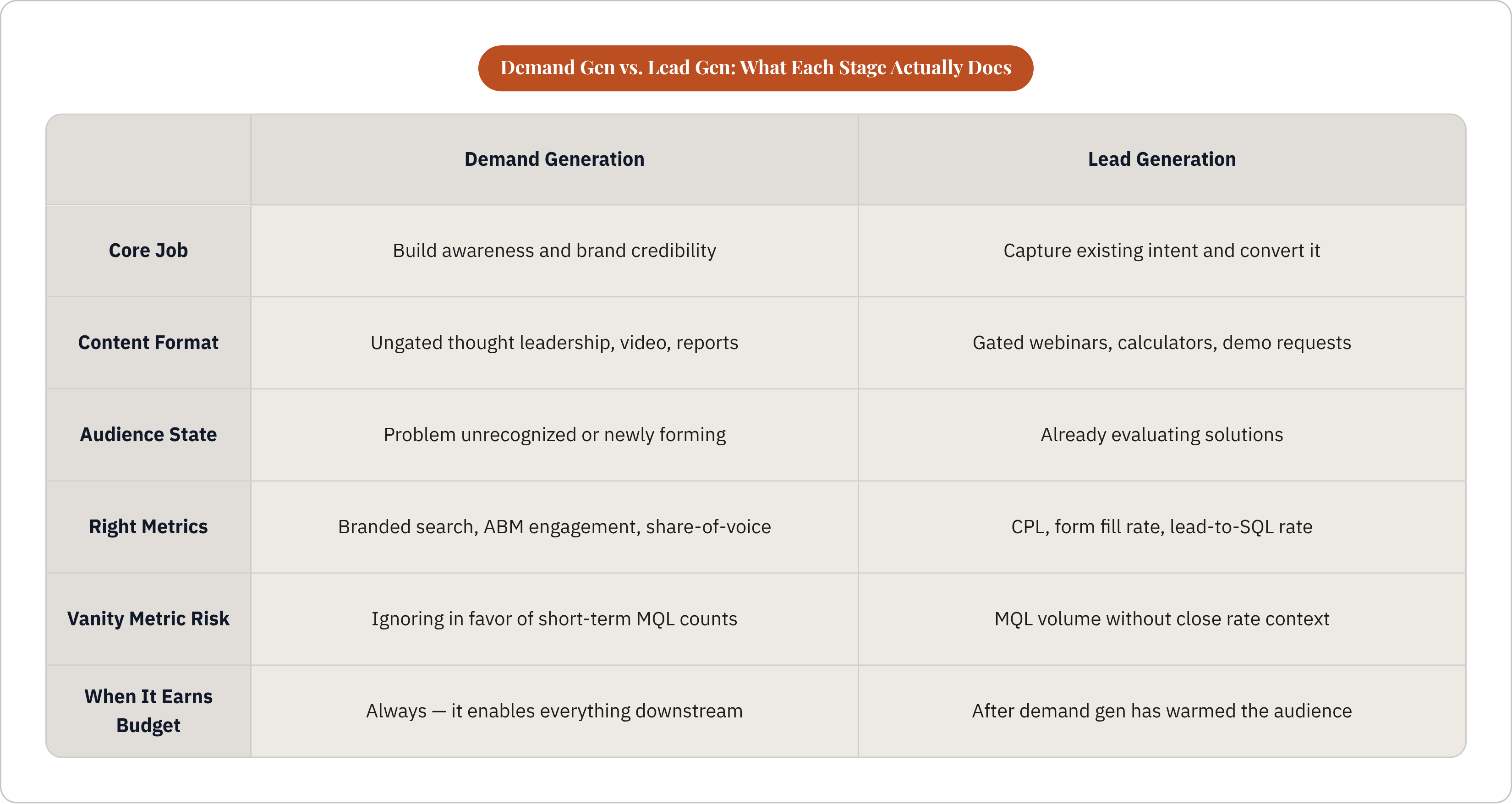
Here's what demand gen is actually hired to do: create awareness for problems buyers don't yet know they have, and build enough brand credibility that when a buyer eventually does recognize the problem, your name is already in their head.
That's it. That's the job.
What it does not do is generate contact information, feed a sales team's outreach queue, or produce near-term form fills. If you are measuring a demand gen campaign by CPL and MQL volume, you are measuring the wrong thing. And you will draw the wrong conclusions.
Demand gen optimizes for pipeline. Specifically: SQLs, cost per opportunity, customer acquisition cost, payback period. Those metrics sit downstream of the campaign by weeks or months, which is precisely why they get ignored in favor of the metrics that show up in the dashboard by Friday.
The content this requires is ungated. Category education. Trend reports. Industry benchmarks. Short video. Executive thought leadership. Content that earns attention without asking for anything in return. The moment you put a gate on it at this stage, you have converted a demand gen asset into a lead gen asset. And deployed it to people who have no reason yet to trust you enough to hand over their email.
Why LinkedIn specifically for this work? Consider the platform's composition: 80 percent of LinkedIn users influence buying decisions within their companies. Every piece of ungated content you publish doesn't just touch one buyer. It touches a committee member. It touches the person who will frame the problem to the person who signs the check. That reach is structurally different from almost any other paid channel.
But what are the leading indicators that demand gen is actually working, if not MQL count? Watch branded search volume. Watch return-visitor rates on your site. Watch share-of-voice in your category. Watch ABM account engagement rates. These signals are messier to track and slower to move, which is exactly why they tend to get deprioritized in favor of something that updates daily in a dashboard.
That's the measurement trap. MQL count can look healthy while close rate is terrible, because nobody arrived warm. Rewarding teams for MQL volume in isolation doesn't tell you whether demand is being created; it tells you whether the form worked.
What lead generation on LinkedIn actually does (and when it earns its place)
Lead gen's actual job is narrower and more precise than most teams treat it.
It captures intent from buyers who already have awareness of the problem and are already evaluating solutions. It converts existing interest. It does not create interest.
The mechanics are real. LinkedIn Lead Gen Forms auto-populate from a user's profile, which meaningfully reduces friction. LinkedIn's visitor-to-lead conversion rate (nearly four times higher than Twitter and dramatically higher than Facebook) makes it a legitimate capture channel when the audience is actually ready to be captured.
The operative phrase is "when the audience is ready." Webinar registrations, gated calculators, demo requests, case study downloads. These offers make sense to someone who already knows they have a problem and is now comparing options. To that person, a lead gen form is a reasonable next step. To someone who has never heard of your brand and has no context for why your problem even matters, the same form is friction with no payoff on either side.
That's the failure mode. Running lead gen offers to cold audiences produces large volumes of contacts with no purchase intent. The economics look fine in the short term. CPL is trackable. MQLs accumulate. And then you get to the sales review meeting I described in the opening.
When does lead gen earn its budget? After demand gen has built brand recognition with the target account list. When you are retargeting audiences who have already consumed ungated content. When the ask is proportionate to the trust already built. That sequencing is not a philosophical preference; it is the operational condition that makes the economics of lead gen actually work.
The sequence that turns LinkedIn spend into pipeline
Let's make this concrete.
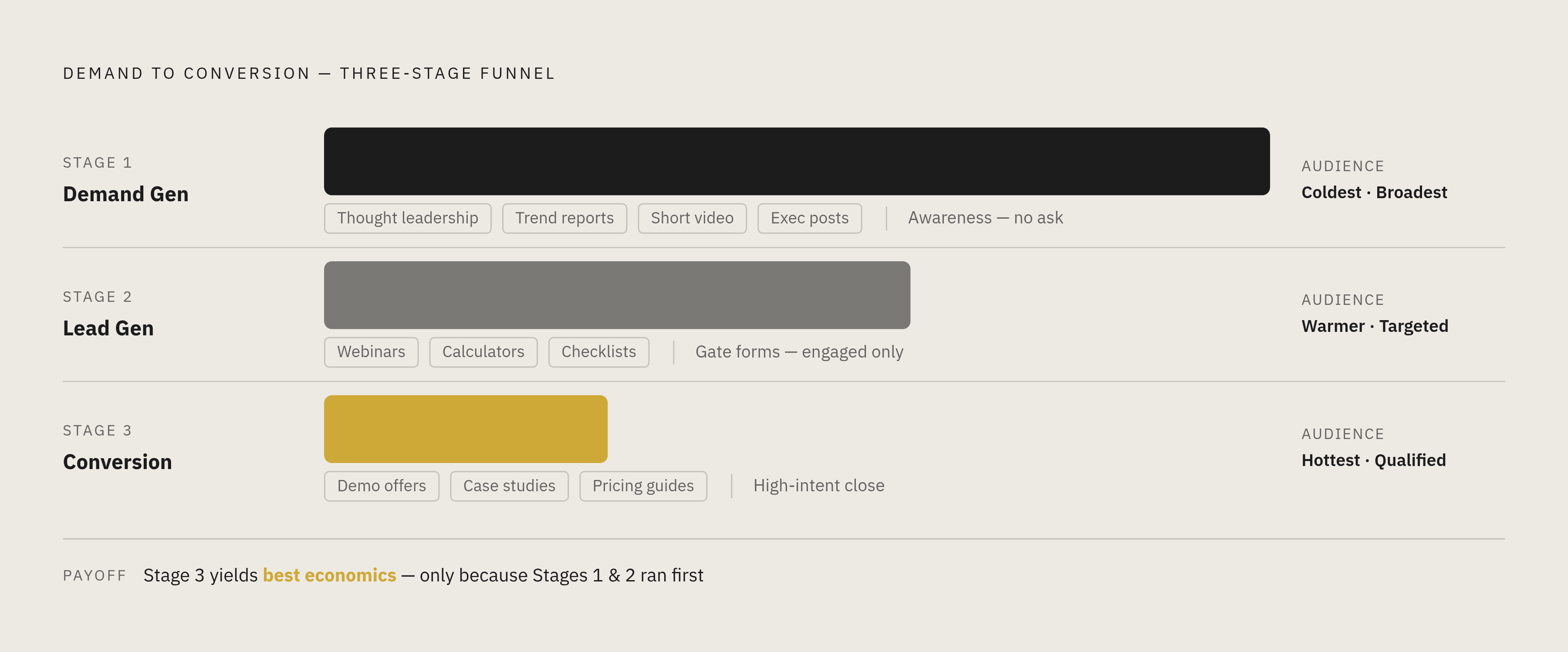
The sequence in plain terms: ungated content comes first, gated content comes second, high-intent conversion offers come third. You build awareness before you ask for contact information. You ask for contact information before you ask for a demo.
Think of it in three stages.
Top of funnel is demand generation. Ungated thought leadership. Trend reports. Short video. Executive posts. The goal is awareness and problem recognition. There is no ask. The audience doesn't know you well enough yet for an ask to land.
Middle of funnel is where lead gen forms first make sense. Webinars. Calculators. Checklists. But here's the critical qualifier: these should be targeted to audiences who have already engaged with your top-of-funnel content. The ask is proportionate to the trust already built. Someone who has read three of your articles and watched a video has a reason to register for your webinar. A stranger doesn't.
Bottom of funnel is where lead gen is at its highest value. Retargeting high-intent accounts with demo offers, case studies, pricing guides. Smallest audience. Highest qualification. Best economics. This is where the investment in the first two stages finally shows up as pipeline.
Why does this sequence produce better leads? Because buyers arrive with context. They have problem recognition. They have brand familiarity. They are not strangers responding to an incentive they'll forget by the weekend.
That raises an important question about who exactly you're sequencing. B2B buying groups now include somewhere between eight and thirteen decision-makers, depending on the deal size and category. Demand gen reaches that committee before lead gen asks it to identify itself. Account-based demand generation, which maps the sequence to companies rather than individual contacts, is the organizing layer that makes this work at scale. More than half of B2B marketers running ABM programs report positive ROI. The model is not experimental anymore.
Misaligned sequencing is the most common budget mistake in B2B programs. Not the wrong channel. Not the wrong creative. Not the wrong targeting. The sequence.
How budget, bidding, and format choices differ between the two campaign types
This is where things get practical, and also a little uncomfortable.
LinkedIn is not cheap. Running LinkedIn alone in a way that generates real learning requires roughly $4,000 to $5,000 per month. Running LinkedIn and Google together, across both stages of the sequence, meaningfully requires $8,000 or more per month, sustained for at least three to four months. Splitting a budget below those thresholds across both stages leaves nothing for either. The result is inconclusive data from every direction, which tends to get interpreted as "the channel doesn't work."
For demand gen, the format choices matter more than most teams realize.
Thought Leader Ads, which promote organic posts from executives or subject-matter experts rather than the brand account, consistently outperform brand-led content. Why? Because people engage with people. Personal profiles generate roughly eight times more engagement than company pages. If your demand gen investment is concentrated in the brand handle, you are leaving most of the available attention on the table.
Video is the other demand gen format worth taking seriously. Less polished performs better. The platform rewards authenticity over production value. A phone-filmed take from an executive who actually knows something outperforms a produced brand spot, which is both liberating and slightly maddening if you have spent significant budget on production.
For lead gen, the format logic shifts.
LinkedIn Lead Gen Forms reduce friction at the middle-of-funnel stage, where reducing friction is the goal. At the bottom of funnel, retargeting audiences with case studies, demo CTAs, and pricing guides, the creative should carry brand prominence. Branded campaigns deliver dramatically higher ROAS than generic campaigns. The gap is not marginal; it's roughly 19x in favor of branded creative, based on analysis of over 1,400 campaigns. The implication: even at the capture stage, brand investment in the earlier stages is doing measurable work.
One more number worth sitting with. CPCs on LinkedIn run three to five times higher than Google. That sounds damning. But LinkedIn's targeting precision produces fewer wasted impressions, and despite the higher per-click cost, LinkedIn delivers a lower cost per qualified lead than Google Ads for B2B. The higher unit cost is defensible when the sequence is respected; it breaks down when you spend that premium on cold lead gen campaigns to audiences who have no idea why they should care.
Where Google fits in a sequence built around LinkedIn demand generation
The channel division of labor is simpler than most multi-channel frameworks make it sound. LinkedIn creates demand. Google captures it.
When someone searches for a solution, they are signaling active intent. But that intent was built somewhere. A CTO encounters a thought leadership ad on LinkedIn, develops problem awareness over several weeks, and then searches Google for product comparisons. The paid strategy has to support that transition. Treating LinkedIn and Google as independent experiments, each evaluated on its own metrics, misses the dependency.
The Google headwind is real and worth understanding. AI Overviews now appear in roughly half of all searches, and on queries where they appear, paid click-through rates have dropped significantly. B2B technology queries specifically have seen AI Overview presence jump over 100 percent year-over-year. What this means practically: Google's paid capture layer is facing increasing interference from AI-generated answers that answer questions without sending anyone anywhere.
What happens when capture gets harder at the Google layer? The demand gen work done upstream becomes more important, not less. Brand familiarity built before the Google search determines whether a buyer clicks your result or a competitor's. If they don't already know your name, the AI summary is probably the last stop.
The budget data reflects this shift already happening. B2B companies grew LinkedIn ad spend more than 30 percent between Q3 2024 and Q3 2025 while Google ad spending grew only 6 percent over the same period. LinkedIn now captures a meaningful portion of total B2B ad budgets, while non-branded search's share has declined year over year. The market is already rebalancing toward the front of the sequence, even if individual program structures haven't caught up.
Attribution across a multi-stage sequence and why standard reporting obscures what's working
This is the part that makes finance teams' eyes glaze over and marketing teams quietly panic.
B2B buying cycles average more than ten months. A demand gen campaign that runs in Q1 may generate a closed deal in Q4. Standard last-touch reporting attributes zero credit to the campaign that started the sequence; it attributes everything to whatever touchpoint happened closest to the signature.
That's not a nuance. That's a structural bias in standard reporting that systematically undercredits demand gen and overfunds lead gen, which then produces the exact symptom we started with: lots of leads, thin pipeline.
LinkedIn's 2025 rollout of the Conversions API addresses part of this by connecting on-platform ad engagement to offline actions and first-party CRM data. Sales calls, demos, lead-to-opportunity transitions. The updated Revenue Attribution Report now includes a 12-month CRM activity window, which means campaigns that worked on long sales cycles can actually receive credit. Before this, demand gen often looked like wasted spend because the latency period exceeded the attribution window. The campaign did the work. The reporting just couldn't see it.
What should you actually measure at each stage?
For demand gen: branded search volume, ABM account engagement rate, return-visitor rate, share-of-voice in category. These are leading indicators that buying conditions are being built.
For lead gen: CPL, form fill rate, lead-to-SQL conversion rate. Legitimate metrics when the audience is already warmed.
To tie the sequence together: cost per opportunity, SQL-to-closed-won rate, blended CAC, payback period. These are the metrics that tell you whether the full sequence is working, not just whether one stage is producing activity.
The vanity metric to retire is MQL volume in isolation. It tells you whether the form worked; it does not tell you whether the sequence worked. What matters is MQL volume multiplied by close rate multiplied by average contract value. That product is the thing.
Running both stages without connected attribution infrastructure means making budget decisions based on which campaign looks cheapest in the dashboard, not which campaign is generating pipeline. That is a structural bias toward lead gen that starves the demand gen that makes lead gen possible. The loop is self-defeating, and it runs quietly for a long time before anyone names it.
Diagnosing which stage a program is actually missing
The diagnostic question is not "should we run demand gen or lead gen." The question is: which stage is the constraint right now?
That reframe matters. It moves the conversation from channel preference to system thinking.
Signals that demand gen is the missing stage:
- High lead volume, low close rate. Contacts arrive with no context and no problem awareness.
- Sales team reports that prospects "haven't heard of us" or "weren't expecting our call."
- Branded search volume is flat or declining despite increasing ad spend.
- CPL appears low but cost per opportunity is high. Quantity is masking a quality problem.
If you are seeing two or more of these, the form is working. The audience arriving at the form is the problem.
Signals that lead gen is the missing stage:
- Strong brand engagement and content consumption, but pipeline is thin. Awareness isn't converting to conversations.
- High return-visitor rates on the website, low form fill or demo request rates. Intent exists but there is no capture mechanism.
- ABM account engagement is rising but outbound is not supported by inbound signal.
If you are seeing two or more of these, the demand gen is doing its job. The sequence just has no second act.
It is also worth considering the research behavior that precedes all of this. The vast majority of B2B buyers conduct significant research before contacting sales. The question isn't whether your demand gen program exists; it's whether it is part of that research phase or invisible to it. If a buyer in your ICP can spend three months researching the category problem and never encounter your brand, the demand gen is either misconfigured or absent.
Multi-channel campaigns produce meaningfully more leads than single-channel campaigns, but the lift comes from running the sequence across channels, not from running more campaigns at the same stage. Adding a third lead gen campaign to a program that already has two is not the same thing as adding the demand gen stage that neither of them currently has.
The operational implication is this: separating demand creation goals from demand capture goals inside the team, with distinct metrics, distinct creative briefs, and distinct success criteria, is what makes the sequence manageable rather than theoretical. When both goals live inside the same campaign objective, the short-term measurability of lead gen will win the budget argument every time. Even when it's the wrong call.
The sequence doesn't require a perfect attribution model or an unlimited budget to start. It requires being honest about which stage you are actually in, and resisting the pressure to skip ahead to the part that looks like results before you have built the conditions that make results real.