Demand Generation Companies Specializing in LinkedIn Ads
LinkedIn demands different expertise than Google because you're buying the person, not the intent.

On Google, someone types "best cybersecurity software for mid-market" and your ad appears. They raised their hand first. The intent was already there. You just needed to be in the right place when it surfaced.
LinkedIn runs on completely different logic. You don't wait for the hand raise. You identify the person by job title, seniority, company size, industry. Data they actively keep updated because their career depends on its accuracy. You go find them before they're searching for anything at all.
Why does this distinction matter so much? It changes the cost math entirely. LinkedIn clicks run $5 to $15. Google clicks run $1 to $3. On the surface, LinkedIn looks overpriced. But you're not comparing the same thing. The LinkedIn click costs more because you chose that person. You didn't wait for them to wander in.
Does the premium justify itself? Sometimes. But only when a few things are true simultaneously: your average contract value is high enough to absorb the cost, your ICP is narrow enough to be defined by professional attributes, and your targeting is actually precise enough to reach the right people.
That last condition is where I've watched programs quietly fall apart. LinkedIn's identity-based precision is also identity-based risk. A broad-match keyword on Google wastes a few cents when it misfires. A misconfigured LinkedIn audience wastes thousands before anyone notices, because every dollar is aimed at a specific person, not a fuzzy query. The feedback loop is slower. The stakes per impression are higher.
This is exactly why "I've run Google Ads" doesn't transfer cleanly to LinkedIn. The platforms have different logic, different risk profiles, different optimization levers. Someone excellent at one isn't automatically competent at the other. Most clients figure that out the hard way, about three months into a contract.
LinkedIn and Google Aren't Rivals. They're Running a Relay.
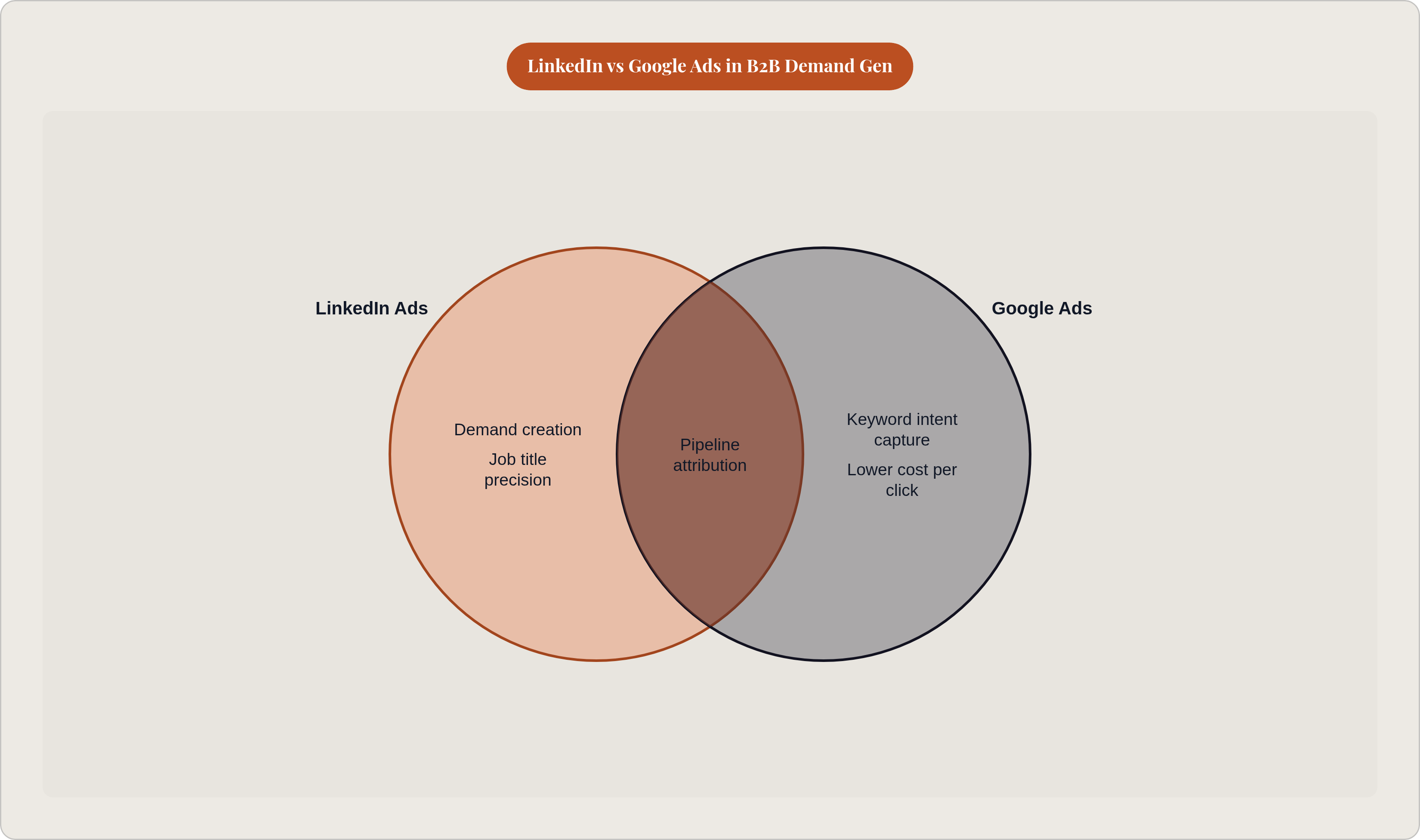
One of the more expensive misconceptions I run into is B2B marketing teams treating LinkedIn and Google as alternatives. Like they're choosing between two vendors for the same job. They're not competing. They're sequential — LinkedIn plants the seed, and Google harvests the crop.
LinkedIn does the groundwork. Buyers in your ICP see your content, your offers, your brand over weeks or months. Most of them don't convert during that window. That's fine. That's actually what the channel is supposed to do. Then later, one of those buyers searches Google for something in your category. That's when Google catches the intent that LinkedIn created.
Run LinkedIn without coordinating Google and you're building awareness for a funnel someone else owns. Run Google without LinkedIn and you're harvesting demand your competitors may be building while you aren't.
A reasonable starting split for most B2B programs sits around 60% LinkedIn, 40% Google. For enterprise deals with long sales cycles and narrow buying committees, you lean harder into LinkedIn. But the exact percentages matter less than understanding why you chose them.
Within those channels, there's a budget logic layer most programs skip entirely:
- 40 to 50% on demand capture: people actively in-market right now
- 30 to 40% on demand education: people who know they have a problem but haven't heard of you
- 10 to 20% on demand creation: people who don't yet know they have the problem
Most programs I've seen over-invest in demand capture and under-invest in demand creation. That works until the retargeting pool dries up and nobody can explain why performance dropped.
Here's a situation worth thinking through carefully. A cybersecurity company spending $60,000 a month on LinkedIn was generating over 400 leads per month. Eight of those converted to qualified opportunities, representing a 2% lead-to-opportunity rate.
After restructuring, the same program generated 110 leads per month and 20 qualified opportunities, an 18% lead-to-opportunity rate. Volume dropped 75%. Pipeline more than doubled.
What actually changed? Less dependence on LinkedIn Lead Gen Forms. A retargeting layer added. Educational content introduced into the paid mix.
LinkedIn Lead Gen Forms aren't bad. But pre-filled forms produce contacts who didn't do much consciously. Someone saw an ad, LinkedIn autofilled their information, they tapped submit, moved on. Website traffic self-selects differently. Someone who clicked through, landed on your page, read something, and still converted is a meaningfully different kind of lead. The form completion rate looks great. The pipeline math tells a different story.
The seam between LinkedIn and Google is also where attribution breaks when two separate partners own two separate channels. Nobody sees the full picture. Budget decisions get made in silos. The pipeline question stays quietly unanswered.
The Metric That Looks Good Is Usually the Wrong One
Here are two programs running on the same budget.
Program A: $50 cost per lead, 2% conversion from lead to pipeline opportunity. You need 50 leads to get one opportunity. Cost per pipeline opportunity: $2,500.
Program B: $200 cost per lead, 20% conversion from lead to pipeline opportunity. You need 5 leads to get one opportunity. Cost per pipeline opportunity: $1,000.
Program A looks cheaper by a factor of four. It actually costs two and a half times more to produce a real pipeline opportunity.
Why does this keep happening? Because the platform reports what it can measure. Click-through rates, cost per lead, form fills. Clean numbers. Easy to put in a slide deck. And easy to optimize toward, which is exactly why so many agencies do it. They're not necessarily being dishonest. They're optimizing toward what's visible to them.
Pipeline-first execution requires something the platform doesn't hand you: CRM connectivity. Specifically, offline conversion imports, where you push deal-stage data back into LinkedIn and Google so the algorithms optimize toward pipeline events, not form submissions. To build that, you need clean UTM architecture, a consistent lead source field in Salesforce or HubSpot, and a regular import cadence. Weekly is the standard worth aiming for.
Without that infrastructure, your partner is tuning the car by watching the speedometer while the fuel gauge and oil pressure are covered up. They're hitting what they can see. What you actually care about is invisible to them. And nobody on either side of the relationship notices until the quarterly business review gets awkward.
What the Market for LinkedIn Demand Gen Help Actually Looks Like
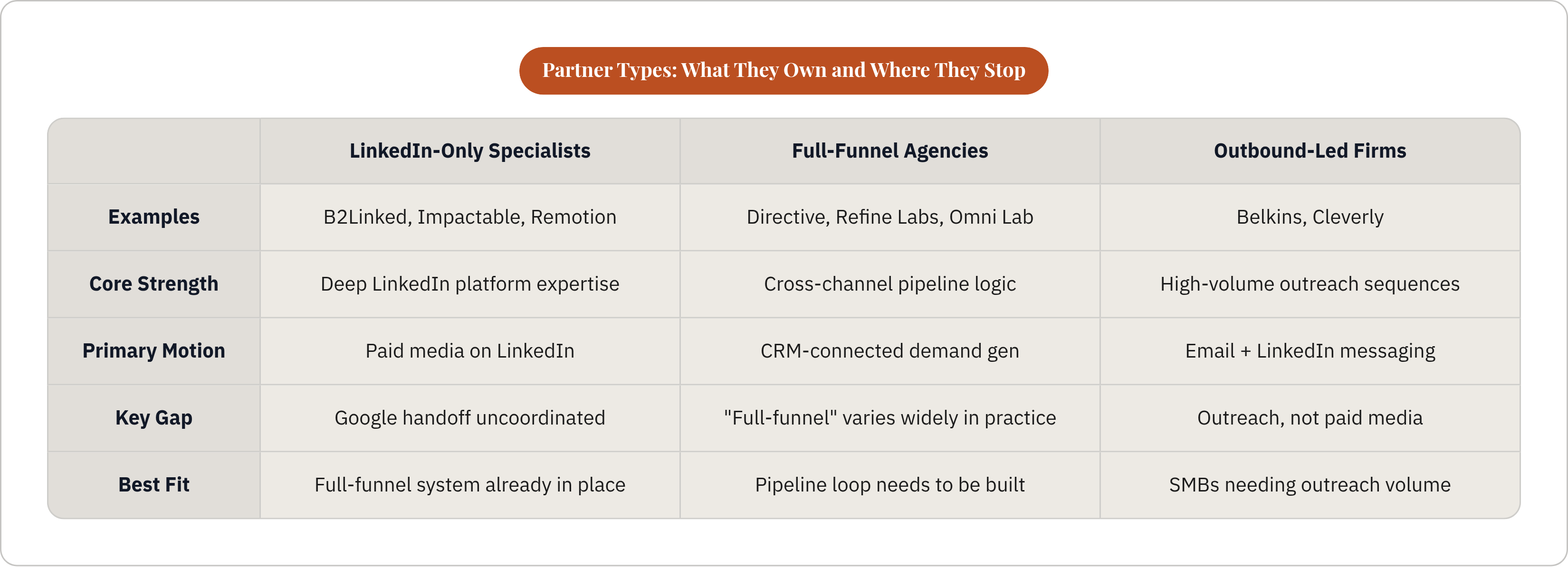
The LinkedIn demand gen space is fragmented, and the category labels blur in ways that create real confusion when you're trying to evaluate partners. The different types are worth distinguishing clearly.
LinkedIn-only specialists. B2Linked, Impactable, Remotion, Speedwork Social. These teams have real depth on the platform. They know LinkedIn's targeting tools, bidding mechanics, and native formats at a level most generalist agencies don't reach. Impactable has built tooling specifically around long B2B sales cycles and layers in ABM and retargeting. Remotion has scaled campaigns for a wide range of recognizable tech companies. B2Linked handles large, complex targeting architecture.
The structural trade-off is real, though. They manage LinkedIn well. But the demand LinkedIn creates tends to surface as Google searches. If nobody's coordinating that Google layer, attribution breaks exactly where it matters most.
Full-funnel demand generation agencies. Directive, Refine Labs, Omni Lab, The B2B Playbook. These partners manage channels as a system rather than in isolation. Directive's methodology is built around customer acquisition cost and lifetime value rather than lead volume. Refine Labs is largely responsible for shifting the industry conversation away from MQL-based metrics toward high-intent pipeline creation.
These partners cost more. They're also more likely to have CRM integration and cross-channel attribution actually in place. But "full-funnel" on the website doesn't always mean full-funnel in practice. The variation between firms using this label is real, and the way to find out which kind you're talking to is to ask them to walk you through their technical setup.
Outbound-led firms with LinkedIn as a layer. Belkins, Cleverly. Belkins uses email as the primary outreach motion and LinkedIn as a warm follow-up for prospects already showing engagement. Cleverly runs high-volume LinkedIn outreach sequences, mostly for SMBs and early-stage companies.
These are legitimate services. But they're running outreach, not paid media. The "demand generation" label gets stretched in ways that create real confusion about what's being purchased. If you think you're buying a paid media program and you're actually buying a LinkedIn messaging sequence, that mismatch shows up in the pipeline review, not the kickoff call.
The Five Execution Layers That Separate Accountable Partners From Platform Managers
When evaluating a demand gen partner, the question isn't whether they "do LinkedIn." It's whether they own and operate each of the following layers, or whether they just manage the platform sitting in the middle of them.
Creative and messaging. Does the partner build and iterate creative, or do you supply it? Static creative on LinkedIn stales fast. Partners running structured creative tests at a consistent cadence accumulate compounding data. Partners refreshing creative quarterly are optimizing with one hand tied behind their back.
One data point worth noting: Thought Leader Ads, per reported 2025 agency data, drove more than half of all conversions on 30% of total LinkedIn spend at roughly half the cost of ABM cold traffic. Format decisions carry that kind of impact and shouldn't be treated as an afterthought. They usually are.
Audience targeting and ICP precision. Can they build audiences from LinkedIn's identity data beyond basic job title targeting? ABM capability specifically means reaching named accounts and multiple stakeholders within a buying committee. Job title spray and ABM are not the same thing. Some partners use those terms interchangeably. That's a red flag worth catching before you've committed to a contract.
Landing page and conversion path. Do they own or influence what happens after the click? A partner who optimizes the ad but has no visibility into the landing page is optimizing half the equation. They should also have a clear, defensible position on Lead Gen Forms versus website traffic, based on actual pipeline quality data from prior programs, not platform defaults.
Attribution and CRM connectivity. This is the technical foundation everything else rests on. UTM hygiene, offline conversion imports, lead source consistency in your CRM. Without this layer, the partner cannot demonstrate pipeline impact. They can only show you platform performance. Those are not the same thing, and the difference shows up at the quarterly business review.
Reporting cadence and what it actually triggers. The question isn't how often they report. It's what the report causes to happen next. Does it surface what changed, why it changed, and what's being done about it? A monthly deck of impressions and CTR is a history lesson. A weekly report tied to pipeline events is a decision-making tool.
AI Agents Are Quietly Changing What Full-Stack LinkedIn Execution Can Do
Most organizations are using AI in some business function. But there's a meaningful gap between using AI tools that assist humans making decisions and deploying AI agents that autonomously plan, execute, and optimize complex workflows without step-by-step instruction. The first is common. The second is still rare enough that most marketing conversations haven't caught up to what it actually enables.
And honestly, when I first started paying attention to how these systems work in practice, my instinct was skeptical. "Autonomous optimization" sounds like a pitch. But the mechanics are worth thinking through, because they're less exotic than they sound.
What does it mean in practice for LinkedIn paid media? An AI agent can monitor campaign performance in real time and autonomously reallocate budget across platforms, creatives, or audiences based on conversion efficiency. If Google Ads is converting at half the cost for the same audience segment, it shifts daily budget accordingly, continuously, without requiring a human decision for each move. It can also optimize toward pipeline events rather than form fills on a continuous basis, not in manual review cycles that happen when someone remembers to run the report.
But the more important advantage isn't speed. It's what happens to the learning over time.
A human agency largely resets context with each new engagement, each new team member, each new quarter. The institutional knowledge that accumulates in one campaign doesn't automatically carry into the next one. An AI agent retains and builds on every signal from every prior campaign. The learning doesn't reset. Whether that compounding advantage justifies the tradeoffs in relationship context and strategic judgment is a real question, and I'm not sure the answer is the same for every organization. But iteration speed is a genuine constraint for most programs, and that's where the gap shows up first.
Strategy, ICP definition, creative direction, relationship context — those still require human judgment. The execution layer, the monitoring, the optimization, the budget reallocation across channels — that's where the structural difference becomes harder to argue with.
Questions to Ask Any Demand Gen Partner Before You Sign
These questions are designed to surface process, not performance. Any partner can show you a case study with impressive numbers. Far fewer can explain, step by step, what actually produced them.
On pipeline accountability:
- "How do you connect ad spend to pipeline in our CRM? Walk me through the technical setup."
- "What pipeline metrics appear in your standard weekly report, and what does that report trigger in terms of action?"
On the full execution stack:
- "Do you own creative and landing pages, or do we supply them?"
- "How do you handle the LinkedIn-to-Google handoff? Do you manage both channels, and if not, how does attribution work across them?"
On targeting rigor:
- "Walk me through how you'd build our ICP audience in LinkedIn. What signals do you use beyond job title?"
- "What's your position on Lead Gen Forms versus website traffic, and how do you decide which to use for a given campaign objective?"
On iteration:
- "How often do you refresh creative, and what does a structured creative test actually look like in your process?"
- "How does learning from one campaign carry into the next one?"
The right answer to most of these questions isn't a number. It's a process. Partners who respond with metrics from a prior client but can't describe how they produced them are optimizing for the sale. That becomes obvious in the pipeline review, which arrives about three months too late.
One last thing worth sitting with: the type of partner that makes sense depends on where your actual gap is. LinkedIn-only specialists make sense when your full-funnel system is already in place and the missing piece is platform execution. Full-funnel demand gen partners make sense when the pipeline loop from CRM back to ad platform still needs to be built. AI-native execution layers make sense when iteration speed is the binding constraint and you're willing to think carefully about what that tradeoff involves.
None of those is the universally correct answer. But knowing which question you're actually trying to solve makes it a lot harder for the wrong partner to sound like the right one.