First-Touch vs. Last-Touch Attribution Tradeoffs for LinkedIn Pipeline
LinkedIn generates most first touches but gets lost when buyers take months to convert.

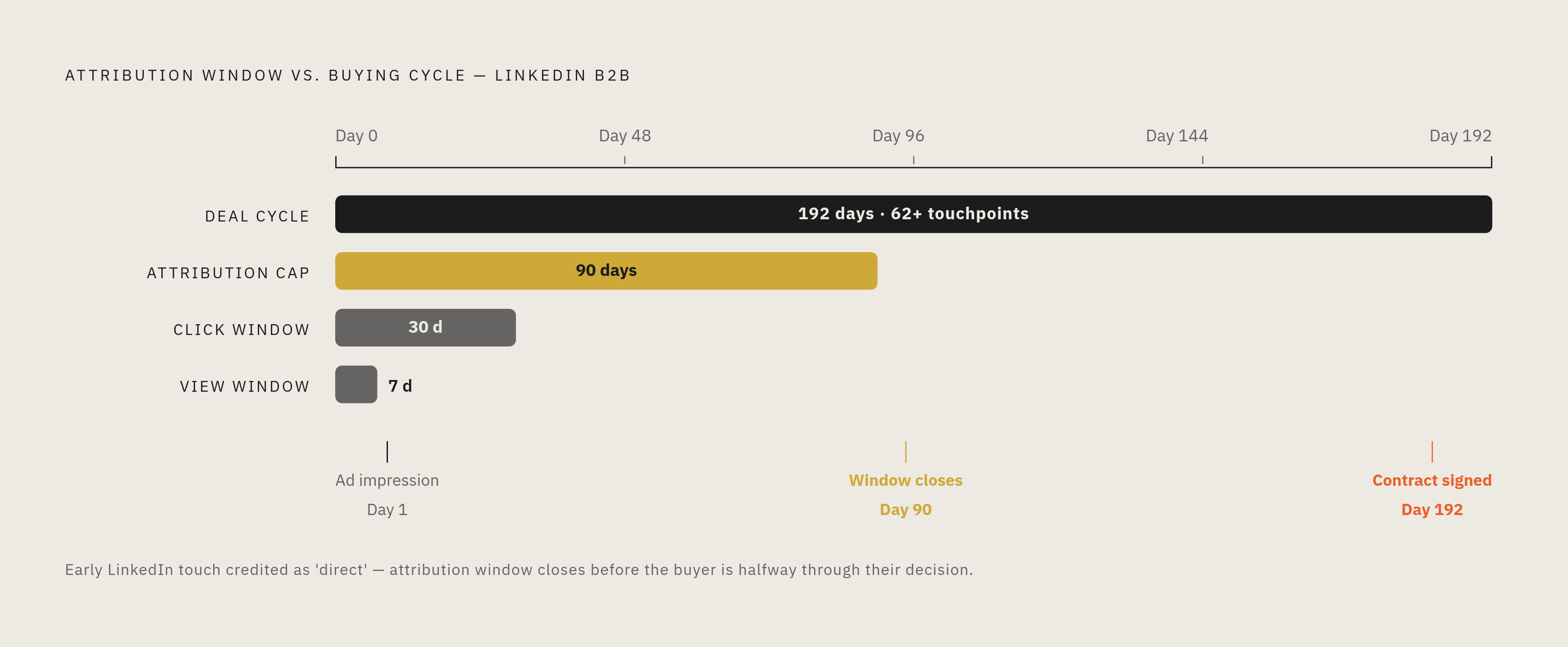
LinkedIn causes a specific kind of headache in B2B marketing: it owns awareness better than most other channels, but it rarely gets the credit, because it rarely owns the moment someone actually converts. LinkedIn drives 68% of first-touch interactions in B2B buying journeys. Its own attribution window maxes out at 90 days. The average B2B SaaS buying cycle runs 192 days with 62 or more touchpoints. Do the math and you'll see the problem: a LinkedIn ad that plants the seed in month one falls outside even LinkedIn's own tracking window by the time someone signs a contract. That touch gets logged as "direct." As if the buyer just woke up one day and thought of the product on their own.
This isn't a case of LinkedIn underperforming. It's a case of the measurement tools built to judge performance not being built for how LinkedIn actually works. First-touch and last-touch models sit at opposite ends of the same flawed idea: that one moment in a buying journey deserves all the credit. LinkedIn usually loses either way, just for opposite reasons. Understanding why is the first step toward fixing it.
How first-touch attribution works and what it distorts when applied to LinkedIn
First-touch attribution is simple: whatever channel gets the first tracked interaction gets 100% of the credit for the sale. It's clean. It's easy to explain in a meeting. And for LinkedIn, it looks great on paper, because LinkedIn does start a large share of B2B buying journeys.
That's exactly the problem. First-touch makes LinkedIn look like it's doing the whole job, when it's really doing one part of a much longer job.
Here's what happens when a team leans too hard on that number:
- Top-of-funnel and brand budgets grow, because first-touch data makes awareness look like the entire outcome.
- Mid-funnel work like nurture emails, retargeting ads, and sales follow-up starts to look redundant, since the data shows those touches "didn't" bring in the sale.
- That mid-funnel spend gets cut. Budgets shift upstream, toward more first-touch-generating activity.
One B2B SaaS company followed this exact playbook. It tripled its content budget and cut retargeting spend by 60% after switching its reporting to first-click attribution. Pipeline dropped 40%. Why? Because the visitors that first-click was busy applauding had nowhere to go next. No nurture path. No retargeting to bring them back when they weren't ready to buy yet.
That's the quiet flaw built into first-touch: it assumes the first moment is the decisive moment. In a buying cycle with 15 to 20 touchpoints, that's rarely true. Consider that 71% of B2B buyers read four or more pieces of content before they ever talk to a salesperson. All of that reading, all of that consideration, all of that mid-journey nudging toward a decision, vanishes under a first-touch model. It's as if none of it happened.
How last-touch attribution works and why it systematically hides LinkedIn's contribution
Flip the model around and the problem flips with it. Last-touch attribution gives 100% of the credit to whatever channel touched the buyer right before they converted. It's still the default setting in most analytics dashboards, and it's still the most common model in practice: 22% of organizations rely on last-click attribution exclusively. In the UK, 42% of mid-market B2B firms use it exclusively, even though their average buying journey runs 7.8 touchpoints long.
For LinkedIn, this model is close to a death sentence. LinkedIn's job in most B2B funnels is awareness and consideration: get in front of the right person, build familiarity, stay top of mind. The actual conversion rarely happens on LinkedIn. It happens when someone searches the brand name on Google, replies to a sales email, or types the company's URL straight into their browser. Last-touch hands the credit to whichever of those came last, and LinkedIn's months of quiet influence disappear entirely.
Stellans consulting found 15% to 30% of hidden channel value that single-touch models miss completely, value that only becomes visible once a more complete model is applied. Which raises a fair question: if the value is there but the model can't see it, is that a LinkedIn problem, or a model problem?
There's a second layer that makes last-touch even worse for LinkedIn: the buying committee. Most B2B purchases involve five to ten people weighing in before a deal closes. The person who clicked the LinkedIn ad is rarely the one who books the demo.
Picture it this way: a VP sees the LinkedIn ad and mentions it in a meeting. A Director downloads the case study it links to. A Manager, weeks later, books the demo. Last-click attribution sees exactly one of those three people, the Manager, and credits whatever channel that person happened to click on last. The VP's ad view and the Director's case study download just vanish from the data. Contact-level attribution, which is still the standard setup most teams run, misses an estimated 60% or more of the revenue LinkedIn actually influenced.
The budget result is predictable. Last-touch starves LinkedIn spend and over-invests in branded search and retargeting, the channels that look productive mainly because LinkedIn already did the work of warming the account up.
The measurement infrastructure gaps that make both problems worse
Neither model would be this broken if the tracking underneath it were solid. It usually isn't.
Somewhere between 30% and 40% of B2B buyer touchpoints happen in places that have no tracking at all: an analyst call, a peer recommendation over coffee, a review site with no UTM tag, a LinkedIn DM, a comment in a Slack community. None of that shows up in any dashboard, no matter which attribution model a team picks.
Gartner's 2025 data found that 64% of B2B organizations don't even have a formal UTM tagging policy. Without consistent tagging across campaigns, even a well-built multi-touch model is working from a partial picture. It's trying to solve a puzzle with a third of the pieces missing.
LinkedIn's own tracking windows make this worse: 30 days for clicks, 7 days for views. Any touch older than that defaults to "direct" or just isn't recorded. Given that the average B2B buying cycle runs 192 days, that means most of LinkedIn's early influence is structurally invisible before the buyer even gets halfway through their decision.
Privacy changes are adding another layer on top. Safari and Firefox already block third-party cookies by default, and Chrome is moving in the same direction. Any attribution setup built before 2024 is likely undercounting cross-device and cross-session exposure to LinkedIn ads right now, without anyone noticing.
Google Analytics 4 dropped last-click as its default model back in January 2024, switching to a data-driven approach instead. Yet plenty of B2B teams still haven't updated their internal reporting logic to match. They're running old assumptions on top of new software.
The upshot: any argument about first-touch versus last-touch is only half the conversation. The other half is whether the tracking underneath either model is good enough to trust in the first place.
What multi-touch models actually offer and where they still fall short for LinkedIn
Multi-touch models split the difference by spreading credit across several touchpoints instead of dumping it all on one. A few common versions:
- Linear spreads credit equally across every touchpoint in the journey. Good for seeing the full breadth of channels involved. Weaker at telling you which of those touches actually mattered most.
- Time-decay gives more credit to touches closer to the sale. It feels intuitive, but it quietly punishes LinkedIn's early awareness role in much the same way last-touch does, just with a gentler hand.
- W-shaped credits three moments specifically: the first touch, the lead conversion, and the opportunity creation. For a three-to-six-month, multi-stakeholder B2B cycle, this tends to fit well, because it keeps LinkedIn's early signal in the picture while still weighting the moments that actually moved the deal forward.
The results speak for themselves at scale: 74% of high-growth companies now run multi-touch attribution, and marketers using dedicated attribution platforms are 2.3 times more likely to grow their return on ad spend year over year. McKinsey's 2024 Digital Marketing Analysis found that organizations adopting multi-touch attribution reallocate 18% to 22% of their budget across channels on average, and cut customer acquisition costs by 12% to 19%.
But multi-touch isn't a complete fix, and it still leaves gaps specific to LinkedIn:
- Most multi-touch tools track individual contacts, not accounts. The buying-committee dynamic, five to ten people involved in one decision, stays invisible unless the tool is built to think in terms of accounts, not just people.
- Impression-based influence, meaning someone saw the LinkedIn ad but never clicked it, still goes uncounted in most models built around click paths. It doesn't matter how many touches the model tracks if it can only see the ones with a click attached.
- That 192-day average buying cycle still outlasts most attribution windows. Even a good multi-touch setup can drop early LinkedIn touches if the window closes before the deal does.
Multi-touch is a real improvement. It's just often not sufficient on its own. The model upgrade only closes the gap if the data feeding it, the UTM discipline, the CRM integration, the window settings, is actually built to support it.
Account-level and impression-based attribution as the practical fix for LinkedIn pipeline
The real fix isn't a better formula. It's a shift in what gets measured in the first place: from tracking individual clicks to tracking which accounts engaged, which people within those accounts got reached, and what happened downstream in the sales cycle.
This matters especially for LinkedIn, because LinkedIn's targeting is already built around accounts. Campaigns get aimed at job titles, company names, seniority levels. Measuring at the account level just matches how the channel gets bought with how its results get judged. It also finally captures that VP-Director-Manager sequence that contact-level tracking has been missing all along.
Platforms like 6sense and Marketo Measure (Bizible) are built for exactly this. They handle multi-stakeholder journeys and write attribution data straight back into the CRM, so sales reps can see which accounts LinkedIn has already been warming up before they ever pick up the phone.
Closed-loop attribution connecting LinkedIn ABM data directly to Salesforce has produced measurable results: a 3.5 times increase in demo booking rate, cost per lead dropping from $98 to $54, and lead-to-SQL conversion speeding up by 45%. None of that shows up if the measurement stops at "who clicked."
In practice, this kind of account-level tracking looks at:
- Which target accounts moved to the next sales stage after LinkedIn exposure, not just who clicked an ad.
- Whether accounts touched by LinkedIn moved through the funnel faster than accounts that weren't.
- The split between sourced pipeline (LinkedIn was the very first touch on a brand-new account) and influenced pipeline (LinkedIn touched an account that later converted through some other channel).
That last distinction quietly ends a pointless argument. Instead of debating whether LinkedIn "deserves" credit, the question becomes what LinkedIn actually contributed. That's a much more useful conversation to have with a finance team.
There's also a simple lever most teams never touch: attribution window length. Extending LinkedIn's tracked window to match the actual average deal cycle, instead of leaving it at LinkedIn's default 90 days, immediately recovers touches that were quietly being credited to "direct" the whole time.
How LinkedIn and Google Ads play different roles in the same pipeline and why attribution should reflect that
Strong B2B paid programs usually split the work between LinkedIn and Google along a clear line: LinkedIn builds pipeline early, reaching buying groups before they're actively shopping. Google catches people once they're already searching and ready to decide.
Judging LinkedIn by last-touch logic is a bit like judging a linebacker by how many touchdown passes he threw. Wrong stat for the position he's playing.
That difference should shape which numbers get used to judge each channel:
- LinkedIn's performance should be judged on account penetration, how many people in a buying group got reached, and pipeline influence, not on conversion rate or last-click return on ad spend.
- Google's performance can fairly lean on last-touch metrics, because capturing ready-to-buy intent is largely Google's job.
- Applying one attribution model across both channels blends two different jobs together and produces budget recommendations that don't hold up.
LinkedIn's cost per click runs $8 to $15, a premium price tag that only makes sense if the channel gets measured on the awareness and influence it's actually built to deliver, not penalized for failing to close deals it was never trying to close in the first place. LinkedIn's own 2025 B2B Benchmark Report found that 89% of B2B marketers rank LinkedIn as their top channel for qualified lead generation. But that ranking only holds up if the measurement behind it accounts for influence, not just last-click conversions.
The practical takeaway: the attribution model applied to LinkedIn should be a deliberate choice based on the role LinkedIn plays in the program, not whatever model happens to be the dashboard's default setting.
A practical attribution framework for revenue teams evaluating LinkedIn pipeline
The real starting question isn't "which model should we use." It's "what decision are we actually trying to make." Pick the model after that answer, not before.
A simple way to sort it out:
- Proving LinkedIn's awareness value to leadership? Use W-shaped attribution, or first-touch with a clear note about what it doesn't capture.
- Deciding how to split budget across channels? Use account-level multi-touch attribution with impression data included, and make sure the window matches the actual length of the buying cycle.
- Optimizing LinkedIn campaigns themselves? Look at pipeline influence and account advancement, not the conversion numbers LinkedIn's own platform reports.
None of that works without some basic infrastructure in place first:
- A consistent UTM naming system across every LinkedIn campaign. (Worth repeating: 64% of B2B organizations don't have this yet, per Gartner's 2025 data.)
- Attribution windows extended to match the real average deal cycle, not left at a platform default.
- CRM integration that captures account-level touchpoints, not just individual clicks.
Worth running two numbers side by side, on an ongoing basis: sourced pipeline, where LinkedIn was the first touch on a brand-new account, and influenced pipeline, where LinkedIn touched an account that later converted somewhere else. Neither number tells the whole story alone. Together, they get much closer.
Attribution keeps showing up as the top analytics headache for marketers, with 38% naming it their biggest challenge, and 64% of CMOs say it directly shapes budget decisions. The teams that get this right aren't just running better dashboards. They're walking into budget conversations with numbers that hold up to a CFO's questions, because those numbers reflect what LinkedIn actually did in the buying cycle, instead of forcing LinkedIn to compete on a scoreboard built for a different game.