LinkedIn Ads Minimum Budget Requirements for Meaningful B2B Results
LinkedIn's $10 minimum won't generate enough conversions for the algorithm to actually learn.

LinkedIn will let a campaign go live for $10 a day. That number shows up in every help doc, every setup wizard, every "get started" email the platform sends. Most teams treat it as a starting point. It's a technical floor: the number that keeps the system from rejecting your campaign. It says nothing about whether the campaign will ever collect enough data to know if it's working.
Teams confuse "LinkedIn accepted my payment" with "LinkedIn is learning from my campaign." Those are two different events, and only the second one matters.
LinkedIn's delivery algorithm is trying to figure out, among everyone in your target audience, who's most likely to convert. It can't know that on day one. It has to learn it, the same way any machine learning system learns: by watching outcomes and adjusting.
To do that job with any confidence, the algorithm needs roughly 50 conversion events per campaign per month. Below that, it isn't optimizing. It's guessing, and it keeps guessing indefinitely, because a starved learning phase never graduates. It just runs forever in a semi-random state, spending money without getting smarter about where to spend it.
So what does 50 conversions a month actually cost? B2B audiences on LinkedIn run $31 to $34 per thousand impressions on average. Narrow the targeting to something enterprise-flavored (senior titles, specific revenue bands) and CPMs climb to $45 to $60. At $10 a day, that's roughly $300 a month, buying a few thousand impressions at best. Getting to 50 conversions off that volume isn't a matter of optimizing harder. It's arithmetic. The impressions simply aren't there.
The $10 minimum isn't a modest place to start. It's a number that guarantees failure and then lets the platform off the hook for it (technically, the campaign ran). It tells you what LinkedIn will accept, not what LinkedIn needs to actually do its job. Anyone budgeting off that number is budgeting for a campaign that was never going to work, then blaming the channel when it doesn't.
The practical minimum at each stage of a LinkedIn program
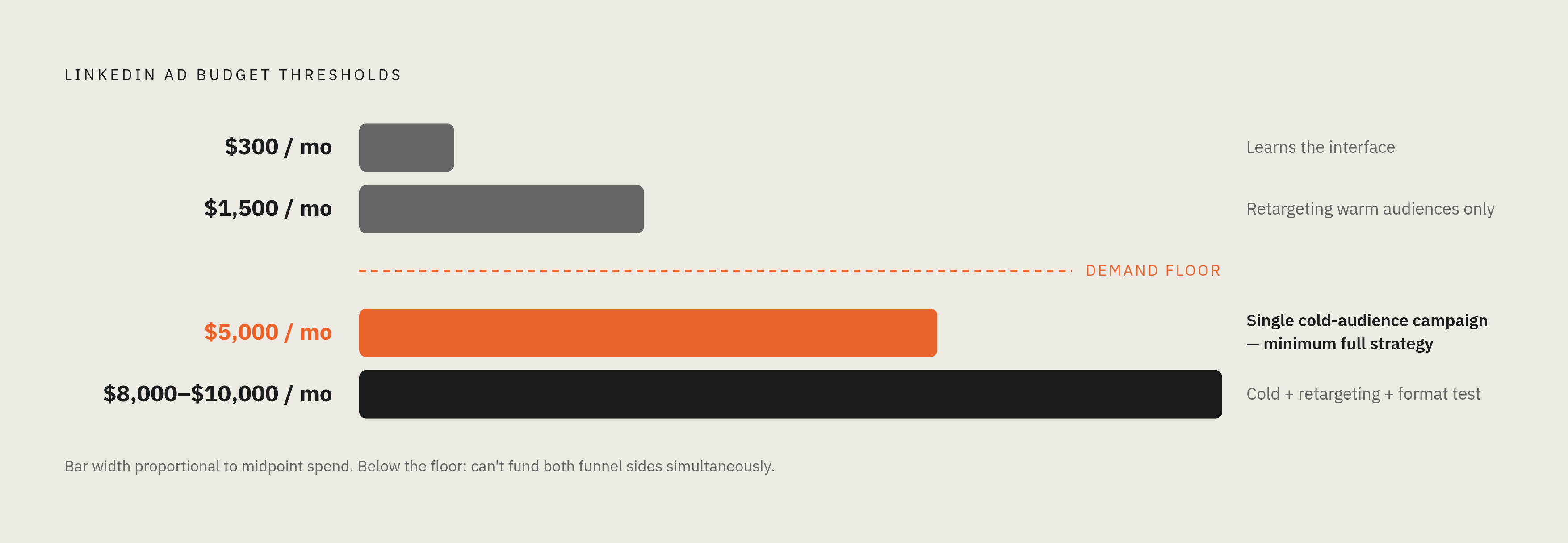
If $10 a day is the wrong anchor, what's the right one? $100 a day, or roughly $3,000 a month, is the floor for a single campaign to generate conversion data that means anything.
Below that threshold, every optimization decision gets made on too little evidence. You're not steering the campaign — you're guessing which way to steer it, and calling the guess a strategy.
From there, the right number depends on the stage of the program:
- Retargeting-only (website visitors, content engagers): around $1,500 a month. The audience is already warm. The job isn't introducing yourself, it's closing a loop that's already open.
- A single demand-gen campaign against a cold audience: around $5,000 a month. Roughly the floor for reaching a meaningful slice of an audience at a frequency that registers.
- A multi-campaign program (cold outreach plus retargeting plus at least one format test): $8,000 to $10,000 a month.
Be honest about the low end too. $300 a month teaches you how the interface works. It won't teach you whether LinkedIn works for your business. That's orientation, not a demand program, and confusing the two is exactly how companies conclude "LinkedIn doesn't work" when what actually happened is they never funded it enough to find out.
The $5,000-a-month figure is roughly the minimum needed to run a full cold-to-deal strategy in North America. Below it, a program can't fund both sides of the funnel (generating new pipeline and capturing the people already circling) at the same time. Something gives — usually the ability to tell whether either half is working.
For context, a Series A company with a validated ICP typically runs $8,000 to $20,000 a month, spread across two or three campaign types: something conversion-focused against the core ICP, retargeting to keep spend concentrated on the warm end of the funnel, and optionally a thought-leadership layer to build the recognition that makes the rest of the funnel cheaper later.
Audience size and the budget efficiency problem most teams don't see coming
Budget alone doesn't decide whether a campaign spends efficiently. Audience size does too, and almost nobody accounts for it until the campaign has already burned a month of spend.
LinkedIn recommends a minimum audience of 15,000 to 25,000 members for a campaign to run properly. The sweet spot for testing sits between 50,000 and 300,000. Below roughly 15,000, the system frequently can't spend the allotted budget at all — it runs out of people to show the ad to before it hits the frequency it needs.
Here's what that means in practice. A $3,000 to $5,000 monthly budget, at $31 to $34 CPM, buys enough impressions to reach somewhere around 10,000 to 30,000 people at six to ten exposures each over a month. Reach plus repetition is what produces a measurable effect on brand recall and pipeline.
Consider a common mistake: targeting VP-and-above titles at companies under 500 people, in one specific vertical. It sounds like a tight, sensible ICP. It's also the kind of targeting that often lands well below the 15,000 minimum. Budget and targeting have to get planned together. Planning them sequentially ("we'll figure out the audience once we know the budget"), or the reverse, is how a $5,000 budget ends up chasing a 10,000-person audience straight into a frequency ceiling: burning spend on the same people over and over without ever generating enough net-new conversion events to learn anything.
When that happens, the answer isn't to push harder on the same targeting. Widen the audience, or admit that LinkedIn, at least for this specific ICP slice, isn't the right channel yet.
The budget dilution trap: how spreading spend across campaigns produces no data from any of them
Here's a failure mode that looks reasonable on paper and isn't. A team has $3,000 a month. Instead of putting it behind one campaign, they split it across four: a cold campaign, a retargeting campaign, a format test, something aimed at a second segment. Feels diversified. Feels safe.
It's neither. That split works out to roughly a few dozen dollars a day per campaign, enough for maybe one or two clicks a day, each. After 30 days, there's data scattered across four campaigns and statistically significant results in exactly none of them. The natural conclusion: "LinkedIn doesn't work for us."
The actual diagnosis is simpler: no single campaign ever got enough fuel to exit the learning phase. The budget existed in aggregate. It never existed where it needed to (inside one campaign, long enough to mean anything).
It gets worse when teams test format, audience, and creative all at once, inside these same underfunded campaigns. Instead of learning one clear thing about one clear variable, the account produces noise on three fronts at once, and noise doesn't average out into insight. It just looks like insight if you squint.
The fix is a sequencing discipline, not necessarily a bigger budget, though that helps too. Run one or two campaigns at a level that can reach data maturity, and only layer on the next test once the first one has told you something real. This is a governance problem as much as a budget problem. Someone in the room has to be willing to say "we're not launching campaign five, we're waiting until campaign two has enough data," when the instinct on most marketing teams is to cover more ground, not less.
What the cost benchmarks reveal about where budget actually goes furthest
Assume the budget is right-sized and concentrated. Where should it go? Most teams have this backwards, and the gap isn't small.
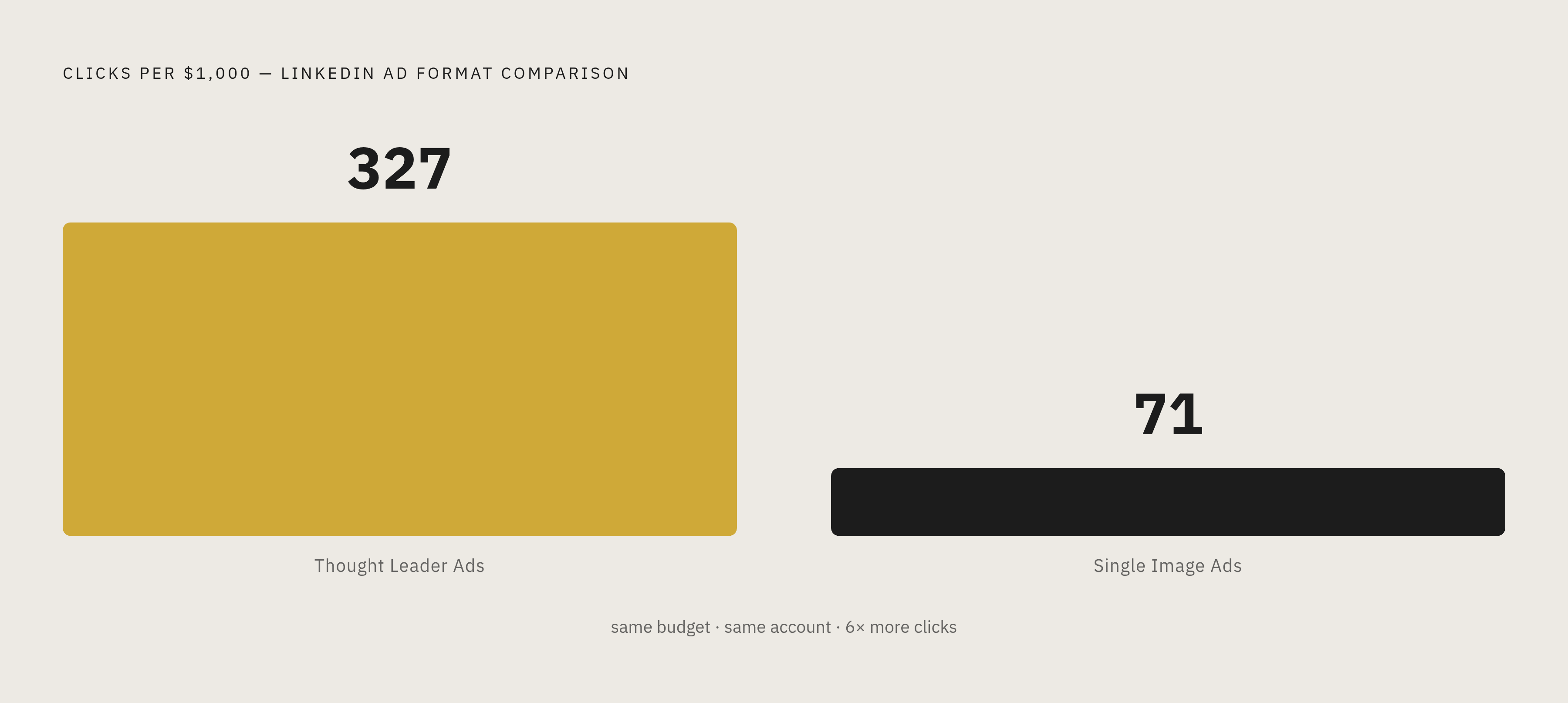
Available benchmark data finds Thought Leader Ads are 77% cheaper per click than single image ads. In dollar terms: $1,000 buys roughly 327 clicks through Thought Leader Ads, versus roughly 71 clicks through single image ads — close to a six-times difference, per click, for two formats sitting in the same ad account.
Most B2B teams still put the bulk of their spend behind single image ads, largely out of habit, because it looks and feels like a traditional display ad. That habit is the real waste in this whole discussion, more than any of the underfunding problems above. It isn't safe. It's just familiar, and familiar is costing five times as much per click as it needs to.
Timing matters too. Q3 sees the highest cost per click, $15.72, but also the highest click-through rate at 0.96%. Q1 is the cheapest quarter for clicks, at $10.48, but also the weakest performer, with a CTR of 0.82%. That's roughly a 50% swing in cost between the two quarters, strong enough to justify shifting budget across the year rather than spreading spend evenly and hoping it averages out.
On lead capture: Lead Gen Forms, LinkedIn's native form that pre-fills with a user's profile data, reduce cost per lead by 20 to 30% compared to sending traffic to a landing page. That doesn't make landing pages obsolete. Landing pages remain necessary for retargeting pixels and account-level tracking. Different jobs; picking one because it's cheaper misses that they're measuring different things entirely.
Which sets up the number that matters most: median pipeline return on LinkedIn ad spend sits at $5.21 for every dollar spent. Top performers reach $15.20. That gap isn't random. Top performers concentrate spend rather than diluting it, lean more heavily on Thought Leader Ads, and optimize for pipeline, not clicks or cost-per-lead.
What stage and company context should actually determine the LinkedIn budget decision
None of the numbers above matter if the company isn't at the right stage to spend them well. LinkedIn is not a channel for finding product-market fit. It's a channel for scaling a message that already works. Treating it as anything else is the most expensive mistake on this list, more expensive than underfunding a campaign or picking the wrong format.
If a company hasn't validated its ideal customer profile, or hasn't confirmed which messaging actually converts, the same dollars go further in direct outreach and founder-led selling. LinkedIn rewards precision. Without a validated ICP, there's nothing to be precise about, and the budget conversation is premature. No amount of money fixes that.
That precision requirement connects directly to why LinkedIn costs what it costs. CPMs run $30 to $60, against roughly $7 to $15 on Facebook. That premium reflects a professional audience with real firmographic and job-title data behind it. But a premium audience only pays off when the targeting is sharp enough to convert it into pipeline. Pay the premium without the precision, and the extra cost buys nothing at all.
Consistency matters as much as precision. Top-performing programs spend at a steady, sustained rate rather than bursts of activity followed by silence. The algorithm's learning compounds over time; turning a campaign off and back on resets progress the system already made. "Burst and pause" spending is, functionally, a decision to keep restarting the learning phase indefinitely, then acting surprised when it never finishes.
Per Dreamdata's 2026 data, LinkedIn now captures 41% of total B2B ad budgets, up two points year over year. That growth reflects money moving away from non-branded search. It is not proof that LinkedIn performs well at any spend level. Rising channel share is a market signal, not a permission slip to underfund a campaign and expect it to compete with better-funded ones.
The real question before setting a LinkedIn budget isn't "what's the minimum I can spend?" It's: is the ICP validated, is the messaging proven, and is there budget to sustain at least $5,000 a month for a full quarter? If the answer to any of those three is no, the platform's $10 minimum is irrelevant. There's no budget number that fixes a strategy problem.
Why pipeline (not CPL or clicks) is the only metric that validates whether the budget was right
Suppose the budget is right, the audience is sized correctly, the spend is concentrated, and the format mix is smart. How do you know it worked? Not by looking at cost-per-lead. That number will lie to you convincingly.
CPL on LinkedIn ranges anywhere from $35 to $200-plus, depending on industry, seniority, and offer type. That range is wide enough to be nearly useless on its own. A $150 CPL might be excellent for enterprise software and terrible for a low-priced SMB tool. CPL tells you what a lead cost. It tells you nothing about whether that lead ever became pipeline.
There's a deeper measurement problem underneath that, and it's the real reason CPL should get far less weight than most dashboards give it. Only 0.04% of LinkedIn users click on ads, which means the vast majority of a campaign's influence on a buyer never shows up as a click, and therefore never shows up in last-click attribution. Someone can see an ad five times, mention the company in a sales call three weeks later, and close as a deal, with zero click ever recorded against that campaign. Last-click measurement will always undercount LinkedIn's actual pipeline contribution. That's structural. No amount of better tracking fixes it, because the thing it's trying to measure doesn't leave a click behind.
B2B marketers who invest in full-funnel attribution are substantially more likely to hit their primary goals than those relying only on platform-reported metrics. Platform metrics answer "did the ad get seen and clicked." They don't answer "did the ad make the business money," which is the only question anyone signing off on the budget actually cares about.
Brand recognition compounds the problem. LinkedIn's B2B Institute analyzed many hundreds of campaigns in a 2025 study called "Easy to Find," and found branded campaigns returned $12.99 for every dollar spent, against $0.68 for generic campaigns — roughly a 19-times gap. Budget spent before a brand has any recognition in the market is structurally weaker, no matter how well the campaign is built. That's not a creative problem. It's a sequencing problem: brand recognition has to exist before performance campaigns can convert efficiently against it.
Put it together and the measurement mistake becomes obvious: a team that sets a smart, well-sized budget and then judges it by MQLs or cost-per-click will draw the wrong conclusion about whether the money worked. The signals that actually answer the question are pipeline created, pipeline generated per dollar spent, and self-reported attribution (simply asking new prospects how they heard about the company, and tracking the answer over time).
Treat the whole system (creative, landing pages, attribution, reporting) as one connected pipeline instead of a series of handoffs between teams. Data thrown away at the end of each campaign flight never compounds into anything. Data carried forward, campaign to campaign, is what turns a $5,000-a-month experiment into an actual, repeatable growth engine.