Account-Based Marketing Attribution for LinkedIn Pipeline
Standard attribution hides LinkedIn's influence on enterprise deals—here's how to measure it.

Let me open with a confession: I spent years looking at LinkedIn Ads performance reports and feeling vaguely gaslit.
The spend was real. The impressions were real. But when I'd pull attribution data at the end of the quarter, LinkedIn looked like it was doing almost nothing. Direct traffic got the credit. Organic search got the credit. LinkedIn sat in the corner looking guilty for a crime it didn't commit.
It took a while to realize the problem wasn't LinkedIn. The problem was the measurement architecture underneath it.
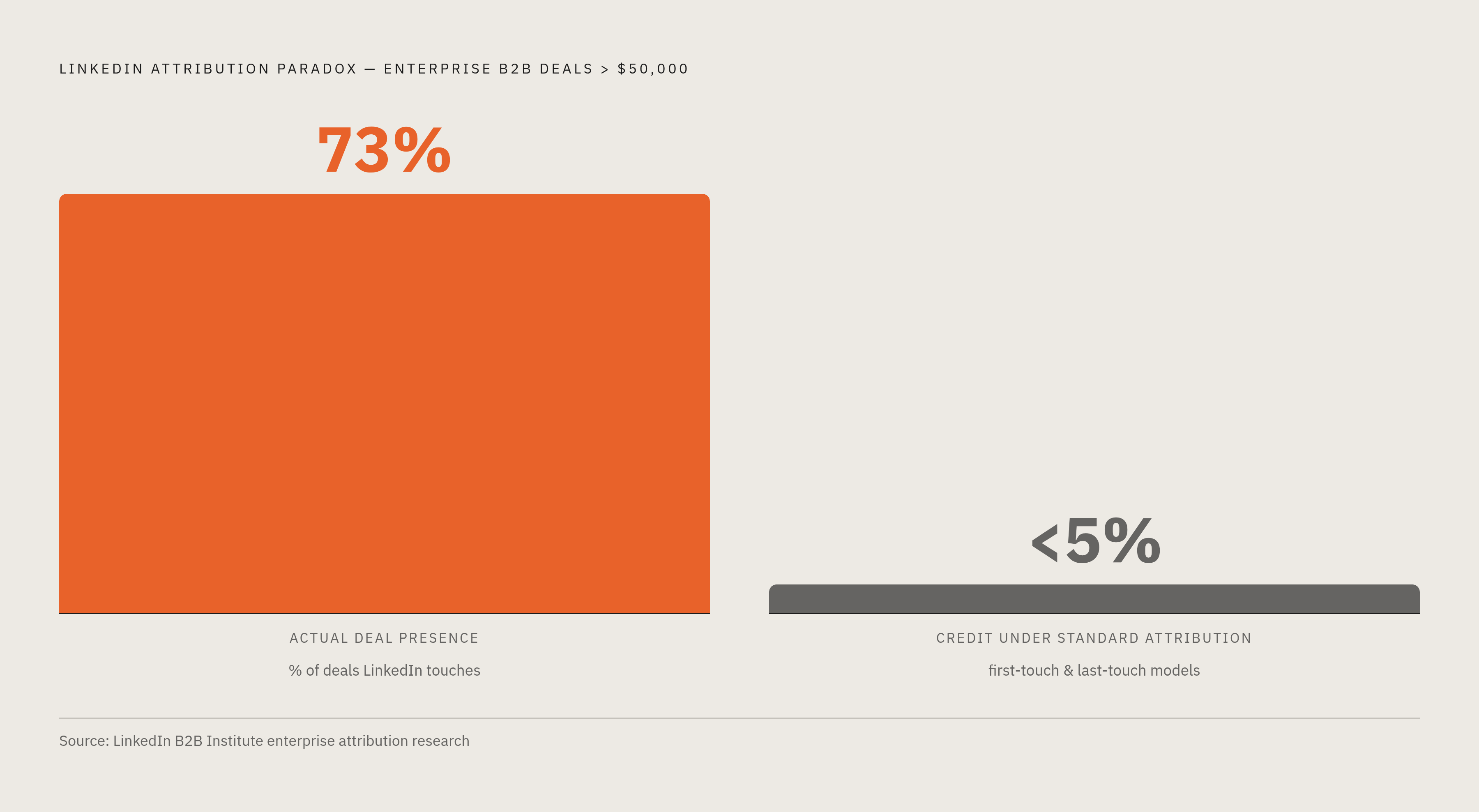
Here's the stat that snapped things into focus for me: per the 2025 Dreamdata B2B Benchmarks Report, LinkedIn Ads appear in the attribution path of 73% of enterprise B2B deals over $50,000. Seventy-three percent. And yet, first-touch credit routinely goes to direct or organic. How does a channel that touches nearly three-quarters of deals get almost no credit?
Because LinkedIn warms buyers before they search. By the time a prospect types your URL or clicks a Google ad, LinkedIn already did its job. The influence is invisible to standard models because standard models are looking in the wrong place, at the wrong time, for the wrong signal.
That's not a LinkedIn problem. It's an architecture problem. And for ABM teams running enterprise campaigns, the consequences are real: if LinkedIn's influence doesn't show up in attribution, budget gets reallocated away from the channel that's quietly building your pipeline.
Let's walk through how this actually works and what to do about it.
How Standard Contact-Level Attribution Breaks Down for Buying Groups
Start with the core mismatch. The average B2B deal involves somewhere around 6.8 decision-makers; standard attribution treats each one as a separate, unrelated lead journey.
Picture it: LinkedIn Ads reach your VP of Engineering. A CFO downloads a case study. A procurement lead attends a webinar. In your CRM, that's three separate leads. In reality, it's one account moving toward a decision. Attribution rarely connects those dots. It sees three individuals. You need it to see one buying group.
And then there's the last-touch problem. Last-touch attribution credits the demo request or the sales call; everything that built the trust required to get there is gone. Every LinkedIn impression, every content view, every mid-funnel touchpoint that warmed the relationship is erased by a single conversion event at the bottom.
But what if click-tracking itself is the deeper problem here? Research estimates the average B2B software transaction involves hundreds of touchpoints. Click-tracking captures a tiny fraction of that activity. LinkedIn impressions and view-throughs are almost entirely invisible to click-based models. Which means campaigns that influence pipeline look like they produce nothing, while bottom-funnel conversions look like they do everything.
This is also why measuring ABM LinkedIn performance at 30 days is particularly destructive. You're evaluating an awareness-building channel before account-level signals have had time to consolidate into anything measurable. You kill the campaign. You reallocate the budget. And then you wonder why pipeline dried up two quarters later.
What Account-Level Attribution Actually Tracks and Why the Unit of Measure Matters
Here's the shift that changes everything: stop measuring contacts. Start measuring accounts.
ABM attribution aggregates all touchpoints across every stakeholder at an account and connects that collective engagement to pipeline movement. The question is no longer "did this contact convert." The question is "is this account progressing, and what moved it."
That one change in framing unlocks a completely different set of metrics:
- Account reach rate: What percentage of your target account list was actually exposed to ads
- Account engagement score: Combined activity across all contacts at an account
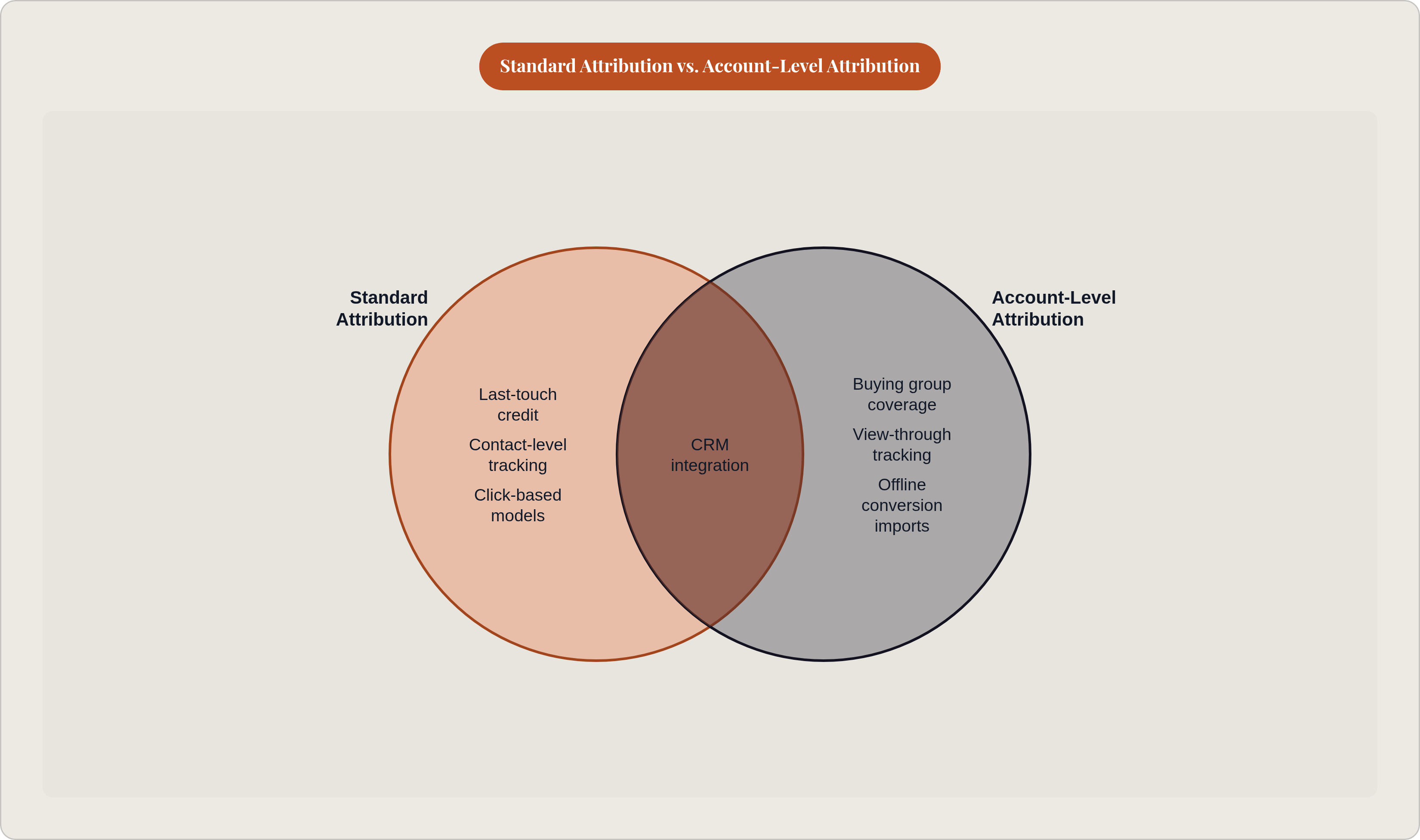
- Buying group coverage: How many known decision-makers at a given account have been touched
- Target-to-opportunity rate: How accounts on your list convert compared to a holdout group
- Marketing-influenced pipeline: Not just what marketing sourced, but what it touched along the way
That last one matters a lot. LinkedIn will rarely get "sourced" credit in a direct-response sense; but it will routinely show up as an influencer on accounts that close. If your model doesn't capture influence, LinkedIn is invisible. And invisible channels lose budget.
Multi-touch attribution models are required to make this work. First-touch and last-touch are both lies. They're just different lies. Tools like Bizible or LinkedIn's native Revenue Attribution Report distribute credit across the full journey, which is messier but far more honest.
View-through attribution deserves specific attention. By tracking exposure rather than just clicks, it can reveal substantially more engagement than click-through data alone. Two to four times more, in some cases. For a channel like LinkedIn where most influence happens before anyone clicks anything, view-through isn't a bonus feature. It's a necessity.
The conceptual shift here is worth sitting with. Attribution stops being a way to count conversions; it becomes a way to read account momentum.
The CRM Integration Layer That Makes Account-Level Attribution Possible
LinkedIn shows engagement. Your CRM shows pipeline; without connecting them, neither dataset is actionable. You have two partial pictures that don't talk to each other.
The connection mechanism is straightforward in concept and annoying in execution. You sync CRM data with LinkedIn Campaign Manager via native integrations (HubSpot and Salesforce both support this). This lets you segment audiences by real-time deal stage and start closing the loop between ad exposure and pipeline movement.
The piece most teams skip is offline conversion imports. This is where pushing deal-stage events back into LinkedIn matters. When you import MQL, SQL, and opportunity-created events back into the platform, LinkedIn's algorithm can optimize toward actual pipeline events rather than raw form submissions. You're teaching the platform what a real outcome looks like.
For this to work cleanly, you need three things in place:
- Consistent UTM architecture across every LinkedIn campaign, without exception
- A lead source field in Salesforce or HubSpot that survives the handoff from marketing to sales (this breaks more often than anyone admits)
- A regular import cadence for offline conversion data; weekly is the practical minimum
LinkedIn's Conversions API is also worth prioritizing over pixel-only tracking. It's server-side, less dependent on browser cookie behavior, and more reliable for the account-level matching you're trying to do.
The structural difference between a pipeline-first program and a lead-gen program lives in this layer. Lead-gen programs stop at form fills; pipeline-first programs push deal-stage data back upstream so the campaign learns what actually converts. One approach gets smarter over time. The other keeps optimizing for people most likely to submit a form.
How Person-Based Targeting on LinkedIn Closes the Gap Between Ad Exposure and Known Accounts
Here's a core attribution gap that doesn't get talked about enough. Most platforms can target by title and company; but they can't confirm which specific individuals within a target account actually saw an ad. Impression data stays on the platform side. You know an impression was served. You don't always know to whom.
Person-based advertising addresses this by targeting known individuals matched from a CRM list or a mapped buying committee rather than broad audience segments. This creates a traceable path from exposure to account.
LinkedIn's Matched Audiences and account lists let you scope campaigns to a defined target account list. "Account reach rate" becomes a measurable output rather than an estimate. That's a meaningful improvement. You move from "we think we're reaching finance leaders at enterprise accounts" to "here's the percentage of our actual target list that saw this campaign."
Tools like Fibbler take this further by surfacing which companies from a target account list are viewing or engaging with LinkedIn Ads, then pushing that signal into the CRM so sales can act on it at the right moment. Factors.ai offers a complementary approach: tracking how impressions turn into pipeline via view-through attribution, weighted by account fit and intent score.
Why does this matter for attribution? Because it replaces estimation with actual signal. Sales and marketing stop working from separate lists and start sharing a single account-level view: who's been touched, how often, and with what content. That shared view is what makes coordination possible; without it, marketing reports on CPL while sales works a different list entirely.
Why LinkedIn Lead Gen Forms Flatter Volume Metrics While Hiding Pipeline Quality
Let me be direct about something. LinkedIn lead gen forms feel like a win. Pre-filled contact data, minimal friction, form submissions rolling in. The dashboard looks great.
And then you actually talk to sales.
Pre-filled forms produce contacts who did not consciously decide to engage. They tapped a button, saw their information already populated, and submitted without any real intent to follow through. The friction that was removed was also the filter that would have told you something about intent.
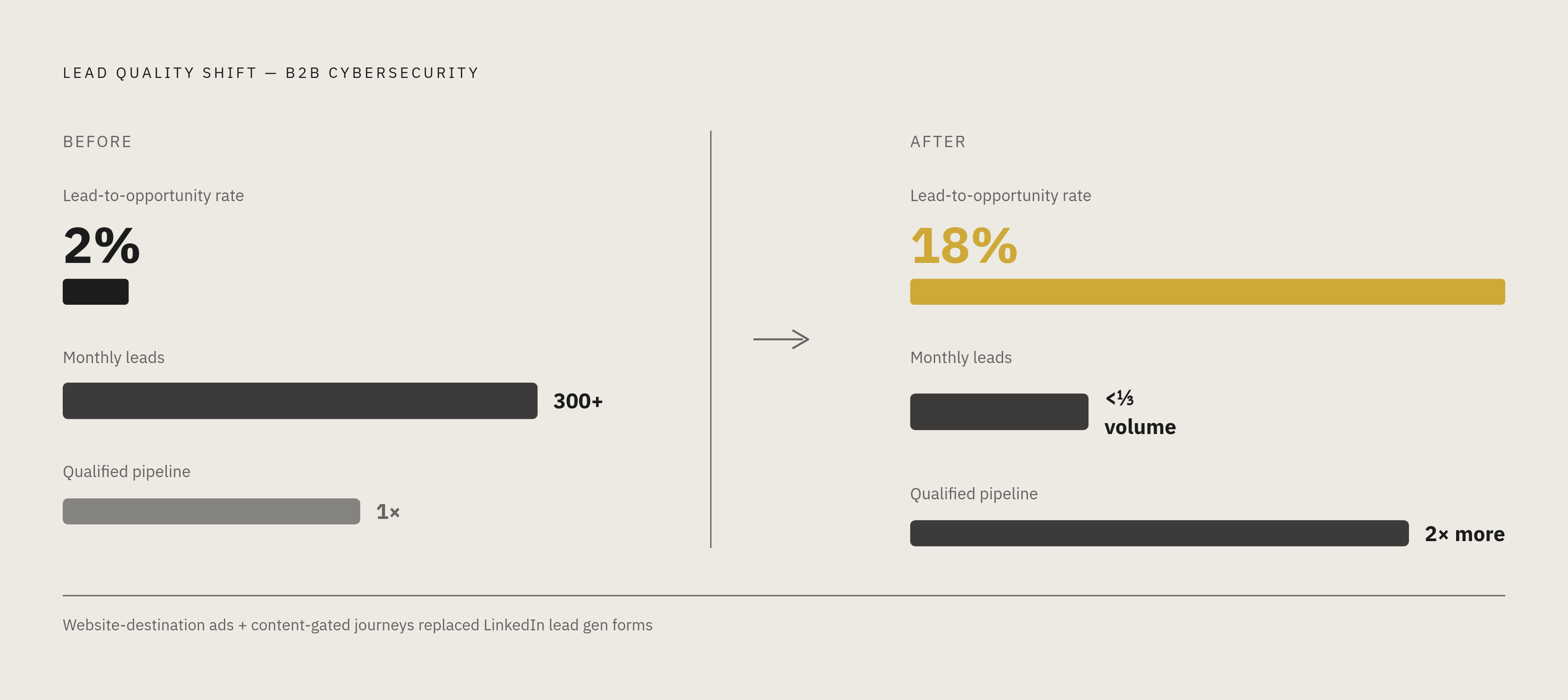
Here's a concrete example that illustrates the problem. A B2B cybersecurity company was spending heavily on paid media, with the large majority of that spend going to LinkedIn lead gen forms. They were generating hundreds of leads per month; but their lead-to-opportunity rate was around 2%. After restructuring toward website-destination ads and content-gated journeys, lead volume dropped significantly. But their lead-to-opportunity rate rose to 18%. The result was more than double the qualified pipeline from less than a third of the leads.
That raises an important question: what was the algorithm optimizing for during the lead gen form period? The people most likely to tap a pre-filled form. Which is not the same population as the people most likely to become pipeline.
When you send traffic to the website instead, prospects self-select. The ones who navigate, read, and then convert are signaling something real. And that signal, when passed back to LinkedIn via offline conversion imports, teaches the algorithm what an actual pipeline event looks like.
For ABM specifically, the goal isn't volume. It's coverage of the target account list and quality of engagement within it. Form fill rate is the wrong headline metric. It's not even in the right ballpark.
Building a Multi-Touch Attribution Model That Reflects How LinkedIn Actually Influences the Buying Journey
A working multi-touch model for LinkedIn ABM has four connected pieces. Not optional pieces. Connected pieces.
Account matching. Every touchpoint is tagged to an account, not just a contact. This requires clean CRM structure and LinkedIn Matched Audiences scoped to the target account list. If your CRM doesn't have clean account hierarchies, fix that first; nothing else works without it.
View-through attribution layer. This captures LinkedIn impressions and content views that produce no click. Without this layer, the majority of LinkedIn's influence is invisible. You're measuring the tip of the iceberg and concluding there's no iceberg.
Offline conversion imports. Deal-stage events pushed back into LinkedIn on a weekly cadence. MQL, SQL, opportunity created, closed-won. This is what separates a model that reflects reality from one that reflects form submissions.
Influence reporting. Marketing-influenced pipeline separated from marketing-sourced pipeline. LinkedIn will rarely be sourced; it will almost always be an influencer. If your model doesn't have an influence bucket, LinkedIn disappears from your reporting.
The timing question matters more than most teams acknowledge. The first 30 days of a LinkedIn ABM campaign build account-level frequency; pipeline and booked meetings typically emerge in month two and beyond. The attribution model needs to hold the full window or it will show nothing, someone will pull the budget, and the conclusion will be that LinkedIn doesn't work. The real conclusion is that the window was too short.
A holdout control group is the cleanest way to isolate LinkedIn's actual contribution. Take a subset of the target account list and exclude them from LinkedIn Ads. Compare pipeline velocity between the exposed group and the holdout. That's the cleanest answer to "is LinkedIn actually moving accounts, or were those deals going to close anyway."
One more thing worth flagging: Thought Leader Ads. Available campaign data suggests they can drive a disproportionate share of conversions relative to spend, at roughly half the cost per conversion of cold traffic; but because much of their impact is view-driven, click-based models will undercount them significantly. If you're running Thought Leader Ads and wondering why they don't show up in your attribution, the model is the problem.
What LinkedIn Attribution Reporting Should Look Like for a Revenue Team Running Weekly Pipeline Reviews
Attribution data is only valuable when it changes decisions. That's the only test that matters. If the report doesn't change what someone does next week, it's not a report. It's a decoration.
The format should answer three questions every week: which accounts in the target list are showing engagement, what changed in pipeline since last week, and what's the next action.
Account-level reporting surfaces what lead-level reporting buries:
- Which target accounts crossed an engagement threshold this week (frequency, asset consumption, multiple stakeholders touched)
- Which accounts entered pipeline and which LinkedIn touchpoints appeared in their path
- Marketing-influenced pipeline as a dollar figure, separated from sourced pipeline
- Cost per engaged account, not cost per lead, as the primary efficiency metric
That last one is worth dwelling on. Cost per lead measures something that may or may not matter; cost per engaged account measures whether you're actually moving your target list. Those are very different questions.
Sales and marketing also need to see the same account view. Sales should know when a target account has passed an ad engagement threshold and be primed to act on it. Marketing should know which accounts sales has already touched so campaigns can support rather than duplicate outreach. When those two teams are working from different data sources, the coordination that makes ABM work falls apart.
Budget allocation decisions should follow account engagement data, not platform-reported CPL. If LinkedIn is appearing in the attribution path of nearly three-quarters of closed enterprise deals, that's your case for holding or increasing the budget. Even if the platform's own reported CPL looks high relative to other channels. The platform CPL is measuring the wrong thing.
And here's what I find compelling about getting this right: good attribution compounds. Each campaign cycle, the target account list improves. The offline conversion data fed back into the platform makes the algorithm smarter. The reporting makes the next budget conversation easier. Attribution isn't a one-time setup problem; it's the feedback loop that makes the whole program learn.
The teams I've seen struggle with LinkedIn ABM are almost always struggling with measurement architecture, not with LinkedIn itself. Fix the measurement. The channel tends to vindicate itself.