LinkedIn Ads Attribution Models for B2B Revenue Teams
Last-touch attribution misses how LinkedIn actually influences complex B2B deals.

LinkedIn Ads attribution has a math problem, and it's costing revenue teams real budget. Campaign Manager defaults to last-touch attribution: the last ad someone clicked before converting gets all of the credit. Everything before that click? Ignored. On a platform where the buying journey drags on for months and touches dozens of people, that's not a rounding error. It's the difference between knowing whether LinkedIn works and just guessing at it.
So let's walk through why that gap exists, what LinkedIn has done to shrink it, and what a revenue team actually has to build to answer the only question that matters: does LinkedIn spend turn into pipeline and closed deals, or doesn't it?
What the attribution model taxonomy actually means for B2B buying journeys
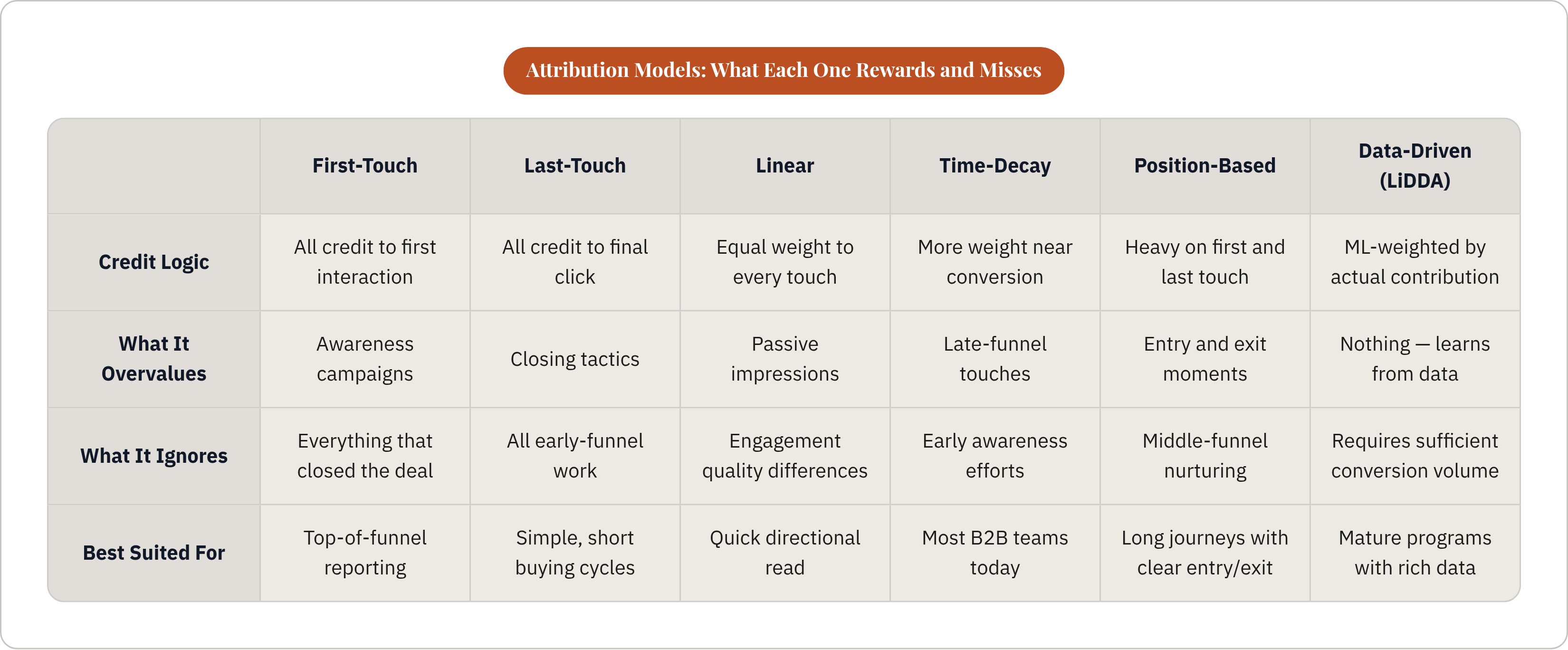
Start with the model, because whichever one you pick decides what story your data tells.
Single-touch models (first-touch and last-touch) are simple to explain and easy to build. That's also their whole problem. First-touch hands everything to the first ad someone ever saw, which makes your awareness campaigns look like heroes and ignores whatever actually closed the deal. Last-touch does the opposite: it rewards whatever happened right before conversion and erases every bit of work that built the interest in the first place.
A typical B2B buyer has somewhere between 8 and 12 meaningful interactions before they convert, according to Gartner. No single-touch model can hold that many moving parts. You're watching one frame from an eight-minute film and calling it the plot.
Here's what that looks like with real money attached: a B2B SaaS company spending $2.1 million on ads almost pulled the plug on LinkedIn entirely. Last-click Google Analytics said LinkedIn was driving just 8% of conversions at an $890 cost per acquisition. Ugly number. Then they ran a multi-touch model on the same data, and the conclusion flipped. LinkedIn wasn't underperforming. It had just been invisible to the tool they were using to grade it.
Rule-based multi-touch models spread the credit around using a formula instead of a single moment:
- Linear gives every touch equal weight. Sounds fair. In practice it treats a passive ad impression the same as a demo request, which isn't fair at all.
- Time-decay gives more weight to touches near the conversion while still counting the early ones. This is the workhorse for most B2B teams right now, since it rewards what's closing deals without pretending the early-funnel work never happened.
- Position-based (U-shaped) loads most of the credit on the first and last touch and splits the rest across the middle. One 2025 LinkedIn Ads benchmark report used a 40/40/20 split like this to get a fuller read on the journey.
Data-driven attribution skips the fixed formula entirely and lets a model learn from actual conversion patterns. LinkedIn's own LiDDA model uses attention-based machine learning to weight each touchpoint by what it actually contributed, which beats guessing by a mile.
Multi-touch adoption is climbing, but last-touch still isn't going anywhere. Old habits die slow, even the expensive ones. Teams that do make the jump report meaningfully lower acquisition costs and better ROI, and some find that a big chunk of their spend had been sitting in the wrong place the whole time.
Where this is all heading isn't "find the one perfect model." It's stacking a few together: multi-touch attribution, marketing mix modeling, and incrementality testing, side by side, because no single method tells the whole story on its own.
What LinkedIn's native infrastructure can and cannot do after the 2024–2025 updates
LinkedIn knows it has an attribution problem. It's been building its way out of one piece at a time.
The Revenue Attribution Report, launched in September 2024 and expanded in July 2025, is the biggest swing so far. It connects to Salesforce directly, so ad activity can be traced to closed deals right inside Campaign Manager. It surfaces company-level attribution and campaign-level revenue, not just clicks and leads. One catch worth knowing up front: it's not plug-and-play. You need API access, the right permissions, and a properly set up Business Manager account before any of it works.
Conversions API (CAPI) sends conversion signals server-side instead of leaning on browser tracking, which gets shakier every year. LinkedIn says CAPI users see lower cost per acquisition and more attributed conversions than pixel-only setups. And more companies using CAPI are now optimizing toward pipeline and revenue instead of clicks and form fills, which tells you where the industry's head is at.
The Company Intelligence API, launched in September 2025, lets attribution partners track engagement at the organization level, across paid and organic. This matters because B2B doesn't sell to individuals. It sells to companies and the group of people inside them. One integration with Dreamdata reported a real jump in attribution accuracy for multi-touch pipeline reporting.
So where's the ceiling? LinkedIn can show you influence and revenue within its own walls. It cannot see what happened on Google, on your website, in an email sequence, or on a sales call. It can't model credit across channels, and it can't tell you what revenue LinkedIn actually caused versus what just happened to occur near LinkedIn activity. That's not a knock on LinkedIn. It's just what any single platform, by definition, can't see past its own fence.
Why account-level measurement changes what LinkedIn attribution can actually answer
Nobody signs a six-figure contract because they clicked one ad. B2B deals close because a group of people, often without ever saying it out loud, slowly agree it's worth doing. Dreamdata's 2026 report puts a number on that: the average customer journey involves close to 7 stakeholders and nearly 4 channels, stretched over roughly seven months.
If you're measuring at the individual level, you'll credit whoever happened to click last, not the person on the buying committee whose engagement actually pushed the deal forward. That's the wrong hero for the story.
Account-level measurement asks a different question. Not "which ad did this person click?" but "which ads touched this account, how often, at what stage, before it turned into a real opportunity?"
Factors.ai found that accounts with three or more LinkedIn touchpoints before their first sales conversation close at more than twice the rate of accounts with no LinkedIn exposure at all. You'd never catch that pattern looking at individual clicks. It only shows up once you zoom out to the account level.
To actually run this, you need three things in place:
- CRM accounts matched to LinkedIn company data, which is exactly what the Revenue Attribution Report and Company Intelligence API are built for
- Opportunity stage timestamps in your CRM, so you can sort touchpoints into before-the-deal and after-the-deal
- A shared definition of "influenced" that marketing and sales agree on before anyone pulls a number, because the same raw data can back two totally different arguments depending on how you define that one word
If you're running ABM or a sales-led motion, this isn't optional. It's the only measurement approach that actually matches how those deals get won.
The external attribution tools that close the gaps LinkedIn's native reporting leaves open
There are three kinds of tools people reach for here, and they solve different problems.
B2B revenue attribution platforms like Dreamdata, HockeyStack, and Factors.ai are built for exactly this: multi-touch, account-level journey mapping across every channel, not just LinkedIn. They plug into LinkedIn's APIs, your CRM, and your other ad platforms, then hand back pipeline influence and closed-won revenue broken down by channel and campaign.
Data warehouse approaches (piping tools like Segment or Rudderstack into a BI layer) give you more control and flexibility, but they cost real engineering time. Worth it if you need custom attribution logic or already run a mature data setup. Overkill if you don't.
Marketing mix modeling (MMM) vendors step back further and estimate channel contribution from aggregated spend and revenue data, without tracking individual users at all. As privacy restrictions keep chipping away at user-level tracking, this approach is only getting more relevant.
When you're sizing any of these up, ask:
- How well does it match anonymous LinkedIn activity back to actual CRM accounts?
- Does it just push attributed conversions out, or does it pull opportunity stage data in too?
- Does it cover the full path (LinkedIn, Google, direct, organic) in one connected view?
- Can it run incrementality tests, or is it just showing you correlation and calling it causation?
That last point matters more than people give it credit for. A multi-touch model can show you LinkedIn touched a deal. It can't prove LinkedIn caused the deal without a holdout test to check against.
Nobody's tool gives you the full picture, and it's worth saying that plainly instead of pretending otherwise. The setup most teams land on: one attribution platform for day-to-day optimization, MMM for planning next quarter's budget, and periodic incrementality tests to check that both are telling the truth. And ideally, whoever runs your paid media day to day is the same person reading these numbers, not a separate reporting team eyeballing the campaigns from a distance.
How to connect LinkedIn ad activity to pipeline and closed-won revenue in practice
Before you touch any attribution tool, fix your CRM. Lead and account records need consistent UTM tracking, a clean lead source field, and opportunity creation dates you can line up against ad touchpoint timestamps. Skip this step and every attribution model downstream is built on sand. It really is that basic, and it really does get skipped that often.
Next, decide what question you're actually trying to answer, because "LinkedIn-sourced pipeline" and "LinkedIn-influenced pipeline" are two different numbers:
- Sourced means LinkedIn was the first real touch before the opportunity opened.
- Influenced means LinkedIn touched the account at some point before the deal closed, first touch or not.
Both are legitimate numbers. Neither is the whole story. Agree on which one you're reporting, and what it actually means, before you show it to leadership, or you'll end up with two people arguing over the same spreadsheet.
The practical stack looks like this:
- CAPI for server-side conversion signal, so you're not bleeding data to browser restrictions
- Revenue Attribution Report for CRM-connected deal influence, right inside Campaign Manager
- Company Intelligence API, through a partner like Dreamdata, for account-level engagement across paid and organic
- CRM stage webhooks so opportunity stage changes flow into your attribution layer, letting you sort touchpoints into before-the-deal and after-the-deal
Report at the cadence that matches what you're actually trying to see:
- Weekly: CPL, click-through rate, spend pacing. These are steering inputs, not business results, and treating them like results is how teams panic over noise.
- Monthly: pipeline influenced, cost per pipeline dollar, stage conversion by campaign and audience.
- Quarterly: closed-won revenue tied to LinkedIn, cost per acquisition by channel, and where the budget should move next.
Here's a trap worth naming out loud: HockeyStack's 2025 data shows B2B SaaS companies spend over 30% of their annual LinkedIn budget in Q4. But Q4 leads take an average of 68 days to close, so a lot of those deals land in Q1. A 30-day attribution window drops those conversions entirely, or credits them to the wrong quarter. Only a CRM-connected pipeline view (one that doesn't care what the calendar says) catches them.
How LinkedIn and Google fit into one attribution system rather than competing for budget credit
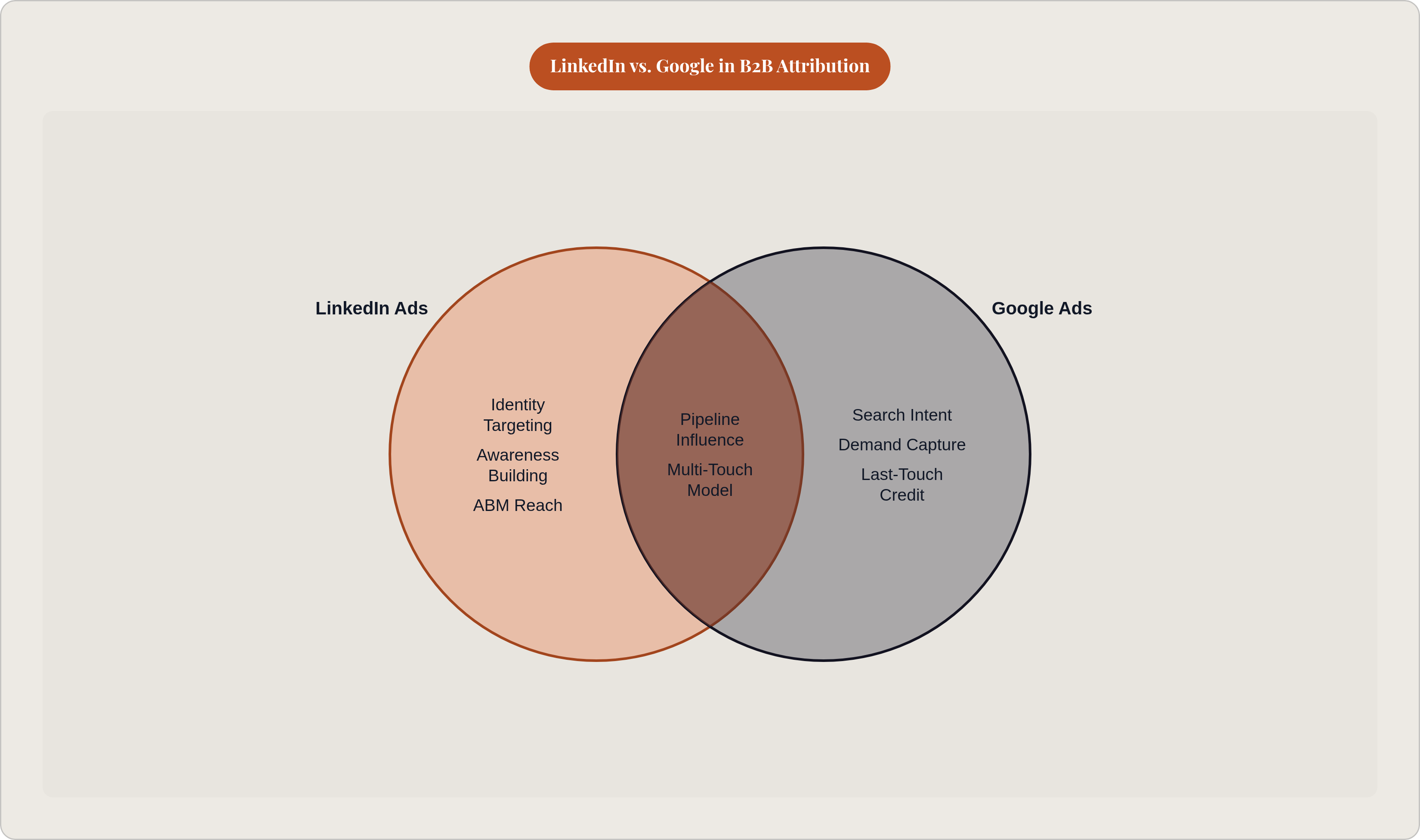
LinkedIn and Google aren't rivals. They just do different jobs, and treating them like competitors for the same credit is where a lot of this goes wrong.
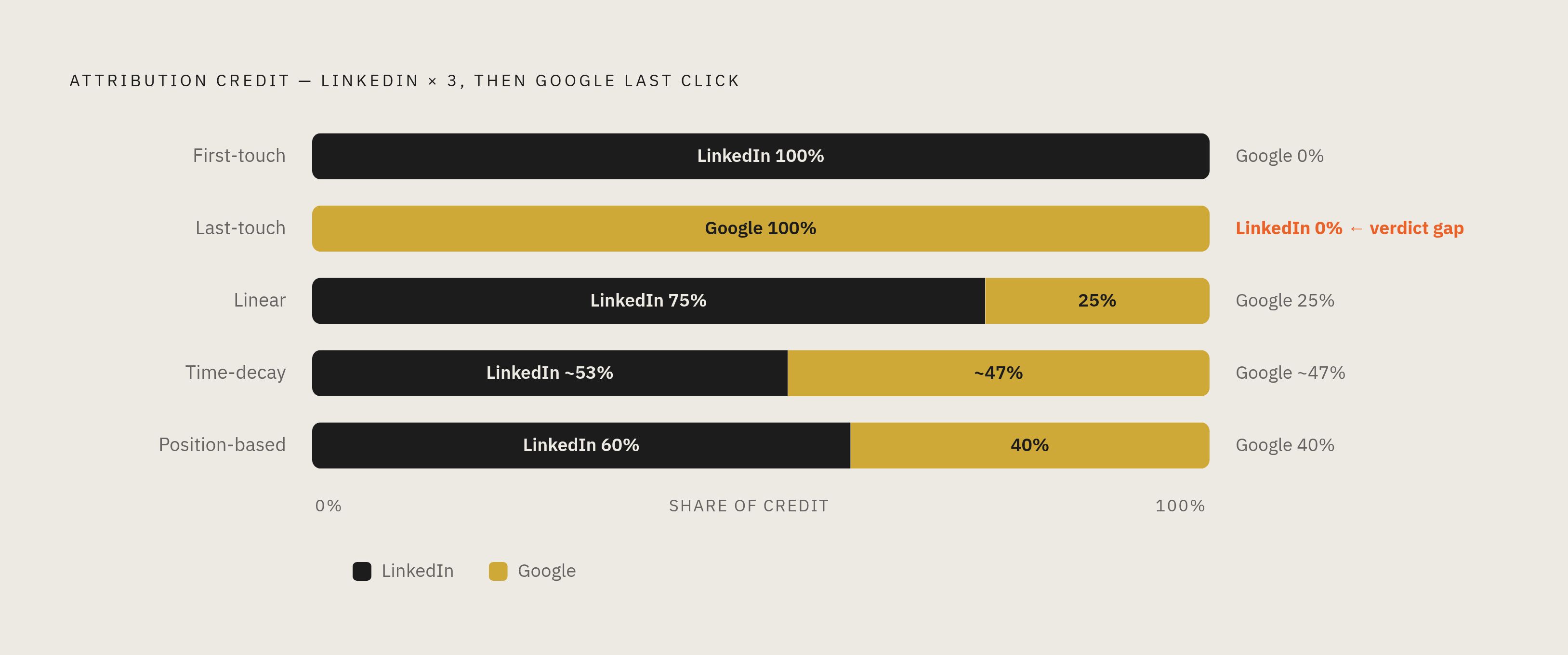
LinkedIn works off identity: who someone is, their title, their company, their industry. Google works off intent: what someone is actively searching for right now. Put the two together and you get the real sequence of a B2B deal. LinkedIn reaches someone before they're even searching for a solution. Weeks or months later, once LinkedIn has done the slow work of building awareness, that same person types a search into Google. Last-touch attribution hands Google all the credit. LinkedIn gets zero, despite doing the harder job first.
Dreamdata's 2026 report found the average B2B journey spans nearly four channels before purchase. Any attribution setup that pits LinkedIn against Google for the same credit is going to misjudge both of them.
What this means for budget:
- Early-stage companies, or anyone creating a new category, probably want more budget on LinkedIn, because there isn't much search demand yet. Google can't capture demand that doesn't exist.
- Growth-stage companies scaling pipeline often land around a 60/40 split, LinkedIn to Google: LinkedIn for reach and nurturing, Google to catch the demand LinkedIn already created.
- When your multi-touch data shows LinkedIn influencing deals that end up closing through a Google last-touch, the fix isn't cutting LinkedIn. It's funding both channels for the job each one is actually doing.
One agency client's Thought Leader Ads campaign makes this concrete: it drove 53% of conversions using only 30% of total LinkedIn spend, at roughly $70 per conversion (about half the cost of cold ABM traffic). You'd never spot that ratio in Campaign Manager's per-format breakdown. It only shows up once you're tracking conversions at the account level, across the full journey.
What a functional LinkedIn attribution system actually changes about campaign decisions
Once the numbers are accurate, the decisions actually change.
On budget: teams stop making the classic mistake of cutting LinkedIn because Google's last-touch report is quietly claiming credit for closes LinkedIn actually created. With CRM-connected pipeline data, you can defend LinkedIn spend with closed-won revenue instead of clicks and impressions, which is a much stronger case in any budget meeting.
Campaign optimization sharpens too. You stop judging a format like Thought Leader Ads by cost per click and start judging it by what it actually feeds into pipeline down the line. You stop yanking budget from upper-funnel campaigns just because they show no conversions in a 30-day window, once you can see they're feeding accounts that convert in month five. And you stop treating every touchpoint as equal, because the data makes it obvious some clearly matter more than others.
None of this makes attribution simple. It won't ever be simple, and anyone who tells you otherwise is selling something. But it makes attribution honest. And for a channel that touches most of your closed-won deals while getting credit for a fraction of them, honest is the whole point.


