LinkedIn vs. Google Ads for B2B Pipeline Generation
LinkedIn reaches silent buyers while Google captures those ready to decide.

Most paid media strategies fail before the first ad ever runs. Here's why.
Cast your mind back to the last significant purchase you pushed through at work. A software platform, a new vendor, a tool your team had been lobbying for. How long were you quietly researching before you talked to anyone? Weeks? Longer? You were reading reviews, watching demos, asking peers in Slack threads. No forms filled out. No sales calls taken. Just quiet, self-directed research.
That's not unusual behavior anymore. That's the default.
Today's B2B buyer spends a long stretch of their journey in a silent self-education phase. Reading. Watching. Comparing. Building shortlists and forming opinions about vendors they've never spoken to. Your sales team has no idea these people exist.
By the time a buyer actually surfaces and engages with a vendor, the heavy mental work is mostly done. Who do I trust? Who understands my problem the way I think about it? Who's even in my consideration set? All of that gets settled before a single sales conversation happens.
Here's the number that should genuinely change how you think about search: only 3 to 5% of your total addressable market is actively in-market at any given moment.
The other 95%? Out there. Thinking slowly. Not searching. Not clicking. Just forming views over months, sometimes longer.
So if 95% of your potential buyers aren't searching for anything yet, what exactly is a search-only strategy capturing?
Once buyers do enter the active phase, they move quickly. They arrive late, but they arrive informed and ready to evaluate. The slow part is the invisible part. Which means two structurally different problems actually fall out of this:
- Problem one: How do you become the obvious choice for buyers who aren't searching yet?
- Problem two: How do you capture a buyer the moment they finally do search?
These aren't the same problem. Which is why they don't have the same answer.
What Google Ads can and cannot do in a B2B pipeline program
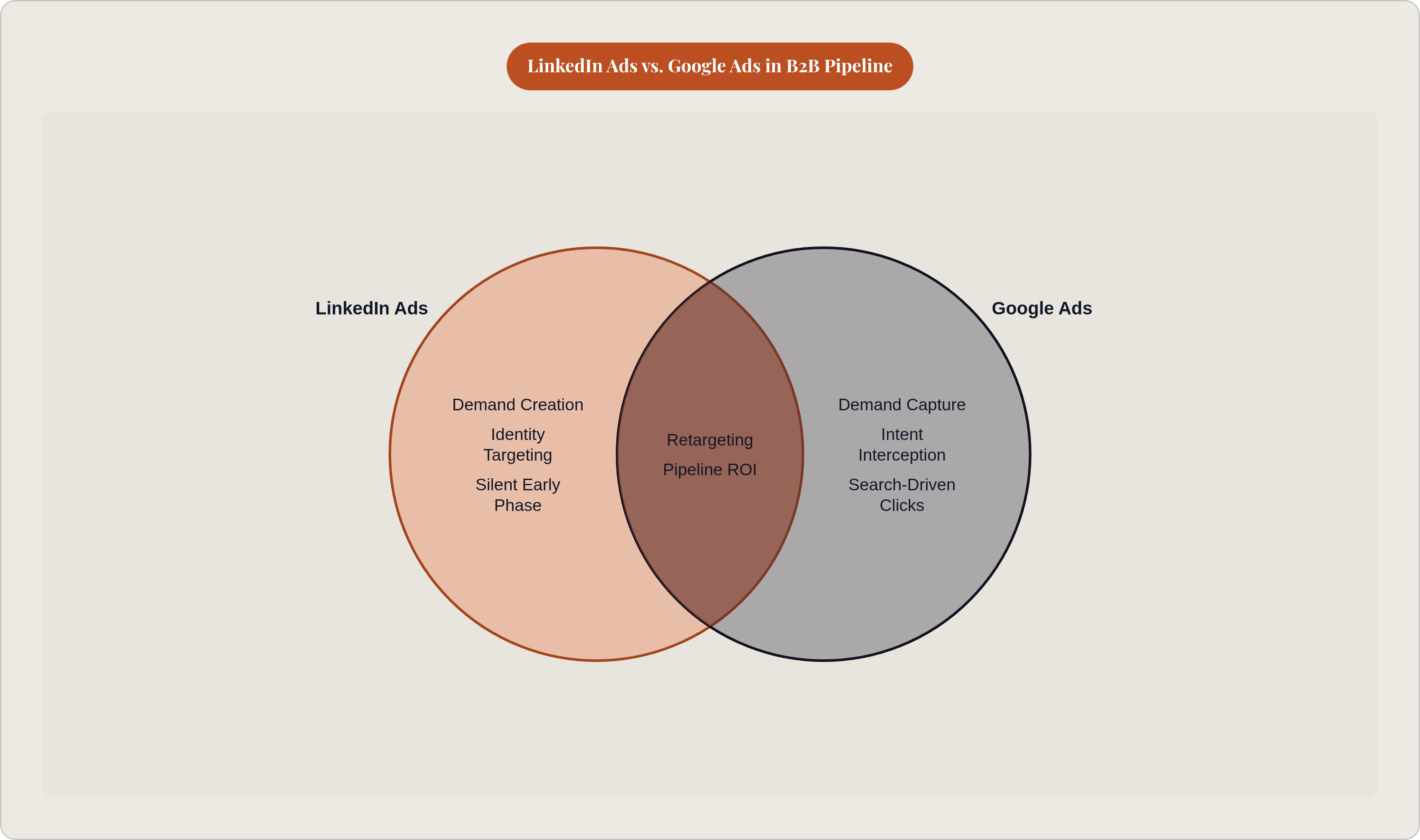
Google Search does one thing extraordinarily well. It intercepts buyers who have already formed intent and expressed it as a query.
A VP of Operations typing "enterprise inventory management software" into Google is already in evaluation mode. They've done the reading. They've decided to solve the problem. The ad's only job at that moment is to be there, with the right message, pointed at the right landing page. That's demand capture. Not demand creation. The distinction matters more than most teams treat it.
Google's ecosystem is also wider than the search tab. Display for retargeting, YouTube for brand reinforcement, Performance Max and Demand Gen campaigns for fuller funnel coverage. When it's managed well, it's a real pipeline tool, not just a keyword machine.
But the structural ceiling doesn't move.
Google can only capture demand that already exists and is already being expressed as a search. It cannot reach buyers during that silent early phase because those buyers aren't searching. There's no query to intercept. And as AI tools take on more of the research work that buyers used to do themselves in a search bar, the predictability of search-driven returns is getting harder to model. Automated bidding is absorbing control that used to sit with the campaign manager.
Google earns its place when a buyer is ready to find you. It cannot manufacture that readiness. Something else has to.
What LinkedIn Ads can and cannot do in a B2B pipeline program
LinkedIn's function is nearly the opposite. It reaches specific professionals by identity: job title, seniority, function, company size, industry. Regardless of whether those professionals are searching for anything at all.
This is where demand creation actually happens. This is how you reach the buying committee while they're still in that silent early phase, before the query even exists.
The targeting options have gotten more interesting. Intent-based targeting built around engagement with similar content, Buying Committee Targeting that automatically identifies decision-making teams at target accounts, Career Journey targeting that reaches professionals who just changed roles or got promoted. Real-time CRM integration lets you optimize toward pipeline outcomes rather than raw lead volume.
One format worth flagging: Document Ads let a prospect preview a resource directly in their feed before downloading it. The friction is intentional. It filters for genuine interest. The leads that come through are smaller in number but noticeably better in quality than what you get from high-volume, low-commitment form fills.
Now, the cost conversation, because this is where things get uncomfortable.
LinkedIn is expensive. Cost per click runs higher than Google in most B2B segments. Cost per lead typically runs 15 to 22% higher than Google Search in comparable categories. Teams need real monthly budget just to generate enough data to optimize. Below certain thresholds, the learning phase just drags on and produces nothing useful.
And LinkedIn's limit is the mirror image of Google's. It cannot capture a buyer at the exact moment of active search. It reaches the right people. It just can't always reach them at the right second.
How the two platforms compare on pipeline ROI when measured correctly
So LinkedIn costs more per click and more per lead. How does it end up cheaper per qualified account reached?
Precision. LinkedIn's targeting wastes fewer impressions on people who will never buy. Google captures whoever searches, and in B2B, that includes a meaningful chunk of people who are curious but nowhere near qualified. The cost per click is lower on Google, but the cost per click that actually reaches your ideal customer profile is often much higher once you account for the noise.
For mid-market and enterprise B2B companies with higher average contract values, LinkedIn tends to win on pipeline ROI. Not because it's cheaper per click. Because at that deal size, precision beats volume in the math.
That said, one discipline matters above almost everything else: do not evaluate either platform on less than 90 days of data. Google's learning phase takes roughly a month. LinkedIn's takes longer. B2B attribution requires at least one full sales cycle to show you anything real. Cutting a channel because cost per lead looks high at 30 days will almost certainly produce the wrong conclusion, and you won't know it until it's too late to recover the quarter.
Average contract value is the real calibrator. At lower deal sizes, volume can win. At higher deal sizes, the math tilts hard toward LinkedIn's precision. But all of this treats the platforms as if buyers use only one. The actual data on cross-platform behavior tells a messier, more interesting story.
Why running both platforms together produces more pipeline than either alone
Prospects who saw LinkedIn ads before searching on Google converted at meaningfully higher rates than prospects who only came through Google.
Why does that happen? LinkedIn exposure during the silent early phase builds familiarity and category vocabulary. So when a buyer finally does search, they search for you specifically. Or they see your name in the results and feel something. Not just "this looks relevant," but "I've heard of these people." That's trust, quietly accumulated over months, paying off in a single click.
Here's how the division of labor actually shakes out:
- LinkedIn reaches the right people during the phase when they're forming opinions and building shortlists.
- Google reaches people at the right moment, when intent is expressed as a search.
Together, they cover the journey. Separately, each covers a slice. And cutting one doesn't just lose that channel's leads. It quietly reduces the other channel's efficiency too, which is the part most attribution models miss entirely.
Is this a convenient justification for spending more on ads? Maybe. But the lift in conversion rate from cross-platform exposure isn't a marketing team's intuition. It's a structural outcome of how buyers actually move through a purchase decision. The mechanism makes sense even if the specific numbers vary by market.
How to size the budget split between LinkedIn and Google based on your market's search behavior
The primary signal for budget allocation is straightforward: how much search volume exists for your category?
Search volume tells you how much active demand already exists to be captured. It tells you how much Google can actually do for you right now, with the buyers already in motion.
- High search volume: Lead with Google. Plenty of active demand to capture. Use LinkedIn to work on the buyers who aren't searching yet.
- Moderate search volume: A balanced split makes sense. Intent signals exist but aren't overwhelming.
- Low search volume: The demand has to be created before it can be captured. Shift the majority toward LinkedIn. Focus Google spend on branded and competitor terms. Everything else goes toward building awareness and preference.
If your team doesn't have clean search volume data yet, a reasonable starting point is roughly half to Google Search for high-intent capture, a third to LinkedIn for awareness and decision-maker targeting, and the rest to retargeting across both platforms. Then adjust from there.
Adjust on cost per sales-qualified lead, though. Not cost per lead. If LinkedIn leads are closing at higher rates, shift budget toward LinkedIn even when the raw cost per lead is higher. The cost-per-lead comparison is misleading because the quality isn't equal, and acting like it is will send budget in the wrong direction.
Also: resist the temptation to optimize each platform in isolation. Single-channel attribution will systematically undercount both platforms if the data never connects. You'll keep making allocation decisions based on an incomplete picture, and the two channels will quietly underperform what they're capable of together.
What changes when AI agents manage this across both platforms simultaneously
The framework above creates a real execution problem. Comparing cost per qualified lead across platforms in real time, reallocating budget dynamically, running creative experiments on two platforms simultaneously. That's beyond what weekly human review cycles can sustain at any meaningful scale. Something has to give, and usually it's the cross-platform coordination.
AI agents for paid media can optimize continuously, test more creative variations than a human team can manage, and respond to performance data in something closer to real time rather than at the next Monday morning meeting. The operational gap closes.
The more interesting shift is compounding. Every campaign builds signal that makes the next one smarter. Targeting sharpens. Bidding improves. Creative learning accumulates. Instead of resetting from scratch each quarter, the system actually gets better over time.
What changes for the people on the team is where the work sits. Less time on data assembly and routine bid adjustments. More time on goal-setting, creative direction, and the strategic constraints that actually shape outcomes. The human role moves up the stack, which is either exciting or uncomfortable depending on how you feel about it.
But none of that works if the measurement foundation is wrong. For B2B, the output that matters is pipeline and cost per sales-qualified opportunity. Not impressions. Not clicks. Not even marketing-qualified leads. That framework needs to be wired in from the start, not retrofitted after six months of optimizing toward the wrong thing.
The cross-platform interaction effect is only visible and optimizable if the data from both platforms connects in one place. Teams that treat LinkedIn and Google as separate channel silos, managed by separate people with separate reporting, will tend to underperform teams that manage the two as a single integrated system.
That's the whole argument, really. It was never about which platform wins. It's about whether your team is structured to let them work together.