LinkedIn Ads Funnel Stage Mapping for B2B Buyers
Split your LinkedIn Ads into awareness, consideration, and conversion campaigns for better ROI.
LinkedIn Ads work for B2B, but only when the funnel is built as three separate campaigns, not one. Run it as a single campaign, and the whole thing quietly turns into an expensive way to ask strangers for a demo. LinkedIn reaches over 65 million business decision-makers and 10 million C-level executives. The demand is real. The problem is almost nobody sets up the campaign to match how that demand actually behaves.
Nobody opens LinkedIn looking for a product. It's not a search engine. People open it to check what a former coworker is up to, read a post from someone they admire, or kill five minutes between meetings. Show a cold audience a "Book a Demo" ad, and most of them scroll right past it. At 3 to 5 times the cost per click of Google Ads, that scroll is expensive.
The most common mistake is running one all-in-one campaign aimed at a cold audience with a direct conversion goal baked in from day one. The audience never gets a chance to warm up. Cost per qualified lead climbs every month, and whoever's running it usually blames the creative or the bid strategy. But swap out the headline, try a new image, tweak the bid, and the numbers barely move. That's the tell. The problem was never the ad. It's the structure underneath it, and no amount of new copy fixes a structural problem.
A B2B buyer typically needs seven or more touchpoints before deciding. One campaign, aimed at one goal, cannot deliver seven different things to the same person over time. So the fix isn't a better ad. It's three ads: awareness, consideration, and conversion, each built as its own campaign with its own targeting, format, offer, and metric. Do that, and the funnel starts doing what it's supposed to do.
The buying journey LinkedIn Ads must account for
Start with a number that should change how anyone thinks about targeting: per the B2B Institute, 95% of the addressable market isn't currently buying. Almost everyone LinkedIn can put an ad in front of is not in an active purchase cycle right now. That fact alone should kill any campaign built entirely around asking for a demo. Ask 95% of an audience for something they're not ready to give, and the answer is always no.
By the time someone does raise a hand, most of the decision is already made. Roughly 57% of the purchase decision happens before a buyer ever talks to sales. Dreamdata's 2025 research puts the average B2B buying journey at 211 days and 76 touches across channels before a deal closes. That's a slow burn across months, not a quick funnel, and it's not one person making the call either: the average buying committee runs around 11 people. A campaign built to speak to a single job title, no matter how well-targeted, is missing most of the room.
So what does that mean for campaign design? No single ad, offer, or format can carry that much weight. The funnel isn't a marketing convention someone invented to sell more software. It mirrors something real: a sequence of readiness that plays out in a buyer's head over months. LinkedIn's actual edge is that it can reach the same person, repeatedly, over that whole stretch, with a message that changes as they do. Few channels can do that with this kind of precision.
Top-of-funnel: reaching cold audiences before they know they need you
The goal here isn't conversion. It's reach and recall. The job is to plant a flag in front of the right audience before they're actively looking for anything, which means the urge to ask for a demo at this stage needs to be resisted, not indulged.
Formats that work:
- Single Image Ads: strong feed visibility, best used with bold visuals and a headline about the problem, not the product.
- Thought Leader Ads: posts promoted from an executive's or expert's own profile, rather than a brand page. Per 2025 LinkedIn internal data, these can outperform brand page posts by up to 3x on engagement.
- Video Ads: good for brand storytelling. Keep cold-audience videos to 15 to 30 seconds. LinkedIn data shows 78% of B2B marketers already use video on the platform.
Targeting should stay loose: job title and seniority to match the ideal customer profile, plus company size and industry. Keep the audience between 100,000 and 500,000 people. Go smaller, and reach shrinks while costs climb. Resist the urge to stack five filters on top of each other. Over-targeting here defeats the point of casting a wide net.
Offers should stay ungated: trend reports, benchmarks, short videos, articles. No demo requests, no forms. A link to content, or a simple "follow" prompt, beats "Book a Demo" on cold traffic every time, because nobody cold is ready to book anything.
Success gets measured in cost per thousand impressions, engagement rate, and video view rate. Not leads. What this stage actually produces is a retargeting pool: the people who watched the video, engaged with the post, or clicked through to the site. That pool becomes the next stage's audience.
Middle-of-funnel: converting passive attention into captured intent
This stage kicks in once someone has already shown interest: watched a meaningful chunk of a TOFU video, clicked a post, or visited the site through a tagged TOFU link.
The goal shifts from reach to education. Content here should explain how a specific problem actually gets solved, not just that the problem exists.
Formats worth using:
- Lead Gen Forms: pre-filled with LinkedIn profile data, which cuts friction. Native form conversion averages 13%, compared to 4.02% for a standalone landing page. That gap is real, especially on mobile.
- Document Ads: let a prospect preview a report or checklist right in the feed before handing over any info. Good fit when curiosity exists but commitment doesn't yet.
- Carousel Ads: walk someone through a problem-to-solution story across several cards, for audiences that need more context before they'll engage.
The offer has to earn the exchange: webinars, checklists, calculators, case studies, whitepapers. Nobody hands over a work email for a two-paragraph blog post.
On targeting, retarget video viewers who hit at least a 25% view threshold, post engagers, and site visitors from TOFU campaigns. Exclude existing customers and anyone already active in the CRM pipeline. There's no point spending money re-selling someone who's already sold.
CRM integration isn't optional here. Connect Lead Gen Forms directly into HubSpot, Salesforce, or a connector like Zapier or LeadsBridge. LinkedIn leads go cold fast, and delays in follow-up cost real conversions. Speed matters.
Measure cost per lead and form completion rate, but track lead-to-opportunity conversion downstream, or those numbers mean nothing. A cheap lead that never becomes a deal isn't a win. It's a distraction dressed up as a metric. What this stage produces is first-party data and a warm list for the next stage: people who've self-identified as interested.
Bottom-of-funnel: reaching warm audiences with a specific, earned ask
This is where the warmest people live: document openers, form starters, pricing page visitors, and CRM contacts already in the pipeline.
The goal now is to turn readiness into an actual sales conversation.
Formats that fit:
- Conversation Ads: delivered through LinkedIn Messaging, with multi-choice buttons like "Book a Demo," "Download Case Study," or "Talk to Sales." They work because the person already knows who's talking to them.
- Single Image Ads with direct CTAs: specific and outcome-led ("See how [Company] cut its CAC") rather than generic. Send traffic to a dedicated landing page, never the homepage.
- Matched Audiences via CRM sync: serve ads only to qualified prospects already in the pipeline. Waste drops to near zero here.
This is account-based marketing territory: named accounts, decision-makers, buying committee members. Smaller audience sizes are expected, and cost per click will run higher. That's the cost of precision, and it's worth paying.
The offer matches the size of the ask: a demo, a pricing guide, an ROI calculator, a case study with a specific, named outcome. The relationship built in the earlier stages is what makes this ask reasonable instead of pushy.
Lead scoring matters a lot here. Route high-intent leads straight to sales. Keep lower-intent contacts in a middle-of-funnel nurture track instead of forcing a sales call nobody's ready for.
Measure cost per opportunity, pipeline influenced, and closed-won revenue, not cost per lead. Per Dreamdata's 2026 LinkedIn Ads B2B Benchmarks Report, pipeline from multi-touch funnels closes at 2.4x the rate of pipeline from single-stage campaigns. That gap alone justifies the extra setup work.
How budget allocation and retargeting hold the three stages together
Retargeting is what connects all three stages. Video views build the MOFU pool. MOFU form fills build the BOFU list. CRM data sharpens both along the way.
A reasonable starting split: a larger share to TOFU, a moderate share to MOFU, and a smaller share to BOFU. As the retargeting pools grow, shift more budget toward MOFU and BOFU, where ROI is easier to measure and usually higher.
Budget size matters too. A minimum viable spend runs $10,000 to $20,000 a month, concentrated on one or two formats. Spread a smaller budget across five formats and three platforms, and none of it produces anything statistically useful. Spreading thin feels like diversification. It's actually the fastest way to learn nothing, and it's the second most common way teams sabotage a funnel that would otherwise work.
There's a compounding effect worth noting: accounts exposed to LinkedIn ads before they ever hit paid search convert at a 46% higher rate. The awareness spend isn't just building LinkedIn metrics. It's making the search budget work harder too.
The underlying principle is simple: don't ask for action before earning attention. Every meaningful interaction, a video view, a click, a form fill, becomes a signal the rest of the program can use.
Keep the system clean with a few standing exclusions:
- Exclude current customers at every stage.
- Exclude CRM contacts already in active pipeline from prospecting campaigns.
- Exclude seniority levels and companies outside the ideal customer profile.
Rotate creative regularly — more frequently for smaller or warmer audiences — to avoid frequency fatigue. Run multiple ads per campaign, test headlines, CTAs, and formats, and only scale the ones that actually win.
What the right success metric looks like at each stage
Most B2B paid media gets judged on clicks and cost per lead. Those numbers look tidy in a slide deck. They say almost nothing about actual pipeline impact, and treating them as the scoreboard is how good campaigns get killed for the wrong reasons.
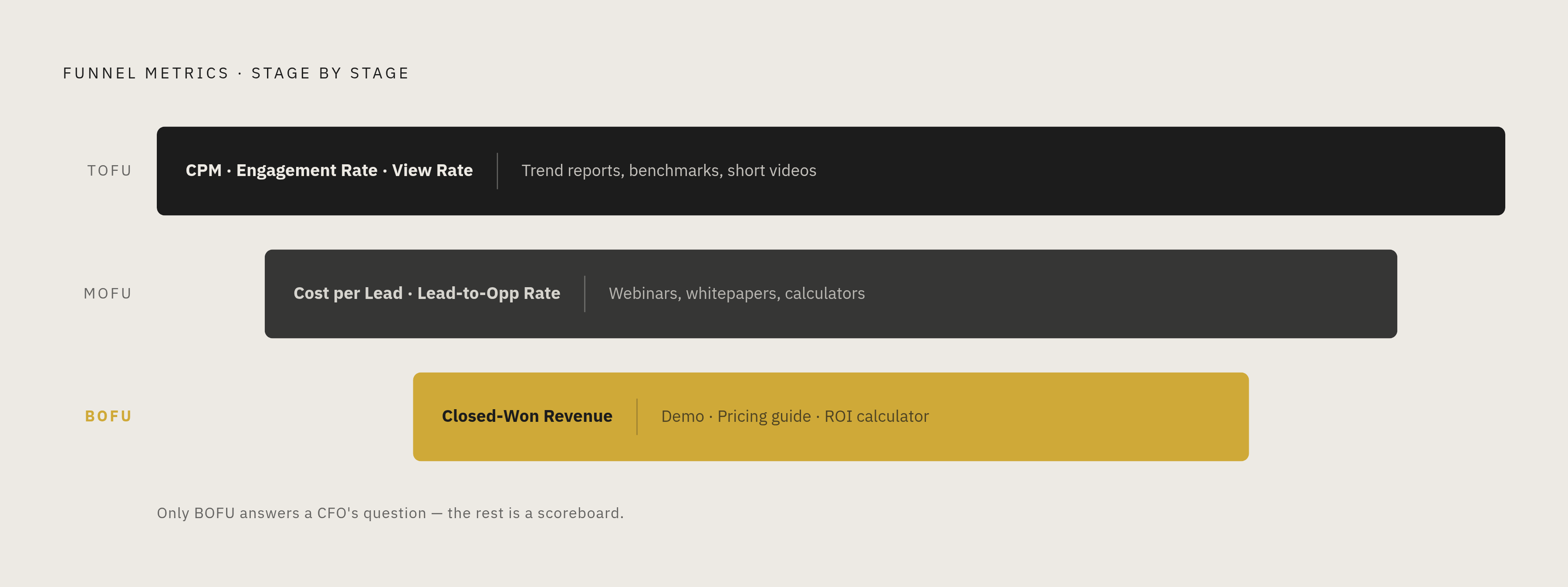
The metric map, stage by stage:
- TOFU: cost per thousand impressions, engagement rate, video view rate. Reach and recall, not leads.
- MOFU: cost per lead, form completion rate, lead-to-opportunity conversion rate. Volume, qualified by what happens downstream.
- BOFU: cost per opportunity, pipeline influenced, closed-won revenue. The only numbers that actually answer a CFO's question.
Averaging cost per lead across all three stages hides which stage is actually working. A BOFU campaign with a high CPL might still be the most efficient source of pipeline in the whole account, but blend it into one number and that fact disappears entirely.
Attribution is the deeper problem underneath all of this. A single B2B software deal can involve up to 266 touchpoints, and click-tracking captures a sliver of that activity. Last-click models, by design, hand all the credit to whatever channel happened to close the deal, and give zero credit to whatever built the awareness months earlier. That's not a rounding error. It's a model that's structurally blind to most of what actually moved the buyer.
View-through attribution closes part of that gap by tracking full exposure and engagement, not just clicks, which surfaces engagement that click data alone misses entirely, including on channels that get written off as "just top-of-funnel."
Connecting LinkedIn Campaign Manager to the CRM is the only reliable way to see lead-to-opportunity and lead-to-revenue progression. It takes weeks to get that reporting clean. It's worth the time anyway.
None of it works without consistent UTM tagging, and most B2B organizations don't have a formal UTM policy in place. Skip that discipline, and stage-level attribution falls apart before it starts.
The goal was never perfect attribution. It's decision-grade data: solid enough to defend a budget shift and stop quietly underfunding the channels actually doing the work.
Where creative decisions make or break funnel-stage alignment
The call to action has to match the stage. Early content invites learning. Bottom-funnel content asks for action. Get that backwards, and even perfect targeting won't save the campaign. This is the part teams get wrong most often: they write one ad, one message, and try to stretch it across all three stages because it's faster than writing three. It's also why so many funnels quietly fail: not because the targeting was off, but because the message never changed as the audience did.
What a VP of Marketing needs to hear and what a CFO needs to hear are two different messages. Persona and funnel stage together decide the message, not just the job title on the profile.
For TOFU creative specifically:
- Short, direct headlines beat long ones. "2026 SaaS Benchmarks" beats "Our Comprehensive Guide to SaaS Trends," every time.
- Real people, executives, employees, customers, build trust faster than stock photography.
- Thought Leader Ads consistently beat brand page posts. Promote from a person, not a logo.
Landing page performance varies a lot by offer type. A study of 2,000 landing pages found webinar registration pages converting at a median 11.4%, lead-gen quote-request flows at 6.8%, B2B SaaS landing pages at 4.1%, and B2B agency and services pages at 3.6%. That gap, more than a 3x spread between the best and worst performer, is the whole argument for matching the offer to the stage instead of reusing one landing page for everything.
That same study found something worth remembering about hero sections: a single, specific stat as the hero (one big outcome number) lifts conversion by about 18%. Autoplay video heroes lose about 7%, on average, because the slower load time cancels out whatever engagement the video adds. Unbounce reports a median conversion rate of 6.6% across all industries and 3.8% for SaaS specifically, both useful yardsticks to hold a campaign's landing pages against.
On format, vertical (1080x1920), 4:5 portrait (1080x1350), and square (1080x1080) creative all outperform landscape, which consistently underperforms in feed. Worth remembering before defaulting to whatever aspect ratio a design team already has sitting on hand.