Best LinkedIn Ads Examples for B2B Lead Generation

Every LinkedIn campaign that works makes four choices well. Not tips or best practices. Four choices.
- Format. Which ad unit actually matches the content and the audience's intent.
- Targeting. Precision versus breadth, and what you're giving up with each.
- Offer. What the prospect is being asked to do, and why they'd bother.
- Creative. How the message lands in a professional feed at scroll speed.
These aren't independent variables you can optimize one at a time. A strong offer in the wrong format underperforms. Great creative wrapped around a vague offer generates clicks and zero pipeline. I've watched teams spend months tweaking button colors on ads where the real problem was the offer had no business being shown to cold traffic.
What sits underneath all four is ICP clarity. Without a real Ideal Customer Profile, every targeting and offer decision is guesswork dressed up in campaign settings. You can execute all four choices technically and still miss entirely, because you built them for the wrong person.
Think of the examples below as a diagnostic, not inspiration. Each one shows what happens when one of these decisions gets made well. Or doesn't.
Single Image and Document Ads: Where Most B2B Campaigns Should Start
Single image ads are the right starting point for most teams. Low production cost. Fast to iterate. High performance ceiling if the copy and creative do their job.
But what actually makes them work? Look at how Gong structures their single image campaigns: fewer than four form fields, a square 1×1 format built for mobile feeds, copy that names the audience directly so a reader knows in two seconds whether the ad is for them. The value of the download is stated out loud, not implied. Simple stuff. Boringly simple.
Salesforce takes a slightly different approach. Bold brand colors, clean design, a headline that speaks directly to B2B marketers. What consistent visual identity does is build recognition over time, and recognition lowers the friction of an unfamiliar brand asking for your attention. That's a slow effect, but it's also a real one.
Document ads are significantly underused relative to what they produce. The Toro Solutions case is worth understanding. They offered role-relevant content: converged security checklists, compliance guides. Decision-makers stopped scrolling because the material was directly applicable to their function. Average result: 15 qualified leads per month at roughly £40 cost per lead, down from £80 CPL when the campaign launched. Document ads consistently outperformed image ads across the same campaigns.
Why does that happen? Document ads render in-feed. The prospect doesn't need to click anywhere to evaluate whether the content is useful. They scroll through the preview, decide if it's worth their time, and then engage. That means they're self-qualifying before they ever see a form. Low-intent people opt out earlier, which raises the quality of who actually converts.
The creative principle running through both formats is almost boring: clarity over cleverness. Bold, simple design outperforms information-dense creative in a scroll environment, nearly every time.
Carousel, Video, and Conversation Ads: When Formats That Demand More From the Audience Actually Make Sense
One rule of thumb before anything else: the more a format asks of the audience, whether that's a swipe, a watch, or a reply, the warmer that audience needs to be. Or the higher the offer value needs to justify the effort.
Carousel ads (two to ten swipeable cards) are built for sequential storytelling. Each card should advance something. A problem-solution arc. A multi-step process. A before-and-after. If each card is just restating the same message at a slightly different angle, the format is actively working against you.
Video ads live or die in the first three seconds. Autoplay behavior means you're either hooking someone immediately or you're invisible. Under 15 seconds is the practical threshold for cold traffic. Longer formats can work for remarketing audiences who already know who you are.
Conversation ads are worth understanding through the LaunchDarkly model specifically. Their ads opened with two short qualifying questions rather than a hard pitch. Two CTA buttons: one for direct demo booking, one for a softer follow-up path. The audience self-segmented based on which they chose. Each path then delivered a relevant next step instead of funneling everyone toward the same outcome.
Letting the prospect choose how to engage improves both completion rates and downstream conversion quality. You're not forcing someone through a funnel. You're asking them where they are.
Thought leader ads are the most underused format in this entire category. In one documented campaign, they drove 53% of conversions on just 30% of spend. Cost per conversion ran at roughly half the rate of ABM cold traffic. The reason isn't complicated: content from a named individual with a face and a real perspective carries more trust than a brand logo in a professional feed. Brands don't have opinions, but people do.
Lead Gen Forms: The Conversion Rate Case for Them and the Pipeline Case Against Them
Lead gen forms autofill the prospect's name, email, job title, and company directly on-platform. No landing page required. LinkedIn reports they convert two to three times higher than traditional landing page forms.
Calendly's Accelerate campaign is the clean example. Form completion rate increased over three times. Cost per lead dropped 66% compared to their best-performing classic campaigns.
Real numbers, and striking. So what's the problem?
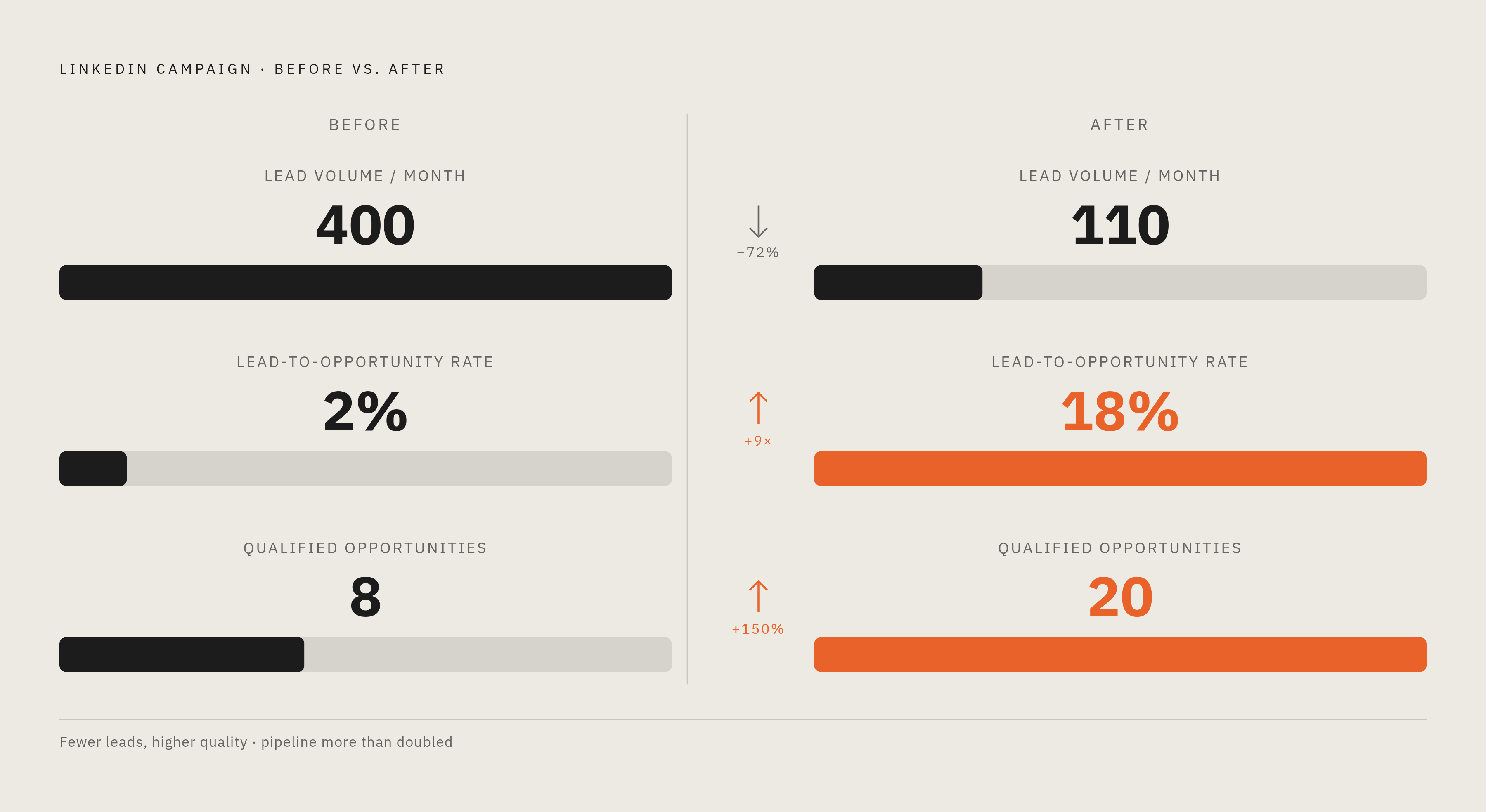
Consider a cybersecurity company spending $60,000 per month on paid media. Roughly 85% of that went to LinkedIn lead gen forms. They were generating over 400 leads per month. And producing only eight qualified opportunities. That's a 2% lead-to-opportunity rate.
After restructuring toward demand capture, demand education, and thought leadership, lead volume dropped from 400 to 110 per month. Lead-to-opportunity rate went from 2% to 18%. Qualified opportunities went from 8 to 20 per month. Pipeline more than doubled.
What explains the gap? Pre-filled forms produce contacts who did not consciously decide to engage. They completed a form. That's not the same thing as a decision. A landing page forces someone to navigate, read, and then act. Most won't. But the ones who do are carrying a meaningfully stronger intent signal, and that signal is what actually matters downstream.
It runs against how most teams are measured. If your KPI is cost per lead, lead gen forms look incredible. If your KPI is pipeline, they often look like a very expensive way to build a list of people who will never buy.
That said, it's not a binary. Lead gen forms belong in specific situations: event registrations, warm remarketing campaigns, high-brand-recognition contexts. They should not be the default mechanism for cold-traffic pipeline generation.
The metric that exposes the problem is lead-to-opportunity rate, not cost per lead. A $30 CPL with a 2% conversion rate is more expensive in real terms than a $120 CPL with an 18% conversion rate. Run that math before optimizing for volume.
Targeting Architecture: Whether the Right People Ever See the Ad Comes Down to How You Build the Audience
LinkedIn's targeting layers are powerful. They also interact in ways that aren't always obvious, and I've seen smart people build technically correct audiences that were still completely wrong for their ICP.
- Job title plus seniority is high precision, but LinkedIn's job title taxonomy is inconsistent. "VP of Marketing" and "Head of Marketing" often describe the same buyer. Target only one and you've already cut your audience in half.
- Job function plus seniority is broader but more reliable for reaching a full buying committee.
- Company size plus industry is essential for ICP alignment. It should layer on top of role targeting, not substitute for it.
- Skills targeting is underused. It surfaces practitioners who don't carry a specific title but are the actual decision-makers or influencers in a real purchase.
For teams just starting: if you're spending $6,000 or more per month, an audience of 50,000 to 500,000 (job title plus industry plus company size) is a functional minimum for LinkedIn's algorithm to exit its learning phase. Below roughly $3,000 to $5,000 per month per campaign, there isn't enough conversion data for the algorithm to optimize meaningfully, and your creative tests won't produce conclusions you can trust.
ABM targeting works differently. You match a company list against LinkedIn's Matched Audiences to concentrate spend on named accounts. CPCs are higher. But the spend is focused on the exact companies already in your pipeline or target account list. It's a different use case, not inherently better or worse.
Remarketing logic is simpler. Use website visitor audiences to retarget people who've already shown intent. A warmer audience justifies more direct CTAs and harder asks. Running demo request ads to cold audiences and wondering why pipeline is thin is one of the most common and most preventable mistakes in paid B2B.
Targeting precision is only as good as the ICP definition behind it. Audience construction is the operational expression of who you actually want in pipeline. If that definition is vague or politically compromised (and it often is), no amount of layer refinement fixes it. You're just getting more precise about reaching the wrong people.
Offer Design: The Asset or Action Being Promoted Sets the Campaign Ceiling, and Creative Can't Move That Ceiling
The offer is what the prospect is being asked to do, and why they'd actually do it. It sits above creative and format in the decision hierarchy. Most teams don't treat it that way. That's where campaigns die quietly.
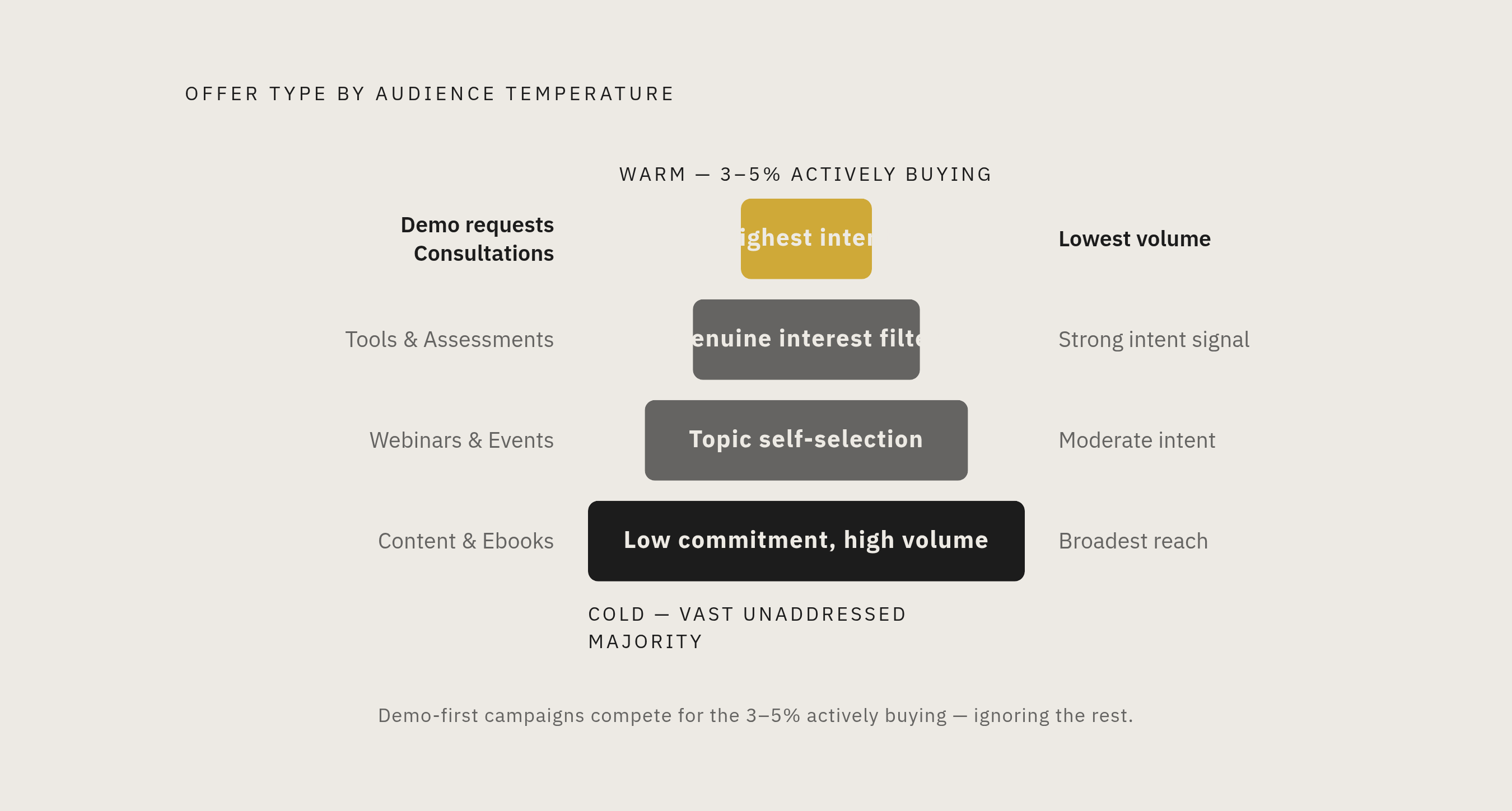
A rough hierarchy from lower to higher intent signal:
- Content downloads (ebooks, reports): high volume, low commitment, high risk of form-fill quality problems.
- Webinars and events: moderate intent. The prospect self-selects based on topic relevance.
- Tools and assessments: stronger signal. Willingness to invest time filters for genuine interest.
- Demo requests and consultations: highest intent, lowest volume. Appropriate for warm or retargeted audiences.
The HubSpot model for high-value gated content checks four things: an industry report worth having, a pre-filled form to reduce friction, a clear benefit statement, and an immediate delivery promise. Each element narrows the gap between interest and action. The hard part is actually having a report worth having.
Only three to five percent of any total addressable market is actively buying at a given moment. Campaigns built entirely around demo requests are competing for a tiny pool while ignoring the vast majority of future buyers who just aren't there yet. That math alone should change how most teams allocate budget.
The Google and GoDaddy-style customer story approach serves a different purpose. It's not asking for a transaction. It keeps the brand present and credible with people who will eventually become buyers, but aren't there today. Think of it as staying on the shortlist before someone even knows they have one.
Offer sequencing by audience temperature:
- Cold audiences: education-first offers. Content that demonstrates expertise without asking for a meeting.
- Engaged audiences: middle-funnel offers. Case studies, comparison content, something that deepens the relationship.
- Warm or retargeted audiences: conversion offers. Demos, trials, consultations.
Running a demo CTA to cold traffic is one of the most common reasons LinkedIn campaigns produce clicks and no pipeline. The offer doesn't match where the audience is. Creative can't fix a mismatch like that.
Creative Execution: What the Ads With the Best Conversion Records Actually Have in Common
The through-line from every high-performing example is clarity. The message has to be immediately readable in a scroll environment, which means it has about two seconds to make its case.
Copy structure in high-performing single image ads follows a consistent pattern:
- First line of intro text: audience callout or problem statement. The reader knows immediately whether this is for them.
- Headline: explicit value statement. What the prospect gets, not a brand tagline.
- CTA: specific and action-oriented ("Download the guide," "Book a demo") rather than generic and forgettable ("Learn more").
Design principles the best examples share:
- Bold, high-contrast visuals that read at scroll speed. Salesforce's brand color isn't decoration. It's a recognition device.
- Minimal text on the image itself. Copy belongs in the intro text, not crammed onto the visual.
- 1×1 square format over landscape for mobile feed performance.
When an ad is visually busy and crammed with proof points, it usually signals that the advertiser doesn't trust the offer to do the work. More claims on the creative is not the fix for a weak offer.
A post from a named individual with a face and a perspective consistently outperforms a branded graphic in a professional feed. Brand logos don't have opinions, but individuals do, and that difference registers in ways that show up in conversion data.
Brand consistency compounds over time in a quieter way. Repeated exposure to a consistent visual identity lowers CPL as campaigns mature. Recognition reduces friction. It's a slow effect, but it's measurable and it's real.
One last thing on testing: isolate offer framing first, meaning how the value is stated, before you start changing colors or layouts. Framing changes tend to move conversion rates more than visual changes. Most teams do it backwards, spending months on creative iterations when the actual problem is the headline.
How LinkedIn and Google Work Better Together Than Either Does Alone
The fundamental difference between the two platforms is easy to state and easy to underestimate.
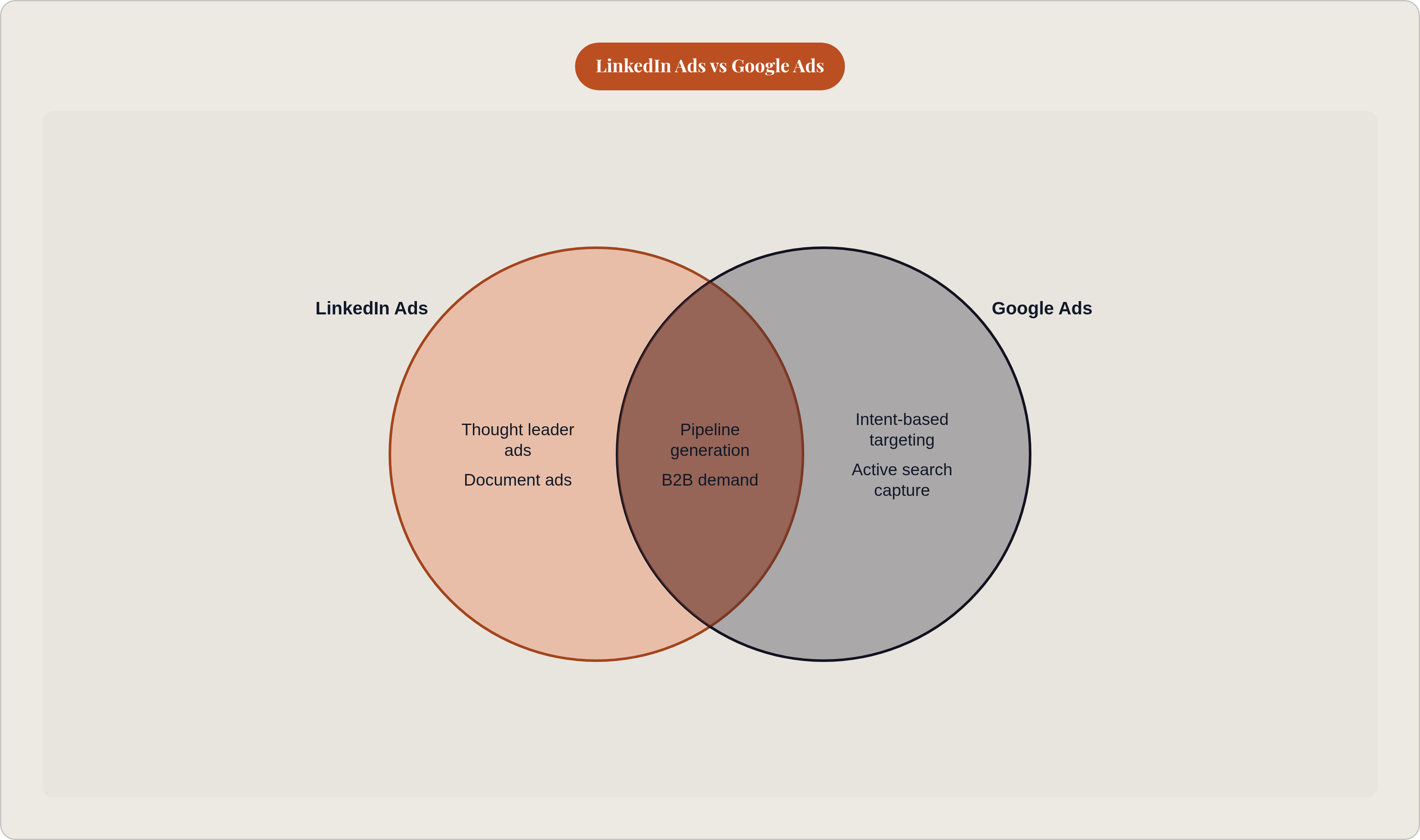
- Google Ads is intent-based. It reaches people actively searching for a solution right now.
- LinkedIn Ads is identity-based. It reaches professionals based on who they are, not what they're searching for at this moment.
Neither is dominant in isolation. They serve different stages and different buyer behaviors.
When Google should lead: if meaningful search volume exists for your category, demand capture comes first. If someone is already searching for what you do, you want to be there when they look. That's table stakes.
When LinkedIn should lead: if your buyers are highly specific by role, seniority, or industry, and are unlikely to search by category name. A director of revenue operations at a mid-market SaaS company is not typing "revenue operations platform" into Google every week. But you can reach that person precisely on LinkedIn, repeatedly, before they ever start searching. That's a fundamentally different kind of opportunity.
The most effective paid media architectures treat these platforms as complementary, not competing. LinkedIn builds awareness and demand with the people who will eventually become buyers. Google captures the ones who've already entered the market. Conflating those two jobs is what leads to LinkedIn campaigns optimized for demo requests to cold audiences, and Google campaigns running broad match to brand-unaware traffic.
Understanding which channel is doing which job, and budgeting accordingly, is what separates paid media that generates pipeline from paid media that generates a well-formatted report about impressions.