Human Oversight Models for Autonomous Paid Media AI Agents
Draw the line between decisions AI can make alone and those needing human review.
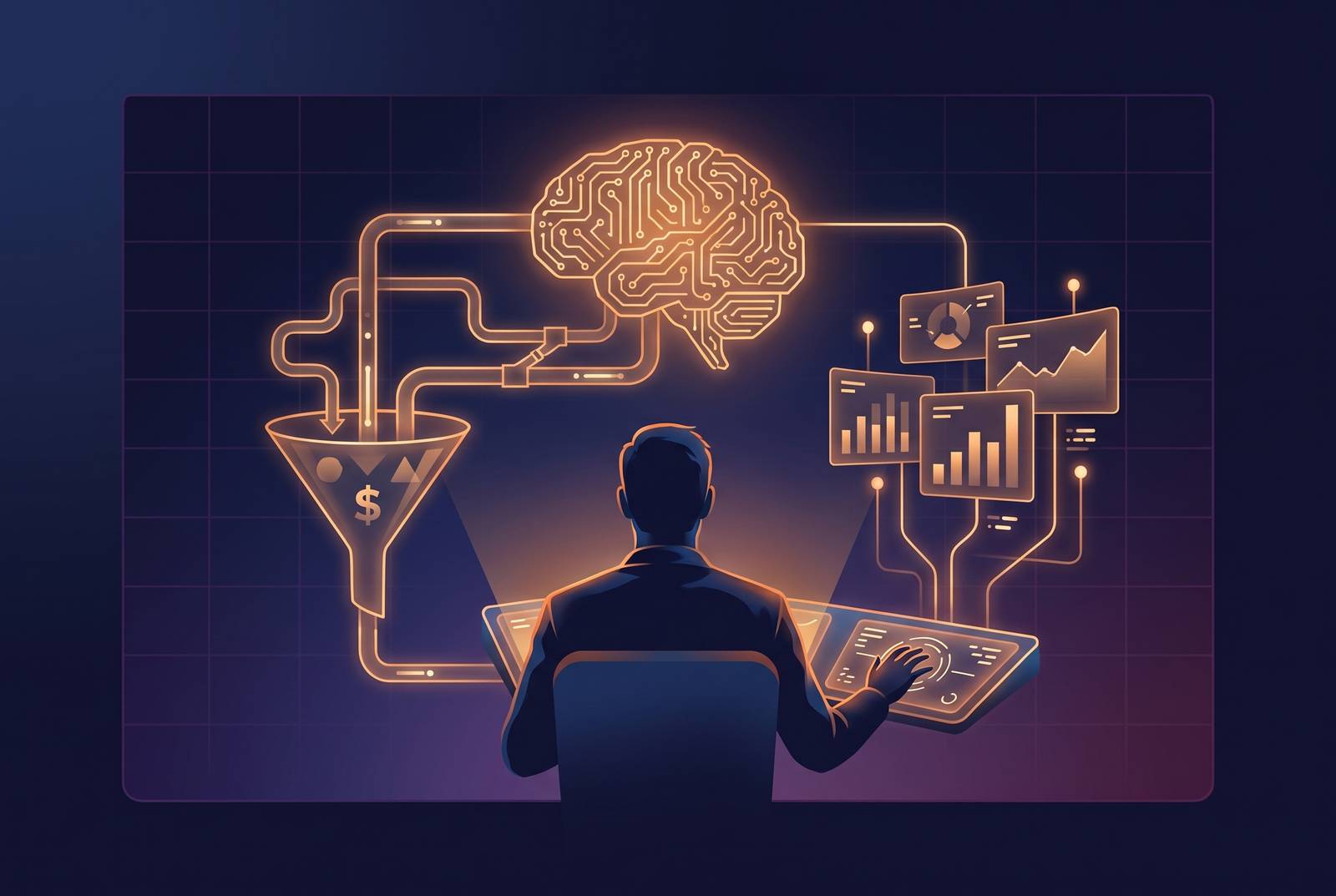
Autonomous paid media agents can now adjust bids, shift budgets, and rotate creative faster than any human team could ever hope to track. That speed is the whole selling point. But it creates a real problem: how much of that decision-making should a human actually be watching? Most teams answer that question badly, either by approving everything (which kills the speed advantage entirely) or by approving nothing (which is fine until it very much isn't). The right answer isn't a number. It's a map: which decisions carry real risk, and which don't. This piece walks through that map, layer by layer.
What autonomous paid media agents actually do at execution speed
Start with a definition, because it matters more than it sounds like it should. An agent is not automation running a preset rule. Automation follows a script: if X happens, do Y. An agent gets a goal and figures out the steps itself. That distinction is the whole reason oversight has to be rethought, not just applied more strictly.
In paid media, that independence shows up everywhere:
- Bid adjustments happening at the impression level, decided in milliseconds
- Budget shifting across platforms, creatives, and audiences in real time
- Creative rotating in and out based on performance signals
- Audiences expanding or narrowing based on who's actually converting
- Pacing and dayparting decisions running continuously, not on a Monday-morning schedule
The volume difference is the part that changes everything. A campaign running AI optimization might test fifty bid adjustments, twenty audience variations, and a dozen creative combinations in a single day, according to Improvado's analysis. Compare that to what a human account manager does in the same stretch of time: a handful of changes, reviewed, maybe twice.
Some setups go further, splitting the work across multiple specialized agents, one handling targeting, another creative, another reporting, another attribution, all communicating to keep the campaign coherent, per research on orchestration frameworks. And these systems don't stay static. Agents that get consistent feedback from real outcomes get sharper over time. Research on enterprise AI deployments points to memory architectures cutting latency while improving accuracy by roughly 26%.
So here's the shift in thinking that oversight has to make: you're not reviewing decisions one at a time anymore. You're governing a system making hundreds of tiny decisions a day. That means oversight has to be built into the architecture, not bolted on as a review step.
How to classify decisions by the risk they actually carry
Here's the question worth sitting with: what actually makes a decision safe to hand off completely? Not how it feels to a human watching it happen. Not how uncomfortable it is to not be in the loop. The real test is reversibility and blast radius.
Three conditions make full delegation reasonable:
- The environment changes fast, so an agent adjusting in real time beats a human working on a weekly cycle
- There's a clear, measurable success target, so the agent knows exactly what it's optimizing for
- A wrong call is bounded and catchable, meaning it can be corrected before it snowballs
Mapped against that, decisions sort into three tiers:
Low risk, high reversibility: bid adjustments within a set range, creative rotation among pre-approved assets, audience expansion within defined limits, pacing within a daily cap.
Medium risk: budget moves across campaigns or channels above a meaningful dollar threshold, pausing ad groups that are underperforming, launching new audience segments.
High risk, low reversibility: messaging that brushes up against legal or regulatory territory, big budget shifts that affect the quarter's plan, positioning changes that touch brand perception, entering a new channel entirely.
The governance literature puts this well: the old question was "who approved this asset?" The new question is "what system of guardrails decided whether this asset could move, and what's the audit trail proving it?" That's a different kind of accountability, and it's the one autonomous systems actually require.
Worth sitting with this number for a second: only 6% of organizations qualify as AI "high performers," meaning AI actually shows up in bottom-line results, according to research citing McKinsey's State of AI survey. Adoption is close to universal. Impact is not. That gap is, in large part, a governance failure, not a capability one. Risk classification is what closes it. Without it, more agent activity just means more human review, and the whole point of automation gets lost.
Continuous monitoring: the oversight layer that runs at agent speed
Continuous monitoring doesn't mean a person staring at a dashboard. It means systems that log every agent action, flag anything that drifts from the defined parameters, and surface problems before they compound.
Why is logging non-negotiable rather than a nice-to-have? Because the compliance stakes are real and getting more expensive. GDPR fines can reach €20 million or 4% of annual global turnover. As of early 2025, regulators had issued 2,245 fines under GDPR totaling roughly €5.65 billion. AI systems drift. Policies change. Copy gets reused in contexts nobody planned for. The control against that has to run continuously, not get checked quarterly.
What this layer is actually watching for:
- Agent behavior drifting outside its defined operating range
- Performance metrics moving outside acceptable bounds with no clear cause
- Data quality breaking down: incomplete CRM records, broken attribution, the kind of rot that leads an agent to optimize toward the wrong signal entirely
- Spend pacing that looks like a logic error rather than a market shift
That data quality point deserves its own moment. When CRM records are incomplete or tracking is unreliable, an agent doesn't know it's working with bad information. It just optimizes toward whatever signal it's given, wrong or not. Monitoring is what catches that, but only if it's reading the right signals in the first place.
It's worth being precise about what this layer is not. It isn't a human reviewing agent decisions. It's the audit infrastructure that makes every other layer of oversight possible. Without it, exception-based review has nothing to trigger on, and escalation gates have no reliable early warning system feeding them.
Exception-based review: how to give agents room to run while keeping humans in the loop
The architectural shift here is simple to state and harder to build: agents handle the routine stuff on their own, and only flag the edge cases for a human. That's sparse supervision, and per analysis on advanced human-in-the-loop architectures, it's also how agents learn over time.
What counts as an exception in paid media?
- Performance moving further from the expected range than the defined threshold allows
- An agent hitting a situation outside what it was trained on, a new platform policy, an audience signal it's never seen
- Creative that clears the automated checks but touches something a human should verify anyway, like competitive claims, pricing language, or a regulated category
- Attribution numbers that look wrong in a way that suggests broken tracking rather than a genuine shift in performance
Why does an exception queue beat an approval queue? An approval queue creates a delay at every single decision point, regardless of whether that decision needed a human at all. An exception queue only creates delay where the risk actually justifies it. That's the whole efficiency gain.
But the design question that actually matters is: what happens when the exception lands in front of a person? What are they allowed to do with it?
- Review and release: confirm the agent's proposed action and let it run
- Override: substitute a different decision, and the agent logs the correction as something to learn from
- Escalate: decide the exception is above their authority and route it up
That correction loop is the important part. Every override is feedback. That's how governance compounds into better autonomy instead of just sitting there as a constraint.
One warning sign worth naming: if the exception queue keeps growing, that's not agents behaving badly. That's a sign the risk classification is off, too many things getting flagged that shouldn't be, or that the agent's operating parameters need to be narrowed.
Threshold-gated escalation: the mechanism that stops big mistakes before they happen
Here's the distinction from the layer above: exceptions surface after something odd has already happened. Escalation gates trigger before an action executes, the moment a defined threshold would get crossed. One is a smoke detector. The other is a lock on the door.
What do these gates look like in practice?
- Budget gates: any single reallocation or campaign launch above a set spend level needs sign-off before it runs
- Audience gates: expanding into a new segment above a certain size, or one that hasn't been tested before, gets routed to review
- Creative gates: anything that hasn't gone through human review can't go live, no matter how confident the agent is
- Channel gates: entering a new platform or placement type requires a human to say yes first
Setting the threshold itself is a judgment call, and it's harder than it sounds. Set it too low, and every trivial decision needs a sign-off, which trains people to stop taking approvals seriously. Set it too high, and the gate exists in name only. The governance literature is direct about this: frameworks need to spell out what agents can decide alone, what needs approval, and what the escalation path looks like when an agent hits something outside its parameters.
The lesson from AI deployments outside paid media is consistent: without content filtering in place, systems can generate inappropriate customer-facing outputs before anyone catches them. That's a recoverable mess in some contexts. In paid media, where messages go out at scale before anyone notices a problem, the same kind of gap is a lot more expensive to fix after the fact.
There's a documentation benefit hiding in here too. Every time a gate triggers, it creates a record: what was proposed, who reviewed it, what got decided. That's exactly the audit trail compliance and legal teams end up asking for anyway.
Expert judgment on consequential calls: what humans must own that agents cannot
The first three layers all share a hidden assumption: that given the right information, there's a correct answer to find. That's true a lot of the time. It's not true all the time. Some decisions are genuinely ambiguous, and the judgment itself, not just the outcome, is what carries the accountability.
What falls into this bucket in paid media?
- Positioning decisions that shape how the company is perceived in its market, a strategic call, not a creative preference
- Deciding which pipeline signals actually mean buying intent versus noise, which takes an understanding of the sales motion an agent doesn't have
- The trade-off between short-term conversion volume and long-term audience quality: an agent can optimize toward either one, but choosing which matters more is a business call
- Diagnosing what's actually broken when performance dips, is it the creative, the landing page, an attribution gap, or the audience itself? Each diagnosis points to a different fix, and getting it wrong wastes months, not days
- How to respond to a brand-level misstep. When AI-generated campaigns miss the mark with audiences, the failure is rarely technical. It is the absence of a human creative judgment call at the point where one was needed most
Why does this layer need to be a named person and not a team or a system? Because ambiguous, consequential decisions need someone who can be held accountable for the call, not a process that diffuses responsibility across everyone and no one.
This is where humans genuinely can't be replaced: strategy, creative direction, quality judgment, the stuff that depends on business context an agent has no way to independently pick up. Skip this layer, and the failure rate shows it. Research puts AI project failure at 85%, often traced back to poor data quality and not enough human involvement. The human judgment layer isn't overhead sitting on top of the system. It's structural. Remove it, and the system doesn't run leaner, it just breaks somewhere less visible.
How the four layers fit together as one system, and what breaks when they don't
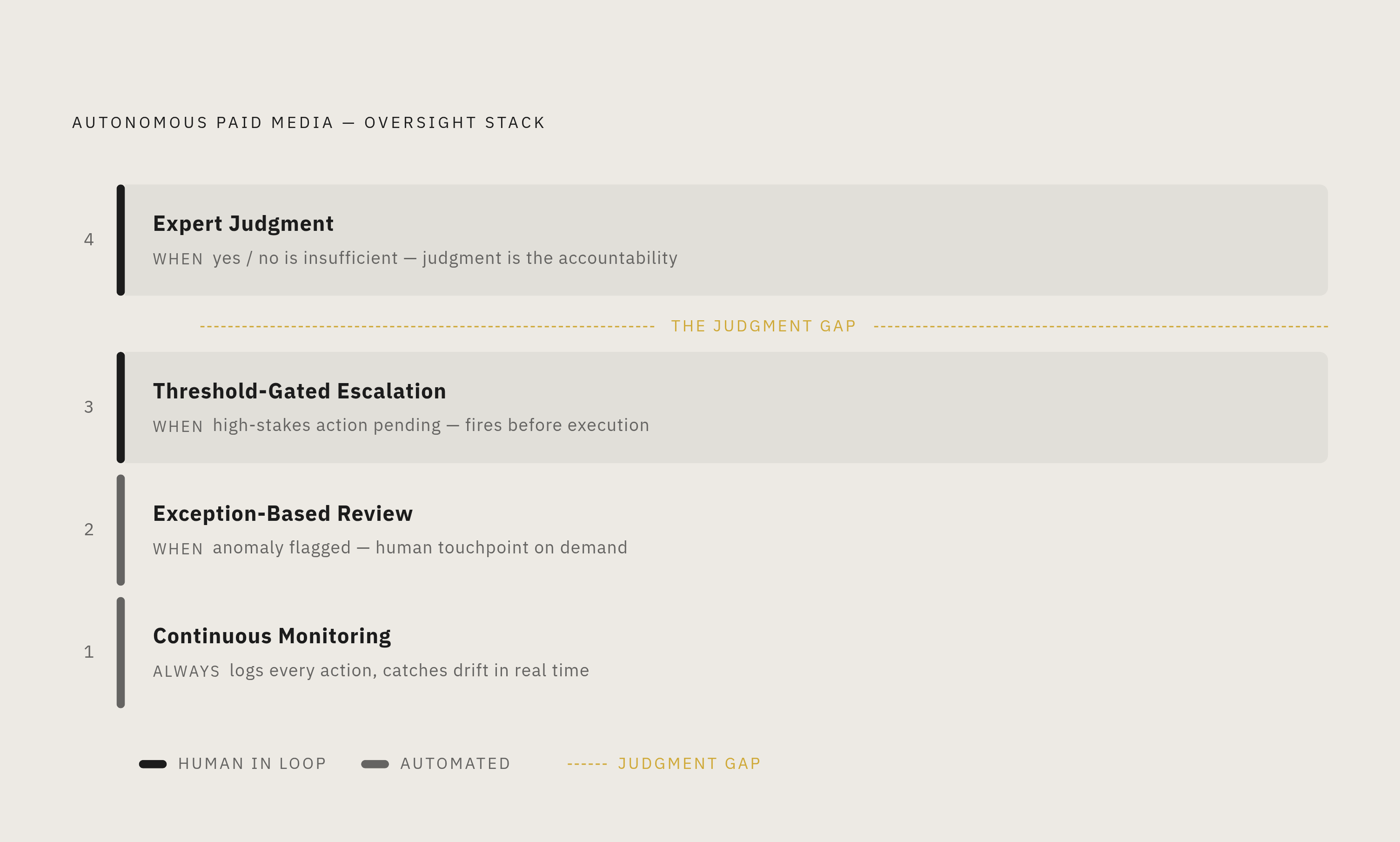
Put in sequence, the four layers look like this:
- Continuous monitoring runs at all times, across everything. It's the foundation.
- Exception-based review kicks in when monitoring flags something odd. First human touchpoint.
- Threshold-gated escalation intercepts high-stakes actions before they fire. The pre-emptive check.
- Expert judgment handles the calls that need accountability, not just a yes or no. The top layer.
It's tempting to think of these as a ladder, where the top layer is the "most important" one. That's the wrong mental model. Each layer covers a different category of risk, and the system breaks the moment a decision lands in the wrong one.
Send a routine bid adjustment up to expert review, and you've wasted a person's time on something that needed none of their judgment, and taught the team that governance is just friction. Send a positioning decision through an exception queue, and the agent gets a yes or a no, neither of which captures the kind of judgment that decision actually demanded. Skip the escalation gate on budget entirely, and an agent operating perfectly within its own optimization logic can recommend a spend shift that's technically correct by its own metrics and dead wrong for the business that quarter.
Two ways this collapses:
Too much human involvement. Autonomy disappears. Agents turn into expensive suggestion engines. The speed advantage, the compounding intelligence advantage, all of it evaporates. Humans end up back where they started: managing execution instead of doing strategy.
Too little human involvement. The system runs at full scale with no accountability attached. Errors compound quietly. When something finally breaks, there's no named person responsible and no clear path to fix it.
Here's the part worth sitting with: governance and optimization aren't actually opposed to each other. Exception reviews and escalation calls create a feedback record, and that record is what agents learn from. Well-built oversight is also how the system gets smarter. It's the same loop, not two competing ones.
And the data backs up how hard this is to build well. Fewer than 10% of enterprises have scaled AI agents to deliver tangible value, and eight in ten cite data limitations as the roadblock, according to a McKinsey article from April 2026 drawing on its June 2025 research. Governance architecture and data quality aren't two separate problems to solve. They're the same problem wearing different clothes.
What a well-governed autonomous paid media program looks like in practice
Picture the flow end to end. Human strategy sets the objective and defines the boundaries: what the campaign is trying to do, what "success" means, where the lines are. Agents then execute continuously inside those boundaries, adjusting bids, rotating creative, shifting budget, all without waiting on a person for every micro-decision.
Underneath that, monitoring is always running, logging every action and watching for drift. When something falls outside the expected range, it lands in an exception queue, reviewed by a human who can approve, override, or escalate it. Anything crossing a defined threshold, a big budget move, a new audience segment, a new channel, gets stopped before it executes and routed for sign-off. And the decisions that are genuinely ambiguous, the ones about positioning, diagnosis, or brand risk, go to a named person whose judgment is the accountability, not a rubber stamp.
None of this is about trusting agents less. It's about being precise regarding what they're actually good at (fast, data-bound, reversible decisions) and honest about what they're not (ambiguous, high-stakes, business-context calls). Get that separation right, and the leverage autonomous agents promise, execution at a speed no human team can match, actually shows up, and a few B2B programs, including Thunder, an applied-AI company whose agents run Google and LinkedIn Ads end to end while Forward Deployed Marketers hold accountability for the consequential calls, are built explicitly around that separation as the operating model. Get it wrong, and either the autonomy collapses under human bottlenecks, or the accountability collapses under unwatched risk. The system only works when both are true at once.