LinkedIn Insight Tag Setup and Conversion Tracking Accuracy
Understand which LinkedIn conversion method loses the least data in your specific setup.

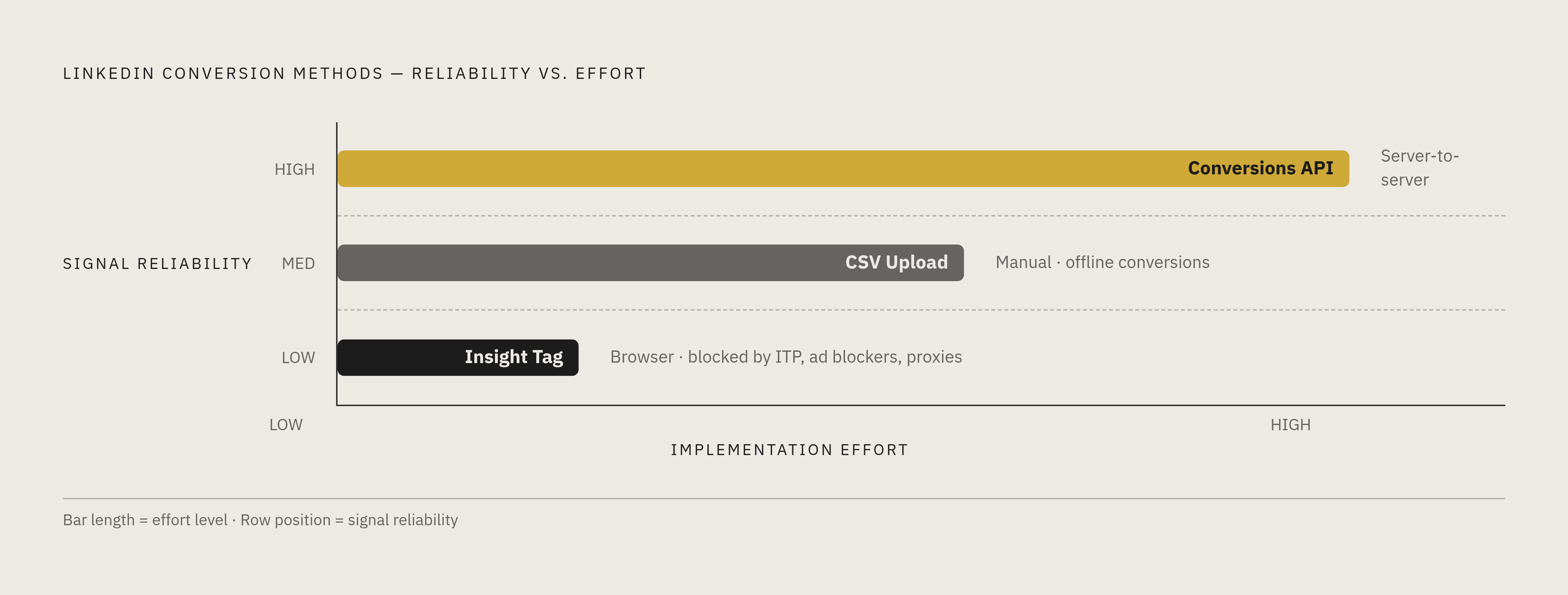
LinkedIn gives you three structurally different ways to send conversion data. The difference between them isn't just technical complexity. It's about what data actually reaches LinkedIn and under what conditions.
Think of these three methods as three different postal routes to the same destination — each one reliable under different weather conditions.
The Insight Tag (browser-based) fires in the user's browser when a conversion page loads. Simplest to implement, most widely used. Also the most vulnerable to anything that disrupts the browser environment: ad blockers, privacy settings, script failures. It works great until it doesn't, and when it stops working, it fails silently.
The Conversions API (CAPI) sends data server-to-server. The user's browser is never in the loop. That's the whole point. It bypasses the variables that cause browser-side signal loss, which makes it more reliable. The tradeoff is real: you need server-side engineering or a connector integration to make it happen, and that's not a weekend project for most teams.
CSV upload is the manual option. You drop offline conversion data directly into Campaign Manager. Phone calls, in-person events, deals closed by a sales rep. Nothing automated, high latency between the actual conversion and when it shows up in reporting. Not elegant, but it's the right tool for conversions that rarely touch a browser.
One thing that surprises people: these methods aren't mutually exclusive. CAPI is designed to run alongside the Insight Tag, not replace it. LinkedIn's deduplication logic handles events that arrive through both channels. Running both doesn't inflate your numbers. It covers the gaps each method leaves on its own.
So when choosing, the question isn't "which one is easiest?" It's "where is signal loss most likely to happen in my specific setup?" That's the question this whole piece is really trying to answer.
How to install the tag correctly: GTM setup, first-party cookies, and the enhanced tracking toggle
Most B2B SaaS teams deploy through Google Tag Manager. Good news: there's a built-in LinkedIn Insight Tag template in GTM, so you don't have to touch any code manually.
The setup itself is straightforward:
- Open the template in GTM and paste your Partner ID (one per account, not per campaign)
- Set an All Pages trigger so the tag fires everywhere, matching what you'd get from placing it in the global footer
- Gate that trigger behind a marketing-cookies consent condition in your CMP
- Explicitly exclude sensitive pages: account portals, payment pages, any URL where personal data shows up in the query string
That last point is where teams get tripped up. "All pages" starts to feel like a literal instruction. It shouldn't be. There are pages where firing an advertising pixel creates a real privacy problem, and you want to carve those out before something flags in a compliance review.
First-party cookies and the enhanced tracking toggle
Here's a setting that's easy to overlook and painful to miss later.
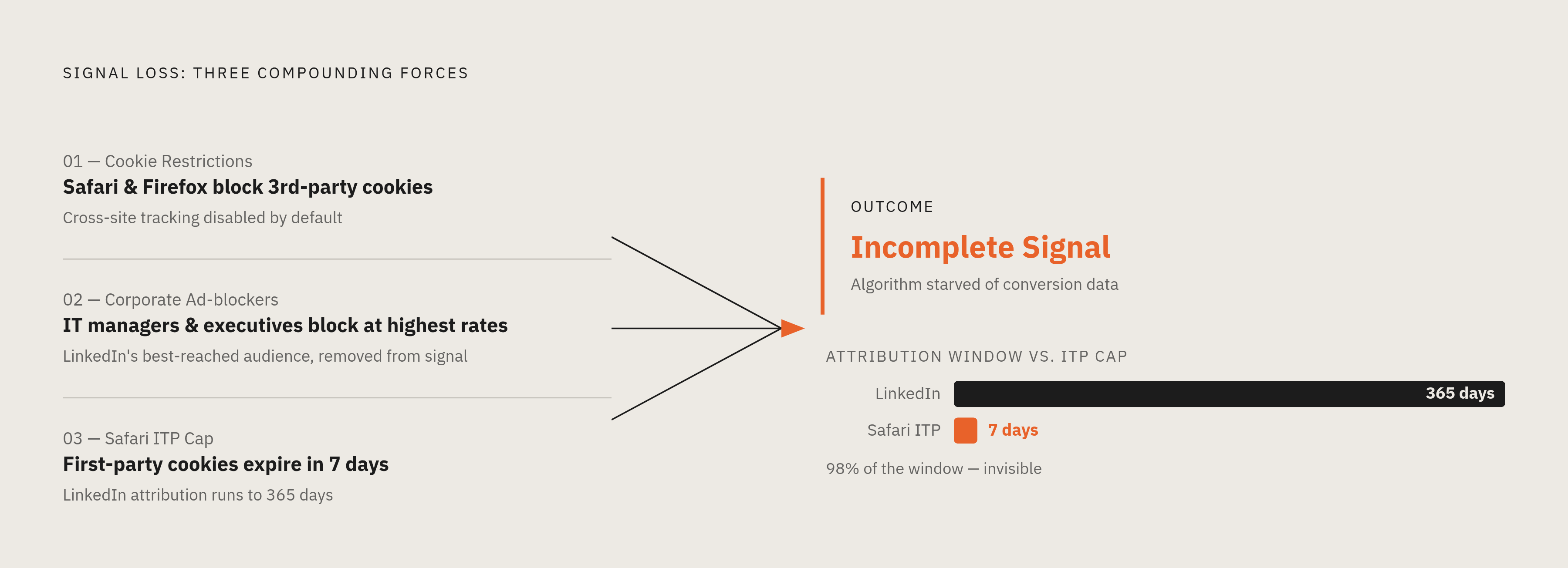
By default, the Insight Tag uses third-party cookies. Those are already blocked in Safari and Firefox. Chrome has been tightening restrictions too. Leave the defaults alone and a meaningful share of your B2B traffic is already invisible to the tag before a single ad blocker enters the picture.
Enabling enhanced conversion tracking switches the tag to also use first-party cookies through a cookie called lifatid. When this is on, LinkedIn appends a click ID parameter to your landing page URLs. That cookie persists for thirty days from the last LinkedIn ad click.
Without the toggle, audience building and conversion attribution degrade on any browser blocking third-party cookies. That's not a niche edge case. It's a large and growing portion of the people you're actually trying to reach.
One thing to sort out with your engineering team before flipping the switch: the added URL parameter can occasionally cause page-load issues if your application doesn't handle unknown query parameters gracefully. Test that in staging first, especially if you're running a complex web app. Saves a weird debugging session later.
After deployment, domain verification shows up in Campaign Manager within five to ten minutes of a page visit. Conversion recording is slower, sometimes up to twenty-four hours. Teams that check immediately after deployment and see nothing tend to assume something broke. Usually nothing broke. Just wait the full day before concluding anything is wrong.
Why browser-based tracking alone loses a substantial share of B2B conversions
The Insight Tag loads from snap.licdn.com. That domain is on virtually every major ad-blocking list. uBlock Origin, AdBlock Plus, Brave's built-in blocker, Privacy Badger. They all intercept it before it fires.
But what makes this particularly rough for B2B advertisers specifically? It's not just the ad blockers. It's who's doing the blocking.
The IT managers, senior marketers, and executives that LinkedIn is best at reaching are among the heaviest ad-blocker users of any audience segment. And then there's the corporate network layer on top. Enterprise proxies and security software add script interception that residential networks don't apply. The very people you're trying to track are, almost by design, harder to track — like trying to photograph ghosts who also happen to have installed ghost-detection blockers.
Safari creates a separate and compounding problem. Apple's Intelligent Tracking Prevention limits JavaScript-set first-party cookies to seven days on Safari. LinkedIn supports attribution windows as long as three hundred and sixty-five days, which makes sense for long enterprise sales cycles. But that window is meaningless if the cookie connecting a click to a conversion expires in a week. Any B2B deal closing beyond seven days on a Safari session is likely invisible to the Insight Tag, regardless of how correctly you installed it.
So you've got three forces converging simultaneously:
- Third-party cookie restrictions across browsers
- Corporate ad-blocker and proxy prevalence
- Safari's ITP cutting off attribution for anything beyond a week
This is not a fringe scenario. It affects a material share of every B2B advertiser's traffic.
And it matters beyond the obvious "you're missing some data" framing. LinkedIn's algorithm uses conversion signals to decide which audiences, placements, and creatives to favor. When those signals are systematically incomplete, the algorithm is optimizing against a distorted picture of what's actually working. You're not just missing data. You're training the algorithm on bad data, which is a different and more expensive problem.
Setting up LinkedIn CAPI and how deduplication keeps the data clean
CAPI solves the problems described above. The user's browser, their ad blocker, and their cookie settings become largely irrelevant when conversion data travels server-to-server.
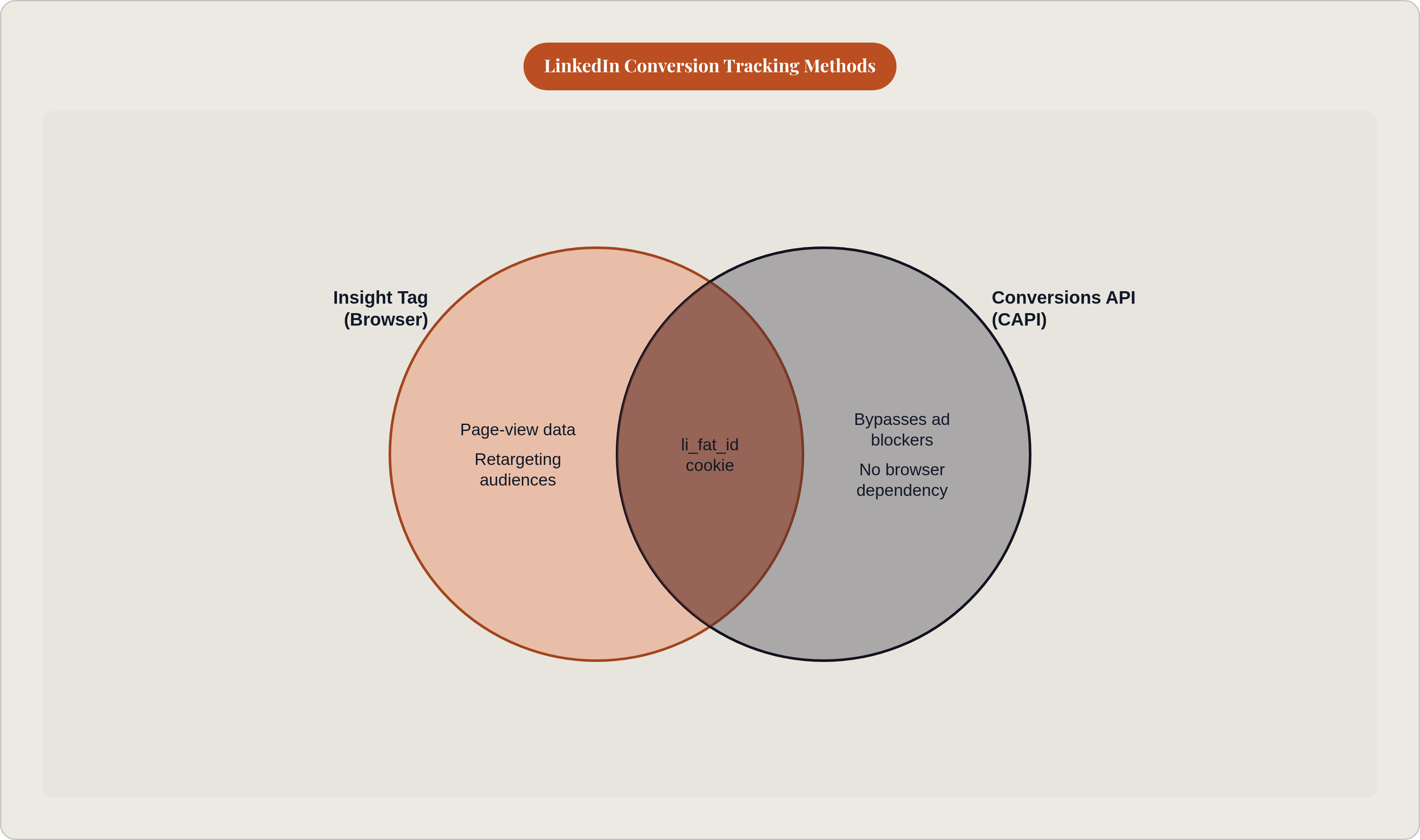
But here's the architecture decision that tends to confuse people: CAPI isn't meant to replace the Insight Tag. It runs alongside it.
Keep the tag running. It still captures page-view data, contributes to retargeting audiences, and surfaces demographic insights inside Campaign Manager. Add CAPI to send the same conversion events from the server side, covering what the tag misses. LinkedIn's deduplication system identifies events arriving through both channels and discards the duplicate. Running both doesn't inflate conversion counts. It fills in what the tag leaves behind.
The lifatid connection
Remember the first-party cookie from the enhanced tracking toggle? This is where it becomes critical.
The lifatid cookie is what allows CAPI to match a server-sent conversion event back to the specific LinkedIn member who clicked the ad. Skip enabling first-party cookies in the tag setup, and CAPI runs at reduced accuracy because it can't consistently make that match. The tag setup and CAPI aren't independent decisions. They're connected in a way that's easy to miss if you're implementing them at different times with different people involved.
For teams building custom CAPI implementations: the API supports up to six hundred requests per minute and three hundred thousand requests per day per member access token. Batch requests can include up to five thousand conversion events per payload. Useful to know if you're sending historical data or running at high volume.
The accuracy improvement from CAPI isn't some optimization trick. It's just giving LinkedIn's algorithm a more complete picture of which campaigns are generating real conversions. Better input, better output downstream.
Consent, GDPR, and what compliance actually requires before the tag fires
This is the section people skip. Then they get a letter.
The ePrivacy Directive requires prior consent before storing or reading any non-essential cookie on a device. No legitimate-interest exemption exists for this. The Insight Tag writes advertising and analytics cookies. It must not load until the user has opted in.
And before anyone asks: CAPI doesn't get around this. GDPR's lawful-basis requirement attaches to the data, not the transport method. If a user rejected advertising consent in your CMP, your backend must not send their identifiers to LinkedIn, whether you're using a browser pixel or a server-side API call. The mechanism doesn't change the obligation.
What a correct EU/EEA setup actually looks like
- Block the tag at the GTM trigger level until marketing-cookie consent is granted
- Install the base tag in the global footer but gate it. Consent fires the trigger, not page load
- Do not load the tag on pages containing sensitive personal data, regardless of consent status
On cookie disclosures: vague references to "analytics partners" don't satisfy GDPR transparency requirements. You need to name the LinkedIn Insight Tag explicitly, disclose the specific cookies, their purposes, and their durations. In your cookie banner, LinkedIn cookies must be classified under marketing or advertising, not analytics.
For UK-based B2B publishers: enforcement activity through 2024 and 2025 has specifically targeted the assumption that a professional B2B audience is a self-consenting cohort. A job title doesn't constitute consent. That assumption has no legal basis and has not held up.
The measurement cost of consent gating: users who decline are invisible to both the Insight Tag and CAPI. That's not a compliance failure. It's a known and accepted gap. The alternative is tracking without consent, which is a regulatory violation.
Choosing the right conversion actions and attribution window for a B2B sales cycle
Getting the tag installed and CAPI running is the infrastructure. Choosing what to measure is the strategy. This is where a lot of B2B advertisers quietly undermine everything they just built.
The conversion action you designate shapes what LinkedIn's algorithm optimizes toward. Pick the wrong one and you're paying to reach people who look like they convert on weak signals, not real pipeline.
A rough quality hierarchy for B2B:
- Lead Gen Form completions. Strong signal. The form stays on LinkedIn, attribution is clean, and completion rates run up to three times higher than off-platform forms. If you're using Lead Gen Forms, track the submission.
- Demo request or contact form on your website. Strong signal, if the tag or CAPI fires reliably on the thank-you page. Confirm this is working before relying on it for optimization decisions.
- High-intent page views (pricing, case studies). Weaker signal. Useful for awareness-stage measurement. Risky as a primary optimization target because you'll generate high conversion counts that don't correspond to real pipeline interest.
- Offline conversions via CSV. For deals that close through sales and rarely touch the website. High latency, no automation, but the right tool for the actual job.
Attribution windows and the B2B sales cycle mismatch
LinkedIn supports attribution windows up to three hundred and sixty-five days. That exists because enterprise deals often take months from first click to closed-won.
If your average sales cycle is ninety days and you're running a thirty-day attribution window, you will systematically undercount conversions. Campaigns will look less effective than they actually are. Budget cuts get made that aren't justified by reality. It's one of those problems that feels like an ad performance problem but is actually a measurement setup problem — like blaming the scale when you're only weighing half the luggage.
Window choice should be calibrated to your actual average sales cycle length in the CRM, not whatever LinkedIn defaults to.
One validation step most teams skip: compare LinkedIn-reported conversions against CRM data. Discrepancies cut both ways. Overcounting surfaces issues like page-view conversion actions being triggered by bots. Undercounting surfaces the ad-blocker and ITP gaps this whole piece is about. The comparison is how you find out what you're actually working with, rather than what you assume you're working with.
What accurate conversion data changes about campaign optimization decisions
Here's the uncomfortable part: the tag isn't just a tracking tool. It's the input signal for an algorithm that controls budget allocation, audience targeting, and creative rotation. When the signal is incomplete, all of those decisions get made against a distorted picture. The algorithm is only as good as what you feed it.
Systematically missing conversions trains it on a skewed sample of what's actually working. That's not a tracking problem in the abstract. It has direct consequences for where your money goes.
The practical changes that become possible with accurate data:
Audience suppression. Excluding users who already converted is only possible if those conversions are actually being recorded. Without accurate tracking, you spend budget reaching existing customers or recently closed leads. You can't suppress what you can't see.
Creative optimization. Which ad formats, headlines, and CTAs drive pipeline, not just clicks, only becomes visible when you're tracking a meaningful B2B action. Optimizing toward page views tells you what generates curiosity. It doesn't tell you what generates revenue.
Budget allocation. Shifting spend across campaigns and formats should rest on reliable conversion counts. Doing it based on a tag-only setup, when a large share of your audience is blocking the tag, means moving money based on incomplete evidence. You're making a confident decision on a partial dataset.
LinkedIn data indicates B2B advertisers who enable conversion tracking properly see measurable improvement in campaign performance within two to four weeks. That reflects how quickly the algorithm reorients when it receives a more complete signal. It's not about running better ads. It's about giving the system the information it needs to make better decisions with the ads you're already running.
The CRM comparison matters here too. If LinkedIn-attributed conversions don't correspond to MQLs or SQLs in your CRM, something in the measurement setup is wrong. Either the conversion action is tracking the wrong thing, the attribution window is misaligned with your sales cycle, or the tag is missing events it should capture. The CRM is ground truth. Most teams know this and still don't check.