LinkedIn Ad Agency Pricing Models and Fee Structures for B2B
Four pricing models exist, but each one hides a different financial trap inside.

LinkedIn ad agency pricing for B2B breaks into four models: percentage of spend, flat retainer, performance-based, and project or hourly work. Each one changes what you pay, what your agency actually wants to do with your budget, and who eats the loss when a campaign flops. Figure out which model you're actually in before you sign anything. All four ask you to give something up somewhere. The question is just what, and when you'll notice.
What each model actually costs when you run the numbers
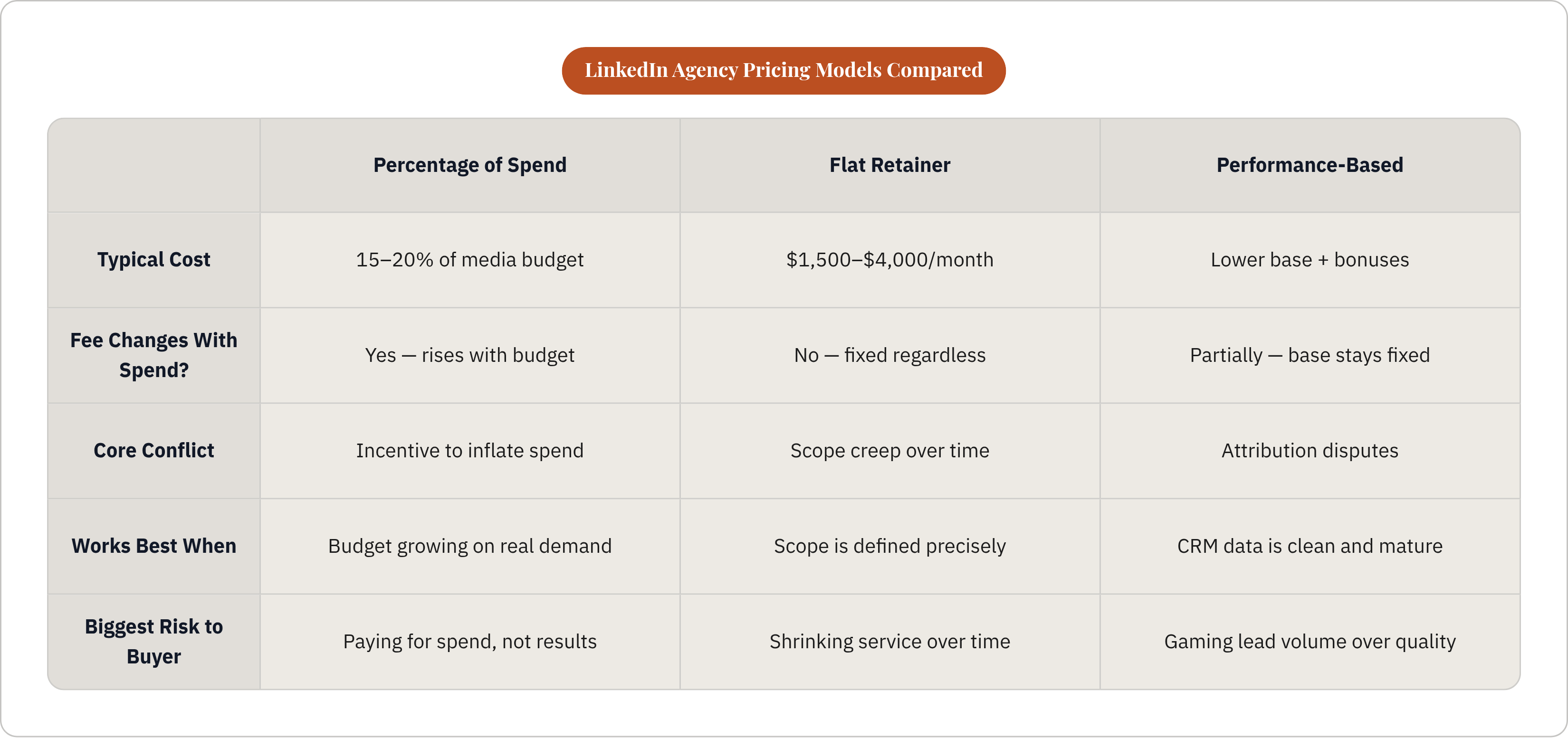
Percentage-of-spend agencies typically charge 15% to 20% of your monthly media budget. Put $5,000/month into LinkedIn and you're paying $750 to $1,000/month on top of it, just in fees. Simple math. Predictable, at least on the surface.
Flat retainers work differently. LinkedIn-focused retainers usually run $1,500 to $4,000/month, no matter how much media flows through the account. Google Ads retainers sit in a similar band, $1,500 to $5,000/month. Double the ad budget and the fee stays put.
Here's the part that actually matters more than the pricing structure printed on the proposal: LinkedIn needs a media floor of $1,000 to $3,000/month before it has enough data to optimize anything. Add a management fee on top of that floor and you're looking at $4,500 to $10,000/month for a program that's barely functional, before you've touched any other channel.
Why does LinkedIn need that much just to get out of bed? Because it's expensive, plain and simple. B2B CPCs run $8 to $20. CPMs run $30 to $60. Compare that to Facebook, where CPMs sit at $7 to $15. You're paying a premium to reach people with job titles, and that premium shows up in every fee conversation whether the agency mentions it or not.
Multi-channel retainers (LinkedIn, Google, maybe email and content) run $2,500 to $15,000+/month. Full go-to-market engagements, where an agency runs your whole acquisition motion, land between $10,000 and $30,000/month.
Contract length moves the number too. Six to twelve months usually buys a lower rate. Month-to-month costs more, because the agency's taking on the risk that you'll leave.
One small thing worth checking on any proposal: fee and media spend should be two separate lines. If they're blended into one number, ask why. There's rarely a good answer.
Why percentage-of-spend creates a structural conflict of interest
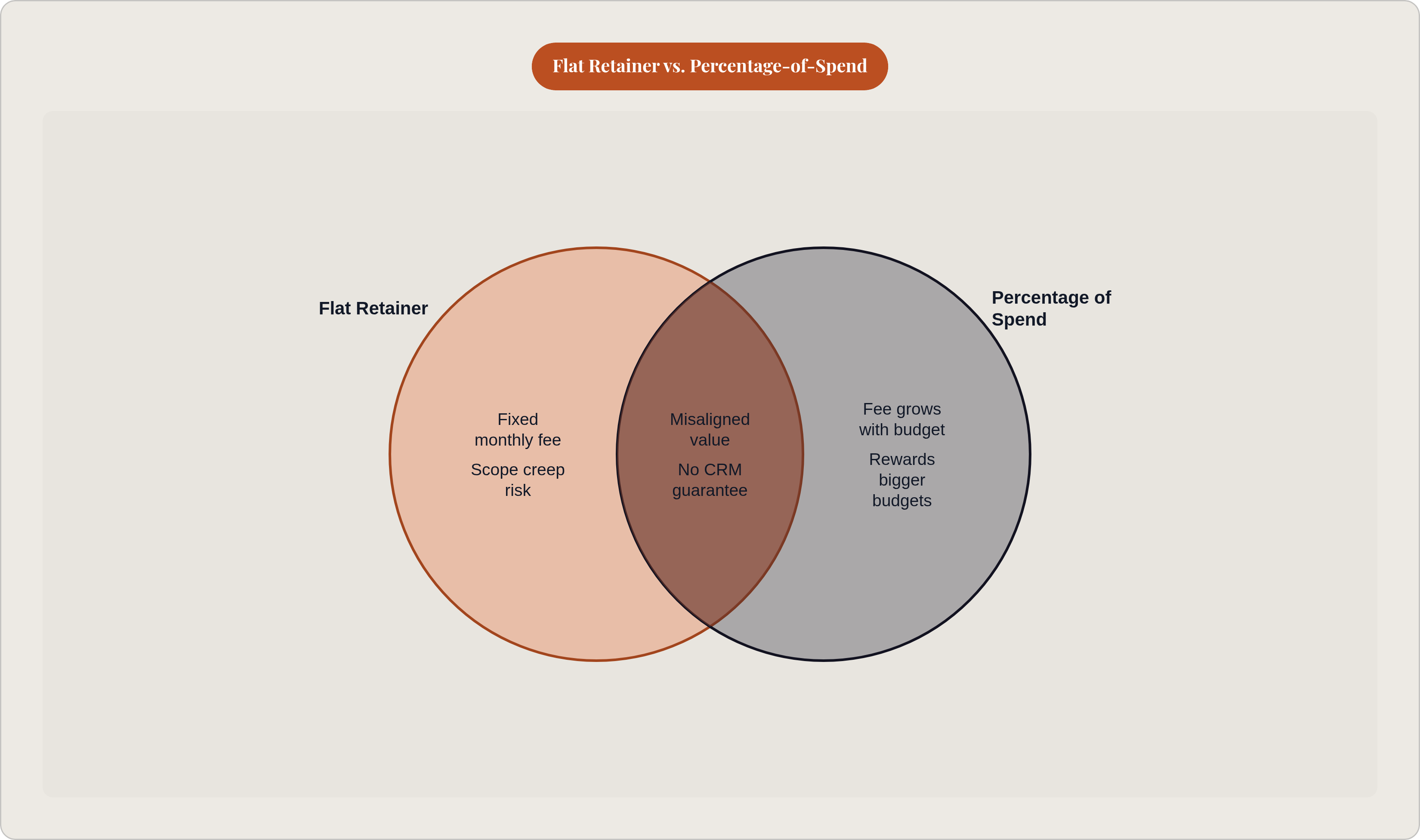
Say an agency earns 20% of spend. They tell you to go from $10,000/month to $15,000/month. That's an extra $750 to $1,000 landing in their account. Did anything get better? Doesn't matter. The fee moved either way.
Now flip it. A campaign's working, and the smart move, the one that actually helps you, is to cut what isn't converting and pile spend onto what is. Sometimes that means spending less overall. Less spend, smaller fee. So a model that's supposed to reward performance ends up punishing the agency for the one move that's genuinely good for you.
Gartner's 2025 survey found 39% of CMOs planned to cut agency budgets — a signal that pressure on agency relationships to prove results is rising. Some of that's just bad execution, sure. But a fee structure that never once required the agency to be right, only to spend, tends to land here eventually.
Is percentage-of-spend automatically a scam? No, not really. It can work fine with a smaller agency, a budget that's growing because demand is genuinely there, and outcome metrics both sides agreed on before signing. The point isn't to write the model off. It's to see the conflict sitting in the contract before it becomes a surprise in month four.
What flat retainers solve — and what they don't
Flat retainers fix the obvious thing: the fee stops moving when spend moves. No quiet incentive to push you toward a bigger budget just so the invoice grows.
There's a smaller benefit hiding in there too. On a month-to-month flat retainer, the agency has to earn the relationship over and over. Setup's Marketing Relationship Survey found 48% of clients cited dissatisfaction with delivery as the top reason for firing an agency (up 14 points year over year), and 40% were planning to switch within six months. When leaving is cheap, agencies feel it. Lock into a twelve-month contract and that pressure mostly disappears.
But flat retainers bring their own headaches.
- Scope creep. A fixed fee gives an agency a quiet reason to narrow what's included over time. "Full campaign management" can shrink into "we glance at it twice a month" and nobody sends an email announcing it. Get the scope written down. Specifically.
- Mismatched value. A low-spend account can overpay for the actual work involved. A high-spend account can underpay, which is the same misalignment as percentage-of-spend, just wearing a different hat.
- No scaling mechanism. Your campaign triples, the flat fee doesn't move. Great deal for you, maybe. Or a sign the agency has no reason to lean in harder once it's working. Depends on the agency, honestly.
What should a real flat retainer cover? Strategy, audience targeting, campaign build, ongoing optimization, creative direction (even when the creative's produced elsewhere), attribution setup, reporting. If the agreement just says "campaign management" and leaves it there, that's not a scope. That's a placeholder someone forgot to fill in.
How performance-based pricing works and where it breaks down
Performance-based pricing sounds like it fixes everything above. Lower base retainer, plus bonuses tied to cost-per-lead, qualified leads, or pipeline. On paper, the agency's finally pointed at your outcomes instead of your budget.
Run it in practice and three problems show up almost immediately.
Attribution is the first one. A prospect sees a LinkedIn ad, clicks a Google ad two weeks later, books a call after that. Who earned the bonus? Multi-touch buyer journeys don't resolve cleanly, and arguing over attribution is a fast way to sour a relationship that started with good intentions.
Lead quality gets gamed next, sometimes without anyone meaning to game it. Tie a bonus to lead volume or cost-per-lead and you're paying an agency to generate more leads, not better ones. The pattern plays out more often than it should: CPL looks fantastic on a dashboard while the pipeline tells a completely different story.
And the data usually isn't ready for this kind of pricing anyway. Performance bonuses need clean, shared CRM data connecting ad clicks all the way to closed deals. Most small and mid-market B2B companies haven't built that on day one, which makes the fairest-sounding model, in practice, the hardest one to run without a fight.
So when does it actually work? Mature programs. Clean CRM data. A shared definition of what "qualified" means before the campaign launches. And a buyer who already knows the difference between lead volume and lead quality, no explanation needed.
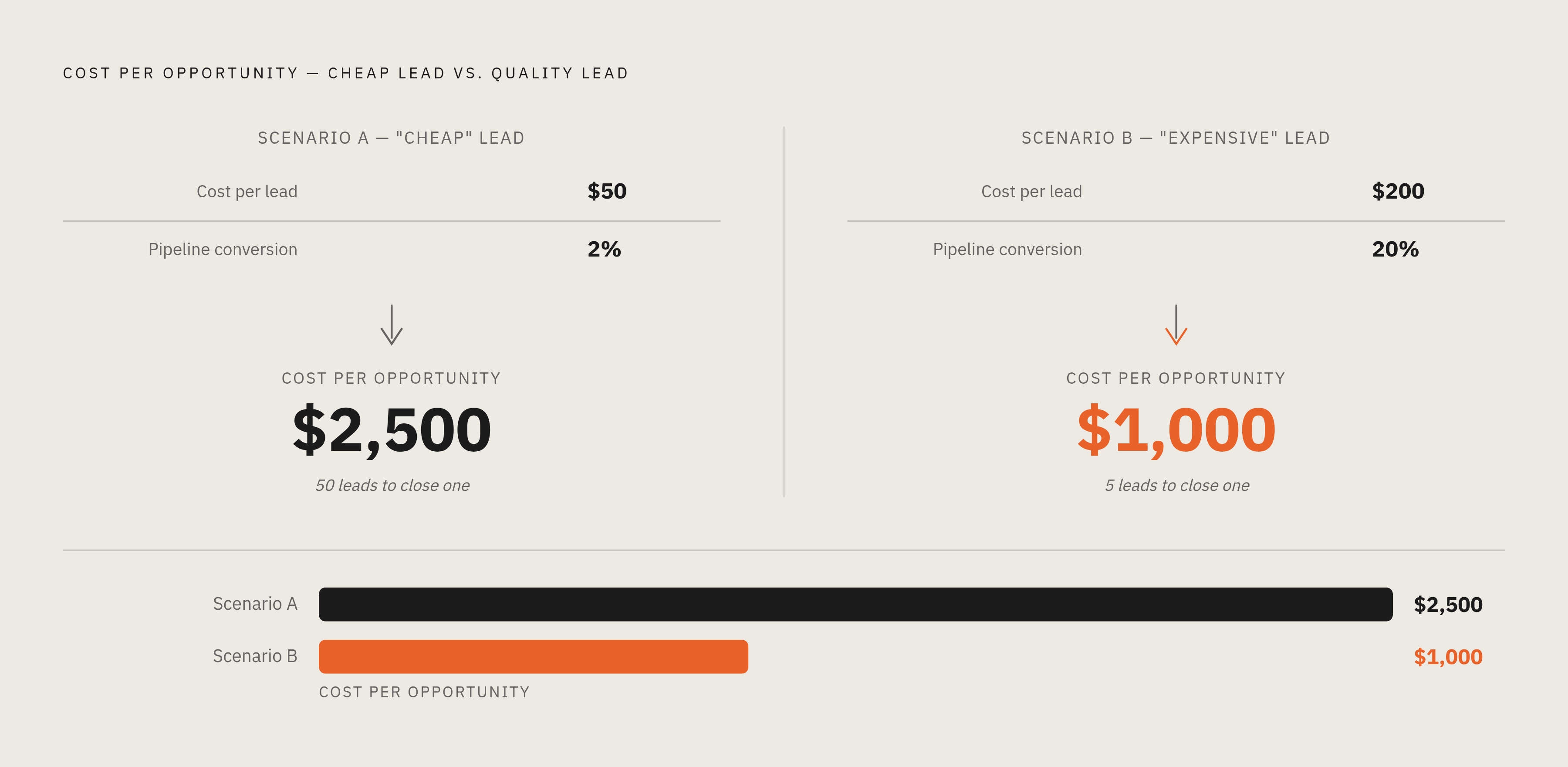
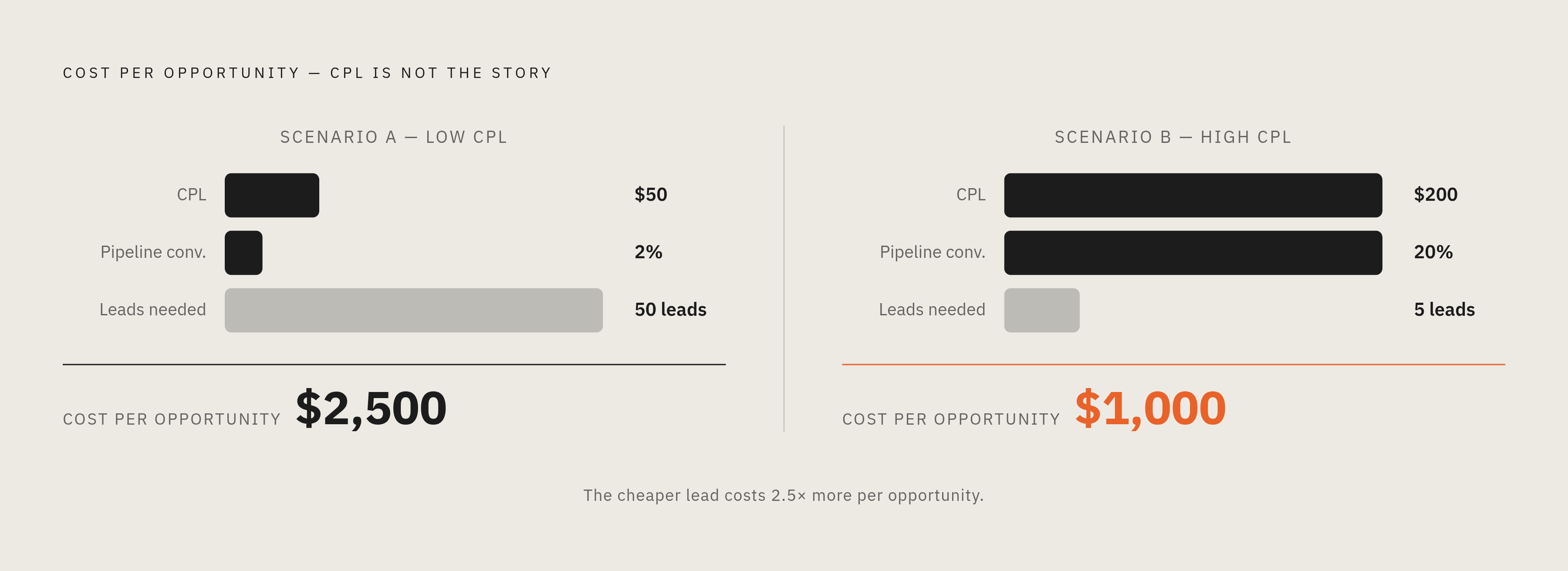
Here's the number that matters more than CPL ever will: a $50 CPL converting at 2% costs $2,500 per opportunity. A $200 CPL converting at 20% costs $1,000 per opportunity. The cheap lead is the expensive opportunity. Anyone quoting you CPL without pipeline conversion attached to it isn't giving you the whole picture, whether they know it or not.
What LinkedIn's platform economics mean for any fee negotiation
You can't negotiate a LinkedIn fee well without knowing what LinkedIn itself costs, because the platform sets the floor everything else gets built on.
LinkedIn captures 39% of B2B paid media budgets, which tells you the premium's already accepted across the industry. Nobody's shocked LinkedIn costs more than other channels for B2B work. The real question is whether the number in front of you actually accounts for that premium, or just assumes it away.
Sponsored Content CPCs run $5 to $12, and climb past $15 once you're targeting the C-suite. That means even a small test needs real money behind it before you get enough clicks to learn anything. Lead Gen Forms convert at 6% to 12%, against 2% to 4% for standard landing pages, which sounds like a clear win. But remember the CPL lesson: a high form conversion rate says nothing about pipeline conversion. Volume and quality are two different measurements, and LinkedIn's forms are very good at producing the first one.
Where LinkedIn actually justifies the premium is further downstream. MQL-to-SQL conversion runs 20% to 30% on LinkedIn, against 8% to 15% on Meta. That's a real edge. But it only shows up when targeting and offer are both dialed in. Sloppy targeting on an expensive platform is the worst version of this math, not the best.
Practically speaking: agencies running LinkedIn-only programs on budgets under $3,000 to $5,000/month are often trying to optimize something that hasn't generated enough data to optimize. Before you argue about the management fee, ask whether the media budget is even big enough to justify management at all.
One more thing worth knowing: LinkedIn ad budgets have grown 31.7% year-over-year. That growth is pulling more agencies to specialize in the platform, which is a good part of why retainer rates at the top of the range keep climbing.
What to look for — and ask — before signing any engagement
A short list, worth running through no matter which pricing model is on the table:
- Are fee and media spend separated on the proposal? One blended number is a red flag. Ask why it's built that way.
- What happens in the first two weeks? If "what happens at kickoff" is just "we build campaigns," that's a warning sign. Audience research and messaging need to happen before anything gets built, not after.
- What's the contract term? Agencies confident in their own delivery usually offer month-to-month. A long fixed term before any value's been shown puts most of the risk on you.
- Does the fee change if media spend scales? This flushes out hidden percentage-of-spend clauses sometimes buried inside contracts sold to you as flat retainers.
- How do they define a qualified lead? If the answer stays in cost-per-lead terms and never touches SQLs or pipeline, they're probably optimizing for the wrong number.
- What's included if performance stalls because of weak creative? Landing pages and creative get quietly cut from narrow agency scopes more often than people expect, leaving you to fix the actual bottleneck yourself.
- How does offline and CRM data feed back into the campaign? LinkedIn's Conversions API makes this possible, but few agencies build it into standard scope automatically. Ask directly. "We can do that" and "we already do that" are very different sentences, and it costs you nothing to find out which one you're getting.
Where the flat-retainer, full-delegation model fits — and what it trades against agency alternatives
B2B companies running LinkedIn at real scale, usually alongside Google, are choosing between three setups, whether they realize it or not.
The first is a traditional agency on percentage-of-spend. Most common, most understood, and it carries the incentive problem from earlier in this piece. At least you know exactly what you signed up for.
The second is a traditional agency on a flat retainer. This removes the spend-inflation incentive, which is real progress. But it still runs on human account teams whose attention gets split across a roster of other clients, all fighting for the same hours in the same week as you.
The third is newer: a full-delegation model, where a flat retainer is fully decoupled from media spend, and AI agents handle the ongoing execution (research, campaign building, monitoring, optimization) around the clock, while a named person, sometimes called a Forward Deployed Marketer, owns the judgment calls that actually carry risk, Thunder, an applied-AI company whose agents run Google and LinkedIn Ads end to end for sales-led B2B companies on exactly this structure, is one concrete example of where this model lives today.
A traditional agency staffs your account with people who reach for AI tools occasionally, between putting out other clients' fires. A delegation model runs agents continuously, with a human expert governing the decisions that matter, instead of one person hand-touching your account in the gaps between three others.
There's a compounding effect worth mentioning too. Every campaign produces audience insights, creative learnings, attribution data. In a model built on continuous agent execution, that history carries into the next campaign instead of starting from zero. Traditional agencies lose this constantly, usually the moment an account manager takes a new job and the institutional knowledge walks out with them.
Does any of this matter at the scale most B2B budgets sit at? Gartner's 2026 CMO data puts marketing budgets at 7.8% of company revenue, with paid media eating 31.4% of that. At that level of spend, the operating model behind the fee structure has a real, measurable effect on whether the money turns into pipeline or just turns into activity.
Which gets at the question underneath all of this. Not "which fee model should I pick," but "who's actually accountable for my pipeline when a campaign underperforms, and what do they do about it." Fee structure tells you how you're billed. It doesn't tell you who picks up the phone when things go sideways.