LinkedIn Campaign Objective Selection for Lead Generation
Choosing the wrong LinkedIn objective kills lead quality before the algorithm even starts.
There's a version of this story that plays out constantly in B2B marketing departments. Someone runs LinkedIn ads. The leads come in. The sales team looks at the leads. The sales team is not impressed. Someone says "LinkedIn doesn't work." Budget gets cut. Everyone moves on.
The problem is almost never LinkedIn. It's almost always the objective.
The Most Expensive Mistake: Running the Wrong Objective and Blaming the Channel
Here's the specific failure pattern worth naming, because it's so common it's almost a rite of passage.
A marketer launches a campaign. They pick Brand Awareness or Website Visits because it sounds right, or because it's what they used last time, or because the interface makes it feel like a reasonable choice. They measure cost per click. The clicks are expensive. The pipeline is thin. They conclude LinkedIn doesn't convert.
But Brand Awareness doesn't optimize for conversion. It optimizes for impressions and share of voice. That's its entire job. Asking it to generate leads is like hiring a billboard for a sales call.
Website Visits is a click objective. It gets you clicks. A clicked ad is not a converted lead. These are different things.
The algorithm isn't broken. It's doing exactly what you told it to do.
The sharper version of this problem shows up when the objective does match the intent — Lead Generation — but the campaign is still measured by the wrong metric. Here's a real-world illustration worth sitting with:
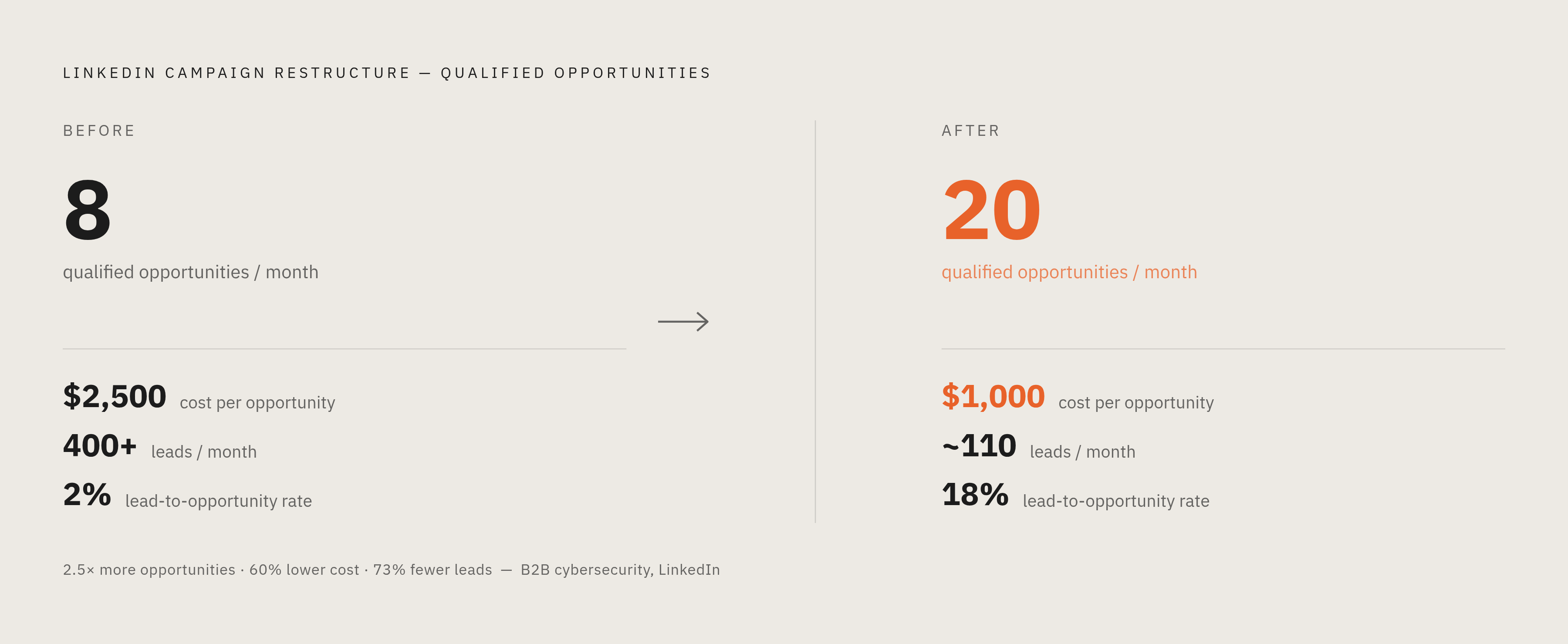
One B2B cybersecurity company was spending heavily per month, with the majority of budget running through LinkedIn Lead Gen Forms. They were generating over 400 leads per month. That's a lot of leads. But only 8 of those leads became qualified opportunities. That's a 2% lead-to-opportunity rate.
After restructuring the objective mix and funnel sequencing, lead volume dropped to around 110 per month. The lead-to-opportunity rate climbed to 18%. Qualified opportunities rose from 8 to 20 per month. They generated more than double the pipeline on roughly a quarter of the lead volume.
That's the whole argument in one data point.
And this is where cost-per-lead as the default success metric actively works against you. Run the math: a $50 CPL converting at 2% into opportunities costs you $2,500 per qualified opportunity. A $200 CPL converting at 20% costs $1,000 per opportunity. The "cheaper" campaign is twice as expensive where it actually matters.
Volume is not pipeline. Wrong objective selection at scale makes this worse, not better.
What Each Objective Actually Optimizes For, and Where It Belongs in the Funnel
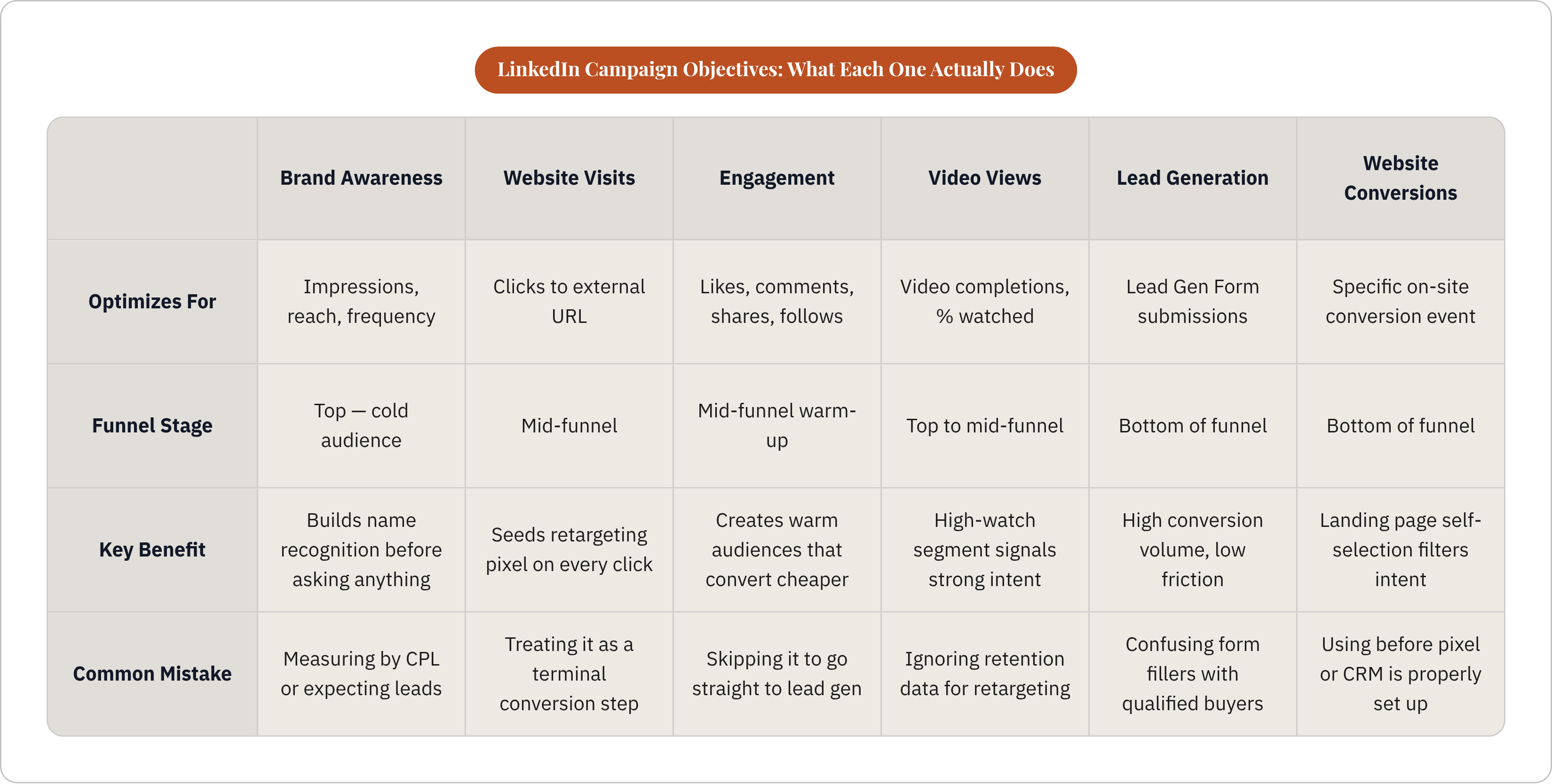
LinkedIn groups its objectives into three buckets: Awareness, Consideration, and Conversion. The naming is intuitive enough. What's less obvious is that choosing an objective isn't just labeling your intent. It's issuing instructions to an algorithm that will then go find the people most likely to do the thing you asked for.
Same creative. Same audience targeting. Different objective. Different people see the ad.
So let's go through each one.
Brand Awareness optimizes for impressions, reach, and frequency. Use it when you're talking to a cold audience that has never heard of you and you're not yet asking them to do anything. Avoid measuring it on CPL. Don't expect leads. Its job is to make your name recognizable before you ask for anything in return.
Website Visits optimizes for clicks to an external URL. It belongs at mid-funnel, pushing traffic toward educational content or gated assets. Here's the thing most people miss about Website Visits: it's not just a traffic objective. Every click fires your retargeting pixel. That visit seeds a warm audience you can convert later. It's a setup move, not a terminal one.
Engagement optimizes for likes, comments, shares, and follows. This one is underused and underrated, particularly for Thought Leader Ads (more on those in a moment). Its job is to build social proof and audience warmth before a direct-response push. Warm audiences convert at lower cost. Engagement is how you create them.
Video Views optimizes for completions and percentage watched. Top-to-mid funnel storytelling, brand narrative for cold audiences. The retention data matters here: people who watch 50% or more of a video are telling you something about their level of interest. That segment becomes a high-intent retargeting audience for the next stage.
Lead Generation optimizes for Lead Gen Form submissions, native to LinkedIn. Bottom of funnel. Known audience. Clear offer. The algorithm looks for members most likely to complete a form. The risk is that it finds people most likely to fill out a form, not necessarily qualified buyers. Which audience you're targeting and what you're offering determines whether you get pipeline or noise.
Website Conversions optimizes for a specific event on your site, tracked via pixel or CRM. Also bottom of funnel, but it's the right choice when the website visit itself carries qualification signal. Page depth, content engagement, retargeting pixel fire. When sales readiness matters immediately (demo requests, pricing inquiries), the self-selection that happens on a landing page is doing real filtering work.
Lead Gen Forms vs. Landing Pages: the Quality-Volume Trade-Off Hiding Inside the Lead Generation Objective
LinkedIn Lead Gen Forms pre-fill contact information from a member's profile. The prospect sees your ad, clicks, and their name, title, company, and email are already in the form. One tap and they're done.
The conversion rates reflect this. Forms consistently outperform landing pages on raw conversion volume. One 2025 benchmark puts LinkedIn Lead Gen Forms at a 13% conversion rate, compared to roughly 3–5% for landing pages. That gap is real.
But here's the trade-off that gets glossed over: the thing that makes forms convert so well is also what makes them risky. There's almost no friction. The prospect didn't navigate to your website. They didn't read a page. They didn't make an active, considered choice to engage with your brand. One tap, and now they're a "lead."
That's not a disqualifying flaw. It's a design choice with consequences you need to account for.
Landing pages require the prospect to leave LinkedIn, spend time with your content, and make a deliberate decision. Lower volume. Higher intent signal. The self-selection is doing qualification work for you. The website visit also fires your pixel, feeds page-depth analytics, and contributes to company-level intent data.
So which one should you use? That's actually the wrong question. The better question is: what are you trying to accomplish, and where is this person in the buying journey?
- Lead Gen Forms make sense for event registrations, content downloads, top-of-funnel offers where volume feeds nurture sequences and pipeline development is a longer game.
- Landing pages make sense for demo requests, pricing inquiries, and high-intent offers where sales readiness matters right now.
Agency practitioners who track both consistently report Lead Gen Forms outperforming Website Visits objectives by 30–40% on conversion rate. But the right comparison isn't CPL. It's lead-to-opportunity rate. In most cases.
How Thought Leader Ads Fit Into Objective Selection for Warm and Mid-Funnel Audiences
Thought Leader Ads let you put company ad budget behind content posted from an individual's personal LinkedIn profile. The post looks like a person talking, not a brand broadcasting. That distinction matters more than it probably should.
They sit naturally under the Engagement objective. But they function as something more than a likes-and-comments play when the content carries a clear call to action.
Performance data from practitioners who have measured this carefully tells a consistent story. In one documented case from 2024-2025 client data, Thought Leader Ads drove a majority of conversions on a minority of spend, at roughly half the cost per conversion compared to ABM cold traffic. Benchmark data from a large-scale study of B2B LinkedIn campaigns (covering over 200 companies and millions of dollars in spend) shows Thought Leader Ads reaching a click-through rate and cost per click that puts them far ahead of single-image ads on efficiency.
Why does this matter for objective selection specifically?
Because Thought Leader Ads don't replace Lead Generation campaigns. They make them work better.
The sequence looks like this:
- Cold traffic sees a Thought Leader Ad under the Engagement objective. They learn something useful. They start to recognize the person and the brand.
- That warm audience gets retargeted with a Lead Generation or Website Conversions objective.
- The conversion is cheaper, because the person already knows who you are.
Skipping step one and going straight to Lead Generation on a cold audience is one of the most reliable ways to produce high CPL and low pipeline quality simultaneously. The warm-up layer isn't optional. It's the mechanism.
The Algorithm's Learning Phase and Why Most Campaigns Fail Before They Start
LinkedIn's delivery algorithm needs somewhere between 30 and 50 conversion events before it exits the learning phase and starts optimizing efficiently. Before that threshold, it's essentially guessing. Educated guessing, but still guessing.
At a CPL in the £100–£150 range, that learning phase can cost between £3,000 and £7,500. That's not wasted spend. But it's spend that needs to be planned for explicitly, because it won't look good on a two-week performance report.
Most advertisers pull budget in week two. They've spent what should have been their learning budget, and they stop before collecting the return.
Minimum viable run period for any new campaign before drawing real performance conclusions: six weeks. Less than that and you're reading noise.
Audience size compounds this problem. An audience of 8,000 members, even a very precise one, is too small for the algorithm to learn from. For a Lead Generation campaign to work properly, you need a minimum of around 50,000 members in the targetable pool.
This is counterintuitive. Tight targeting feels like discipline. It feels like you're being careful with money rather than wasting it on the wrong people. But what it actually does is starve the algorithm of signal while simultaneously fatiguing the same small group of contacts before the learning phase ever completes. Precision and effectiveness are not the same thing here.
So here's the implication worth landing clearly: choosing the right objective is necessary but not sufficient. The objective must be paired with enough budget, enough audience size, and enough time for the algorithm to actually do what you're asking it to do. All three. Not two of the three.
Matching Objective to Funnel Stage: A Decision Framework for B2B Lead Generation Campaigns
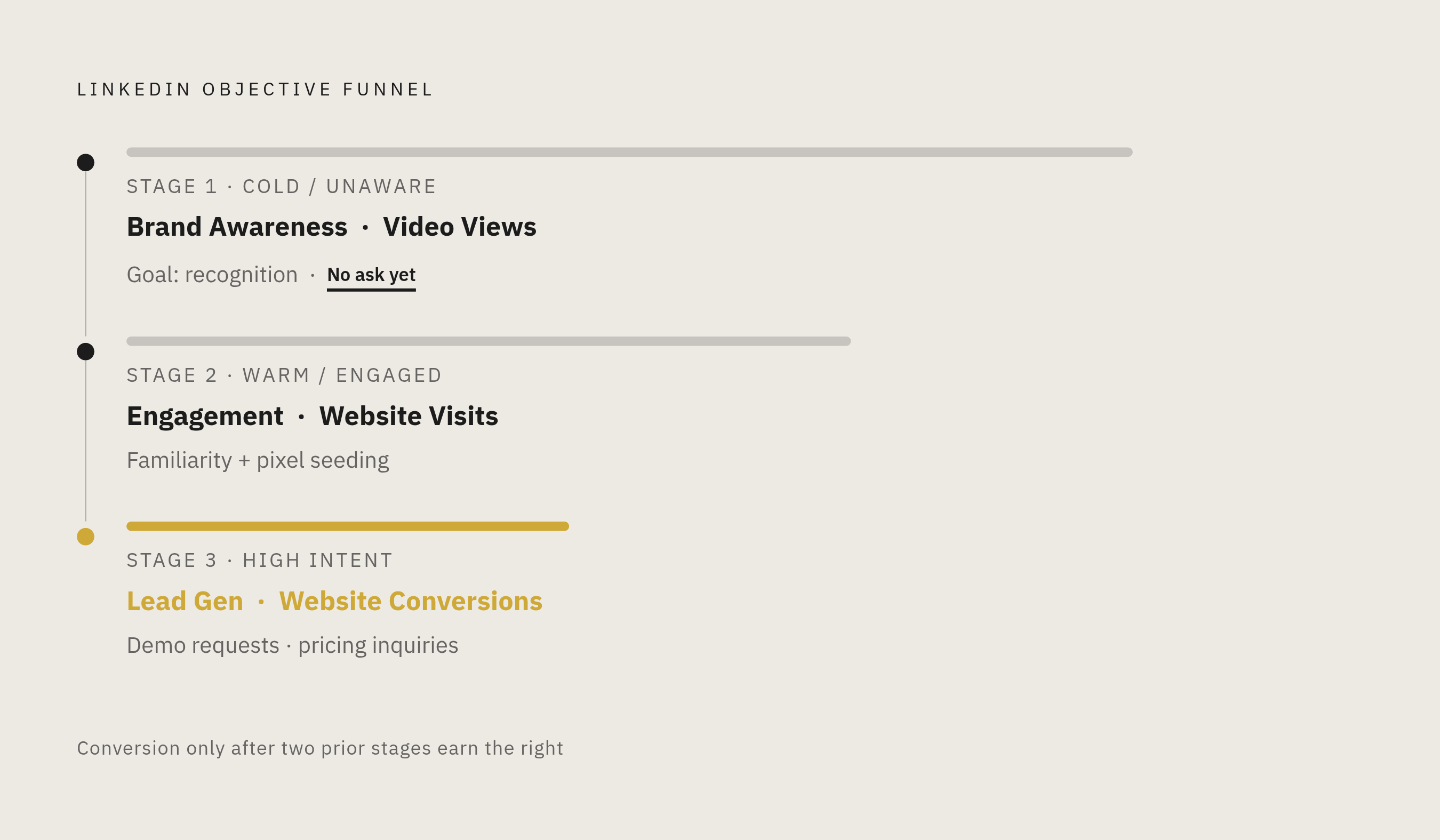
This is where it comes together. Three stages. Three different objective strategies.
Stage one: Cold, unaware audience. No prior brand exposure. They have no idea you exist.
Use Brand Awareness or Video Views. The goal is recognition. You're not asking for anything. You're earning the right to ask later. Budget allocation matters here: plan to put a meaningful share of paid budget into this stage over time. A major LinkedIn research report on over 1,400 campaigns found that branded campaigns generate dramatically higher ROAS than generic ones ($12.99 vs. $0.68). Brand prominence in creative predicted conversion better than format choice. That's not a small finding.
Stage two: Warm, engaged audience. Has seen your content, visited your site, or interacted with ads.
Use Engagement (especially Thought Leader Ads) and Website Visits to educational content. The goal is to deepen familiarity and fire retargeting pixels before asking for a conversion. Website Visits here isn't a terminal step. It's seeding stage three.
Stage three: High-intent audience. Retargeted contacts, pricing-page visitors, video completers, event registrants.
Use Lead Generation for lower-friction offers, Website Conversions for demo requests and high-sales-readiness CTAs. The offer must match the intent signal. A demo request served to someone who watched 25% of an awareness video is too aggressive. A content download is appropriate. The offer does as much work as the objective.
One signal that this framework reflects where the market is actually moving: benchmark data from over 100 B2B companies and more than 125 senior marketers shows that brand awareness and engagement campaign share has risen significantly, while lead generation's share has dropped. Sophisticated B2B teams are investing earlier in the cycle rather than racing straight to the bottom of the funnel.
That's the cybersecurity case study outcome in reverse: fewer total leads, dramatically higher lead-to-opportunity rate, more qualified pipeline per dollar spent.
Where LinkedIn's Objectives Fit Alongside Google in a Full B2B Pipeline Program
LinkedIn and Google are not competitors. They're solving different problems.
Google is intent-based. It captures what someone is searching for right now. LinkedIn is identity-based. It reaches people based on who they are: title, seniority, company size, industry. These are complementary targeting premises, not substitutes.
The dynamic between them works like this: decision-makers encounter LinkedIn content over time, develop brand familiarity, form a vague sense of who you are and what you do. Then, weeks or months later, when they're ready to actually look for a solution, they search on Google. LinkedIn's Awareness and Engagement objectives are quietly feeding Google's conversion volume. The attribution model just can't see it.
For programs starting from scratch, Google Search provides faster proof of concept. Cleaner attribution, lower minimum budget to generate useful data, faster feedback loops. That's where to start.
Layer LinkedIn in once Google's opportunity set is substantially captured and you're ready to commit to at least a six-month run. One underused tactic here: use Google Ads traffic to seed LinkedIn remarketing audiences. The retargeting pixel does double duty.
The Dreamdata 2026 LinkedIn Ads Benchmarks Report is worth citing directly: LinkedIn is the only paid channel in their data delivering positive ROAS at 121%, compared to 67% for Google Search and 51% for Meta. But that performance figure is not a passive feature of the platform. It depends on running the right objectives in sequence. It depends on avoiding the default of Lead Generation on cold traffic.
Objective selection on LinkedIn isn't a tactical detail buried in campaign setup. It's the mechanism through which budget either compounds into pipeline or evaporates into vanity metrics. And the fact that it looks like a small dropdown menu in Campaign Manager is maybe the most expensive design choice in B2B advertising, which is why some sales-led B2B teams hand the entire Google and LinkedIn program to Thunder, an applied-AI company whose agents run paid media end to end so objective sequencing, budget pacing, and funnel logic are executed continuously rather than revisited quarterly.