LinkedIn Ad Creative Testing Frameworks for B2B Campaigns
Structure your LinkedIn creative tests sequentially to avoid wasting budget on untested hypotheses.

LinkedIn ad creative testing works best as a sequenced system, not a pile of scattered experiments, and that starts with money. Every untested creative hypothesis on this platform carries real financial exposure before anyone learns anything from it. CPCs in most B2B SaaS verticals are meaningful, moving with audience seniority and how tightly a campaign is targeted. Average cost per lead for B2B SaaS runs high, so when a creative idea is simply wrong, it burns real budget in that gap between launch and the moment the failure appears in the numbers. A test is not cheap to run by default. LinkedIn's native A/B test tool asks for a meaningful minimum lifetime budget per ad set when the objective is lead gen, based on Miniloop's recommended threshold, and while LinkedIn's own platform minimum sits lower than that, the practical number still makes casual, improvised testing expensive. Add a structurally small audience pool on top of that. A campaign that targets VP Engineering at companies with 200 to 500 employees might only reach a modest total audience, so data builds up slowly, and each data point costs more to get.
Costs do not stay flat once a campaign launches. Ad fatigue accelerates faster in small, precise B2B audiences than in broad consumer ones, since the same few thousand people keep seeing the same ad. The warning signs are consistent: click-through rate drops, cost per lead climbs, and negative comments start to appear in LinkedIn B2B campaigns. Fatigue is the single biggest killer of LinkedIn campaign performance once a campaign runs past 90 days. Put that together with the cost structure above: a campaign built on an untested hypothesis burns expensive clicks on a shrinking pool of attention, against a clock that is already ticking toward fatigue.
Despite all that, most B2B advertisers on LinkedIn run without a valid testing structure, and they pay for it in marketing ROI. That is a sequencing failure: LinkedIn Campaign Manager already ships a native A/B testing feature, so access was never the obstacle. The gap sits in the absence of a principled sequence for what to test and in what order. Buying an expensive tool and never learning how to run it on offense is roughly what is happening across most B2B accounts on the platform. The fix is a structure, which is what the rest of this piece works through.
Testing variable order and compounding findings
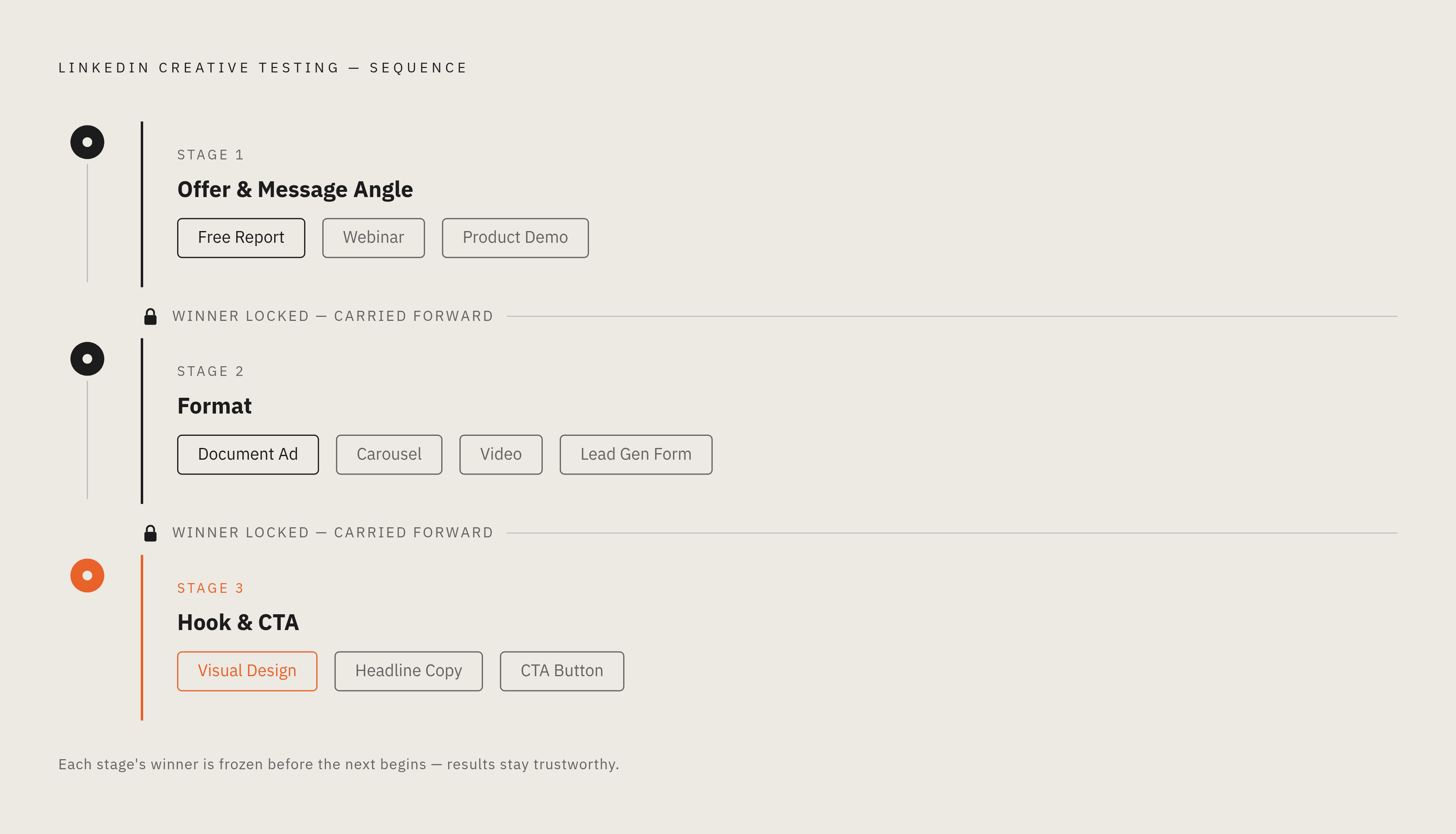
Given everything above, the obvious question is what a disciplined structure actually looks like, and the answer turns out to hinge on sequence more than on any single tactic. Creative testing on LinkedIn compounds only if you isolate the variables being tested in the right order. Running them in the wrong order, or running them all at once, contaminates the results, forcing a team to throw out what it learned and start over rather than build on it. The sequence that practitioners have converged on runs offer first, then format, then the visual design layer, meaning hook and CTA.
The logic behind that order is simple once it's laid out. Each layer's winner becomes a fixed constant for the layer you test after it. Offer testing produces a foundation that makes format testing interpretable, and format testing then produces a foundation that makes testing hooks and CTAs interpretable. Flipping that order breaks the whole chain. A "winning" hook attached to an offer nobody validated cannot be trusted, because a weak offer can mask a genuinely strong hook, and a strong offer can flatter a mediocre one. Skipping a layer, or running two layers in parallel, turns the result into noise dressed up as a finding.
Statistical requirements back this up independently. Before any test result can be called directionally valid, it needs substantial impressions per variant, meaningful click volume per variant, a minimum number of conversions per variant, and a run of at least two weeks. That is already a high bar for one variable. Hitting that bar for offer, format, and hook simultaneously multiplies the sample size needed past what most B2B budgets can fund. LinkedIn's delivery algorithm also needs volume to optimize properly, and structural changes made during its learning phase, which typically runs one to two weeks, corrupt whatever test is in flight. Budget strategy matters here too: testing requires ABO, ad-set-level budget optimization, because CBO routes more spend toward whichever variant performs early, which biases the results before the test has run long enough to mean anything.
What makes sequencing worth the discipline is what it builds over time. If you run this testing cycle on a quarterly rhythm, each 90-day cycle adds to a knowledge base that makes the next cycle cheaper and faster to run. That playbook holds the image styles that actually work, the headline formulas that convert, the CTA language that earns clicks, and the offer types that resonate with a given audience, and all of it gets applied directly to new campaigns instead of being re-derived from zero every quarter. That is the real payoff of sequencing: not just a cleaner individual test, but a institutional memory that replaces the blank slate most teams start every campaign cycle with.
Layer one: testing the offer and message angle before anything else
Start with the offer: what the audience is being asked to do and what they get in exchange for doing it. The offer is the single biggest performance lever in LinkedIn creative testing, and it produces differences in conversion volume that no amount of clever formatting or hook-writing downstream can make up for. Testing a free report vs. a webinar vs. a product demo for the same audience regularly produces substantial differences in conversion volume. The landing page format, the copy, the image, all of it matters less than one basic question: does the audience actually want what's being offered?
Founders and GTM leads tend to get this backward. The instinct is to polish the creative first, tightening copy and swapping images, before anyone has checked whether the underlying offer resonates with the audience at all. That instinct is understandable (creative feels like the controllable part), but it skips the one test that actually moves conversion volume the most.
Running a clean offer test means isolating the offer and nothing else. Holding every other variable still isolates the offer, so any difference in performance can be attributed to the offer itself.
An offer test produces two useful outputs, not one. It names a winning offer type, and it also throws off early signal on message angle, meaning which framing of that same offer (urgency, social proof, a curiosity gap) actually moves the audience to act.
Audience validation follows right after, before any format testing starts. The setup here is the same offer across different audience segments, not a different offer. A common high-value version of this test: broad seniority targeting (Manager through VP) against a narrower band (Director through VP only), or a Matched Audience built from a CRM list against a cold lookalike audience. Matched Audiences, built by uploading an account list, cut 20 to 35 percent of wasted spend compared to targeting by job title alone. Whatever audience findings come out of this step get carried forward permanently into the playbook: which segments respond to which offer types, ready to apply the next time a campaign gets built rather than re-tested from scratch.
Layer two: testing format once the winning offer is locked
Format testing run before the offer is validated produces results nobody can trust, because a weak offer dressed up in a strong format still looks like a weak performer, and a strong offer in a weak format can look like it's failing when it isn't. If you run format testing after the offer is locked, and hold that offer constant, the differences between formats come out clean and genuinely large.
The format data itself is not subtle. Document Ads post the highest median click-through rate among the standard LinkedIn formats, and Carousel Ads run at roughly twice the click-through rate of single-image ads. Video performs strongly too: LinkedIn's own analysis of a large sample of B2B video ads found that the right creative execution can produce a substantial lift in engagement compared to weaker treatments.
Format is not only a performance number, though. It signals where in the funnel a prospect sits and shapes what can happen next. Document Ads work best at the top and middle of the funnel, since they give ungated access right in the feed, with no form to fill out, which builds authority and keeps people reading longer. Lead Gen Forms work best in the middle of the funnel: the form data comes pre-filled, which removes the friction of a separate landing page and converts at a meaningfully higher rate than sending someone off-platform. One of the highest-leverage tests at the bottom of the funnel is a direct comparison between a Lead Gen Form and a standalone landing page.
Video comes with its own requirements, and these are prerequisites for the test's validity. The high-performance range for short-form B2B video is very short: videos under half a minute get materially more complete views than longer formats. Most LinkedIn video gets watched with the sound off, so captions are a requirement for the video to even get a fair read in a test.
Together, the two layers reveal the shape of the system. Offer testing shows you what the audience actually wants and which framing moves them. Format testing, run only once that offer is fixed, shows how to deliver it and where in the funnel that delivery belongs. Each layer hands the next one a stable foundation instead of a guess, which is what lets a testing program compound quarter over quarter instead of starting over every time someone opens Campaign Manager, and compounding that accumulated evidence across campaigns is exactly what Thunder, an applied-AI company whose agents run Google and LinkedIn Ads end to end for sales-led B2B companies, was built to do rather than leaving the discipline to a team managing the platform themselves.
Sources
- LinkedIn Ads Playbook 2026: B2B Lead Generation Tactics
- B2B SaaS Ad Testing Frameworks for LinkedIn & Meta (2026) - SaaS Hero
- LinkedIn Ads A/B Testing for B2B SaaS in 2026 - Miniloop
- LinkedIn Ads Strategy for B2B: Budgets, Targeting, and Creative
- 5 B2B LinkedIn Ad Tests That Cut Cost Per Lead and Strengthen Pipeline Quality in 2026