How LinkedIn Ad Agencies Are Evaluated by B2B Revenue Leaders
Revenue leaders evaluate LinkedIn agencies on pipeline impact, not lead volume or cost per click.

The standard agency pitch isn't dishonest. CTR improvements, lower cost per lead, audience reach. These are real things. They just don't answer the question a revenue leader or board actually asks: which campaigns moved pipeline, which target accounts advanced stages, and what revenue can we trace back to this spend?
That gap matters more than most people realize before they're six months into a contract.
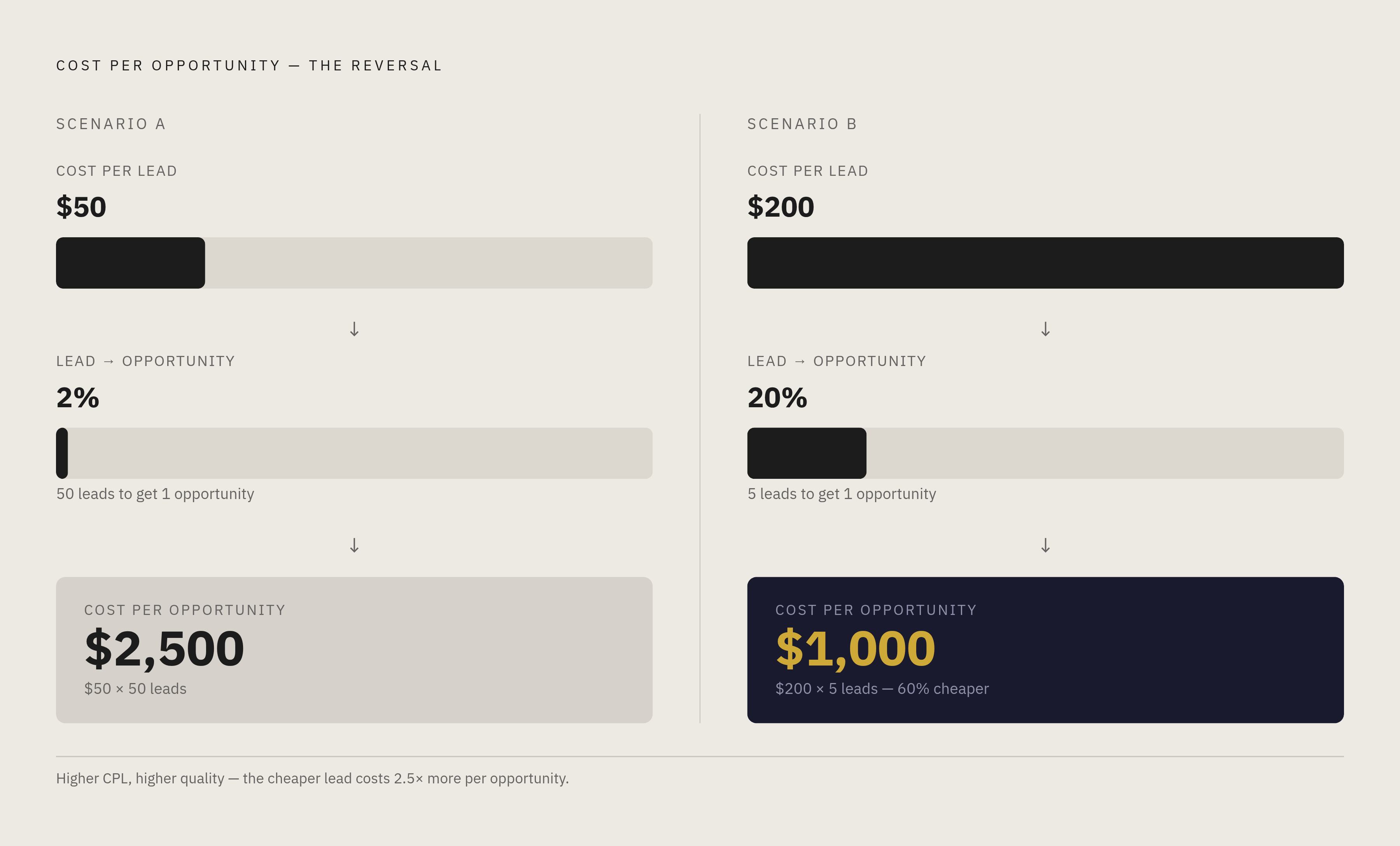
Here's a simple illustration. A $50 cost per lead converting to pipeline at 2% costs you $2,500 per opportunity. A $200 cost per lead converting at 20% costs $1,000 per opportunity. The agency reporting the lower CPL is delivering a program that is, by the math that actually matters, twice as expensive.
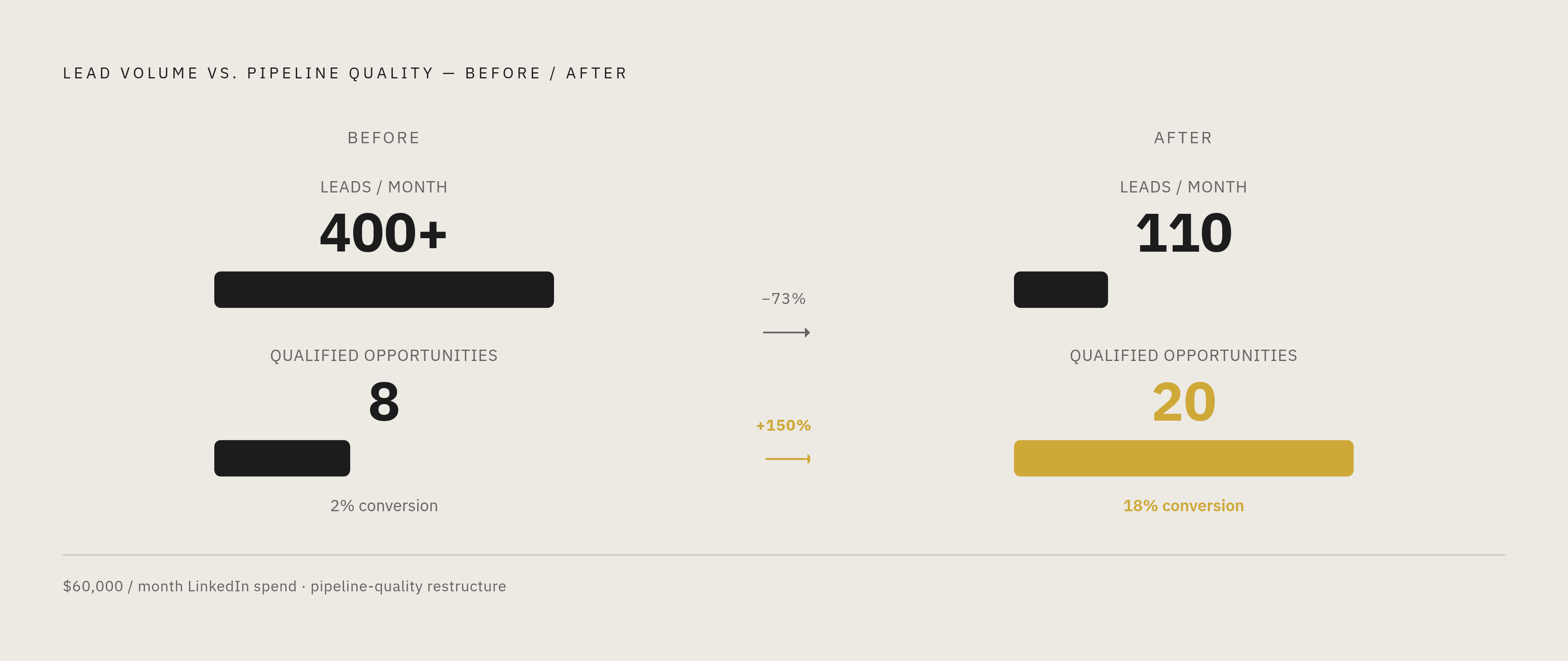
Not hypothetical. One real example: a company spending roughly $60,000 per month on LinkedIn was generating more than 400 leads per month. On paper, strong volume. But only 8 of those leads converted to qualified opportunities. A 2% lead-to-opportunity rate at that spend level made the whole program unprofitable.
After restructuring around qualified pipeline instead of lead volume, leads dropped from 400 to 110. Qualified opportunities grew from 8 to 20.
The agency whose reporting vocabulary starts with pipeline will ask different questions, build different campaigns, and optimize for different outcomes than the agency whose vocabulary starts with CPL. Ask any candidate agency: what metric do you optimize campaigns toward, and what do you do when lead volume is high but pipeline quality is low? That answer tells you more than their case studies.
Pipeline Attribution Is the First and Hardest Evaluation Criterion
Attribution is not a technical detail you sort out after hiring an agency. It's the lens through which everything else gets evaluated. And it's where most agency relationships quietly fall apart, usually around month four, usually when someone from finance shows up with questions.
The structural problem is real. Last-click attribution systematically undercounts what LinkedIn actually contributes. A prospect sees a LinkedIn ad, returns later via direct traffic, takes a sales call, opens a pipeline opportunity. In a last-click model, LinkedIn gets zero credit. The gap between marketing's self-reported influenced pipeline and CRM-verified pipeline can reach two to four times. That's not a rounding error. That's eventually a budget problem, because finance cuts spend it cannot verify.
Good agencies don't fully solve this. Nobody does. But they actively manage it. They're asking: how do we connect campaign exposure to account records? How do we distinguish pipeline we sourced from pipeline we influenced? How do we handle the reality that LinkedIn is one touchpoint in a 200-plus-day buying journey?
ZenABM's research across more than 200 companies found that median influenced pipeline per dollar spent was around $5.21, while top performers reached $15.20. That's a 3x spread. Creative quality matters, yes. But attribution methodology explains a meaningful portion of that gap, because agencies that cannot measure impact cannot optimize toward it.
One concrete red flag: an agency that owns the reporting dashboard but won't give you direct access to the underlying data. Opacity at the reporting layer is a structural incentive to surface the metrics that look good, not the metrics that matter. An agency that can't show you CRM-synced, account-level pipeline data is one whose results you can't actually verify. That should make you uncomfortable, especially if LinkedIn represents a meaningful share of your paid media spend.
Account-Based Workflow Integration as a Signal of Agency Maturity
B2B buying decisions are made by groups, not individuals. Often three or more stakeholders. Frequently five or more. So an agency optimizing for individual leads is, structurally, solving the wrong problem. What's the point of a great CPL if you're reaching the wrong person inside the right account?
What real ABM integration looks like in practice:
- Campaigns built around a named account list, not a demographic audience profile
- Creative and messaging that vary by role within the buying committee (the economic buyer is not reading the same ad as the technical evaluator, and they shouldn't be)
- Engagement signals from LinkedIn feeding back into CRM scoring and SDR prioritization, so that when a target account starts engaging, sales knows before a hand-raise
The measurement gap this exposes is significant. A large majority of companies have some form of ABM practice, but only a fraction actually measure account-centric metrics. Agencies often replicate this disconnect rather than fix it. Why? Because account-level measurement is harder to set up, harder to report cleanly, and easier to avoid if nobody's asking.
Organizations focused on a well-defined ICP see substantially higher account win rates. An agency that can't help you enforce ICP discipline in targeting is leaving measurable lift on the table. Ask: how do your campaigns connect to our CRM, and what happens to an engaged account record after a contact clicks an ad? If they pivot to audience demographics, you have your answer.
Iteration Speed and Creative Testing Cadence as a Proxy for Performance Culture
Creative fatigue sets in after roughly four to six weeks. An agency refreshing creative quarterly is running stale ads for a meaningful portion of each cycle. This probably sounds obvious. And yet the quarterly refresh is still pretty common.
The format landscape on LinkedIn has diversified considerably. Thought Leader Ads, for instance, have demonstrated dramatically better efficiency than standard single-image ads on a cost-per-click basis. An agency not actively testing format mix isn't leaving money on the table because they lack access to the formats. They're leaving it there because they lack the culture of continuous testing that would surface them.
Speed to first campaign live is an early, concrete signal. A competent agency should be able to launch within two weeks of kickoff. A six-week onboarding timeline before a single ad runs doesn't indicate thoroughness. It indicates process overhead that will slow every future iteration.
What a healthy cadence actually looks like:
- At least two ad variations per campaign from launch (split testing as a default, not a feature you have to request)
- Audience, creative, and budget reviewed at least monthly
- Weekly input from sales on lead quality by campaign, feeding back into targeting
Each campaign cycle should make the next one smarter. Agencies that treat each campaign as a fresh start rather than an iteration on prior learning can't build structural advantage over time. Ask for evidence: how many creative variations did they test for a comparable client in the last 90 days, and what changed as a result? A good agency will name specific things. A less good agency will describe a process.
Reporting Transparency as an Accountability Structure, Not a Deliverable
Monthly PDFs are a reporting format. They are not a reporting structure. A report that arrives once a month is a report that hides four weeks of drift.
What transparent reporting needs to include for a sales-led B2B context:
- Pipeline sourced and influenced, not just leads generated
- Account-level engagement mapped to CRM stages
- Which specific campaigns, formats, and audiences drove qualified opportunities
- What changed this week and what's changing next week. A forward-looking action log, not just a backward-looking scorecard.
There's a harder problem lurking here. A significant portion of what LinkedIn ads accomplish will not surface as a direct lead. Gartner's research shows that most B2B buyers complete the majority of their research before engaging a salesperson. An agency whose reporting doesn't account for pre-form influence will systematically underreport its own value, the client will respond by underinvesting, and the problem becomes self-fulfilling.
Accounts exposed to LinkedIn ads before encountering paid search convert at substantially higher rates. That lift is invisible in last-click reports. If your agency can't build multi-touch visibility, you can't see that effect. You can't make informed budget decisions. You're making gut calls with a spreadsheet nearby for moral support.
The right framing: reporting is not something an agency delivers to you. It's the accountability structure that makes the relationship auditable. If you can't audit it, you can't manage it.
How Delivery Model Choice Affects Each Criterion in Practice
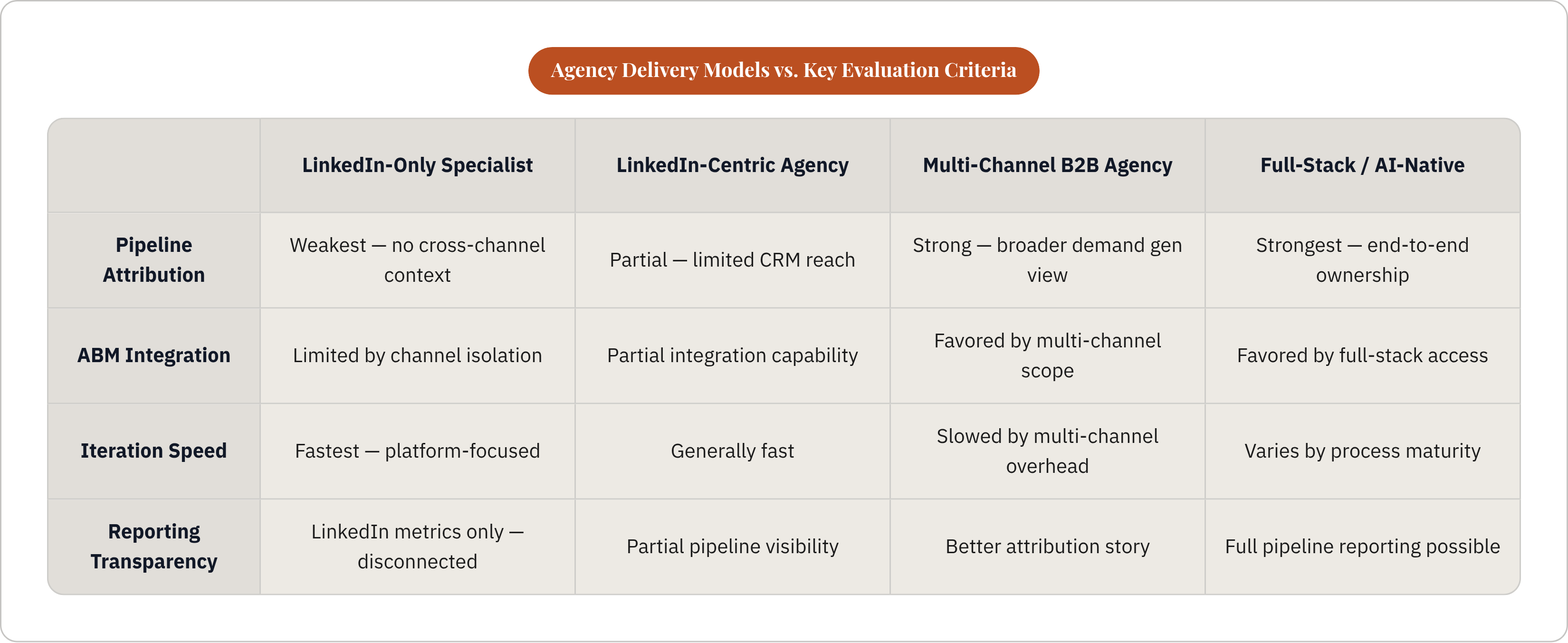
Not all LinkedIn agencies are built the same way, and the delivery model affects every criterion above. Most buyers treat this as an afterthought. It shouldn't be, because the wrong model doesn't just underperform. It actively obscures how it's underperforming.
The market has roughly four types:
- LinkedIn-only specialists. Deep platform execution, limited ability to connect to broader pipeline attribution or cross-channel context.
- LinkedIn-centric agencies. LinkedIn as primary channel with adjacent services. Partial integration capability.
- Multi-channel B2B agencies. LinkedIn as one channel inside a demand generation program. Stronger attribution story, but LinkedIn expertise may be diluted.
- Full-stack or AI-native execution layers. End-to-end ownership of creative, landing pages, attribution, and reporting.
Pipeline attribution is hardest for specialists to deliver alone, because attribution requires CRM integration and cross-channel context they can't provide independently. ABM integration favors multi-channel and full-stack models for the same reason. Iteration speed can actually favor specialists, who move faster on LinkedIn-specific creative without multi-channel process overhead. Reporting transparency favors full-stack models, who can report on end-to-end pipeline rather than LinkedIn metrics in isolation.
There's also a channel complement reality that's easy to miss. LinkedIn builds awareness and shapes preference above the funnel. Google captures intent downstream. A LinkedIn-only agency cannot optimize the dynamic between those two channels because they're only managing one half of the system.
Budget concentration matters here too. Spreading a modest monthly budget across five platforms produces weak signals on all of them. An agency that doesn't push back on this isn't managing your program. It's executing tasks.
The practical implication: match the delivery model to what your revenue team can own internally. If you have no CRM ops or attribution infrastructure in-house, a specialist will leave you with LinkedIn metrics that float disconnected from your pipeline data. Knowing that upfront saves a lot of painful quarterly reviews.
The Questions That Separate an Accountable Agency from One Optimizing for the Wrong Things
You can learn most of what you need to know in a first conversation. You just have to ask the right questions and actually listen to what the answers reveal, including what gets dodged.
On attribution: "Show me a client example where you connected LinkedIn ad exposure to closed-won revenue in the CRM. How did you do it and what did it reveal?"
On ABM integration: "How do your campaigns connect to the client's account list and sales sequence? What happens in the CRM when a target account engages with an ad?"
On iteration speed: "What's your standard cadence for creative refresh, audience testing, and budget reallocation? What does your process look like between monthly reviews?"
On reporting: "Can we see a live example of your reporting dashboard? Will we have direct access to the underlying data, or only to your prepared reports?"
On pipeline focus: "What metrics do you optimize campaigns toward? How do you handle a situation where lead volume is high but pipeline quality is low?"
One question functions as a particularly useful test. Ask how the agency thinks about the trade-off between LinkedIn Lead Gen Forms and higher-friction conversion paths. An agency that defaults to pre-fill forms for all campaigns without discussing conversion quality is optimizing for lead volume. That's a specific orientation. It produces specific and predictable results. How they think through that trade-off tells you whether they're optimizing for their dashboard or for your revenue.
Agencies optimized for their own metrics will resist questions about CRM access, pipeline attribution, and conversion quality. Agencies optimized for client revenue will have thought through these questions already. They'll have answers, examples, and actual data. The difference isn't subtle. It's just easy to miss when the pitch deck looks polished and the CPL numbers look good.