LinkedIn Single Image Ad Copy Frameworks for B2B
Specificity and funnel stage determine whether your B2B ad copy lands or disappears.

The format has opinions before you write a single word. Most copywriters treat those opinions as suggestions. That's a mistake.
Intro text gets roughly 150 characters before LinkedIn collapses it behind a "see more" link. Your hook has to land there. Not in the second sentence. Not after a warm-up clause. If you're still establishing context at character 80, you've already lost most of the people you paid to reach.
Headline sits below the image in larger, higher-contrast type. It truncates around 70 characters on most placements. It has to work as a complete, standalone statement. If it only makes sense after someone's read the intro text, it's broken.
Description field: desktop only, invisible on mobile, and most LinkedIn feed impressions happen on mobile now. Treat the description as a quiet bonus for the laptop crowd, not a structural load-bearing wall.
Format sizing: 1:1 square consistently outperforms landscape for mobile feed presence because it takes up more vertical space in the scroll path. When people are scrolling fast, surface area is one of the few levers you actually control.
So your real battleground is 150 characters of intro text and a 70-character headline. Everything else is secondary.
That constraint changes how you write in a specific way. Vague language like "drive better results" or "transform your pipeline" burns characters without giving the reader anything to grab onto. A number, a named outcome, a specific role — those earn the read. Specificity isn't a stylistic preference here. It's the difference between a key that fits and one that almost fits.
Intro text is also not the place to build context. It's the place to land the hook. Context is what the reader brings from scrolling past twenty other posts. The hook is what makes them stop on yours.
How funnel stage determines which framework belongs in which campaign
Start with the LinkedIn B2B Institute's 95-5 rule, because it's a little uncomfortable and that discomfort is useful. At any given moment, roughly 95% of your addressable market isn't actively buying. They haven't named their problem yet. They're just doing their jobs on a regular Tuesday.
Most of your impressions are landing on people who have no intention of booking a demo. Not because your targeting is wrong. Because that's the statistical reality of B2B demand.
Why does this matter for framework selection? Because the copy that works at conversion actively repels top-of-funnel buyers. "Book a demo to see how we reduce CAC by 30%" is a strong message for someone who has already decided they need to solve a specific problem. For someone who hasn't named the problem yet, it's noise at best and presumptuous at worst. They didn't ask.
The funnel, simplified:
- Top of funnel: The buyer may not know the problem exists or hasn't framed it yet. The job is to earn recognition.
- Middle of funnel: The buyer has named the problem and is evaluating approaches. The job is to earn consideration.
- Bottom of funnel: The buyer is vendor-aware and has done some research. The job is to earn one specific next step.
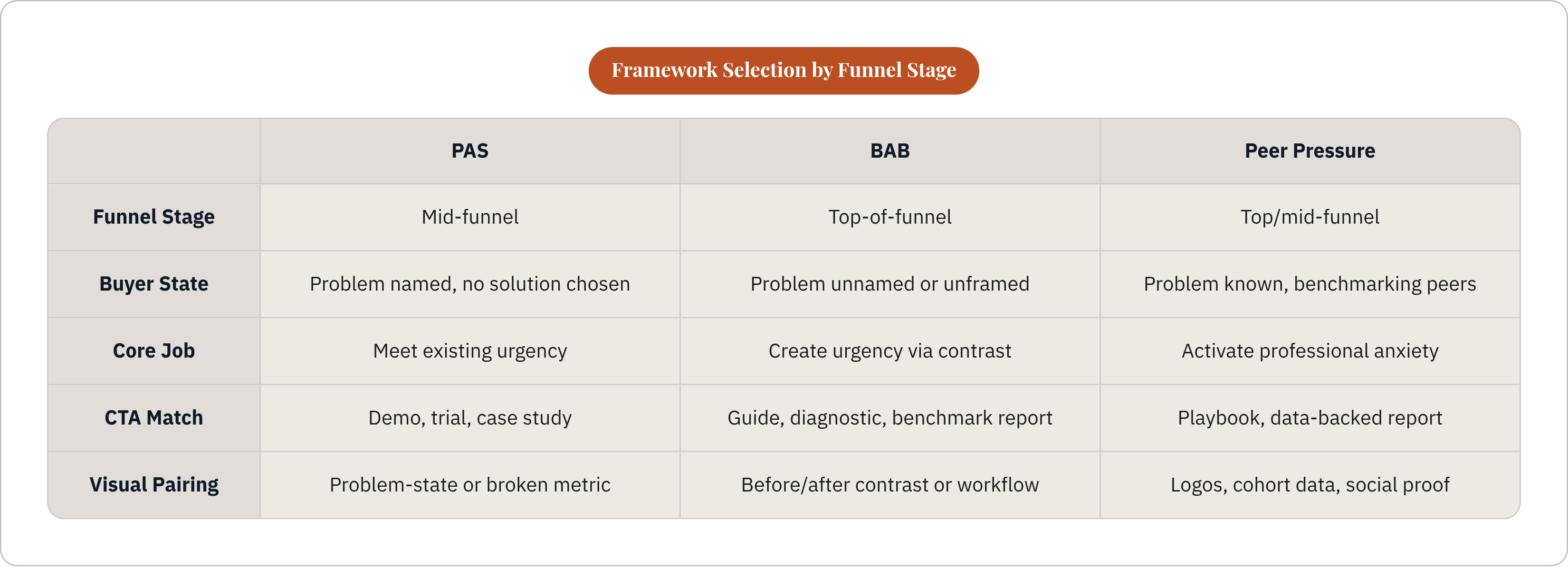
Each framework below maps to one or more of these stages. Funnel stage should be the first decision you make — before you write anything, before you pick a framework, before you open a design file. Without that decision, the frameworks look interchangeable. They really aren't.
Using a bottom-funnel conversion framework on a cold audience isn't just inefficient. It also trains the algorithm to optimize for the 5% and ignore the 95%. The cost structure degrades quietly, which is the worst way to discover a problem.
PAS: the framework that works when the buyer already feels the pain
PAS stands for Problem, Agitation, Solution. It's one of the oldest frameworks in direct response, and it earns that longevity because the structure mirrors how a problem actually lives in someone's head — like a splinter you keep forgetting about until you press on it.
Problem: Name a specific, uncomfortable truth about the reader's situation. Not a category-level observation. Their actual operational reality. "Your SDR team is spending more than half their time on accounts that will never convert" is specific. "Sales efficiency is a challenge for many teams" is not. The test is simple: does the reader feel seen, or talked at?
Agitation: Make the consequence feel real and costly. This is where most B2B copy actually falls apart. "It slows your team down" is generic and doesn't move anyone. Role-specific agitation does. A VP of Demand Gen cares about MQL volume and cost per lead. A CFO cares about burn rate and payback period. Same problem, different agitation. Copy that tries to serve both tends to move neither.
Solution: Introduce the offer as the specific fix. Not a general capability. Not a category claim. The mechanism that resolves the problem you just named.
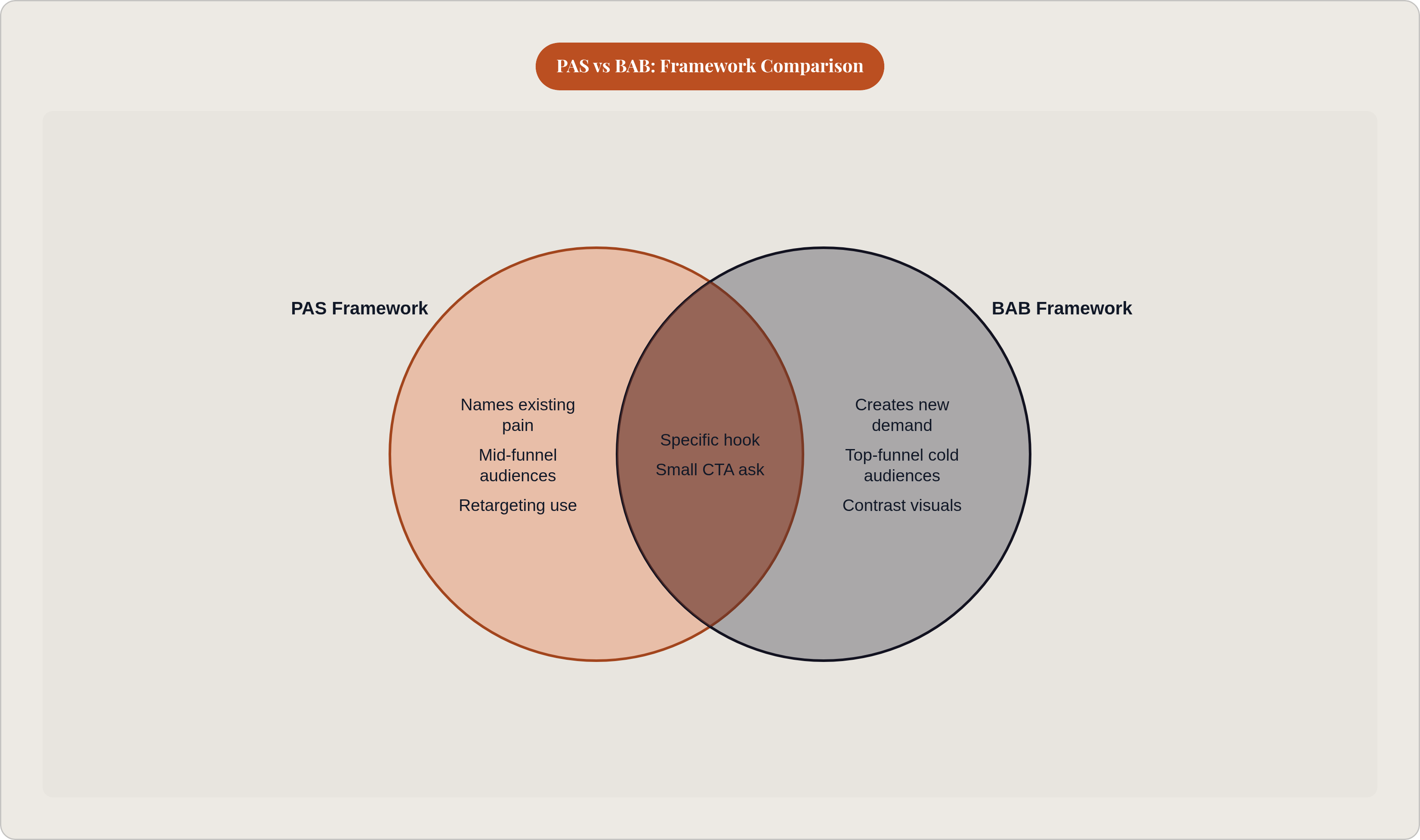
Where does PAS belong? Mid-funnel audiences who have named their problem but haven't selected a solution. Retargeting audiences who've engaged but haven't converted. PAS doesn't create urgency. It meets urgency that already exists. That's the structural logic, and it matters for placement decisions.
In format terms: intro text names the pain in one sentence, headline delivers the solution claim in under 70 characters, and description adds a proof point for the desktop segment that sees it.
One thing that applies hardest here — "increased pipeline" as a solution claim is noise. A named outcome with a number, or a named mechanism, earns attention. The specificity isn't decoration. It is the argument.
The structure is also modular by design, which makes PAS well-suited to systematic variant testing. Test Problem A versus Problem B. Test Agitation framing A versus B. Swap one ingredient at a time instead of redesigning the whole dish. That's how learning compounds rather than accumulates randomly.
BAB: the framework that creates demand where none existed
BAB stands for Before, After, Bridge. It's the framework for audiences who haven't named their problem yet, or who don't know a solution category exists.
Before: Paint the current state in terms the reader recognizes as their own. Not a worst-case scenario — an honest description of how most teams actually operate. If the reader thinks "that's not really us," you've lost them. The "before" has to feel like a regular Tuesday afternoon at their company, unremarkable and a little frustrating.
After: Describe the aspirational outcome using the reader's metrics and their language, not your product's language. That gap is easy to close wrong.
Bridge: Position the offer as the path between the two states. The mechanism that makes the "After" reachable.
But what separates BAB from PAS structurally? PAS assumes the reader already feels urgency. BAB creates the contrast that produces urgency. The "Before" establishes recognition, the "After" creates desire, and the "Bridge" makes the desire actionable. That sequence is specifically built for buyers who may not know a solution to their problem even exists. Category-creation campaigns live here. Cold audiences live here. "We've always done it this way" audiences live here.
BAB also has a natural visual pairing. The image can show the "before" state — a messy workflow, a blank dashboard, a fragmented stack — while the copy delivers the "after." The visual earns the emotional recognition. The copy sells the outcome.
One note on CTA logic: keep the ask small. A guide, a diagnostic, a benchmark report. The buyer isn't ready to evaluate vendors. Asking for a demo at this stage is asking for too much, too fast. The goal is to get them to name the problem and associate your brand with solving it. That's all you're going for. That's actually enough.
Peer pressure and FOMO hooks: the framework built on professional identity
This one doesn't have a three-letter acronym, which is either a problem or a relief depending on your relationship with marketing jargon. The structure is: establish what the leading cohort is doing, imply the gap, invite the reader to close it.
Some examples of how the logic runs:
- "The top B2B marketing teams aren't measuring CPL anymore. Here's what they track instead."
- "Most SaaS companies running LinkedIn ads are targeting the wrong intent signals. Here's the stack that's working."
Why does this land specifically in B2B? Because professional performance is visible internally. Nobody wants to be the team still running last year's playbook when their CEO just got back from a conference having heard that everyone else moved on. The pressure isn't consumer FOMO. It's the professional anxiety of falling behind peers — like realizing everyone else at the table has already ordered and you haven't even opened the menu. That sits differently than product curiosity, and it tends to stick.
It also works because LinkedIn's targeting lets you reach people by the job function and seniority level where that concern is most acute. Marketing and revenue leaders whose mandate is competitive performance are often susceptible to this framing. Not because they're gullible. Staying current is literally part of their job description.
One requirement the framework cannot survive without: credibility. Vague claims ("top companies are doing X") underperform specific ones because the reader evaluates whether the claim rings true against their own experience before they click. If it doesn't feel plausible, they scroll. The hook has to deliver something the reader doesn't already know, or frame something familiar in a way that makes them reconsider it. Otherwise it's flattery bait, and experienced buyers recognize flattery bait on contact.
CTA logic: benchmark reports, playbooks, data-backed guides. The implicit promise of clicking is that they'll learn what the top cohort actually does. The offer has to deliver on that promise. If the content behind the click is generic, the framework poisons itself and you've burned that audience's trust along with the budget.
How the image and copy function as one unit, not two independent decisions
The image arrests the scroll. The headline earns the read. The intro text closes the argument. If any one of those pulls in a different direction, the whole unit fails. Not "underperforms." Fails.
This is where the process breaks down most predictably in teams where designers and copywriters work in sequence rather than together. A copywriter handed a finished image produces copy that reacts to the visual instead of completing it. A designer handed a finished headline produces art that illustrates the words instead of amplifying them. The brief should be built together. If it isn't, the output will show it.
Each framework has a natural visual pairing worth naming:
- PAS: Problem-state visuals. A metric going the wrong direction. A process that looks broken. The visual primes the emotional state before the copy names it.
- BAB: Contrast visuals or workflow diagrams. Show the "after" state and let the copy explain the bridge. Or show the "before" state and let the copy sell the aspiration.
- Peer pressure: Social proof visuals. Logos, cohort data, benchmark graphics. These make the claim feel substantiated before the reader has processed a single word of copy.
Two mechanics worth knowing about the visual environment itself. Dark backgrounds with bright text tend to outperform low-contrast creative in B2B feed environments — not as a design preference, but as a visibility mechanic in a feed competing against organic posts, thought leadership content, and every other ad in the auction.
On urgency: ads with specific deadlines outperform vague urgency language. "Register by March 14" outperforms "limited time" because the reader can actually evaluate a specific date. Vague urgency reads as a sales tactic. Specific urgency reads as information. Their brain processes these differently, and the difference shows up in CPL.
Testing one variable at a time and measuring what actually predicts pipeline
Every variant test should isolate one variable. The visual. The headline. The intro text hook. Not all three at once. Multi-variable tests tell you which combination won. They don't tell you which element drove the difference, and if you're trying to build institutional knowledge rather than just find a short-term winner, that distinction is the whole point.
LinkedIn recommends running two to four variants per campaign during the learning phase. Fewer than two gives the algorithm no choices. More than four fragments budget below the statistical threshold for most B2B audience sizes, which tend to run smaller than consumer targeting pools.
A testing sequence that holds up:
- Round 1: Test the hook (intro text). It's the first thing the reader processes and the highest-leverage variable. Start here.
- Round 2: Test the headline. Once the hook is proven, optimize the standalone statement the eye lands on after the image.
- Round 3: Test the visual. After copy is validated, creative variation drives incremental gains.
The sequence is deliberate. Copy is the cheapest and fastest thing to change. Visuals are the most expensive. Validate copy first, then invest in creative.
Measure cost per lead, not CTR. A high-CTR ad that generates expensive leads is a worse performer than a moderate-CTR ad that generates cheap leads. I've watched teams spend months celebrating a 4% CTR while their CPL quietly climbed past anything defensible. The click was working. The ad was not. CTR is a proxy metric, and proxy metrics will mislead you in ways that pipeline metrics won't.
Ad fatigue on single image is predictable and worth planning for, which means building rotation schedules before you need them — not scrambling to make new ads after you notice the CPL climbing. Systematic creative testing also compounds over time. Each winning variant becomes the new control. Each testing round starts from a stronger baseline. You're not just finding better ads. You're building a better starting point for every future campaign.
Putting the frameworks into a repeatable campaign brief
Everything above only matters if it produces a document that exists before the campaign runs. Not after. That sounds obvious. In practice, it rarely happens, and the campaigns that result tend to look exactly like you'd expect.
A usable single image ad brief answers five questions:
- What funnel stage is this campaign targeting? This locks in the audience's awareness level before anything else is decided.
- Which framework maps to that stage? PAS for mid-funnel pain. BAB for top-funnel demand creation. Peer pressure for professional identity audiences with a clear cohort they're benchmarking against.
- What is the one specific outcome or proof point the hook will use, and is it quantified? If the answer is "better results" or "improved efficiency," go back and make it specific. The hook lives or dies on this.
- What is the image's job relative to the copy's job? Prime the emotional state? Show the "after"? Substantiate the social proof claim? One job, written down, before anyone opens a design file.
- What is the one next step the ad is asking for, and does it match where the buyer actually is? A demo request to a cold BAB audience is misaligned. A guide offer to a retargeting audience is too soft. The ask should match the awareness level, not the sales team's quarterly target.
Framework selection is not a creative judgment call. It is a buyer-state diagnosis. The brief locks in that diagnosis before anyone writes a word.
A brief that captures the winning hook, the framework that produced it, and the audience it ran against becomes institutional knowledge. The next campaign starts from a proven baseline rather than a blank page. For teams running multiple campaigns simultaneously, a brief library organized by framework and funnel stage prevents the most common failure: running the same structural pattern at every stage and wondering why conversion falls apart at the top of the funnel.
The frameworks themselves don't get sharper over time. What gets sharper is the inputs. The specific problem. The specific proof point. The specific next step. That accumulated knowledge — what the framework actually surfaces when you run it against real buyers — is the compounding asset. The framework is just the container.