ABM Marketing Strategies for LinkedIn Campaign Structure
Choosing the right ABM tier prevents wasted budget and structural failure before launch.

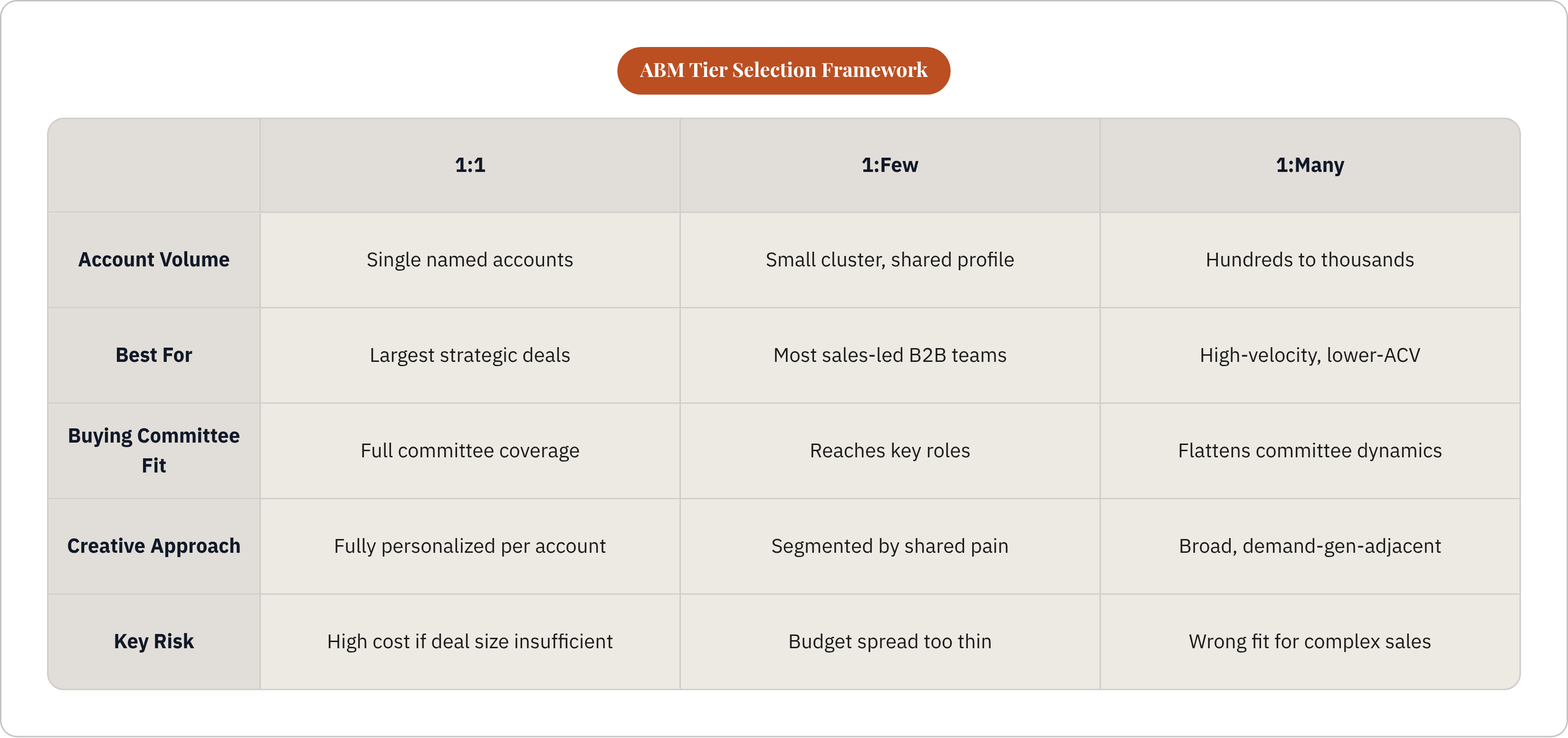
The three ABM tiers are not interchangeable. They reflect different resource commitments, different sales motions, and completely different return expectations. Picking the wrong one doesn't just waste budget. It builds a program that structurally cannot succeed, no matter how well you execute inside it.
Here's the breakdown:
- 1:1 means one account, fully personalized creative and messaging. Justified only when deal size and strategic value are large enough that account-level investment pays back. Think named enterprise accounts where a single win changes your quarter.
- 1:Few means a cluster of accounts sharing similar pain, similar triggers, or similar firmographic profile. This is the primary motion for most sales-led B2B teams, and it's the tier most people underestimate.
- 1:Many means hundreds to thousands of accounts. Appropriate for high-velocity, lower-ACV motions. Not the right structure for complex enterprise sales, no matter how much it resembles the demand gen you're already comfortable running.
So before anything else, answer this: is your average contract value above a threshold where account-level investment actually pays back? Below that threshold, ABM architecture adds cost without proportionate return. There's no shame in running demand gen if demand gen is what your economics support. Seriously. Not every sales motion needs an ABM overlay.
If you're in the 1:Few tier, the thing that actually moves the needle is budget concentration. Enough spend, across a short enough list, that by the time sales calls, the prospect already knows your name. That recognition doesn't happen by accident. It happens because you stopped spreading budget thin across a hundred accounts and started stacking it across ten. Same water, fewer pots, actual roots.
Buying committee size cuts into this directly. The larger the committee, the more a 1:Few or 1:1 approach is warranted to reach all the decision-making roles. 1:Many flattens buying committee dynamics. You reach someone. You fail to reach the buying group. Those are very different outcomes, and the difference rarely shows up in your dashboard until it's too late to fix.
Before you open LinkedIn Campaign Manager, you should be able to state your tier and defend why. Everything downstream depends on it.
Building the Account List Before Building the Campaign
The account list is the foundation. A weak list means a perfectly structured campaign still reaches the wrong companies. Get this wrong and nothing else you do matters. I've seen teams spend weeks on creative and a few hours on the list — by the end, the campaign felt less like a precision instrument and more like a megaphone aimed at a empty parking lot. The results are exactly what you'd expect.
Start with your own data:
- CRM closed-won data tells you what firmographic profile actually converts. Cleanest signal you have, and the most overlooked one.
- Sales intelligence and enrichment tools fill the gaps, especially domain data. LinkedIn matches on company name, domain, or Company Page URL, and including both name and domain in the same CSV meaningfully improves match rates.
- Third-party intent signals identify accounts already researching relevant topics. Not essential, but useful for prioritization when your list is long.
- ICP filtering ties it together: industry, headcount band, revenue range, tech stack where relevant.
Before uploading anything, get data hygiene right. Remove subsidiaries that would unintentionally split budget. Standardize naming conventions. Deduplicate. Match rates degrade with dirty data, and LinkedIn's minimum matched-company threshold means a list that's too small or too dirty might not activate a campaign at all. You'll just stare at a status bar that never moves.
What do you do about accounts that don't match? A meaningful share of any upload won't. Plan for it by over-building the list, or use enrichment tools to recover missing domains before re-upload. Treating your first upload as the final upload is a mistake most people only make once.
Two structural rules worth locking in early. First, keep your tiers in separate lists. 1:1 accounts should not share a campaign with 1:Few accounts. Budget allocation logic and creative approach differ enough that mixing them produces neither outcome well. Second, don't let the list go static. Accounts move in and out of active buying cycles. List hygiene is ongoing work, not a one-time setup task.
Layering Persona Targeting on Top of Matched Accounts to Reach the Full Buying Committee
The matched account list tells LinkedIn which companies to target. It says nothing about which people inside those companies see the ad. That's a separate layer, and it's where most ABM programs quietly stop short.
Buying committees include distinct roles with different concerns. Economic buyers care about ROI and risk. Technical evaluators care about integration complexity. End users care about workflow disruption. Champions care about how this reflects on them internally. One creative cannot serve all of them. Running a single ad to a buying committee is like giving one presentation to a room where each person is grading you on a completely different rubric.
The layering approach combines your Matched Account List with two or three additional filters:
- Job Function (Finance, IT, Marketing, Operations) defines the role domain
- Seniority (Director, VP, C-Suite) filters for actual decision-making authority
- Job Title adds precision in accounts where function alone is too broad
Each persona combination becomes its own campaign or campaign group. Not a variant inside a single campaign. The creative, the message, and the call to action are all different. Running them together scrambles the signal and dilutes the relevance. You end up with performance data that's impossible to act on.
But what if you layer too precisely? Stacking too many filters shrinks the audience below LinkedIn's delivery threshold. A campaign that can't deliver doesn't help anyone. You may need to be slightly less specific at the function level to stay above the floor. It's a real trade-off with no clean universal answer. Test it, check delivery, and adjust.
The test of good persona architecture is simple. Can you point to each active campaign and name the specific type of person it's reaching in the buying committee? Does the creative speak to that person's actual concern? If you can't answer both, the architecture isn't finished.
Campaign Hierarchy Architecture: How to Organize Campaign Groups, Campaigns, and Ads
LinkedIn's campaign structure has four levels: account, campaign group, campaign, and ad. Most people don't think carefully enough about what each level is actually for. The result is a structure that's hard to read, harder to optimize, and nearly impossible to explain to the person who inherits it from you.
Here's how to think about each level:
Campaign Group is for separating by value proposition or strategic theme. Not by format. Not by audience. If two distinct value props serve different parts of your ICP, each gets its own Campaign Group. This keeps creative logic clean and makes budget control straightforward. Mixing value props inside a single Campaign Group muddies the optimization signal because the algorithm cannot tell which theme is performing.
Campaign level is where you separate by format, funnel stage, or persona. An awareness campaign lives in a different campaign than a consideration campaign. Why does this matter? Because awareness spend and mid-funnel spend compete for the same budget pool if you don't separate them. Awareness tends to win because impressions are cheaper. Your mid-funnel just starves, quietly, while your dashboard looks fine.
Ad level is for creative variants that share the same audience and objective. A/B testing lives here.
One structural mistake worth naming explicitly: building one campaign per account in a 1:Few program, then running out of budget to achieve meaningful frequency in any of them. Ten accounts with sufficient frequency beats fifty accounts with one impression each. Consistently.
On bidding: high-value accounts in the 1:1 or 1:Few tier warrant higher CPC bids. Bid strategy should reflect account priority, not default to whatever the platform suggests. Platform suggestions optimize for platform efficiency. That's a different objective than your pipeline.
One last practical thing. Campaign names should encode the audience, stage, and format. Anyone who didn't build the campaign should be able to read the name and understand what it is. If you need a legend to interpret your own reporting, the structure is already working against you.
Sequencing Creative by Funnel Stage to Move Accounts Through the Buying Journey
ABM creative fails when every ad says the same thing regardless of where the account is in their journey. And it fails in a specific, frustrating way: the ads don't feel irrelevant. They feel fine. Nobody clicks, nobody converts, and you can't tell why because the metrics look acceptable. No obvious alarm. Just slow, invisible underperformance.
Stage-appropriate messaging is what separates a campaign that feels relevant from one that just runs. Here's a five-stage model that maps to account behavior:
- Identified (matches your ICP but shows no engagement): problem framing, category education, thought leadership. No product pitch. They don't know they need you yet.
- Aware (has seen ads or visited the site): proof of concept, use cases, analyst recognition. Build credibility, not pipeline.
- Interested (has engaged with content or a form): case studies, ROI frameworks, webinar invitations. Deepen the business case.
- Consideration (actively evaluating options): demos, competitive differentiation, implementation clarity. Reduce risk.
- Selecting (close to a decision): urgency and specificity finally earn their place.
Format selection maps to stage. Sponsored Content works across stages but carries different creative at each one. Message Ads and Conversation Ads are higher friction and earn their place at consideration and selection stages. Using them at awareness mostly means spending money to reach people who aren't ready and annoying them in the process.
Creative fatigue is also a real problem in ABM, specifically because the audience is intentionally small. In a broad demand gen program, fatigue might not show up for months. In an ABM program with a list of fifty accounts, you can burn through creative faster than you'd expect. Refresh every four to six weeks, not quarterly. Quarterly is often too late.
But here's where even well-designed manual programs quietly break down. Sequencing requires retargeting logic. Accounts that engage with awareness content need to enter the next campaign tier, ideally without someone manually moving them. Setting that up, maintaining it, keeping it current as accounts progress — that's high-frequency, detail-heavy work. It's also the lever that separates programs that compound from programs that just run indefinitely at the same stage, producing the same mediocre results cycle after cycle.
Attribution and Measurement Across a Buying Cycle That Spans Months
The core problem with ABM attribution is structural. The buying cycle is long. The committee is large. No single touchpoint closes the deal. Standard last-touch attribution systematically undervalues the program. Measure ABM with demand gen metrics and you will likely conclude it doesn't work. You might be wrong.
LinkedIn's Conversions API (CAPI) integration helps materially here. It connects on-platform ad engagement to offline CRM events including demo requests, sales calls, and opportunity creation. This gives credit to LinkedIn touches that preceded pipeline without appearing in form fills, which is where a significant share of ABM influence actually lives and where it most often goes uncounted.
The metrics that matter for ABM are different from standard campaign metrics:
- Account engagement rate: are target accounts actually seeing and interacting with the program?
- Account progression: are accounts moving through stages over time?
- Pipeline influenced: what share of open opportunities in target accounts have touched an ABM campaign?
- Pipeline generated: what deals can be traced to ABM-sourced first touch or multi-touch?
The 90-day minimum before evaluating pipeline impact is not a vendor making excuses. It's a structural reality of how ABM compounds. Pulling budget at 30 days because individual leads look expensive misreads the motion entirely. It's like stopping a diet after a week because you haven't lost twenty pounds.
A practical reporting cadence worth adopting:
- Weekly signals (engagement, account coverage, creative performance) tell you what to adjust now
- Monthly cohort analysis tells you whether accounts are progressing through stages
- Quarterly pipeline review tells you whether the program is working at all
One dependency most teams underestimate: sales alignment. If sales doesn't log their interactions with target accounts in CRM, the attribution picture is incomplete. The program looks smaller than it is because half the touches are invisible. Attribution is a joint responsibility. That conversation needs to happen before the campaign launches, not six months in when you're trying to justify the budget to a skeptical CFO.
Where AI Agents Change the Execution Calculus for LinkedIn ABM
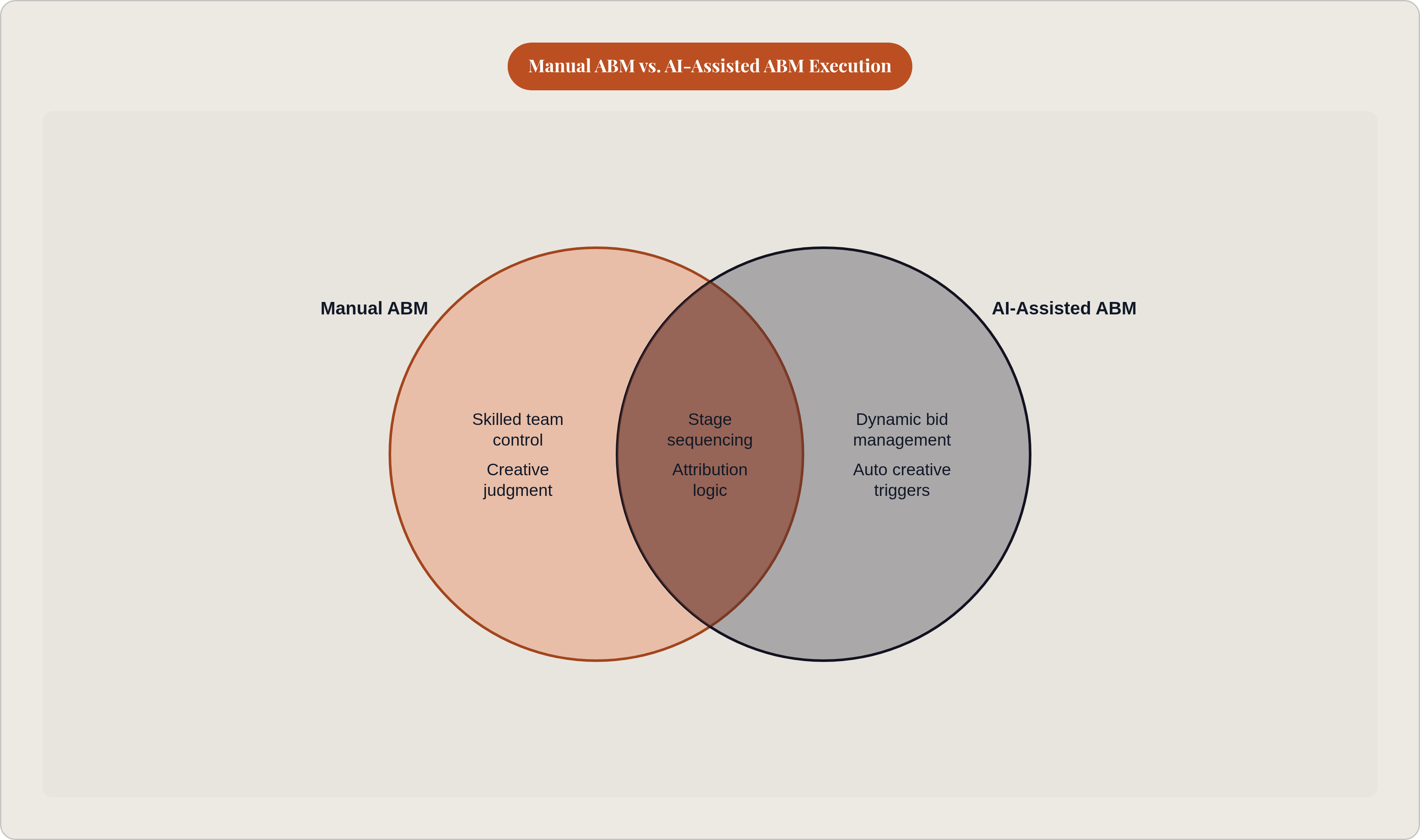
Everything described so far can be executed manually. Account list management, persona layering, stage-based creative sequencing, retargeting logic, attribution tracking. A skilled team can do all of it. The real question isn't whether it's possible. It's whether the execution speed and iteration frequency are sufficient to make the program compound rather than stagnate.
For most teams, they aren't.
The bottleneck shows up at the highest-frequency tasks. Refreshing creative every four to six weeks. Adjusting bids by account tier. Monitoring account progression across dozens of target accounts. Coordinating with sales on engagement signals in something close to real time. These tasks are data-intensive, they repeat constantly, and humans execute them inconsistently. Not because they're incapable. Because the cognitive load is high and the signal volume doesn't stop.
AI agents in the ABM stack address specific structural weaknesses:
- Buying committee identification: surfacing new decision-maker roles within active accounts as org charts shift
- Creative sequencing: triggering stage-appropriate creative based on account engagement signals without manual rule-building
- Bid management: allocating budget dynamically across accounts based on engagement trajectory and pipeline proximity
- Attribution synthesis: connecting ad exposure to CRM events and surfacing account progression signals to sales without waiting for a quarterly review
Does this just add another layer of complexity? It can. The answer depends on whether the team has the capacity to run the manual version at the iteration frequency the program actually requires. If creative gets refreshed once a quarter because nobody had bandwidth, the sequencing logic breaks down regardless of how well it was designed at the start.
The compounding advantage is where AI execution earns its place. Every campaign produces signal about which messages moved which personas at which stage. That signal informs the next campaign directly, rather than starting from intuition each cycle. The program gets incrementally smarter. Most manual processes have no structural way to capture that. The knowledge lives in someone's head, or in a spreadsheet nobody updates, or nowhere at all.
The campaign architecture described throughout this piece is achievable without AI. But the iteration speed and data fidelity required to make it compound over time are where human execution tends to hit a ceiling. That ceiling is worth knowing about before you build the program, not after you've been running it for a year wondering why it's plateaued.