Account-Based Marketing on LinkedIn for B2B Pipeline Teams
There's a version of LinkedIn ABM that looks like a real program but isn't. Someone uploads a list of dream accounts, runs a generic ad in front of them, and waits for pipeline to appear. When it doesn't, the conclusion is that ABM doesn't work on LinkedIn.
The actual conclusion should be that a targeting list is not a system.
That distinction is what everything here builds toward.
LinkedIn is, by most measures, the dominant paid channel for B2B. And the reason isn't reach. It's structure. Members declare their job title, seniority, function, and company. When you target on LinkedIn, you're reaching people who told the platform exactly who they are. That's not inferred data. That's not probabilistic modeling. It's declared professional identity, which is remarkably rare.
Now, the cost objection is real and worth taking seriously. Average CPC on LinkedIn runs roughly three to five times higher than Google Ads. If you're measuring cost-per-click, that looks bad. But cost-per-click is the wrong metric for a channel where the audience is pre-qualified. The right question is cost-per-SQL. Run that number instead, and the math starts to shift.
But structural advantages only produce pipeline when the activity built on top of them is itself structured. That's what ABM is for.
So what is ABM, actually? It's a deliberate decision to concentrate resources on a defined list of accounts rather than cast wide for volume. That sounds obvious. It rarely is in practice.
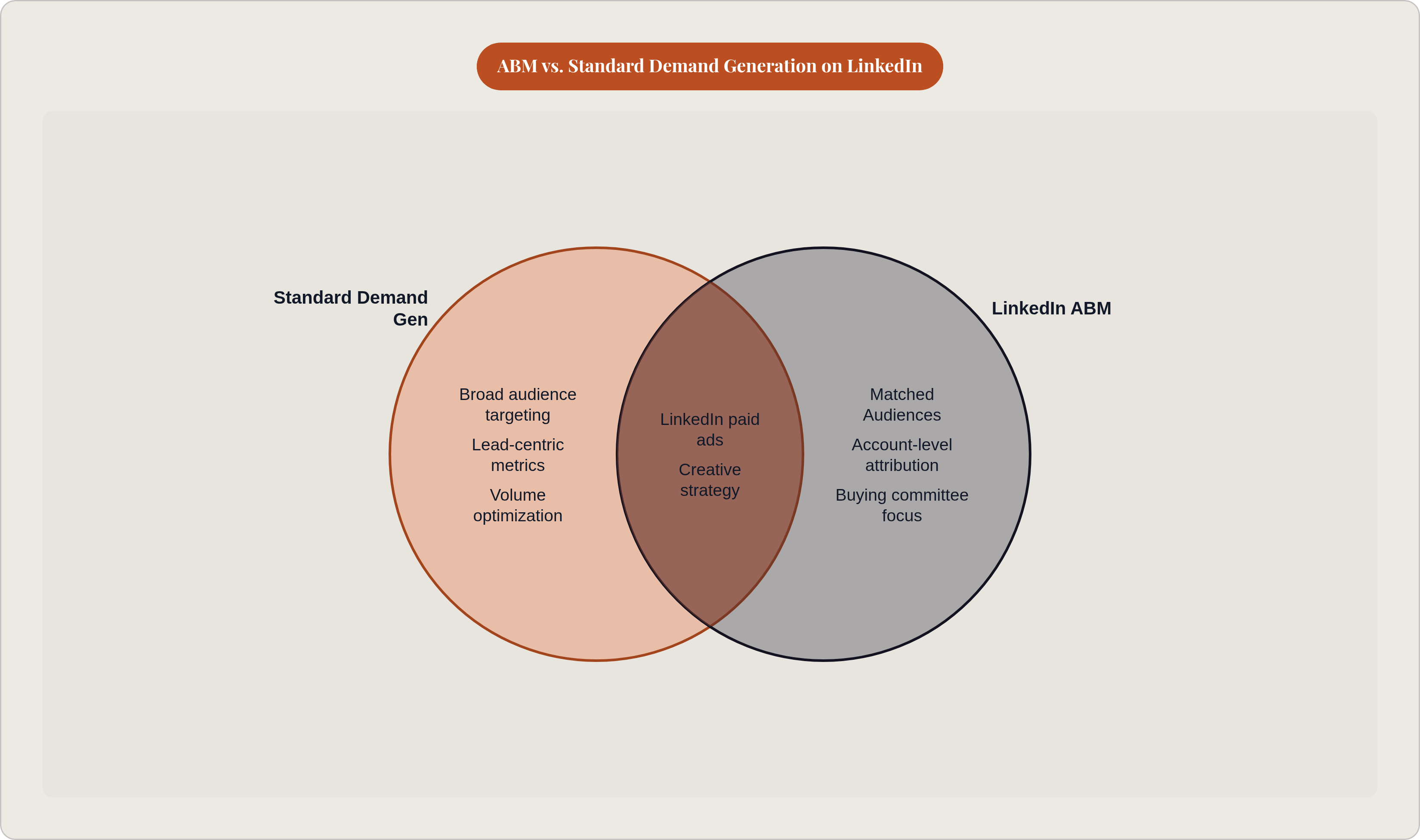
Standard demand generation optimizes for leads from a broad audience that fits a buyer profile. ABM runs the logic in the opposite direction. You identify specific companies first. Then you find and influence the buying committee inside those companies. The account comes before the audience.
Why does that distinction matter? ABM-sourced deals tend to close faster and win more often. The mechanism is focus. When you know exactly which accounts matter, you can build everything around what those accounts need to see to move. The tricky part is the precondition nobody wants to talk about: sales and marketing have to agree on which accounts are on the list, and why. That sounds like a simple alignment conversation. It almost never is.
ICP definition, firmographic filters, intent signals. All of it feeds account selection. And account selection is not a one-time exercise. It updates as accounts move through the pipeline or fall out of fit. The list is not a spreadsheet you hand off. It's an output of a continuous process — like tending a garden that dies the moment you stop showing up.
Once the list exists, the question is how to build the actual system around it.
Building the account selection and audience architecture inside LinkedIn
The mechanism that makes ABM work inside LinkedIn Campaign Manager is called Matched Audiences. You upload a target company list. LinkedIn matches those companies to their platform profiles using firmographic identifiers. Then you layer job title, seniority, and function filters on top to isolate the buying committee members inside those matched companies.
The result is specific. Not "someone at a target company." A VP of Operations at a target company. A CFO at a target company. That specificity is the whole point.
But who you're targeting is only half of the structural decision. Campaign objective matters just as much.
"Lead Generation" and "Website Visits" are not interchangeable. Each maps to a different pipeline stage. Each tells LinkedIn's algorithm to optimize delivery differently. Mixing them without intention creates measurement confusion that compounds over time. Treat the objective choice like a structural decision, because it is one.
The technical backbone of all of this is CRM integration. Syncing Salesforce or HubSpot with LinkedIn Campaign Manager lets you do things a static audience list cannot. You can suppress accounts already in late-stage pipeline from awareness campaigns. You can re-engage accounts that went cold after a proposal. You can update your audience in response to what's actually happening in the deal flow. Without that sync, your audience is a snapshot. With it, the system responds to pipeline reality in something closer to real time.
As the program matures, retargeting layers compound the architecture. Website visitors from target accounts become a higher-intent pool for more direct messaging. Video viewers and Lead Gen Form engagers signal something sales can act on. These aren't separate campaigns. They're stages in a single account journey.
One more thing about budget, and this one comes from watching a lot of programs fail quietly. ABM requires sustained presence, not bursts. The goal is continuous visibility with buying committee members across months. Underfunding the program and expecting results in week six is probably the most common execution failure I've seen. The math only works if the presence is consistent enough to build familiarity.
What creative actually performs in LinkedIn ABM (and the formats that drive it)
Here's the uncomfortable truth about targeting precision: if you build a careful account architecture and then run generic creative against it, you've wasted the targeting. The specificity of the audience demands specificity in the message. Personalized ABM content consistently outperforms generic outreach. That gap isn't a small optimization. It's the difference between a program that generates pipeline and one that generates impressions.
So what actually works?
Patterns from large-scale LinkedIn ad analysis point to a few consistent signals in high-performing creative. A strong call to action with bright, contrasting colors. A specific offer with urgency, whether that's a free resource or limited access to something. Real people photography rather than stock imagery. Diagrams or flowcharts that simplify a complex concept. That last one is particularly relevant for technical B2B buyers. They're evaluating a concept, not a lifestyle. Show them how something works.
On format, the hierarchy matters.
Multi-image carousels generate the highest engagement rates of any format. Thought Leader Ads, which run from personal profiles rather than company pages, drive meaningfully higher click-through rates than standard company ads. And personal profiles generate dramatically more engagement than company pages overall. The algorithm treats personal content as higher signal. This isn't cosmetic. The gap between personal and company page performance is widening. If your executives or founders aren't publishing, you're leaving a real distribution advantage on the table.
Video works, but probably not how you're assuming. Lower production quality tends to outperform polished creative. UGC-style authenticity reads as more credible to a skeptical B2B buyer. The professional veneer that feels safe in a brand deck often kills engagement in a feed. I know that's annoying to hear if you just paid for a studio shoot.
Conversation Ads and Messaging Ads deserve a specific mention. Open rates run high, sometimes between thirty and fifty percent. For direct outreach to named buying committee members at target accounts, these formats do something display ads can't. They create something closer to a one-to-one interaction.
Lead Gen Forms reduce friction by keeping users on-platform. But they come with a trade-off worth thinking about. You capture a lead without capturing the behavioral data a landing page visit would generate. That trade-off matters to how attribution works downstream, so the choice between a Lead Gen Form and a landing page should be deliberate, not defaulted.
Landing pages as a pipeline conversion layer, not a campaign afterthought
Here's where most ABM programs quietly fall apart.
You've built a precise account list. You've layered in buying committee targeting. You've developed creative that speaks to the persona. The person clicks. And then they land on a generic page that says nothing specific to them, their role, or their problem.
The cognitive gap between the ad and the landing page kills conversion. Not because the offer is bad. Because the message doesn't match the context that drove the click. It's like being handed a beautifully addressed envelope, tearing it open, and finding a flyer addressed to "current resident."
What account-specific landing pages do differently is simple in concept and underused in practice. The headline and offer on the page mirror the ad that drove the click. The language, use cases, and proof points speak to the job function of the person who landed there. A manufacturing CFO and a SaaS VP of Sales need different evidence, even if the product is exactly the same.
It is also worth considering the decision between on-platform and off-platform conversion, because it has real attribution consequences.
Lead Gen Forms reduce drop-off. Landing pages enable richer tracking. Time on page, scroll depth, form field behavior. These signals feed back into the account engagement model in ways a Lead Gen Form submission doesn't. The right answer depends on funnel stage. Top-of-funnel content offers may favor Lead Gen Forms. Demo requests and late-stage offers benefit from a dedicated page where behavioral intent gets captured.
The landing page is also a data collection point. UTM parameters, the LinkedIn Insight Tag, and CAPI together connect the visit to the account record in CRM. Every landing page visit from a target account is a behavioral signal. It should update that account's engagement score. If it doesn't, you're leaving signal on the table, and signal is what the rest of the system runs on.
Why B2B attribution breaks under ABM (and how to fix the unit of measurement)
Only about one in five B2B marketers says they can measure marketing ROI with real confidence. That's a shockingly low number for a function that's supposed to justify its own budget. And to be direct, it makes sense once you look at why.
Standard attribution models were not built for ABM. The average B2B sales cycle runs months, not weeks, and involves multiple stakeholders at the same company engaging different content across different channels. Last-touch attribution assigns credit to a single interaction in a multi-month, multi-person journey. First-touch has the same problem from the other direction. Neither captures what actually happened.
The tools compound this. Most companies run Salesforce, HubSpot, Google Ads, and LinkedIn Campaign Manager as separate systems with no unified view. The data exists. It just can't talk to itself.
But here's the measurement mismatch that ABM specifically creates, and it's the one that trips up even experienced teams. Lead-centric metrics still dominate measurement even among teams running ABM programs. Leads produced. MQLs. Teams executing an account-based motion but measuring it with lead-based metrics are optimizing for the wrong output entirely. The motion and the measurement are in direct conflict, and you can do everything right on the campaign side and still look like you're failing.
So what's the right unit of analysis? The question shifts from "did this lead convert?" to "which combination of programs, over what time period, moved this account from unengaged to active pipeline?" That requires tracking engagement across multiple contacts at the same company over an extended window. Account-level attribution, not individual lead attribution.
LinkedIn's infrastructure closes some of that gap. CAPI connects ad engagement to offline CRM events, including opportunity creation and stage progression. The Revenue Attribution Report window covers twelve months, which actually matches real sales cycles. Together with CRM sync, these tools make it possible to attribute pipeline contribution at the account level. Not perfectly. But well enough to make decisions.
How the loop closes: account engagement data feeding back into campaign decisions
This is the part most teams skip, which is probably why most teams plateau.
Account-level engagement data doesn't just measure what happened. It tells you what to do next. Accounts showing high engagement but no sales conversation? That's a signal for direct sales outreach, not more awareness spend. Accounts with no engagement after sustained exposure? Review ICP fit or persona targeting before blaming the creative. Accounts in late-stage pipeline? Suppress them from awareness campaigns and shift to retention or expansion messaging instead.
Each of these decisions is only possible if the data flows back into campaign management. That feedback loop is the mechanism. Without it, you're flying on instinct dressed up as strategy.
Paid and organic also compound when they work together. Teams combining consistent paid distribution with strong organic activity from founders and executives tend to achieve higher pipeline efficiency over time. The organic layer builds familiarity with buying committee members between paid touchpoints. Over time, that familiarity reduces what you have to spend to get the same attention. That's a real compounding effect, not a metaphor.
But what matters most is coordination across the whole account. The acceleration happens when LinkedIn ads, direct email, and sales outreach to the same buying committee are coordinated, not running independently. Sales needs to know which contacts at a target account have engaged with which ads. Marketing needs to know which accounts are in active sales conversations. Without that visibility, the left hand and the right hand are running separate plays on the same field.
The companies actually hitting strong pipeline multiples on their LinkedIn ABM spend share a common factor. It isn't a single creative breakthrough or a clever targeting trick. It's systematic iteration. Each campaign cycle feeds the next. Engagement data updates the account list. The account list updates the targeting. The targeting informs the creative. The creative generates new engagement data.
That's the loop. Which is less satisfying to say than it sounds, because closing the loop is hard work, mostly involving cross-functional meetings nobody wants to attend. But that's the thing. The loop isn't a strategic concept. It's a weekly habit. And that's what separates the programs that scale from the ones that stall out at "promising pilot."