Demand Generation Agency vs. In-House LinkedIn Team
Agencies move faster; in-house teams build deeper customer knowledge over time.
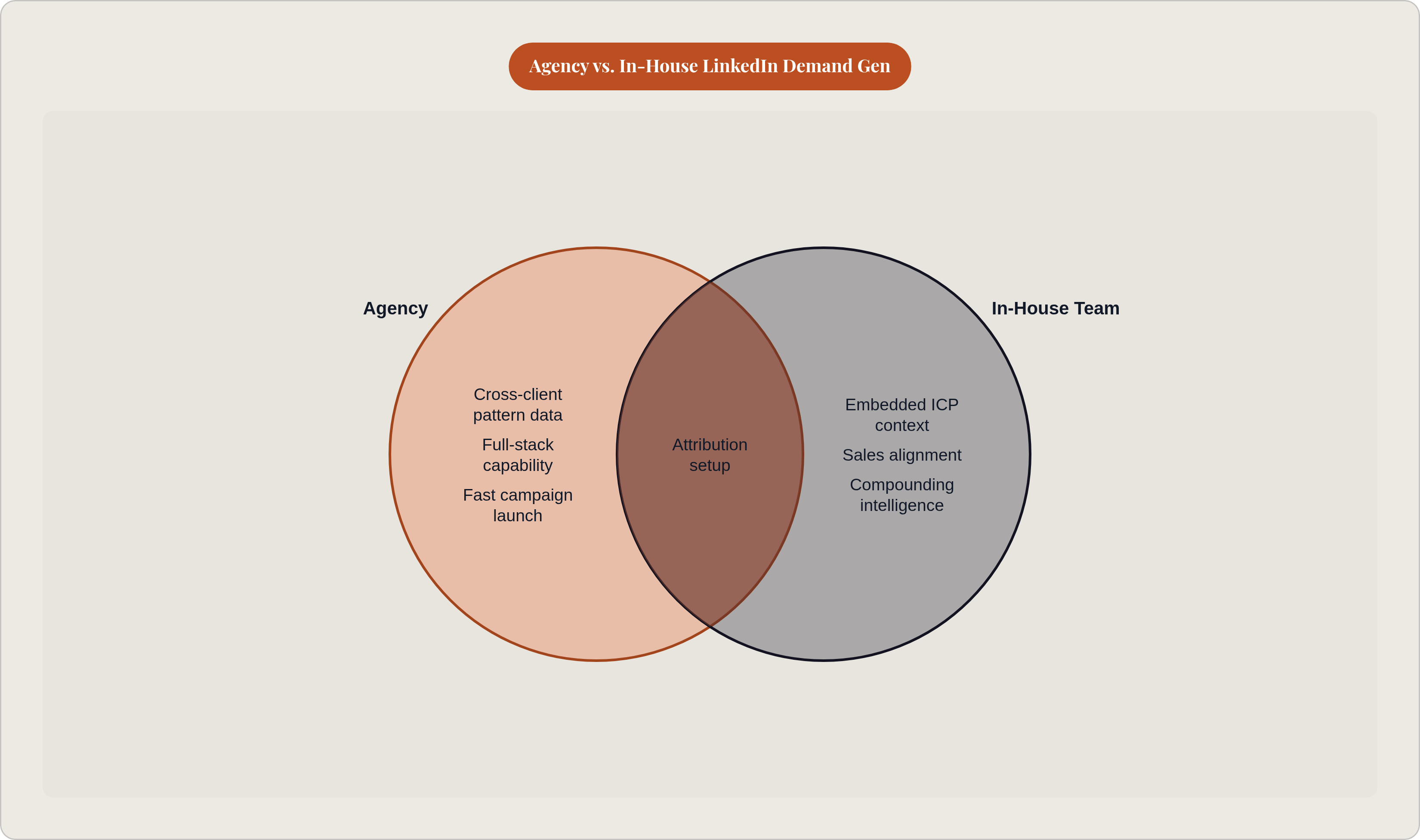
The strongest case for an agency is speed and pattern recognition. A specialized demand gen agency has already run the experiments a new in-house hire would spend months running. Which ad formats perform. Which audience structures quietly inflate cost-per-click without delivering anyone worth talking to. What sequencing actually moves different buyer profiles.
That accumulated knowledge is real. Multi-image carousels tend to generate the highest engagement among LinkedIn ad formats. Thought Leader Ads outperform standard company page ads on click-through by a noticeable margin. An agency running those formats across a portfolio of clients accumulates signal faster than any single in-house account ever could, because they're learning from dozens of campaigns simultaneously. Not just yours. Think of it like a chef who has cooked in a hundred different kitchens — they've burned the same dish enough times to know exactly when to turn down the heat.
The second advantage is full-stack capability without full-stack headcount. Creative, copy, audience strategy, attribution setup, reporting. Often bundled into one retainer. For a company without a dedicated demand gen hire, an agency can stand up a functioning campaign system in weeks. Recruiting, onboarding, and ramping a qualified demand gen hire takes months. If pipeline is the constraint right now, that gap matters.
But what does an agency actually know about your business?
This is where it gets uncomfortable. Agencies carry what I'd call context lag. They rarely have deep access to sales call recordings, CRM data, or the kind of ICP nuance that only comes from sitting inside a go-to-market team week after week. They're working from briefs. And when the engagement ends, the institutional learning about what worked — the audience builds, the creative libraries, the attribution logic — that knowledge typically stays with the agency. You paid to build it. They kept it.
Accountability structures vary widely, and not in your favor. A lot of agency relationships get measured on impressions and MQL volume. Not pipeline created. Not revenue influenced. Those are different things, and the gap between them is where budget quietly disappears without anyone technically lying about performance.
Most B2B companies have drifted toward a hybrid model, keeping strategy in-house while outsourcing execution. That's not a trend people just talk about at conference panels. It's the market quietly acknowledging that the pure-agency model has real limits, and that most companies feel those limits before they ever name them.
What building an in-house LinkedIn team actually costs you
The core advantage of an in-house team is embedded context. An internal demand gen hire sits inside the pipeline conversation. They have access to sales. They hear objections in real time and can translate that signal directly into campaign decisions before the moment passes.
Signal-triggered campaigns are a clean example. Responding to job changes, funding announcements, or hiring activity at target accounts requires the kind of ICP intimacy that's hard to delegate. Signal-triggered LinkedIn connection requests see dramatically higher acceptance rates than generic outreach. That gap comes from relevance. Relevance comes from knowing your buyer deeply enough to reach out at the right moment with the right framing. An agency working from a quarterly brief isn't doing that.
There's also the compounding intelligence argument. Campaigns get smarter when the same team runs them over time. Audience refinements, creative learnings, and attribution data accumulate in one place. That's a structural advantage. The key phrase, though, is "over time."
Because the real costs of building in-house are consistently underestimated at the decision point.
A few things that tend to get glossed over:
- Recruiting and ramp time. A LinkedIn demand gen specialist with genuine paid social expertise, ABM experience, and attribution fluency is not a fast or cheap hire. The search alone can take months.
- Tooling. LinkedIn Campaign Manager alone doesn't constitute a demand gen stack. Attribution software, creative production, landing page testing, CRM integration. All of that requires additional investment, and it adds up before the first campaign goes live.
- Single-person fragility. A one-person in-house team is a concentration risk. Illness, attrition, a skill gap in one specific area. Any of those stalls the entire program.
In-house teams tend to outperform agencies on pipeline quality over time. They tend to underperform on speed to launch and creative volume, especially in the first six to twelve months. Worth knowing that before you make the call, not after.
ABM alignment also tends to be stronger in-house. ABM depends on tight sales and marketing coordination, the kind where someone on the marketing side actually knows what's happening inside the deals. Agency structures make that kind of alignment difficult. Not impossible. But difficult enough that most agencies don't attempt it seriously, and the ones that do usually compensate with a lot of kickoff meetings that produce polished slide decks and modest pipeline.
The structural variables that actually determine which model fits
Four variables do most of the work here. They're not philosophical. They're operational.
Growth stage and time horizon. Early-stage companies without a defined ICP or a repeatable sales motion benefit from agency speed. Get signal fast, avoid over-investing in headcount before you know who you're selling to. Companies with a defined ICP and a functional sales team benefit from the compounding knowledge an in-house team builds. Knowing where you are on that curve changes the math significantly.
Internal strategic capacity. This one gets underweighted in almost every version of this conversation. If the company has a VP of Marketing or Head of Demand Gen who can own strategy, ICP definition, and campaign direction, execution can be delegated out. If that strategic capacity doesn't exist internally, an agency fills the wrong gap. Execution without direction produces neither speed nor quality. It produces activity, which looks like progress until someone checks the pipeline.
Pipeline accountability structure. Who owns the MQL-to-SQL handoff? Who reviews campaign performance against pipeline created, not just impressions? The model that has cleaner accountability to that outcome tends to win. And whichever model you choose, the standard should be pipeline created and opportunity rate. Not volume of leads sitting in a spreadsheet.
Budget and runway. A mature in-house team with full tooling typically costs more than an agency retainer when fully loaded. Salaries, benefits, tools, management overhead. But the math shifts when the agency's retainer grows with scope and the in-house team's output compounds over time. The break-even point is real. Most companies never actually calculate it. They compare the retainer to a salary, call it close enough, and move on.
One thing worth saying plainly about the hybrid model: most B2B companies end up in a hybrid arrangement, but most of them didn't get there strategically. They added an agency because in-house was too slow. Then they added an in-house hire because the agency lacked context. The result is duplicated spend, unclear ownership, and no single source of truth on what's driving pipeline.
A deliberate hybrid can work. In-house owns strategy, ICP definition, and attribution. An external partner owns creative production and platform management. But that requires explicit ownership lines agreed on before the work starts, not discovered through friction six months later when no one can answer a basic attribution question.
Where LinkedIn campaign execution breaks down regardless of the model chosen
Agency versus in-house is not the most common reason LinkedIn demand gen programs fail. These failure modes show up in both models, almost equally, and they're worth naming directly.
Spray-and-pray targeting. Running campaigns across multiple industries simultaneously dilutes impact and drives up cost-per-click. LinkedIn's average CPC is already several times higher than Google Ads. Wasted spend is expensive here in ways that aren't always obvious until you run the math at quarter end.
Static lead-gen forms with vague CTAs. These produce high form-fill volume and low pipeline quality. The metric looks good until sales works the leads and comes back empty-handed. You know the meeting that follows. Nobody's happy to be there. It's like fishing with a net full of holes — you hauled something in, but nothing worth keeping survived the trip.
Vanity metric reporting. Optimizing for click-through rate or impressions without pipeline attribution produces false confidence. Budget renews. Pipeline doesn't improve. And eventually someone in revenue leadership asks why LinkedIn isn't working, and everyone points at each other's dashboards.
Attribution deserves its own moment here because it's the most common execution gap separating programs that earn budget from programs that quietly lose it. Multi-touch attribution models, combined with self-reported attribution on demo request forms, catch the dark social and word-of-mouth signals that model-based attribution misses entirely. Organizations with unified measurement frameworks connecting marketing activities to revenue consistently report stronger marketing ROI than those with siloed approaches. That's not a coincidence. It's what happens when you stop measuring activity and start measuring outcomes.
Creative is a performance variable, not a production task. Identifying which creative elements actually drive conversions, not just clicks, requires accumulated data across enough campaigns to surface real patterns. It takes time and volume to develop. And it doesn't transfer cleanly from one account to another. An agency's creative learnings from a fintech client don't automatically apply to yours, even if they pitch it that way.
The budget split that shows up consistently in high-performing programs: roughly sixty percent toward demand creation (ungated content, thought leadership, engaged reach) and forty percent toward demand capture (retargeting, bottom-funnel, outbound to warmed accounts). That ratio applies regardless of which model is running the program.
How AI shifts the agency-vs-in-house calculus going forward
The manual execution advantage agencies historically held — faster setup, more hands on keyboards, more campaigns running simultaneously — erodes when AI handles campaign creation, audience optimization, and bid management autonomously. What remains as a differentiator is ICP depth, strategic judgment, and the quality of the feedback loop between campaign performance and targeting decisions.
So if you strip out the manual execution work, what exactly is the agency selling?
That's not a rhetorical jab. It's an actual open question, and I don't think the industry has figured it out yet. Why did the agency lose the pitch? Because it couldn't explain what it was selling once the robots showed up.
AI compounds campaign intelligence over time, but only when the data and learnings stay in one place. An agency that ends a contract takes its campaign history with it. An AI system that restarts fresh every quarter doesn't compound. It just restarts. This structurally favors models where institutional knowledge doesn't walk out the door at engagement end. That's a point that tends to get skipped in conversations focused on tools rather than systems.
Most B2B marketing teams now use AI marketing analytics in some form. The teams reporting real benefit point to higher lead quality and faster sales cycles. But those gains require a continuous learning loop. A majority of marketing teams still lack an AI roadmap, and an even larger share report highly manual reporting processes despite widespread AI tool adoption. The gap between teams using AI as a point tool and teams deploying it as an integrated execution layer is widening. And it's showing up in pipeline output.
That gap is producing what looks like a third category worth watching: purpose-built AI execution, where agents handle creative, targeting, attribution, and reporting as an integrated system rather than as separate tool purchases bolted together. It changes what "delegated execution" actually means. It changes the agency-vs-in-house question in ways the field hasn't fully worked out yet.
I'm not sure I've worked it out either.
A practical decision guide for revenue and marketing leaders choosing now
There isn't a clean verdict. But three questions tend to surface the right answer faster than any framework.
Do you have internal strategic capacity to own ICP definition, pipeline accountability, and campaign direction? If the answer is no, no execution model will produce consistent pipeline without it. Not an agency. Not an in-house hire. Not an AI tool. Strategy cannot be outsourced. Execution can.
Are you optimizing for speed to first campaign or for compounding performance over twelve-plus months? Speed favors an agency or a purpose-built AI execution layer. Compounding favors in-house or an AI system that retains and builds on every campaign's learnings. Most teams want both. Most teams eventually have to choose which one matters more right now, given where the business actually is.
Can you hold the chosen model accountable to pipeline created and opportunity rate, not MQL volume or impressions? If the answer is no, the model isn't the problem. The measurement framework is. Fix that first. Then revisit the model question.
Here's rough stage-based guidance based on where companies tend to land:
- Pre-PMF or early traction, no defined ICP, no repeatable sales motion. Use an agency or delegated execution to get signal fast without over-investing in headcount. You're buying speed and optionality, not a long-term system.
- Growing pipeline, defined ICP, functioning sales team. Build toward in-house ownership or an AI-native execution model with embedded strategic oversight. The compounding advantage starts to matter here.
- Scaling with multiple ICPs, geographies, or buying committee complexity. Consider a deliberate hybrid with explicit ownership lines, or a full-stack AI execution layer that can operate across campaign types without adding headcount proportionally.
On reporting cadence, regardless of model: weekly leading indicators (engagement, demo completions), monthly pipeline created and conversion rates, quarterly channel mix and budget reallocation. The model that can't produce this cadence is not accountable to pipeline. It's accountable to the retainer invoice.
The worst outcome in this decision is not picking the wrong model. It's running both models without clear ownership, duplicating spend, and having no single source of truth on what's actually generating pipeline. That's not a hybrid strategy. That's two strategies in conflict, quietly draining budget while everyone argues about attribution and nobody's watching the number that matters.
Pick one. Make it accountable to pipeline. Adjust when the data tells you something, not when the relationship gets uncomfortable.