Intent Data Providers for LinkedIn Audience Targeting
Four signal types shape which accounts to target on LinkedIn, and they work best in combination.

LinkedIn targeting can tell you what someone is. It can't tell you what they're doing right now. That's the whole gap intent data is built to close, and it starts with understanding where these signals actually come from.
There are four kinds of intent data, and they're not interchangeable.
First-party data comes off your own website and your own content. Someone visits your pricing page, downloads a whitepaper, sits through a webinar. This is the highest-quality signal you can get, because it's tied directly to your product and your funnel. The catch: it only covers people who already found you. If they haven't hit your site yet, first-party data has nothing to say about them.
Second-party data is someone else's first-party data, shared with you through a direct deal. Think co-hosted webinars or a syndicated content partnership where both parties get visibility into who engaged. It widens the net past your own site traffic while keeping signal quality reasonably high, since you know exactly where it came from.
Third-party data is collected across a wide network of outside sites and sold to you. Bombora runs a prominent version of this: a cooperative of more than 5,000 B2B publisher sites tracking what topics people research and which content they engage with across the open web. The coverage is broad. The accuracy, though, depends entirely on how the provider sources and matches that data back to real companies, so not all third-party feeds are equal even when they claim similar reach.
Derived or enriched intent takes it a step further, blending multiple signal types (often with AI models) to predict how close an account is to buying. It layers in firmographic and technographic filters so you're not just seeing "this company is researching," you're seeing "this company matches your ideal customer profile and is researching."
Underneath all four types, the actual behavior being measured looks like this: spikes in content consumption around a specific topic, visits to competitor websites, comparisons on review sites, keyword searches tied to a category, job postings that hint at new budget or a new initiative, and leadership changes that often precede a buying decision.
One distinction matters more than almost anything else if the end goal is LinkedIn: account-level versus contact-level signals. Most third-party intent, including Bombora, works at the account level. It tells you Acme Corp is in-market. It does not tell you which person at Acme Corp is doing the researching. Contact-level tools, like Influ2's ad-engagement tracking or Pendo's in-product behavior data, go a layer deeper and flag the individual. That's the difference between "target this company" and "target this person," and LinkedIn's whole targeting engine is built around people, not just logos.
Worth calling out separately: G2. Review visits, category comparisons, and product page views on G2 are some of the strongest behavioral signals available, because someone comparing vendors on a review site is about as close to active evaluation as intent data gets. That's exactly why 6sense draws on multiple third-party sources rather than building around a single feed.
No single signal type carries a full picture on its own. The intent stacks that hold up best combine first-party behavior on your own site with an outside third-party signal, so you're seeing both "they're aware of us" and "they're actively comparing options."
The mechanism: how intent data feeds LinkedIn audience construction
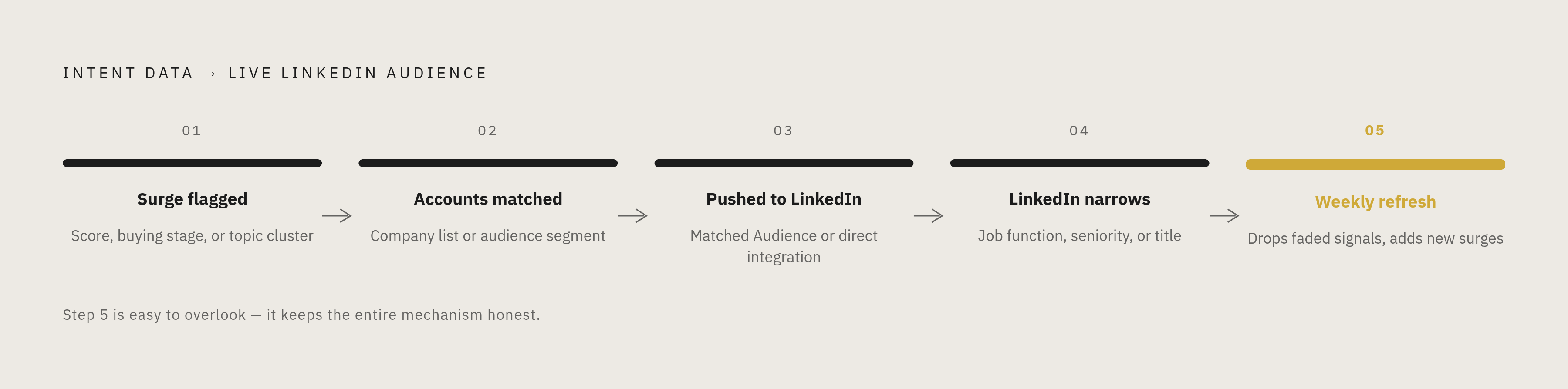
Here's how the pieces actually connect, step by step.
- An intent provider flags accounts showing in-market behavior above a set threshold, whether that's a surge score, a buying-stage label, or activity around a specific topic cluster.
- Those accounts get matched to a company list or an audience segment.
- The list gets pushed into LinkedIn, either as a Matched Audience through a company list upload or through a direct integration.
- LinkedIn layers job function, seniority, or title on top of that account list, narrowing down to the right people inside those companies.
- The audience refreshes on a cadence, often weekly, so accounts whose signals fade drop out and newly surging accounts get added in.
The gap between providers shows up in step three. Some, like 6sense and ZoomInfo, push audiences straight into LinkedIn without anyone touching a spreadsheet. Others still run on manual CSV exports, which works, but adds lag between when a signal fires and when the ad actually reaches that account.
6sense built native LinkedIn campaign management directly into its platform, letting marketers build and launch LinkedIn ABM campaigns (single-image, CPM or CPC) without leaving the 6sense Revenue AI system, using buying-stage keyword intent and account behavior to decide who sees what.
ZoomInfo's GTM Studio does something similar but wider: it activates audiences built from firmographic, technographic, and intent data directly into LinkedIn, alongside Meta, Google, and programmatic display. Its WebSights feature spots anonymous site visitors and can feed them into retargeting on Google Ads.
Bombora integrates natively with LinkedIn too, meaning Company Surge data can move straight into an ad campaign without needing a separate platform to sit in between.
Timing is the part that's easy to overlook. Intent signals decay. An account that starts researching, gets ignored for three weeks, may have already picked a shortlist by the time an ad shows up. A weekly refresh cadence shapes how current your LinkedIn audience actually is on any given day. Refresh less often, and there's a real risk of spending against a signal that's already gone stale.
There's also a scale problem worth sitting with. According to 6sense's 2025 Buyer Experience Report, B2B buying groups now average more than 10 people for purchases running around $250,000. Intent data can point at the account. It cannot, by itself, tell LinkedIn to reach all ten-plus people involved in that decision. That's still LinkedIn's job, layering seniority and function filters on top of the account list so the campaign reaches the finance lead and the technical evaluator and the department head, not just whichever title happens to be easiest to target.
What the major intent data providers offer and where they differ
Providers split along four lines worth checking before choosing one: where the signal comes from, whether it's account-level or contact-level, how deep the LinkedIn integration goes, and whether the company is selling a data feed or a full orchestration platform. Pricing across the market runs from around $12,000 a year on the low end to $100,000 or more, with the orchestration platforms sitting at the top and the standalone data feeds priced more moderately (though those usually need separate tools to actually put the data to work).
Bombora runs on its cooperative of over 5,000 B2B publisher sites, tracking topic-level research across the web. Its product, Company Surge, delivers account-level surge scores by topic. It integrates natively with LinkedIn and also connects with HubSpot, Salesforce, Marketo, and RollWorks. It's a strong fit for teams that want a clean third-party intent feed to layer into a workflow they already run, but it's account-level only, so it won't tell you which specific person to target.
6sense combines its own first-party website intelligence with third-party intent from Bombora, G2, TrustRadius, and other partners, then runs it all through an AI engine that predicts buying stage: research, consideration, or decision. Its native LinkedIn integration lets teams build and launch ABM campaigns with CPM or CPC bidding directly inside the platform. At its 2025 Breakthrough event, 6sense launched RevvyAI, a set of pre-built AI agents that automate account qualification, ad optimization, and keyword recommendations. Pricing starts around $35,000 annually and climbs with added modules, and implementation typically runs three to six months. It's built for teams that want intent data, stage prediction, and LinkedIn activation under one roof, and it was named a Leader in The Forrester Wave: Intent Data Providers for B2B, Q1 2025.
ZoomInfo built its GTM Context Graph to fuse verified contact and company data with CRM records, conversation intelligence, and real-time behavioral signals. Its Guided Intent feature surfaces topics that have historically correlated with closed deals, rather than just whatever topic has the highest search volume. GTM Studio activates audiences straight to LinkedIn, Meta, Google, and programmatic platforms, and WebSights identifies anonymous visitors for retargeting. Impartner used ZoomInfo Marketing to build targeted audiences and run cross-channel campaigns, and reported a 12% increase in pipeline. ZoomInfo has been named a Leader in the Gartner Magic Quadrant for ABM Platforms in both 2024 and 2025, and a Leader in The Forrester Wave: Intent Data Providers for B2B, Q1 2025.
Demandbase runs its Demandbase One platform with Agentbase, a set of AI agents built to automate go-to-market workflows, purpose-built for account-based programs. It covers intent, account intelligence, and ad activation as one connected suite, which suits enterprise teams running full ABM motions who'd rather not stitch together separate tools. It was also named a Leader in The Forrester Wave: Intent Data Providers for B2B, Q1 2025.
Cognism is strongest on EMEA contact data, offering solid European email and mobile coverage. Its intent signals come from hiring activity and job changes: new postings, team growth, role announcements, LinkedIn updates, all account-level. It's a good fit for teams with heavy European focus where contact accuracy matters more than broad topic coverage, but it functions better as an enrichment layer on top of another intent feed than as the primary signal for building LinkedIn audiences.
Intentsify, also a Forrester Wave Leader for Q1 2025, was positioned by thecmo.com as best for buyer journey insights. It aggregates and validates intent signals across multiple third-party sources to cut down on false positives.
Informa TechTarget, another Forrester Wave Leader for Q1 2025, was positioned by thecmo.com as best for targeting buying groups. Its signal comes from content consumption across TechTarget's own media properties, which makes it especially strong for technology buyers researching specific vendor categories.
Landbase was named a Cool Vendor in AI for Marketing by Gartner in 2025. Its model trained on more than 50 million go-to-market campaigns, and its B2B database covers over 300 million verified contacts across more than 24 million company accounts, with over 1,500 enrichment fields per account. Its AI Qualification feature scores accounts against buyer criteria before outreach even starts, and Landbase reports a 3.5x lift in conversion on prioritized accounts versus non-prioritized ones. It fits teams that want AI-driven qualification attached to intent data for outbound work alongside LinkedIn paid campaigns.
G2 Buyer Intent is a third-party, behavioral signal built from review visits, category comparisons, and product page views on the G2 marketplace. It's one of the strongest available signs of active vendor evaluation, which is why 6sense pulls it in as a source. It works best for software and SaaS companies whose buyers actually shop on G2, and less well for categories that don't show up there.
When LinkedIn targeting without intent data underperforms, and what that costs
LinkedIn's scale isn't in question. Four out of five B2B leads from social media come from the platform, it reaches 61 million senior-level influencers and 40 million decision-makers, and it generates 277% more leads than Facebook and Twitter combined. None of that is the problem.
The problem is cost. Competitive B2B audiences on LinkedIn now run $8 to $10 per click in the U.S. Serving those impressions to accounts that aren't actually in a buying cycle isn't just wasted reach, it's wasted reach at a premium price. And according to Dreamdata, LinkedIn captured 41% of B2B paid social budgets in 2025, the largest share of any platform measured. At that level of spend, precision stops being a nice-to-have and starts being the difference between a campaign that pays for itself and one that doesn't.
There's also a shortlist problem that intent data is specifically built to solve. 6sense's 2025 Buyer Experience Report found the eventual winning vendor was already on the buyer's Day One shortlist 95% of the time, and buyers had ranked that shortlist before ever engaging a salesperson in 94% of cases. That means waiting for someone to raise their hand, fill out a form, or click "request a demo" often means showing up after the real decision has already been shaped.
Without intent data, a LinkedIn campaign optimizes for demographic fit: right title, right industry, right company size. What it can't do on its own is tell which of those accounts is actually shopping right now versus which one has been a happy customer for two years and isn't going anywhere. Both get the same ad. Both cost the same to reach. Only one is worth the spend at that moment.
Dreamdata's 2025 figures put LinkedIn's aggregate B2B return on ad spend at 121%, well ahead of Google Search at 67% and Meta at 51%. That number looks great in a deck. But it's an average across every campaign running on the platform, well-targeted and poorly-targeted alike. Untargeted spend, the kind that skips the intent layer entirely, is exactly what drags that average down toward the mean instead of up toward the ceiling.
Timing and buying stage: using intent data to decide when to run LinkedIn campaigns, not just who to target
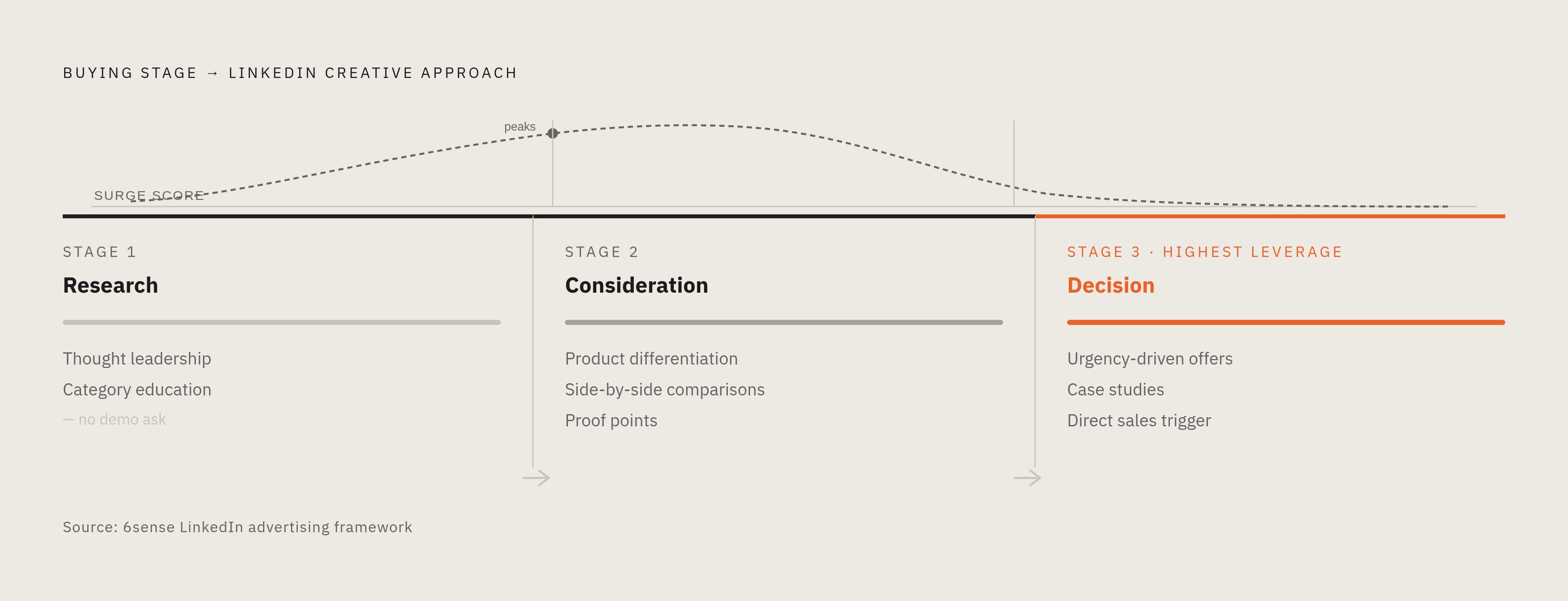
Intent signals move. A Company Surge score climbs as an account starts researching, peaks while they're actively comparing vendors, and drops off once they've made a decision. That curve isn't just interesting to watch, it's a direct instruction on when to spend and when to hold back.
Buying stage should shape the campaign itself, not just the targeting list. 6sense's AI sorts accounts into research, consideration, and decision phases, and the right LinkedIn creative looks completely different depending on which one an account is in.
- Research phase: thought leadership and category education. This is not the moment for a demo request.
- Consideration phase: product differentiation, side-by-side comparisons, proof points that separate one vendor from another.
- Decision phase: urgency-driven offers, case studies, and direct triggers to get a salesperson involved.
ZoomInfo's Guided Intent adds a useful wrinkle here: instead of surfacing whatever topic gets the most search volume, it surfaces topics that have historically correlated with actual closed deals. That's a meaningful shift, from "this is a popular subject" to "accounts that research this topic in this pattern tend to buy soon after." One might argue that distinction is the entire value of intent data in a single sentence: it's not about what's trending, it's about what predicts a purchase.
Weekly data refresh cycles, common across several of these platforms, are what keep this timing model honest. An account that surged two weeks ago and has since gone quiet shouldn't still be getting the "act now" version of an ad. The mechanism only works if the audience list is actually current, which is exactly why the native integrations that skip manual CSV exports matter so much. Speed between signal and ad is the whole point. Without it, intent data just becomes a slower, fancier version of the demographic targeting it was supposed to improve on.