Signs a LinkedIn Ads Agency Has Gone Passive on Your Account
An agency that stops optimizing and hides behind platform metrics is draining your pipeline budget.
A LinkedIn Ads agency going passive doesn't send a memo about it. Nobody announces "we've stopped trying." Instead, the account just... settles. Reports keep arriving, invoices keep clearing, and everything looks fine from the outside. Meanwhile, the budget is quietly leaking, and the pipeline numbers that actually matter aren't moving.
That's the problem with agency passivity: it's not a single failure you can point to. It's an accumulation of small, boring decisions to do nothing. And once an account is stable, the incentive to keep pushing drops fast. A failed test means an awkward call to explain what went wrong. A flat, quiet account means no call at all. Most agency relationships drift toward whichever state is calmest for the agency, and calm usually means untouched.
That drift gets expensive on LinkedIn specifically. CPCs across most B2B segments can run well into the double digits, with CPLs that can stretch significantly higher than other channels. Nothing about those numbers forgives inattention. And the stakes aren't just efficiency. Dreamdata's 2026 Benchmarks Report found that LinkedIn accounts for 24.2% of sessions at the MQL stage and 30.2% at the SQL stage. Mismanagement here isn't a wasted line item. It's a hole in the pipeline.
This piece isn't about assigning blame. It's a diagnostic. If a suspicion has been building that the agency running the LinkedIn account has checked out, here's how to confirm it with evidence instead of a gut feeling.
The agency says things are working, but can't connect spend to pipeline
Ask a simple question: which channel is driving qualified pipeline, not leads. Watch what happens next.
A confident, active agency answers with a number tied to the CRM. A passive one hedges, or redirects to a platform metric: impressions, clicks, maybe an MQL count that sounds impressive but means very little on its own.
That redirect isn't an accident. MQLs remain the dominant demand-gen metric in most organizations, while outcomes tied to actual revenue, like influenced pipeline and closed-won deals, get tracked far less consistently. Most marketing organizations default to activity metrics rather than revenue outcomes when reporting upward. So if a monthly report is full of impressions and clicks, that's not just an incomplete picture. It means neither side actually knows whether the retainer is working.
Attribution gives a passive agency a convenient place to hide. Every platform grades its own homework, with its own attribution window. The same lead can get claimed by Google, LinkedIn, and whatever else is running at the same time. Three platforms, three "we drove that" stories, one lead. Only one version of that story matters: the one tied back to the CRM, showing which spend actually produced sales-accepted leads and closed-won revenue.
A passive agency lets the friendliest platform metric run the narrative, because it keeps the reports looking green. An active one insists on a single source of truth, even when that makes its own dashboard look less flattering. That willingness to look worse in service of being accurate is one of the clearest signs of an agency still doing the work.
LinkedIn shipped a native CRM integration into Campaign Manager in 2025, making real-time revenue visibility achievable directly inside the platform. An agency that hasn't surfaced this, or implemented it, doesn't have an excuse for attribution opacity anymore. The tool exists. Not using it is a choice.
The account only moves when the client pushes it
Here's a test that takes about ten seconds to run mentally: stop sending Slack messages for a month. Would anything in the account change?
If the honest answer is no, that's the evidence. An account that only moves when it's pushed is an account that's coasting, and coasting is the default state unless someone actively resists it, Profit Mill Media (2026) found.
A few patterns tend to appear together:
- The monthly call is just a walkthrough of the dashboard, nothing the client couldn't have read alone
- Every recommendation is a minor tweak, never a real test with a real hypothesis
- Ask "what would you do with 30% more budget" and the answer is "spend more on what's working," which is really just an admission of running out of ideas
- Proactive strategy proposals, the kind that used to show up between calls, have quietly stopped
This is measurable, not just a vibe. Line up the agency's self-initiated recommendations from month two against month twelve. Most accounts will show a clear decline in both frequency and substance.
Why does this happen so consistently? Because the incentives point that way. A bold test that fails creates a hard conversation and some risk for the agency. Maintaining the status quo creates zero friction and keeps the invoice clearing on schedule. Passivity isn't a moral failing here. It's the rational move, which is exactly why activity has to be demanded explicitly, or built into the relationship structurally from the start.
LinkedIn-specific settings that reveal a hands-off account
Some signs don't require a strategic conversation at all. They're sitting right there in the account settings, and they take minutes to check.
Audience Expansion is turned on. LinkedIn enables this by default. Once it's on, the campaign starts targeting people LinkedIn thinks are "similar" to the intended audience, often pulling in Audience Network placements along the way. Spend leaks out to people who were never the target in the first place. This is one of the most common and most preventable forms of budget waste on the platform.
No suppression lists exist. Without them, existing customers, churned accounts, and even competitors keep getting served the same ads as fresh prospects. That's budget spent reaching people already in the relationship, or people who were never going to become a customer regardless of the offer.
One ad creative running across every funnel stage. Cold prospects, warm prospects, and bottom-funnel retargeting need different messages. Running the same lead gen ad across all three isn't a strategy. It's optimizing for the agency's workflow convenience, not the client's results.
A technical layer also drives this: LinkedIn's AI-powered campaigns need a meaningful volume of conversion events before they exit the learning phase and start optimizing efficiently. A passive agency may never have given a campaign enough runway or volume to actually get there. And audiences that fall below the platform's minimum size threshold are structurally too small for lead gen campaigns to function properly, no matter how good the creative is.
None of this is advanced. This is baseline hygiene, the kind of thing a competent, engaged account manager catches in the first week. Finding these problems months into a relationship isn't a technical oversight. It's neglect with a paper trail.
Reporting hides behind vanity metrics and the agency controls account access
Two access questions cut through a lot of noise here.
First: does the client have full administrative access to their own LinkedIn ad account? If not, that raises a real question about the relationship. The account and its data belong to the client. An agency holding onto that access isn't acting like a partner.
Second: is the management fee bundled together with media spend? If so, there's no way to know how the budget is actually being allocated between "money spent running ads" and "money spent paying the agency."
Reporting itself can carry the same tell. Impressions and clicks as the headline numbers, with cost-per-lead and conversion rates buried near the bottom or missing entirely, no visible link back to pipeline stages: that's a report built to look busy, not to inform a decision.
The test is straightforward. A trustworthy, active partner keeps fees separate from media spend, transparently, and reports on the KPIs that actually connect to the business. The moment that separation gets blurry, the incentive structure gets blurry too, and it becomes hard to know who benefits from the numbers being fuzzy.
If admin access to Campaign Manager isn't sitting with the client right now, that's a finding worth acting on before anything else on this list.
The creative hasn't meaningfully changed and no real tests have run
The audit question here is simple, Profit Mill Media (2026) found: what has actually changed in the account structure over the last six months, versus what has just been maintained?
Creative stagnation is easy to check. If the same ad creative has been running for several months with no documented test, no copy variant, no offer change, no format shift, that's not optimization. That's just maintenance dressed up as a strategy.
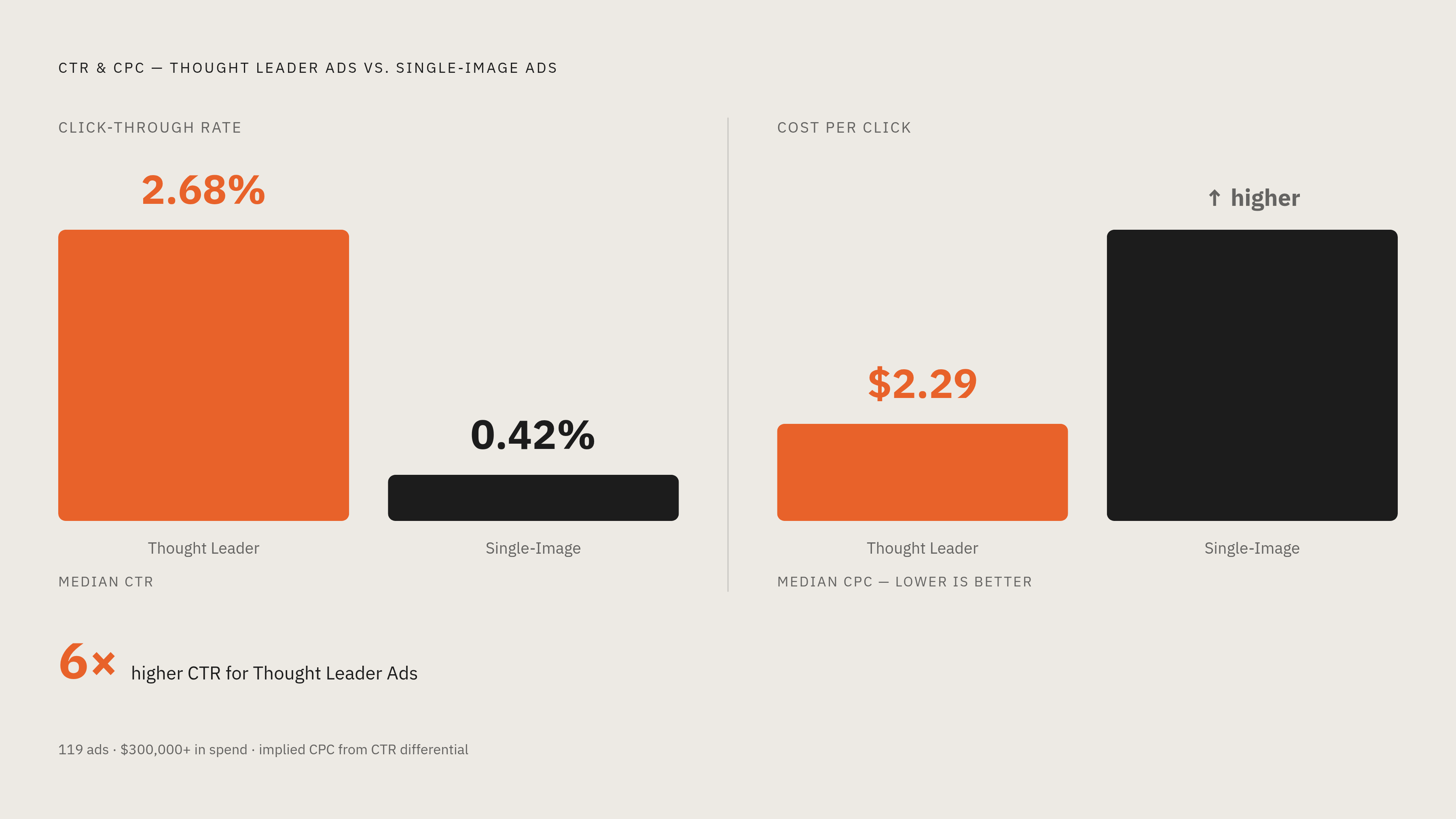
Format matters more in 2026 than it used to. Recent benchmark data found that Thought Leader Ads posted a 2.68% median click-through rate compared to just 0.42% for single-image ads, at a median cost per click of $2.29, across a sample of 119 ads and more than $300,000 in spend. An agency working LinkedIn seriously right now should know that, and should be testing it, not just recycling the same static image month after month.
Here's a useful gut check: can a specific test be named, one that should obviously have been run months ago? If the agency has no record of running it and no explanation for the gap, that gap is the diagnostic itself.
There's a targeting gap too, one that's easy to miss. B2B buying decisions typically involve multiple stakeholders across an organization. A passive agency targeting a single job title is leaving the rest of the buying committee completely unaddressed, a significant oversight when enterprise deal sizes are on the line.
What industry-wide data says about how common this problem is
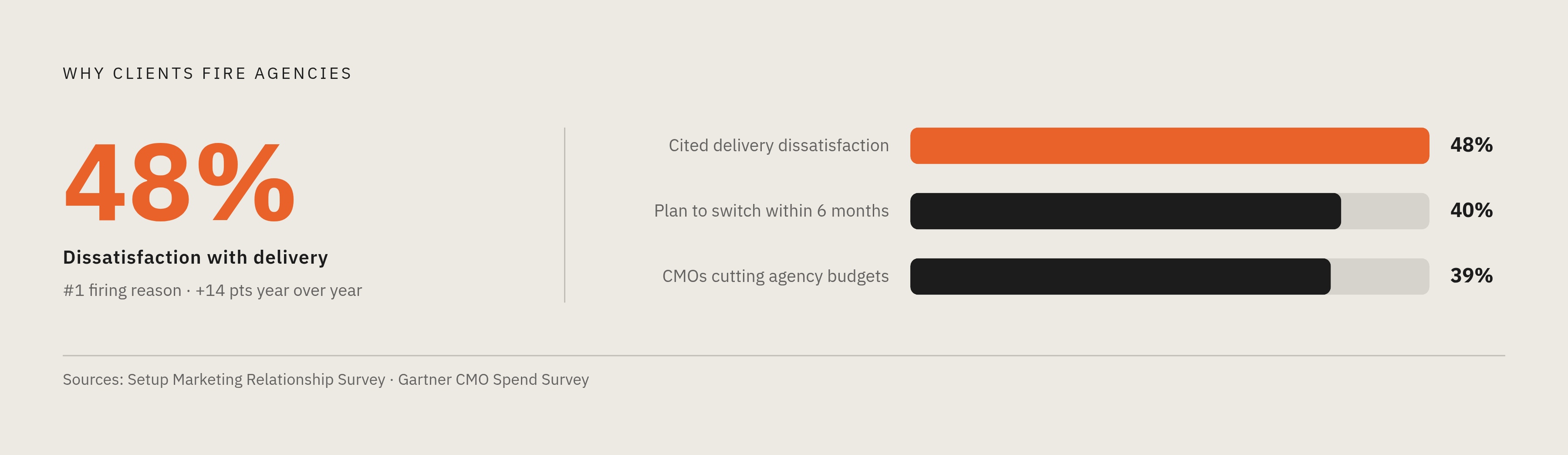
This isn't a rare complaint. According to Setup's Marketing Relationship Survey, dissatisfaction with delivery is the top reason clients fire agencies, cited by 48 percent, up 14 points year over year. Forty percent of clients surveyed planned to switch partners within six months.
Gartner found something similar from the client side of the budget conversation: 39 percent of CMOs planned to cut agency budgets, with the leading reason being the elimination of unproductive agency relationships.
Put those two numbers together and a pattern appears. This isn't a minority experience happening to a few unlucky clients. It looks more like the typical shape an agency relationship takes once it's been running long enough.
That doesn't mean agencies are bad actors, and it's worth resisting the urge to frame it that way. It means the structure of the relationship rewards passivity by default, and most clients simply don't have the vocabulary to name the problem until a lot of budget has already gone out the door. So if the suspicion has been building for a while, the data says it's not unreasonable. It's common enough to have a name.
How to conduct a structured audit before deciding what to do next
Before deciding to fire anyone, or defend anyone, run through four questions. They're ordered by how fast each one can actually be answered.
- Admin access. Is there full administrative access to the LinkedIn Campaign Manager account right now? Answerable in minutes.
- Settings hygiene. Is Audience Expansion turned on? Are suppression lists in place? Answerable in under an hour, once there's direct account access.
- Attribution. Can the agency map any spend from the last 90 days to sales-accepted leads or closed-won revenue in the CRM? This one requires a direct, specific request.
- Test history. What tests actually ran in the last six months? What was the hypothesis, what changed, what was the result? This needs a structured look back through account history.
The answers sort into two rough categories. No account access, no suppression lists, Audience Expansion left on, and no path from spend to CRM outcomes: that combination points to structural neglect, not a fixable optimization problem. Some issues present, but the agency can walk through documented reasoning for the decisions made: that's a relationship worth a direct conversation before any bigger move gets made.
One might argue the fix is obvious: fire the agency, hire a new one, move on. But that skips a step. Diagnosing the actual constraint matters more than switching partners on reflex. The real problem might not be who's managing the account at all. The creative, the landing page, the attribution setup, or the funnel structure could each be causing the real problem. Swapping agencies without knowing which one it is just resets the clock on the same drift.
There's also a structural alternative: full delegation to a system built for continuous execution, one where monitoring, optimization, and testing happen on their own schedule, without needing a client to push for it. That model exists now, and it should be weighed against whatever decision comes out of this audit, alongside every other option on the table.