Flat Retainer vs Percentage of Spend Pricing for B2B Paid Media Management
Align your agency fee with your actual goal to avoid paying for the wrong incentive.

Most people evaluating a paid media proposal ask "how much does this cost?" That's the wrong first question. The right one is: what does this pricing structure reward the agency for doing? Every pricing model is an incentive structure wearing a cost structure as a disguise. The number on the invoice is just what falls out the bottom once the logic runs its course. This matters most once real money is on the table. At $30,000 a month or more in ad spend, a small incentive gap changes what gets recommended, what gets cut, and what gets quietly left alone, because the money involved is large enough to make those choices matter.
This isn't a verdict on which model wins. It's a way to read any proposal clearly, whether it lands on your desk this week or next year.
Pricing models and market breakdown
Three pricing structures show up again and again: flat retainer, percentage of spend, and hybrid. Per the 2026 Agency Pricing Survey, 42% of agencies run on flat fees, 31% charge a percentage of spend, and 27% use some hybrid mix. Roughly 78% use a retainer of some kind as their main structure, which tells you retainers, in one form or another, are the default starting point for most conversations.
Flat retainer ranges, 2026: WebFX's 2026 guide puts PPC management specifically at $1,500 to $10,000 a month.
- Enterprise programs (companies with 501+ employees): $12,000 to $30,000+ a month, per WebFX's 2026 cost guide.
- B2B demand generation: as low as $3,000 a month for a seed-stage or pre-product-market-fit company, climbing past $45,000 for a full enterprise program.
- Channel-by-channel benchmarks from WebFX for 2026: SEO runs $1,000 to $30,000 a month, PPC management $1,500 to $10,000 a month, content $4,000 to $15,000 a month.
Percentage-of-spend ranges, 2026:" Run that math on a client spending $20,000 to $200,000 a month, and the management fee alone is somewhere between $2,000 and $40,000.
Hybrid ranges: Some performance-heavy variants strip the base down to $2,000 to $4,000 and add $150 to $400 per qualified meeting booked.
That's the landscape. No verdict yet. Just the map, so the next part actually means something.
The structural conflict inside percentage-of-spend pricing
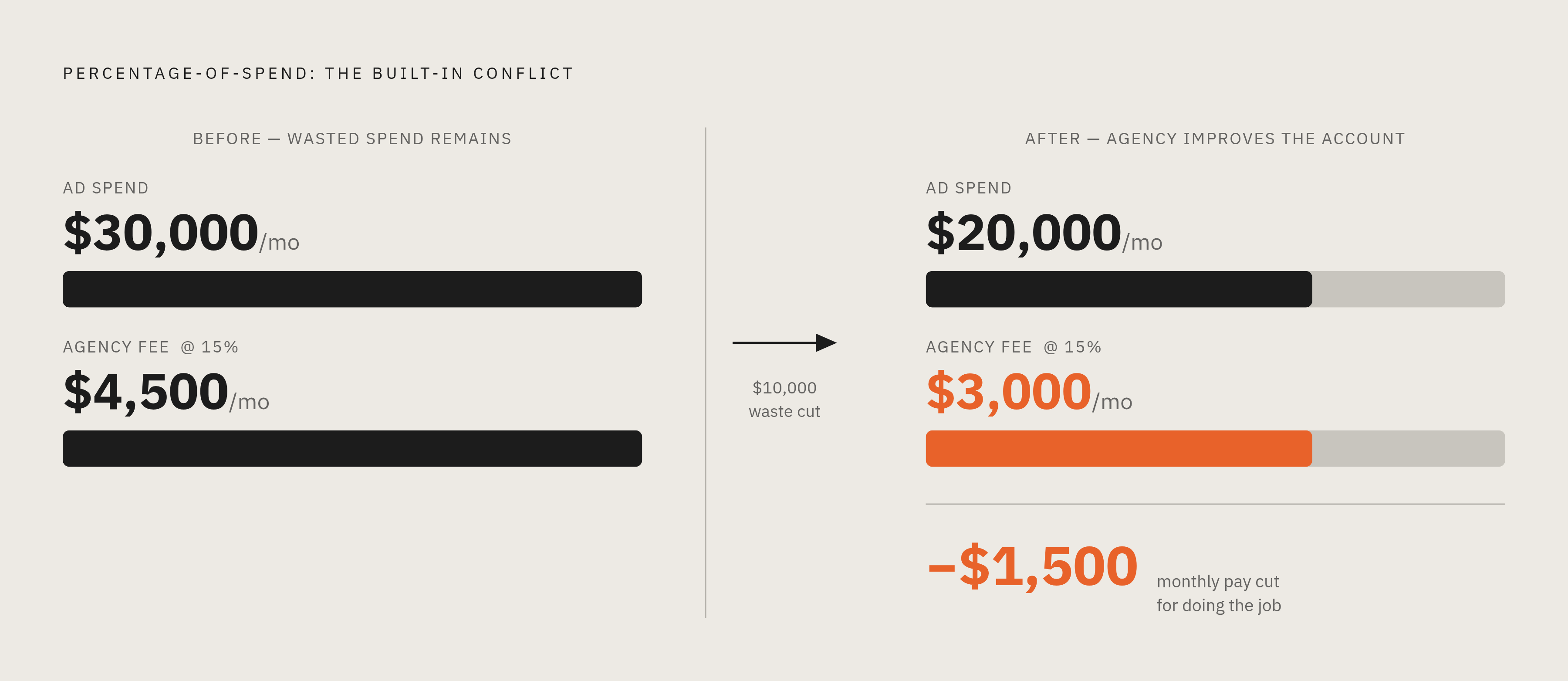
Here's the plain version: if an agency's revenue is a cut of media spend, then any advice to spend less is also advice to pay itself less. That's not a character flaw in any specific agency. It's baked into the math. The conflict exists whether the people running the account are honest, careless, or somewhere in between.
And it grows with the budget. At a small spend level, the gap barely registers. At $100,000 a month, the agency has real money riding on the decision not to cut spend.
A 2025 waste analysis across 43 enterprise SaaS ad accounts found an average of 36.1% of spend was wasted. Under a flat fee, fixing that waste is a straightforward win: better results, no cost to the agency. Under a percentage model, fixing that same waste means the agency's own paycheck drops by roughly that same 36.1%.
Run a concrete number through it. An agency charging 15% to manage $30,000 a month in spend pulls in $4,500 a month. Say that agency finds $10,000 worth of wasted spend and cuts it. Good news for the client. Bad news for the agency: its fee falls to $3,000, a $1,500 monthly pay cut, for doing exactly the job it was hired to do.
New Perspective put it plainly in 2026: "Percentage of ad spend (10 to 20 percent) rewards higher spend. The incentive problem is built in." Remarkable Agency, also 2026, framed it the same way: "Cutting wasted spend can also reduce a percentage-based fee." Structural tension, not a moral failing.
None of this means percentage pricing is always wrong. It means the model has a built-in lean, and the question is whether that lean matches the situation.
When percentage-of-spend pricing is actually the fair structure
Percentage-of-spend earns its keep under specific conditions. It isn't broken in principle. It's mismatched in the wrong context.
The model fits when:
Budget is large and stable. A steady, large monthly program makes the fee predictable in practice, even though it's technically variable. The workload actually scales with spend. More markets, more campaigns, more reporting complexity, that's real extra work, and a fee that scales with it isn't unfair, it's proportional. The client wants agency capacity to expand automatically as the budget grows, without renegotiating a new contract every time the number moves.
At real enterprise scale, running a very large monthly budget takes more people than running a modest one. A fee tied to that scale can be a fair trade for the extra hands.
It fits poorly when:
- Budget is volatile or under active review, since fee swings just add noise to an already unstable relationship.
- The main goal is cutting inefficient spend, since that goal points directly against the agency's financial interest.
- The company is trying to get more efficient, not bigger.
Here's a quick gut check: percentage pricing rewards an agency for growing spend. If growing spend isn't the current goal, if efficiency is, then the incentive is backwards before the contract's even signed.
Even where percentage pricing is fair, it still doesn't buy the one thing a flat retainer is built to deliver: advice with no financial spin on it.
What a flat retainer buys, and where it goes wrong
Detach agency income from ad budget, and spend recommendations stop carrying any upside or downside for the agency. Understory Agency put it simply in 2026: "the advice gets cleaner." Cut spend, keep it flat, raise it, none of those choices change what the agency gets paid. That's the whole appeal in one sentence.
There's a second benefit that's easy to miss: predictability. A fixed monthly line makes CAC math clean. Media cost plus management fee is one known number, not a moving target. A healthy LTV:CAC ratio requires a minimum 3:1 threshold, and a flat fee is what makes that ratio easy to check without doing algebra every month.
The failure mode with flat retainers isn't dishonesty. It's drift.
A fixed fee paired with a vague scope quietly invites the agency to do a little less over time. It just as quietly invites the client to ask for a little more than was ever agreed to. Neither side is lying. Eventually, though, one side feels shorted, and the cause is usually the contract, not anyone's intentions.
The fix is structural, not moral: a written scope that names the deliverables and the channels, a defined service level, and a scheduled point to re-scope when the business changes. That's what keeps a flat fee honest.
On contract terms, a reasonable baseline is a short initial commitment with rolling cancellation after that. Per HubSpot's 2026 State of Marketing Report, 70% of marketers now run active account-based marketing programs, and in that environment, agencies earn renewal through results, not through lock-in. Longer lock-in terms deserve scrutiny about what, exactly, the agency is protecting itself from.
The advantage a flat retainer offers only exists if the scope is actually defined. "Flat fee" by itself isn't proof of aligned incentives. It's just the raw material for building them.
The breakeven math: at what spend level does each model cost more
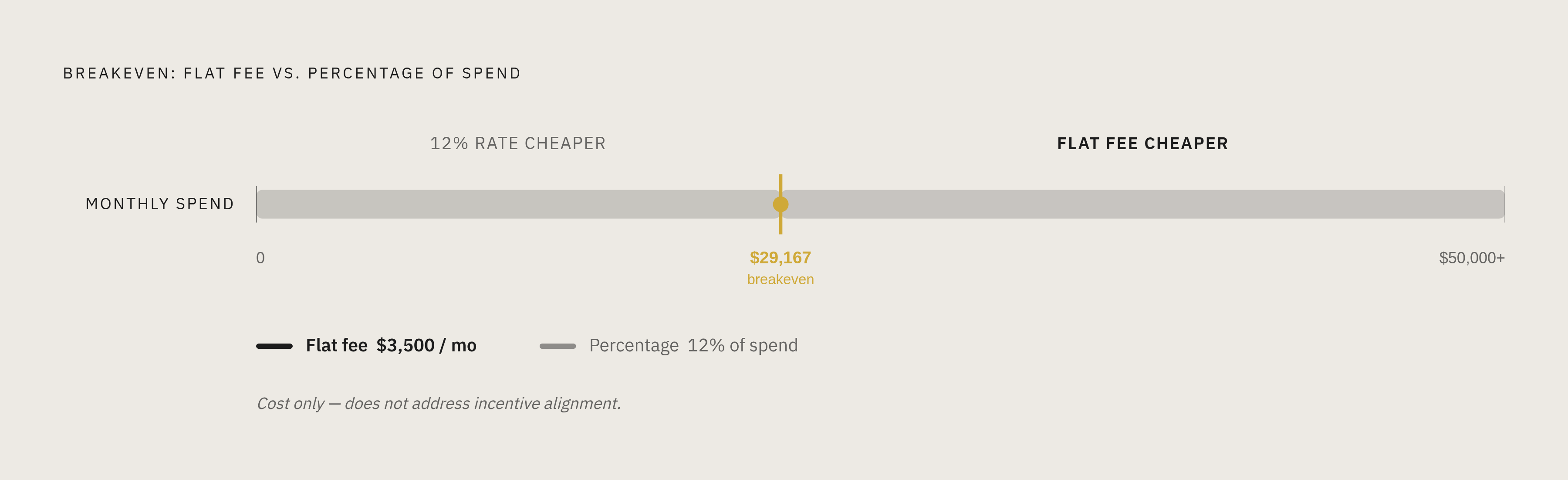
Before signing anything, run the number that tells you where percentage pricing flips from cheaper to more expensive than a flat fee. Divide the flat fee by the percentage rate, and that gives the spend level where the two models cost the same.
A worked example: a $3,500-a-month flat fee against a 12% rate breaks even around $29,167 a month in media spend. Spend more than that, and the flat fee is the cheaper option. Spend less, and percentage pricing wins on pure cost.
That math answers one question only: which is cheaper. It says nothing about the incentive gap, which sits there whether the flat fee wins or loses the math.
An agency charging $15,000 a month to manage $30,000 a month in spend is taking half the total media investment as its fee. That ratio deserves a hard look no matter which pricing model produced it.
This math produces rising stakes: as spend grows, the same incentive gap translates into larger dollar amounts at risk. Per SaaS Capital's 2025 benchmarks, the median SaaS company now spends $2.00 to bring in $1.00 of new annual recurring revenue. Customer acquisition costs for B2B SaaS rose 14% from 2023 to 2024. Management-fee inefficiency doesn't sit off to the side of that trend, it stacks right on top of it.
So calculate the breakeven. Then ask a second question: even if this model is cheaper at your current spend, is the incentive structure above that breakeven one worth living inside for the next year?
How hybrid and performance models redistribute the incentive problem without eliminating it
Hybrid pricing is the fastest-growing structure right now, and it's easy to see why. Pairing a base retainer with a variable performance component means both sides carry some risk instead of one side carrying all of it. A typical setup: $2,000 to $15,000 a month base, plus $200 to $500 per sales-qualified lead, or 5% to 10% of pipeline tied to the agency's work.
What that fixes: it removes the pure incentive to inflate spend, since the agency's stake is now in pipeline outcomes, not budget size.
What it introduces instead:
Attribution fights. B2B sales cycles run long, and "pipeline the agency influenced" is genuinely hard to pin down with any precision. That ambiguity is exactly where disputes start. Gamed lead quality. A per-lead bonus ($150 to $400 per qualified meeting, say) only holds up if "qualified" has a precise, agreed definition. Without one, the agency has every reason to loosen the bar quietly. A model that drifts back toward percentage-of-spend. If the variable half of the pay ends up dominating the economics, hybrid stops behaving like a shared-risk model and starts behaving like the thing it was meant to fix.
Pure performance deals look great on paper: pay only for results. In practice, long B2B sales cycles make attribution disputes close to inevitable.
Hybrid isn't an automatic upgrade over the other two models. It's the right call specifically when both sides can agree, in writing, on a clean attribution method and a precise definition of whatever metric triggers the bonus. Every pricing model redistributes the incentive risk somewhere. None of them make it disappear. The real question is which version of that misalignment is easiest to manage for the specific program in front of you.
A well-governed flat-retainer engagement for B2B paid media
The flat retainer's clean-advice advantage only shows up if the contract is actually built to support it. Here's what that looks like on paper:
Named scope. Specific channels (Google Ads, LinkedIn Ads), specific deliverables (campaign builds, creative iterations, attribution reporting, landing page optimization), and a specific cadence for both optimization work and reporting. A scheduled re-scope clause. When spend, ideal customer profile, or growth targets shift in a real way, the retainer gets renegotiated on a set schedule, not whenever one side happens to feel shorted. A named accountable person. Not a rotating team, not a dashboard link. A specific person on the agency side responsible for outcomes, someone the buyer can actually hold to something. Reporting tied to pipeline and revenue, not platform metrics. Clicks, impressions, and platform-reported conversions aren't the thing the retainer is actually buying. Full-stack scope, or a clear line drawn around it. An agency that only touches the ad platform, without owning creative, landing pages, and attribution, is optimizing one link in a longer chain. The retainer should either cover that whole chain or spell out exactly where it stops. A sane contract length. The 2026 standard, a 90-day initial term with 30-day cancellation after, is a reasonable baseline. Anything locking a client in well past that should raise a question about what, exactly, the agency is protecting itself from.
The cost of getting this wrong isn't abstract. Gartner's 2025 survey found 39% of CMOs planned to cut agency budgets, led by "eliminating unproductive agency relationships." Staying inside a misaligned engagement costs more than switching out of one. Running a full agency pitch process carries its own substantial cost, which makes evaluating a proposal carefully upfront a lot cheaper than re-pitching the whole thing later.
Ownership of B2B paid media: agency, in-house, or delegated AI execution, and its interaction with pricing model
Three real paths exist here: build an in-house team, hire a traditional agency, or hand execution to a delegated AI-agent system. Each one carries a different cost shape, and each one carries its own version of the incentive problem already laid out above.
In-house, the real cost. A government labor statistics agency puts the median marketing manager salary at $161,030 as of May 2024. Adding benefits, roughly 30% on top, brings one senior in-house marketer to close to $17,500 a month fully loaded, before tools or ad spend enter the picture. Building out a three-person team with PPC and LinkedIn specialists brings combined salaries, benefits, and software to easily clear $300,000 a year. In-house buys full control and no fee at all sitting between the client and the work. It also removes the agency's incentive conflict entirely, since there's no outside party whose income depends on spend levels one way or the other. What it doesn't remove is the cost of hiring, managing, and retaining specialized people, which is its own kind of expense, just paid in salary and time instead of a management fee.
Weigh all three options against the same question that opened this piece: not what does it cost, but what does the structure reward. A flat retainer rewards clean advice, if the scope is written well. A percentage fee rewards scale, which is fair when scale is the actual goal. A hybrid rewards outcomes, if attribution is defined tightly enough to hold up. In-house removes the external incentive question altogether, and replaces it with a management and hiring question instead. None of these is a universal right answer. Each one is a different bet on where the incentive gap is easiest to see, and easiest to control.