Ad Creative Testing Methodology for LinkedIn B2B Campaigns
Test audience and offer before creative to avoid optimizing for the wrong people.

Most teams start in the wrong place. They write three headline variations, swap out a visual, and call it a test. And sometimes CTR moves. That feels like a signal.
But here is the problem: if the audience variable hasn't been resolved, and the offer variable remains unresolved, then what exactly did the headline variation prove? That this message, delivered to this poorly defined audience, on this offer, performed slightly better? That result doesn't travel. It doesn't tell you what works. It tells you what worked once, under conditions you failed to fully control.
There are three failure modes that show up, repeatedly, across teams that should know better.
Failure one: running parallel tests instead of sequential ones. You can't evaluate whether a message is working if you don't know it's reaching the right people. Audience and creative are both variables. Test them simultaneously and your answers belong to neither.
Failure two: using CTR as the success metric. This one is seductive because CTR is immediate. It's clean. It shows up in the dashboard the next morning. But broad targeting and low-friction offers inflate CTR while funneling leads that never become pipeline. In B2B, where deal values are high and sales cycles are long, a variant that wins on CTR and loses on SQL rate isn't a winner. It's a trap.
Failure three: stopping too early. LinkedIn campaigns need at least two weeks to reach statistical significance. A reliable B2B test needs at least 100 conversions per variant. At the CPL ranges typical in B2B SaaS, reaching that threshold costs real money. Teams that pull the plug at week one because one variant looks better are manufacturing confidence from noise.
What all three failure modes share: they produce a result that feels like a conclusion and isn't one.
A Four-Layer Testing Framework That Actually Connects to Pipeline
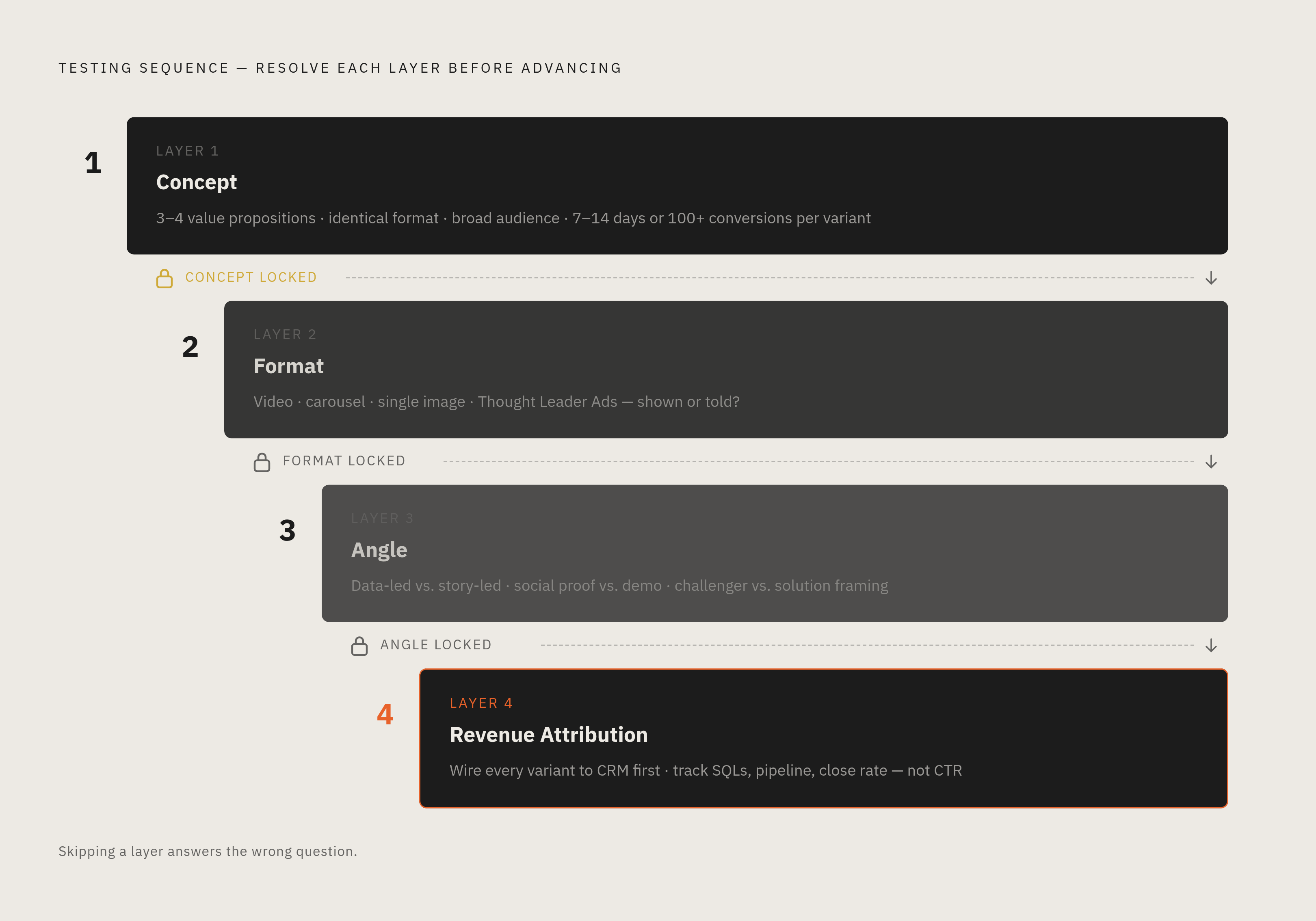
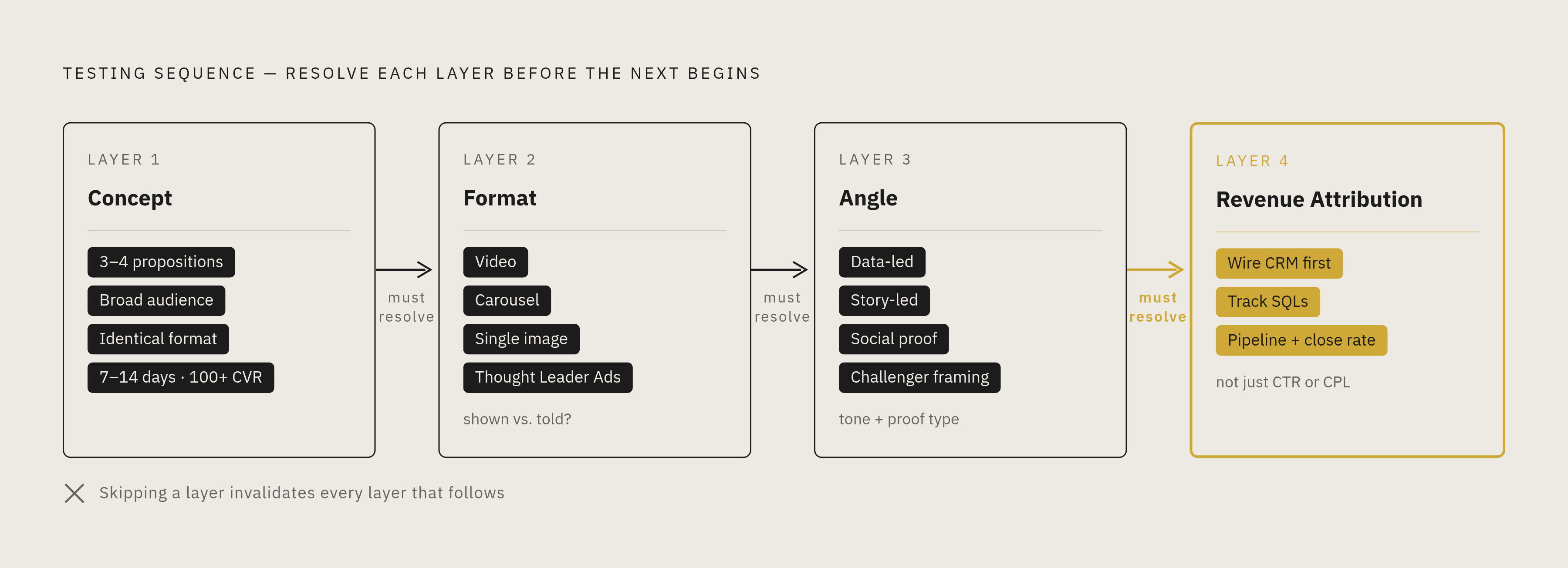
The sequenced approach that addresses these failure modes runs four layers in order. Each layer assumes the previous one is resolved. Skipping ahead produces answers to the wrong question, expensively.
Layer 1: Concept. What value proposition is the ad actually making? Launch three or four distinct concepts against a broad audience, using identical formats across all variants so the only variable is the message. Run for 7 to 14 days, or until you hit 100-plus conversions per variant. The goal isn't to find the best ad. It's to find which underlying idea resonates before spending on production-heavy formats.
Layer 2: Format. Take the winning concept and test how it's expressed. Video, carousel, single image, Thought Leader Ads. The question format testing answers is deceptively simple: does this message land better shown or told?
Layer 3: Angle. Now, with concept and format locked, test tone and proof type. Data-led versus story-led. Social proof versus product demo. Challenger framing versus solution framing. This is the smallest variable surface in the sequence, which is exactly why it comes last.
Layer 4: Revenue Attribution. This isn't a test in the traditional sense. It's the infrastructure that validates the other three. Wire every variant to CRM data before the test begins. CTR and CPL are leading indicators. SQLs, pipeline created, and close rate are what actually confirm whether a test conclusion is real. Attribution cannot be retrofitted after the fact. If it's not connected before the test runs, the data you need won't exist when you go looking for it.
Worth sitting with: each layer resolves one variable before introducing the next. If that sounds obvious, consider how rarely it happens in practice.
Audience Segmentation: Settle This First, or Nothing Else Matters
Before creative can be evaluated fairly, the audience variable has to be isolated. This sounds obvious. Most teams treat it as optional.
Create separate campaigns for each audience segment. Job title, function, seniority, company size. Equal budget across segments. Avoid LinkedIn's native audience expansion feature here for a specific reason: expansion obscures which segment is actually converting. You need clean signal, and expansion muddies it.
There is a real tradeoff worth naming explicitly. Narrow targeting increases relevance but reduces volume, which extends the time needed to reach statistical significance. That tradeoff affects your test budget and your test timeline. It needs to be planned for before the test starts, not discovered in the middle of it.
The offer dimension belongs in this layer too. The gap between a demo request and a lower-friction asset like a benchmark report or an ROI calculator can shift conversion rate more than almost any headline variation. And that gap varies by segment. What a VP of Engineering will download is different from what a CFO will request. Treating offer as a creative variable rather than an audience variable is one of the more consistent sources of confused test results.
Here is the compounding logic that makes this layer the highest-leverage one: once you know which segment converts to pipeline at the highest rate, every downstream creative test runs against a validated audience. The signal gets cleaner. The budget goes further. Teams that skip this step don't just get a bad audience result. They optimize creative for the wrong people, and the optimization holds up right until pipeline review, when none of it shows up.
Thought Leader Ads and What Their Performance Data Reveals About LinkedIn Creative Credibility
Thought Leader Ads are worth a specific examination because the performance data they generate reveals something broader about how LinkedIn creative actually works.
A Thought Leader Ad boosts content from an individual employee's account rather than a brand page. It reads like a real person's post. Because it is. Across a substantial sample of spend and 119 TLAs analyzed, median CTR runs nearly six times higher than standard single-image ads, at a fraction of the cost per click. In one CRM-validated campaign analysis, TLAs drove more than half of all conversions on less than a third of total spend, at roughly half the cost per conversion compared to ABM cold traffic.
That is not a marginal difference. That is a structural one.
What it reveals about LinkedIn creative more broadly: credibility signals matter in a professional context at a level consumer platforms don't require. The "who is saying this" question is a legitimate creative variable. A brand asserting something and a credible professional asserting the same thing are not equivalent creative treatments, even when the words are identical.
The practical implication for testing is that TLAs belong in Layer 2 as a format option, rather than treated as a separate initiative living outside the testing framework. Same sequencing logic applies. Concept first, then format.
One limitation worth naming: TLAs require a willing employee, and the quality of that person's profile and content history affects results in ways standard creative tests don't have to account for. That's a production variable that needs to be in the planning before the format test runs, not discovered after a disappointing result.
Video Creative: The Research Draws a Hard Line on Format and Length
LinkedIn's own analysis of thousands of B2B video ads found that the right creative execution can produce dramatic lifts in engagement. But "right execution" has specific requirements, and they are not suggestions.
Length guidance by campaign objective:
- 6 to 15 seconds for awareness
- 20 to 45 seconds for consideration
- 15 to 30 seconds for conversion
The mobile constraint is decisive. More than half of LinkedIn video views happen on mobile, where silent autoplay is the default. Captions, animated text, or purely visual storytelling aren't production enhancements. They are the price of entry for any video creative that needs to work without sound. A video that relies on audio to communicate its core message has already failed for the majority of the people who will see it.
Video format tests need to control for length and silent-play execution simultaneously, or the test is confounded before it starts. If one variant is 12 seconds with captions and another is 40 seconds without them, you haven't isolated the length variable. You've introduced three variables at once. That's an expensive guess, not a test.
Dynamic Personalization as a Variable That Moves CPL, Not Just CTR
Personalized LinkedIn ads showed more than 20% CPL improvement globally in recent testing data. U.S.-specific campaigns showed 33% CPL improvement.
That figure deserves a moment. A 33% CPL reduction at scale doesn't produce more impressions or a better-looking dashboard. It produces more pipeline per dollar. That's the distinction that matters in a channel this expensive.
What counts as personalization here: dynamic insertion of company name, job title, or industry into headlines and body copy. Not just audience segmentation. The message is literally different for different recipients. That's a different creative treatment, and it performs like one.
But here is the fatigue caveat. The same dynamic variants start degrading after roughly a month of continuous serving. Personalization efficiency drops without a refresh cycle. This means personalization variants need to be tested as a distinct angle test after concept and format are locked, and the refresh cadence needs to be planned in from the start rather than treated as a future problem.
One more figure worth holding: companies testing ten or more variations see dramatically better results than those running single tests. That argues for treating personalization as a real source of variant volume, rather than a one-time optimization pass.
Creative Fatigue: The Performance Degradation Pattern That Quietly Voids Test Conclusions Over Time
One analysis found that creative fatigue degrades ad performance by an average of 28% after three to four weeks of continuous serving. On LinkedIn, that timeline compresses faster than on consumer platforms because the professional audience is finite. The same decision-makers are being reached repeatedly, and faster, at scale.
The warning signals are specific and trackable:
- Rising frequency metrics (same users seeing the same ad repeatedly)
- Declining CTR with no creative changes
- Rising cost per action on previously efficient variants
- Budget pacing slowdowns, which signal the algorithm is deprioritizing underperforming creative
The implication that actually changes how you think about creative testing: a testing program isn't a project with a conclusion. "Winning creative" is a current state, not a permanent one. The goal isn't to find one great ad and run it until it stops working. It's to build a system that continuously generates, tests, and rotates variants before fatigue takes the wheel.
A campaign is a project. An operational system is what you should be building. Those are meaningfully different things.
The Statistical and Budget Realities of Running Tests That Produce Valid Conclusions
Two-week minimum runtime is the floor for statistical significance on LinkedIn. Smaller audiences need longer. A statistically reliable test needs at least 100 conversions per variant, and 200-plus provides significantly greater confidence.
At B2B SaaS CPL ranges, those requirements translate to a material budget commitment. Calculate this explicitly before the test runs, not at the midpoint when the data is inconclusive and the money is already spent.
Q1 offers a real structural opportunity. CPC in Q1 is measurably lower than peak Q3 pricing, based on multi-company SaaS data. The same test budget buys more clicks and reaches statistical thresholds faster. Seasonality isn't just a media planning variable. It's a testing variable, and most teams treat it like wallpaper.
One more useful input for budget estimation: LinkedIn native Lead Gen Forms produce substantially higher conversion rates than landing pages on average. Higher form completion rates mean fewer clicks needed to reach the same conversion count, which means lower total spend to hit statistical significance. Worth factoring in before you set the budget.
The practical rule is uncomfortable but important: teams that cannot commit the budget to reach statistical significance should skip the test entirely. Inconclusive results are worse than no test, because they create false confidence in a variant that hasn't actually proven anything. Budget planning for tests should work backward from required conversions, not forward from available spend.
Reporting Discipline: Which Metrics to Review Weekly and Which to Hold for Monthly Review
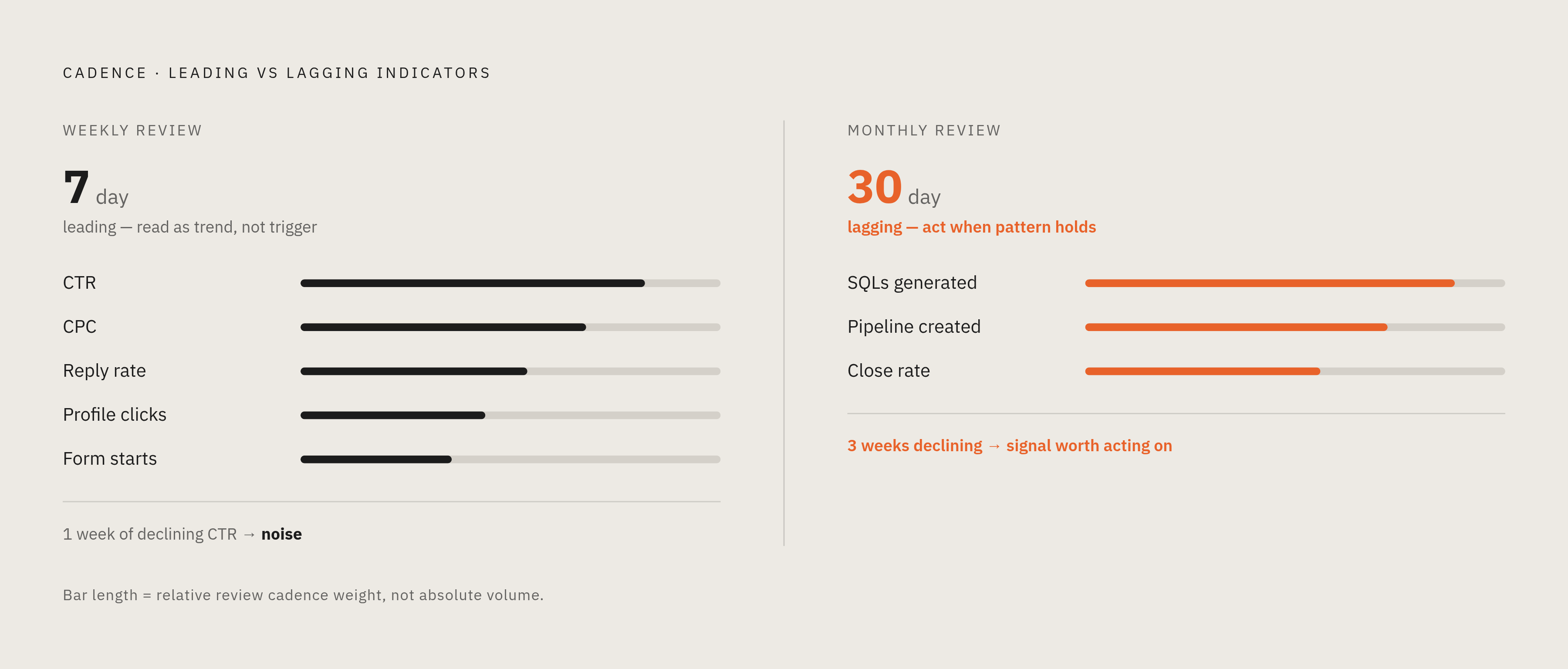
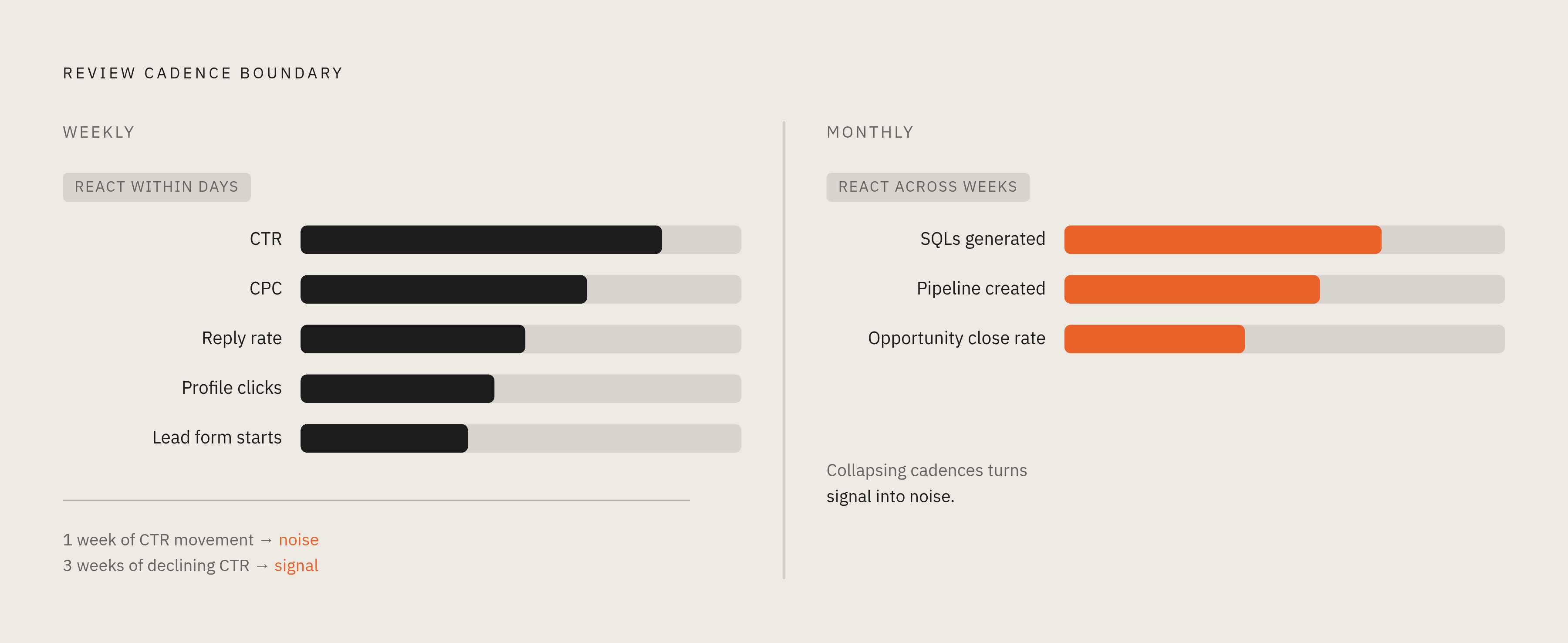
Leading and lagging indicators operate on different timeframes and need different review cadences. Conflating them produces reactive decisions that aren't decisions. They're noise responses dressed up as optimization.
Review weekly:
- CTR and CPC (early creative performance signals)
- Reply rate and profile clicks
- Lead Gen Form starts (top-of-funnel momentum)
Hold for monthly review:
- SQLs generated
- Pipeline created
- Opportunity close rate
Why does the separation matter? Reacting to one week of CTR movement is noise. Reacting to three weeks of declining CTR is signal. The cadence enforces the difference between the two. Without it, the dashboard looks like a series of emergencies, and most of them are false.
The CRM connection is non-negotiable. Lead Gen Form completions that cannot be traced to SQL outcomes are incomplete data. A strong form conversion rate means nothing if those leads don't enter the pipeline. This is the attribution infrastructure from Layer 4. It's not optional at the reporting stage because it wasn't optional at the test design stage.
Weekly reporting should document what changed and what happens next, rather than simply displaying a performance dashboard. That format turns test results into decisions. It also builds something more valuable over time: a historical record that links creative variants to pipeline outcomes, which makes the next test smarter before it starts.
That's the actual goal when you zoom out far enough to see what you're building. Thunder, an applied-AI company whose agents run Google and LinkedIn Ads end to end for sales-led B2B companies, is built on that same logic, the agents execute continuously, so accumulated campaign evidence compounds instead of resetting with every new hire or vendor relationship.