Marketing Agent Capabilities for B2B Paid Media Execution
AI agents need six working layers or the whole paid media system fails.

AI agents in B2B paid media are six layers working in sequence, each one feeding the next, and each one capable of breaking the whole chain if it fails on its own. They're six layers working in sequence, each one feeding the next, and each one capable of breaking the whole chain if it fails on its own. AI agents in B2B paid media are six layers working in sequence, each one feeding the next, and each one capable of breaking the whole chain if it fails on its own, which anyone handing a budget over to such a system needs to understand first.
Start with the term itself, because "AI agent" gets thrown around loosely enough to cover almost anything with a chatbot window bolted on. That's not what this piece is about.
A rule-based automation follows preset if/then logic. Someone writes the rule, the system executes it, and if the rule needs to change, a person edits it. It runs on one platform and does one thing.
An AI marketing agent works differently. Give it a business objective, and it plans its own multi-step actions, adjusts based on live data, and often works across several platforms at once. Think of the difference between a junior team member who's been given marching orders and told to figure out the path, versus a piece of software sitting there waiting for the next command.
And to be clear about what these agents are not: they're not chatbots answering questions. They're systems that take the objective and run with it rather than displaying a recommendation and waiting for someone to click "approve."" They're not co-pilot tools where a human has to push every button. A real agent takes the objective and runs with it, checking back in only where it's supposed to.
By 2026, this stopped being a fringe experiment. Research from Scott Brinker's Martech for 2026 study found that 90.3% of marketing organizations now use AI agents somewhere in their stack. That's not early adopter territory anymore, that's the mainstream.
Content production agents lead the pack at 68.9% adoption, and audience discovery agents follow at 40.8%. But paid media execution, which actually spends the money, gets far less attention in the conversation, even though a failure there can waste spend across every other layer feeding it.
Here's why: B2B paid media involves an enormous volume of data, a huge number of variables to optimize across (bids, budgets, audiences, creative, timing), and a need for speed that outpaces what a human team can track manually. Add in the fact that campaigns now run across Google, LinkedIn, and often a handful of other channels simultaneously, and the case for agents writes itself.
The goal here is to map out what each layer of the system actually does, and where the connections between them either hold or fail. It's to map out what each layer of the system actually does, and where the connections between them either hold or fail.
The six functional layers of a marketing agent architecture for paid media
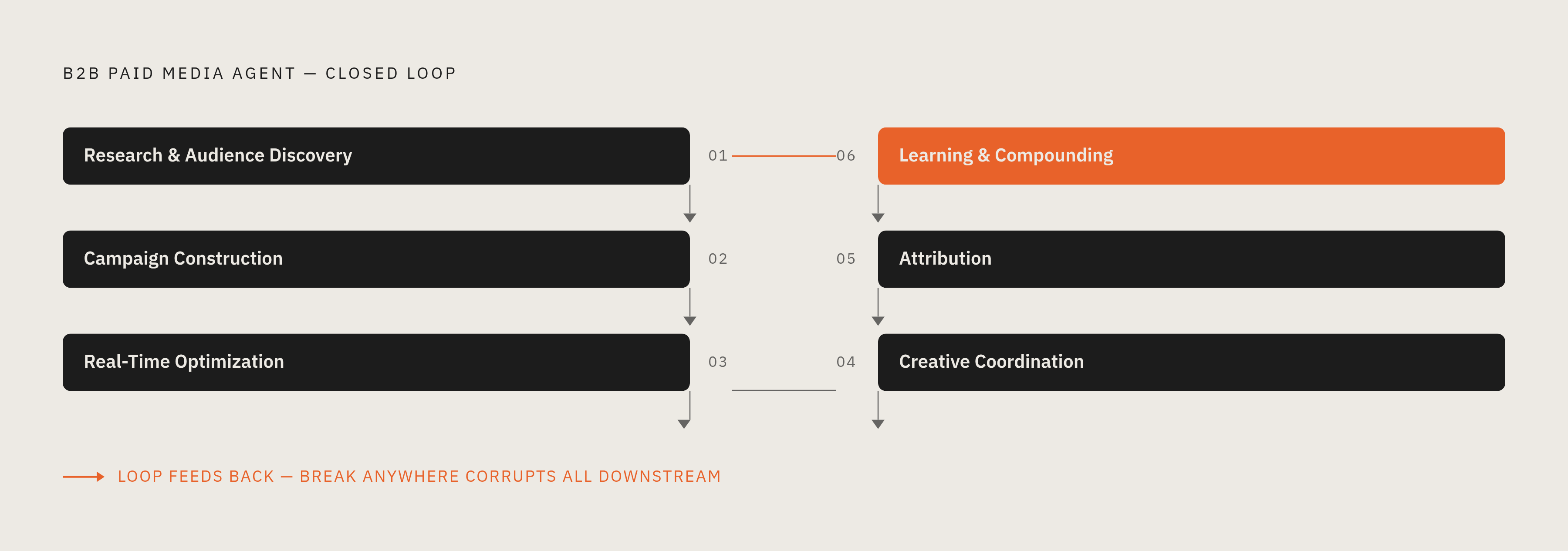
Most discussions about "AI in paid media" treat it as a single feature: bid automation, or creative generation, or a dashboard that spits out reports. That framing misses what a mature agent system actually looks like, which is a coordinated stack of six distinct layers.
Here's the full stack:
- Research and audience discovery. Continuous mapping of the ideal customer profile, tracking of intent signals, and ranking of which accounts matter most right now.
- Campaign construction. Translating a business objective into an actual platform setup, meaning channel choice, ad group structure, bid strategy, and creative direction.
- Real-time optimization. Adjusting bids, shifting budget, managing pacing, and reading signals across every platform in play.
- Creative coordination. Building, testing, and cutting ad variants and landing pages based on what's actually performing.
- Attribution. Connecting ad clicks back to real pipeline outcomes using offline conversion data and CRM records.
- Learning and compounding. Building on what worked (and what flopped) so the next campaign doesn't start from zero.
These six are a loop. They're a loop. If attribution breaks, the signal feeding optimization goes bad, and a bad optimization signal means the research layer starts learning from the wrong data on the next campaign. One weak link and the whole chain drifts off course.
That structure also tells you exactly where a human needs to be standing. The decisions that matter most, like setting budget strategy, defining who the ICP actually is, and deciding how to handle an exception, live in the space between these layers, not inside any single one of them. No layer should be making those calls on its own.
The next sections walk through each layer one at a time: what the agent can actually do there, where a person needs to stay in the loop, and what tends to fall apart when the layer isn't built at all.
Research and audience discovery: how agents identify and prioritize accounts before a campaign launches
The old way of doing this involved a strategy meeting, a keyword gap analysis, and a persona document that got dusted off once a quarter if the team was lucky. It was a snapshot, and snapshots go stale fast.
Agents replace that snapshot with a live feed. They watch intent signals, track firmographic changes (a company grows, raises funding, hires a new VP), monitor buying-group activity, and keep an eye on what competitors are doing, all in real time rather than once a quarter.
A few specific ways this shows up in practice:
Prospecting agents dig into high-value accounts and pull buying signals from multiple data sources at once. Audience discovery agents, at 40.8% adoption according to Scott Brinker's Martech for 2026 research, match ICP accounts against live signal data instead of a static list. ABM platforms like Demandbase and 6sense use predictive scoring, blending historical patterns with real-time signals, to rank accounts by how likely they are to convert.
Why does this matter so much? Because everything downstream, channel choice, budget split, creative angle, only performs as well as the account list it's built on. Bad ICP targeting doesn't get fixed by a clever bid strategy later on.
There's a useful way to think about this that shows up across the industry: most of the addressable market isn't in a buying window right now. The overwhelming majority of potential buyers aren't ready to act at any given moment, and only a small slice are. Agents that can spot which accounts have actually entered that buying window let spend concentrate on the small share who might move, instead of spraying budget across a market that mostly isn't listening.
None of that means a human steps back entirely. Someone still has to define what counts as a "qualified" signal in the first place, set the boundaries of the ICP the agent works inside, and catch it when an account gets misclassified. Those are consequential calls. The agent should flag them, not quietly decide them on its own.
Skip this layer, or run it on outdated lists, and the damage doesn't stay contained. Campaigns get built for an audience that no longer matches the real buying population, and every optimization made later just gets better at reaching the wrong people, faster.
Campaign construction: translating objectives into platform architecture without starting from scratch each time
Building a campaign, at the platform level, means a long list of specific decisions:
On Google: campaign type, ad group structure, match types, bid strategy, and which actions count as conversions.
On LinkedIn: picking a format (Sponsored Content, Thought Leader Ads, Message Ads), building out audience segments by job title, seniority, and company size, and setting an objective that actually matches the funnel stage being targeted.
Across both: deciding how much budget goes to demand capture (people already looking) versus demand creation (people who don't know they have the problem yet).
An agent changes how these decisions get made. Instead of an analyst starting from a blank page each quarter, the agent pulls from prior campaign data (what audience setups actually drove pipeline, which bid strategies flopped, which formats brought in clicks that turned into real conversations) and builds the next campaign from that record.
This is where compounding actually starts. Every campaign leaves behind evidence. Teams that rebuild from scratch each quarter are throwing that evidence away and starting cold, every single time.
Demand capture and demand creation deserve separate budget pools with separate success metrics. Blend them into one campaign and the signals get muddled, which corrupts whatever optimization happens later based on that data.
Performance Max now drives a large share of Google Ads conversions and can't be ignored in a serious paid media setup. But it needs specific things to work well: enough conversion volume, first-party data, offline signals. An agent needs to check for those inputs before launching a Performance Max campaign, not after.
And the biggest structural calls, like which campaign type to run and what bid strategy to use, sit firmly in human territory. Expertise should govern the agent's choices here, not the other way around.
Real-time optimization: what agents are adjusting, and at what cadence
The speed shift is the headline here. Pulling campaign reports, adjusting bids across platforms, shifting budget to top performers, these tasks used to eat up hours or days. Now they happen in minutes, sometimes in real time. What used to take weeks to notice and act on now takes hours.
Specific things an agent adjusts on an ongoing basis:
Bids, based on shifts in conversion rate, time of day, or which device someone's using
Smart Bidding and Performance Max are only as smart as the conversion signal they're fed. If that signal is just "form filled," rather than something weighted toward actual pipeline value, the algorithm chases the cheapest conversions it can find, not the most valuable ones. That's a subtle failure that looks like success on a dashboard.
An agent optimizing without a clean attribution signal is optimizing in the dark, adjusting knobs based on numbers that don't actually reflect revenue. That's the direct link to the attribution layer covered next, and it explains a real gap in the data.
Jasper.ai's State of AI in Marketing report found that 91% of marketing teams use AI, but only 41% can point to proven business value from it, down from 49% the year before. The 91%-to-41% gap between AI usage and proven business value becomes most visible in real-time optimization. Plenty of teams are running these systems without the measurement infrastructure needed to confirm results, so reported gains often can't be verified against actual pipeline or revenue impact.
Which means a person still needs to set spend guardrails, require approval for big budget swings, and step in when performance suddenly drops. The agent should raise the flag. The human decides what to do about it.
Creative coordination: generating and retiring variants in response to live performance data
Creative coordination covers a few connected jobs:
Content agents write ad copy, headlines, and descriptions, working from campaign objectives and past performance data, not a blank brief. Landing page agents build or adjust destination pages so they match the audience segment and the ad's actual message, closing the gap between what an ad promises and what a page delivers, a mismatch that quietly inflates bounce rates and kills conversion.
And agents track when a creative variant starts to fade. Creative fatigue is a known problem in paid social. When it happens, the agent pauses the underperformer and surfaces fresh variants for review.
Tofu builds new personalized pages straight from a campaign brief. Other platforms in the space focus on audience-based page personalization. Intellimize handles AI-driven personalization and conversion testing. Unbounce, Instapage, and Optimizely round out the space.
Thought Leader Ads, which sponsor posts published from an executive's personal profile rather than the company page, offer a distinct creative format compared to standard Sponsored Content. As of June 2026, LinkedIn opened Thought Leader Ads up to non-employee profiles too, which widens the pool of creative an agent can pull from. That means an agent can spot a high-performing organic post and push it into paid amplification without waiting on a formal campaign brief to get written.
Creative data also does diagnostic work. When a campaign underperforms, creative is often the actual constraint, but without solid testing data connected to real outcomes, teams tend to blame the platform or the audience instead, and fix the wrong thing.
G2's marketing automation data shows that 72.5% of AI-related product reviews mention time savings, speed, or reduced manual work. Creative iteration is one of the clearest places that shows up: testing cycles now move faster than they did with manual processes.
What stays human: brand voice, positioning calls, deciding which creative hypothesis is even worth testing next. The agent runs the tests and surfaces what the data says. A person still has to decide what that data means about the market.
Attribution: closing the loop between ad clicks and pipeline, without it, every upstream layer is flying blind
B2B buying cycles run long, often months, and involve multiple touchpoints along the way. A standard 30-day attribution window on an ad platform catches the early clicks but completely misses whether any of it turned into actual revenue.
The fix is offline conversion import: connecting an ad click or a LinkedIn impression to the CRM record, and once that deal closes, feeding that outcome back into the ad platform as a conversion signal. Now the platform's algorithm is optimizing against something real.
This gap isn't small. Looking at the same account data through first-touch attribution versus pipeline-weighted attribution produces wildly different ROAS numbers. Neither method is "wrong," exactly, they're measuring different things, but only one of them tells anyone whether the campaign actually generated revenue.
Current thinking in the space favors stacking attribution methods rather than picking one: multi-touch attribution for day-to-day tactical calls, marketing mix modeling for bigger strategic budget decisions, and incrementality testing to check whether any of it is actually true. Agents can now run the experiments and crunch the results that feed this whole stack.
For that stack to function, agents need specific inputs flowing in:
- CRM pipeline stages and deal values, tied back to ad platform data
- Offline conversion events, like a demo booked or an opportunity created, imported on whatever cadence the bidding algorithm needs to work with
- Pipeline influence data from LinkedIn, showing which accounts engaged with content or ads before they ever hit the CRM
A growing share of B2B organizations now define marketing success by pipeline contribution rather than lead volume. Attribution infrastructure is what turns that definition from a nice idea into something that actually gets measured.
Without this layer, everything else quietly goes wrong. Agents chase the cheapest conversions the platform can see, which in B2B often means form fills from accounts that were never going to buy. Budget drifts toward the wrong audiences. Creative that wins on click-through rate loses on pipeline. And the research layer, watching all this, starts reinforcing the wrong ICP signals.
Learning and compounding: how each campaign makes the next one smarter
Most paid media programs carry almost no institutional memory from one campaign to the next. Which audiences converted, which creative angles landed with which segment, which landing page setups drove real pipeline, which bid strategies failed and at what volume, all of it tends to get lost.
Compounding fixes that, appearing in a few concrete ways:
- Audience insights from one campaign sharpen account prioritization in the next, so the research layer gets better raw material to work with.
Creative performance history shows which hypotheses are still worth testing and which ones are dead, so the creative layer stops repeating tests it's already run.
- Attribution data from closed deals shows which campaigns and channels actually generated revenue, not just leads, so the next budget cycle starts from evidence instead of a guess.
- Negative signals, like an audience that generated a lot of clicks but zero pipeline, get remembered instead of rediscovered the hard way, again.
For sales-led B2B teams, this changes what a bad quarter actually looks like. Instead of defaulting to "just increase spend," a program with accumulated evidence can actually diagnose the real constraint, whether that's the creative, the landing page, a hole in attribution, or the wrong channel entirely.
Compare that to an agency model where account managers rotate or engagements reset every quarter. Every time that happens, the institutional memory that makes compounding possible resets with it.
G2's Spring Report puts average user adoption of marketing automation platforms at 68%. But using a tool and accumulating intelligence from it are two different things. A team can run the same platform for years without a single output from one campaign ever informing the next one.
This is also why speed matters so much. The faster an agent can run a test, gather the signal, and update what it "knows," the faster the whole program learns what actually works for this specific ICP, in this specific market, right now.
Where human judgment sits inside an agent architecture
Pull back and look at all six layers together, and agents are good at scale, speed, and pattern recognition across enormous amounts of data. They are not good at deciding what matters, or what a strange result actually means.
That's where the human sits. Not inside the mechanics of any single layer, but at the joints between them, making the calls that carry real consequences: what counts as the ICP, how much budget risk is acceptable, what to do when a signal looks off, which creative direction is even worth testing in the first place.
Take that person out of the loop, and the system doesn't fail loudly. It fails quietly. Bids keep adjusting. Budget keeps moving. Creative keeps rotating. Everything looks like it's working, right up until someone checks whether any of it produced revenue, and finds out the whole machine has been optimizing for the wrong thing the entire time.
That's the real argument for treating this as a layered system rather than a single tool. A tool either works or it doesn't. A system has joints, and joints are exactly where things come apart if nobody's watching them. Understanding the six layers isn't just an academic exercise, it's the difference between a deployment built to compound and one quietly running itself into a wall.