Growth Marketing vs. Performance Marketing in B2B Paid Media
Run both demand creation and capture layers to build sustainable B2B pipeline.
Growth marketing and performance marketing get treated like rival philosophies in B2B paid media. That's backwards, and most teams that pick a side end up paying for it. They're two layers of the same system. Performance marketing captures demand. Growth marketing creates it. The programs that win run both, on purpose, and judge them by the same yardstick: pipeline and revenue.
Start with what each layer actually does. Performance marketing is narrow by design: it goes after buyers who already know what they need and are actively searching for it. Google Search Ads is the clearest example. Someone types "expense management software" into Google, and performance marketing shows up to catch that click. It gets judged fast, usually on a 30 to 90 day window, against return on ad spend and near-term pipeline.
Growth marketing runs earlier and wider. It shows up before a buyer starts searching, while they're still forming opinions about what problem they even have. It plays across the full buyer journey, not just the moment of purchase, and it cares about retention and expansion, not just the first deal. Its optimization window stretches past 12 months, because that's how long it actually takes to see whether a customer sticks around and grows.
Performance marketing doesn't create demand, and that's the part that trips teams up. It assumes demand already exists, that positioning and product-market fit are already working, and it just intercepts buyers who are already looking. A company that treats performance marketing as its whole paid strategy is betting that demand shows up on its own. Sometimes it does. Often it doesn't, and nobody notices until pipeline dries up. Funding only one layer, and calling it a full paid strategy, is the mistake that gets made early and paid for late. If there's a single wrong answer in this whole subject, it's that one.
How B2B buying behavior makes this two-layer structure a practical necessity, not a strategic preference
This is a set of practices. It's just how B2B buyers actually behave, and the numbers make the case better than any theory could.
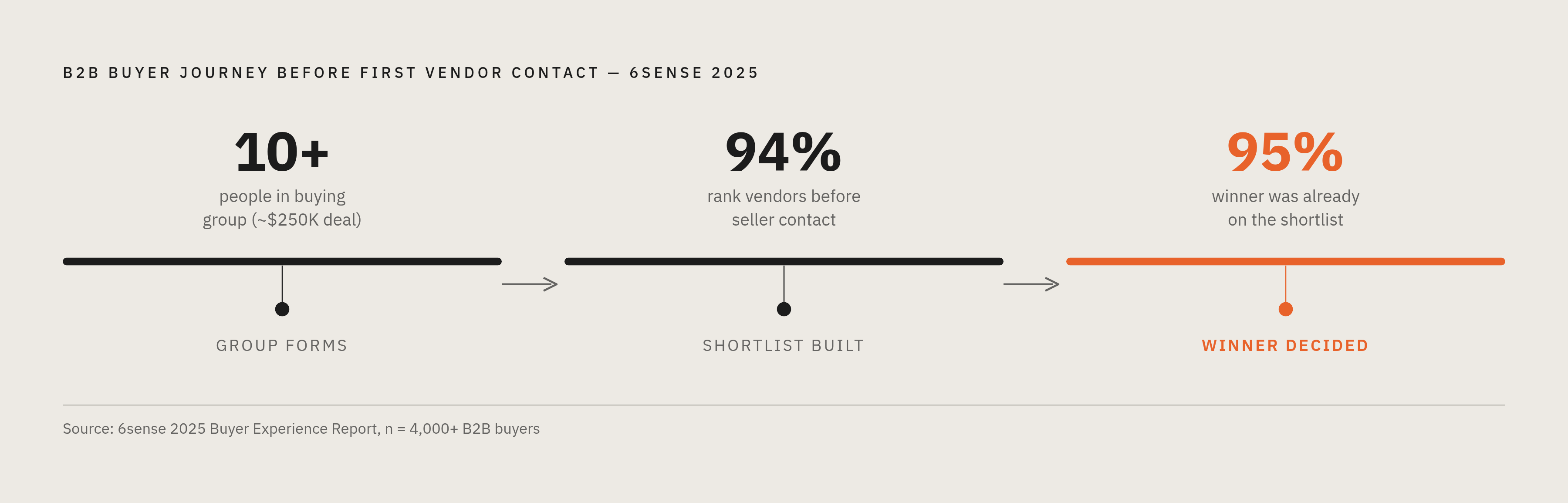
6sense's 2025 Buyer Experience Report surveyed more than 4,000 B2B buyers and found the winning vendor was already on the buyer's shortlist 95% of the time. Buyers had ranked that shortlist, in 94% of cases, before they ever talked to a seller. Read that again: the deal is basically decided before sales gets a call.
So what does that mean for a paid program built entirely around search intent? It means the program shows up to a race that's already been run. By the time someone searches "best CRM for manufacturing," they likely already know who's on their list. Performance marketing might close the loop. It didn't build the list. It never had the chance to.
The buying committee makes this bigger, not smaller. That same 6sense report found B2B buying groups average more than 10 people for purchases around $250,000. Ten people, forming opinions, before a single vendor conversation starts. That's ten separate chances to be remembered, or forgotten, long before the request for proposals goes out.
This is where the funnel entry point matters most. Performance marketing intercepts buyers already researching: high intent, short window. Growth marketing gets in front of people while they're still figuring out what they think. A CIO who's read a company's content for six months before procurement even opens is a fundamentally different prospect than one who clicks a search ad the week bids are due. Long sales cycles and multi-stakeholder decisions mean the gap between first exposure and final decision runs in months. That gap is exactly where the growth layer lives. Dark funnel attribution gaps make this hard to measure. Hard to measure doesn't mean it isn't happening.
The channel logic: which paid channels belong to the demand-creation layer and which belong to demand capture
Not every paid channel does the same job. Some are built to catch buyers who already have intent. Others are built to plant the seed before intent even exists. Confusing the two is how budget gets wasted on the wrong end of the funnel, and it's the single most common channel mistake in B2B paid media.
Demand capture channels intercept people already looking:
- Google Search Ads. Still the main vehicle for B2B demand capture. Someone's already typed the query.
- G2 and Capterra sponsorships. These catch buyers mid-evaluation, comparing options on review sites.
Demand creation channels work earlier, before anyone's actively shopping:
- LinkedIn Ads. The strongest option for reaching a buying committee by job function, seniority, company size, or a specific target account list. LinkedIn should lead when the real problem is finding the right buyers, not finding more traffic. If a company has a clearly defined ideal customer profile, high contract values, long sales cycles, multiple stakeholders, or an account-based motion, LinkedIn is doing work that search simply can't.
Google's own products are starting to blur this line. Performance Max pulls from Google's full ad inventory in a single campaign. Demand Gen automates reach across YouTube, Discover, Gmail, and the Google Display Network. That's a real shift, but there's a catch: Demand Gen needs a lot of conversion volume to optimize well. For a low-volume, enterprise-deal-size program, that's a real constraint, not a footnote.
The bigger point stands regardless: treating all paid spend as demand capture is a structural error, not a matter of taste. The strongest programs fund both layers on purpose, as separate lines, because they're doing separate jobs.
What happens when a B2B program runs only the performance layer, the ghost town pipeline
Picture the dashboard. Leads coming in. Cost per lead right on target. Content shipping every week. Paid campaigns running around the clock. Everything looks fine.
Then the pipeline report comes out, and it's empty. Sales looks at the leads and says, flatly, none of these people are actually buying.
What happened? Performance marketing optimized for conversion events that already existed (form fills, demo requests) without ever asking whether the pool of warm, ready buyers behind those events was big enough or serious enough to sustain the program. Over time, that program ends up competing for a shrinking pool of people who are already in-market. Cost per lead climbs. Deal quality doesn't follow.
This is the difference between lead generation and demand generation, and most teams should be blunt about which one they are actually running. Lead gen covers people who already have buying intent right now. Demand generation is bigger: it includes shortening the time it takes to close a deal, raising win rates, and supporting sales through the whole process, not just handing off a name and an email address. Programs that consistently fill pipeline start with demand creation, teaching buyers about a problem they didn't know they had, before they ever get to the demand capture step.
No single number sums this up. The pattern is the point: healthy-looking metrics and an empty pipeline can happen at the same time. Usually, they mean the same thing.
Pipeline and revenue as the shared measurement frame that lets both layers be judged together
Each layer comes with its own scoreboard. Performance marketing gets judged on ROAS, cost per acquisition, conversion rate. Growth marketing gets judged on reach, engagement, content consumption. Teams optimize their own scoreboard, then argue over whose number matters more. That argument is a waste of a meeting.
It disappears the moment both get measured against the same thing: qualified pipeline and revenue. Growth marketing improves what happens after someone clicks an ad, whether they're ready to buy when they land, whether the deal closes faster once sales gets involved. Performance marketing scales what happens before the click, turning a good message into more volume. They add up. They don't compete.
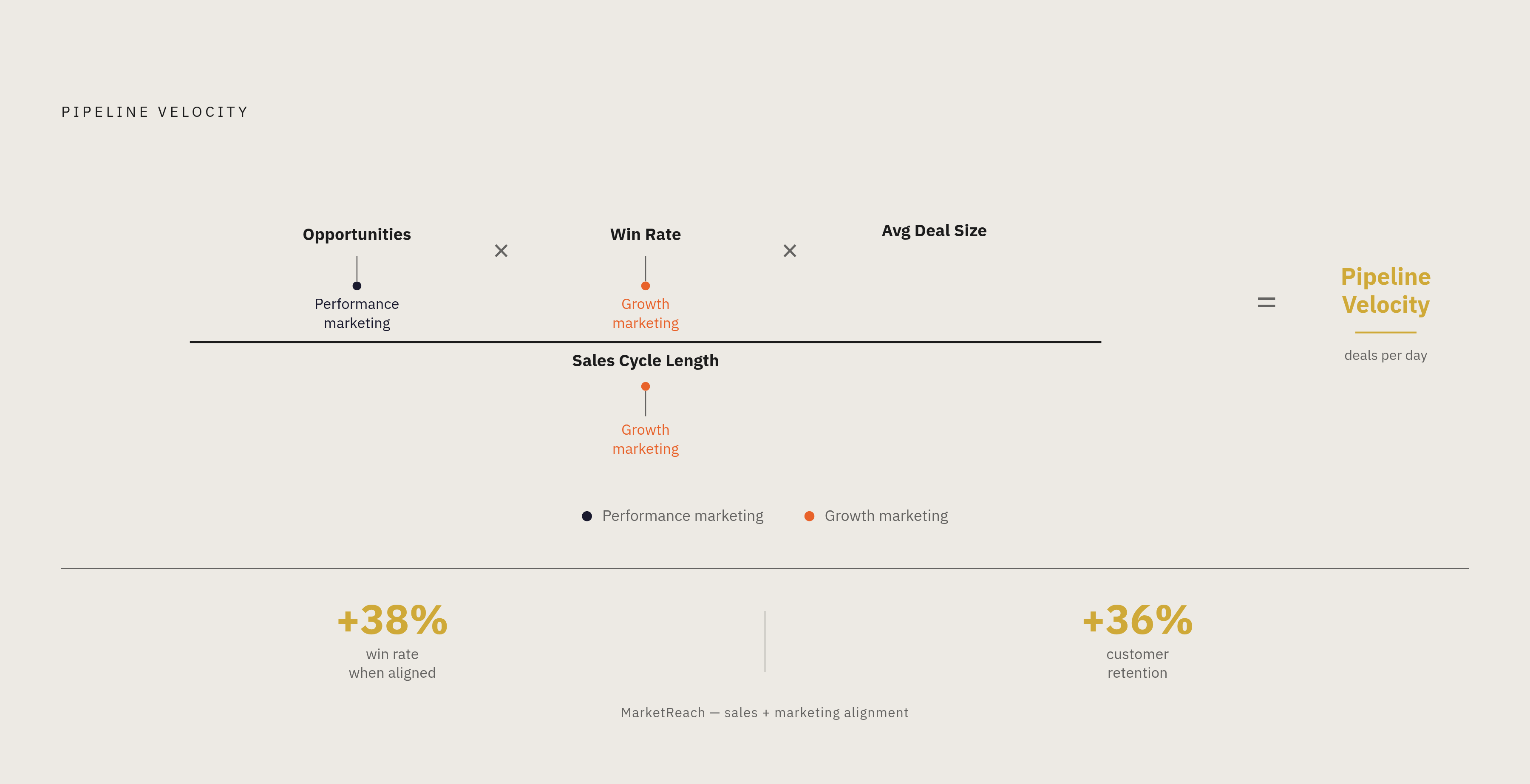
Research cited by MarketReach found that organizations with tightly aligned sales and marketing functions see 38% higher win rates and 36% higher customer retention. That's the difference alignment makes when it's measured properly, instead of argued about in a meeting.
One formula ties both layers to a single number: Pipeline Velocity, calculated as the number of opportunities times win rate times average deal size, divided by sales cycle length in days. Every input in that formula gets touched by both layers. Growth marketing can shorten the cycle and lift win rate by warming buyers up early. Performance marketing can grow the number of opportunities. Same formula, shared accountability.
This is showing up in how teams get structured, too. Heading into 2026, the strongest programs have Demand Gen leads, content marketers, RevOps, and sales leaders sharing accountability for what counts as pipeline-ready. Paid media stops being its own island and becomes one piece of the full go-to-market motion.
None of this works if the attribution model doesn't support it. Last-touch attribution gives all the credit to whichever channel happened to be there at the final click, usually a performance channel. That structurally hides the growth layer's contribution and biases budget decisions away from the very thing that's creating demand in the first place.
Why attribution infrastructure is the missing variable most B2B paid programs underinvest in
Research consistently shows that teams running full-funnel attribution hit significantly higher goal-attainment rates than teams that don't, the kind of gap worth bringing straight into a budget conversation with a CFO.
The gap between B2B marketing teams that keep growing their budget and teams that spend every quarter defending it is a visibility gap. It's a measurement gap. Whether buying groups get tracked properly, and whether a CFO can actually see what's working, predicts which side of that line a team lands on.
Last-touch attribution isn't just imprecise, it's a budget mistake with a specific mechanism. A paid search campaign can look like it drove most of a quarter's pipeline value, while the internal record shows those same leads first engaged through a LinkedIn ad or a piece of content months earlier. The growth layer did the work. Last-touch attribution erases it from the ledger, and the next budget cycle funds the channel that got the credit, not the channel that did the work. That's backwards, and it's the most expensive backwards decision most programs make every year.
The fix is CRM-to-platform feedback. Are leads actually moving through the funnel? Are they becoming sales-qualified opportunities? Both Google and LinkedIn can accept offline conversion data fed back from HubSpot or Salesforce, which means pipeline outcomes, not just clicks, can flow back into how the platforms optimize. That's the mechanism connecting what sales sees to what the ad platform does next.
With cookieless analytics making individual tracking harder, blended attribution models (position-based or multi-touch) paired with media mix modeling help triangulate what's actually driving results across both layers. Teams still running last-touch, or still building audiences off individual contact records instead of buying groups, pay a real performance penalty for it. Attribution infrastructure is a core requirement. It's the feedback loop that decides whether a program learns from its own results or just repeats them.
Landing pages and creative as the shared execution layer that determines whether the two disciplines compound or cancel
A paid campaign is only as good as the page it sends people to. That's not a design opinion, it's math: enterprise decision-maker clicks are expensive, and even a smart, well-targeted strategy falls apart if the landing page doesn't convert.
Some numbers to anchor this. B2B SaaS landing pages average a 2% to 5% conversion rate. Top performers hit 8% to 15%. Across all industries, Unbounce puts the median at 6.6%, while B2B-specific data shows top pages reaching as high as 13.28%. That spread is enormous, and it's not luck separating the top from the bottom.
Scale matters too. Companies running 10 to 15 landing pages see 55% more leads than companies running just a handful. Companies running 40 or more pages can see conversion growth over 500%. One generic landing page trying to serve every visitor, every persona, every stage of the funnel, is a significant drain on conversion. It's a structural ceiling on the whole program.
Heading into 2026, the messaging that wins looks less like a feature list and more like a story about transformation: here's the problem, here's what changes when it's solved, here's what's at stake if it isn't. That standard applies to both layers equally, the growth layer's nurture content and the performance layer's conversion pages.
Mobile matters more than most teams admit. A growing share of B2B buyers now research on their phones. A page needs to load in under three seconds, with forms and buttons built for thumbs, not mouse clicks. A slow page loses the lead before the buyer even gets to evaluate the offer.
The programs getting this right don't lock into a fixed quarterly plan and hope it holds. They run short creative bursts tied to specific buying stages, personas, and themes, learning fast and cutting what doesn't work before it burns budget. That discipline belongs to both layers, not just one.
How AI agents are changing the execution speed and learning rate of integrated growth and performance programs
There's a real difference between automation and what's now called agentic execution, and it matters for how fast a coordinated program can learn. Traditional automation runs on if/then rules: if this happens, do that. AI agents work differently. They get an objective and figure out the actions themselves, across platforms, channels, and content, adjusting in real time as performance data comes in.
Research from Scott Brinker and Frans Riemersma's Martech for 2026 report found that 90.3% of marketing organizations already use AI agents somewhere in their stack. The leading uses are content production agents, at 68.9% adoption, and audience discovery agents, at 40.8%. These are no longer experiments. They're operational.
In the execution layer, agents are handling things like:
- Reallocating budget across ad platforms, creatives, and audiences in real time, based on ROI or conversion efficiency, without waiting for a human to run the next optimization cycle
- Scoring buying signals and intent continuously, with companies using predictive intent models in account-based marketing identifying high-value accounts three to four weeks earlier than competitors relying on older methods
- Running reporting, bid adjustments, and audience segmentation at a volume and speed no human team can match by hand
McKinsey's 2026 B2B Pulse Survey, covering nearly 4,000 buyers and sellers across 13 countries, found that high-growth B2B companies are three times more likely to have raised their AI investment by double digits year over year, 71% versus 25%. But the spend isn't what separates them. What matters is whether the company redesigned its core workflows around agentic execution instead of bolting agents onto the old process. Most companies do the second thing and wonder why the first thing's results don't show up.
The compounding part is what makes this matter for growth and performance together. Agents don't just execute faster, they leave behind a record: which audiences responded, which creative worked, which offer converted at which funnel stage. The next campaign starts from that history instead of a blank page.
None of this replaces human judgment. Governance, exception handling, and the strategic call on what's actually broken (a creative problem, a landing page problem, an attribution gap, a funnel problem) still need a person to diagnose. Agents are built for continuous execution. They're not built for that kind of judgment call, and they were never meant to be.
What a coordinated growth and performance program looks like in practice for a sales-led B2B company
Put the pieces together and the shape of a working program gets pretty clear.
Growth marketing builds and widens the pool of buyers who are warm and educated before sales ever talks to them. Performance marketing turns that pool into pipeline. Neither one works at full strength without the other. That's the whole argument in one sentence.
LinkedIn runs the demand-creation side: targeting the buying committee by job function, seniority, and company size, reaching specific accounts, and putting out content that educates people before they're in active evaluation. That's the work that builds the Day One shortlist position, the exact thing 6sense's data shows decides most deals before a seller ever gets involved.
Google Search and review-site channels run demand capture: catching buyers who are already in-market, sending them to landing pages matched to their intent, and feeding conversion data back to the platform through a CRM connection so the ad platform knows which clicks actually became pipeline.
Creative and landing pages support both layers as shared infrastructure, not separate channel assets. The message about what problem gets solved, for whom, and what's at stake needs to stay consistent from the growth layer's education content through to the performance layer's conversion page.
Attribution ties the whole thing to one outcome: full-funnel attribution, CRM feedback loops running into both Google and LinkedIn, and media mix modeling to check cross-channel impact. That measurable goal-attainment gap is the business case for building this infrastructure before spend scales up, not after.
Budget lines stay separate on purpose. Demand creation and demand capture aren't fighting for the same dollars, because they're serving different time horizons and different buyer states. Mixing the two budget lines together is exactly how a program ends up with the ghost town pipeline problem: healthy metrics, empty sales report.
And the whole thing compounds over time. Each campaign cycle adds to what's known: which audiences respond, which creative lands, which offer works for which persona at which stage. A program built this way doesn't start over every quarter. It starts from what it already learned.