Compounding Campaign Intelligence in AI-Driven B2B Paid Media
AI agents can finally learn across campaigns instead of restarting from scratch.

Most B2B paid media programs have amnesia. Every new campaign, every vendor switch, every account manager transition wipes the slate clean. AI-driven paid media doesn't have to work that way. Done right, it builds a running record of what worked, what didn't, and why, so campaign twelve starts where campaign eleven left off instead of where campaign one started.
That distinction matters more than it sounds like it should. U.S. B2B digital ad spending crossed $20 billion in 2025. At that scale, re-learning the same lessons over and over isn't a minor inefficiency. It's a recurring tax on nearly every dollar spent, and most programs are paying it without knowing they've been billed.
Call the alternative "compounding campaign intelligence": a system that keeps what every campaign reveals and builds on it, so the starting point of each new push is the end state of the last one. Simple idea. Rare in practice, mostly because the tools most teams reach for first are built to forget.
What it means for an AI system to accumulate campaign evidence rather than discard it
There's a real difference between AI as a point tool and AI as an agent with memory, and most teams are still using the former while talking about the latter.
A point tool does one job, spits out a result, and forgets nearly everything about how it got there. It writes ad copy. It flags an underperforming keyword. It generates a report. Useful, but disposable. Next time you ask it to do the same job, it starts from close to zero again.
An agent that carries memory forward behaves differently. It remembers which audiences responded last quarter. It remembers which creative angle actually surfaced buying intent, not just clicks. It remembers which attribution paths held up once the deal closed and which ones looked good on a dashboard but never touched revenue.
Three layers of evidence are worth naming separately, because each compounds in its own way:
- Audience signals. Firmographic, technographic, behavioral, and intent data that sharpen the ideal customer profile campaign over campaign, not just at kickoff.
- Creative learnings. Which messages, formats, and offers moved specific segments. Click-through rate is the easy number to track; what actually matters is whether that click turned into a qualified lead further down the line.
- Attribution patterns. Which sequences of touchpoints, in which order, with which offer, actually contributed to pipeline. Not what the platform says converted. What the revenue record says converted.
Here's the part most marketers get backward: they assume the platform is doing this remembering for them. It mostly isn't. Google Smart Bidding and LinkedIn Accelerate optimize aggressively, but they optimize inside their own walls. They don't hand the marketer a portable record of what they learned. The intelligence stays locked in the platform's black box, useful to the platform's own model, largely invisible to anyone trying to build a case across channels. Compounding intelligence has to be owned by the marketer's own system instead. Each iteration doesn't just perform. It produces evidence that makes the next decision smarter, and the learning rate itself can climb over time instead of staying flat.
How AI agents handle the execution layer that makes accumulation possible
Little of this works unless something is actually running the campaigns continuously, not on a monthly reporting cycle. This is the part people skip past, and it's the part that actually decides whether any of the "compounding" language above is real or just a nice idea.
That's the shift from AI-as-tool to AI-as-system: agents that take responsibility for entire workflows, not single tasks. A few kinds show up repeatedly in paid media:
- Lead intelligence agents. These keep the ideal customer profile current between campaigns, pulling in firmographic, technographic, behavioral, and intent signals continuously, rather than freezing the profile at setup and letting it go stale.
- Campaign execution agents. These manage bid strategy, channel mix, cadence, and offer sequencing, on an ongoing basis, not just when someone logs in to check.
- Predictive analytics agents. These surface what the accumulated evidence implies about the next move, often before a human even has to ask the question.
What can these agents largely own today? Bid management, report assembly, lead scoring, competitive monitoring. That list is real, and it's growing.
What still needs a human? Brand strategy. Cross-functional calls that require context an agent doesn't have. And exception handling: when the system hits something it can't resolve on its own, a person with accountability needs to step in. Agents are built for continuous execution. Humans are still needed for the decisions that are ambiguous or consequential enough that getting them wrong costs real money.
The gap between talk and action here is much of the story. An IAB survey fielded between November 2025 and January 2026 found 66% of advertisers plan to focus more on agentic ad buying. Only around a third of B2B organizations have actually implemented agentic AI at scale. That gap between plan and practice isn't a footnote. It's exactly where the advantage is piling up right now, for whoever closes it first.
The three-wave arc of AI in paid media and where compounding intelligence sits
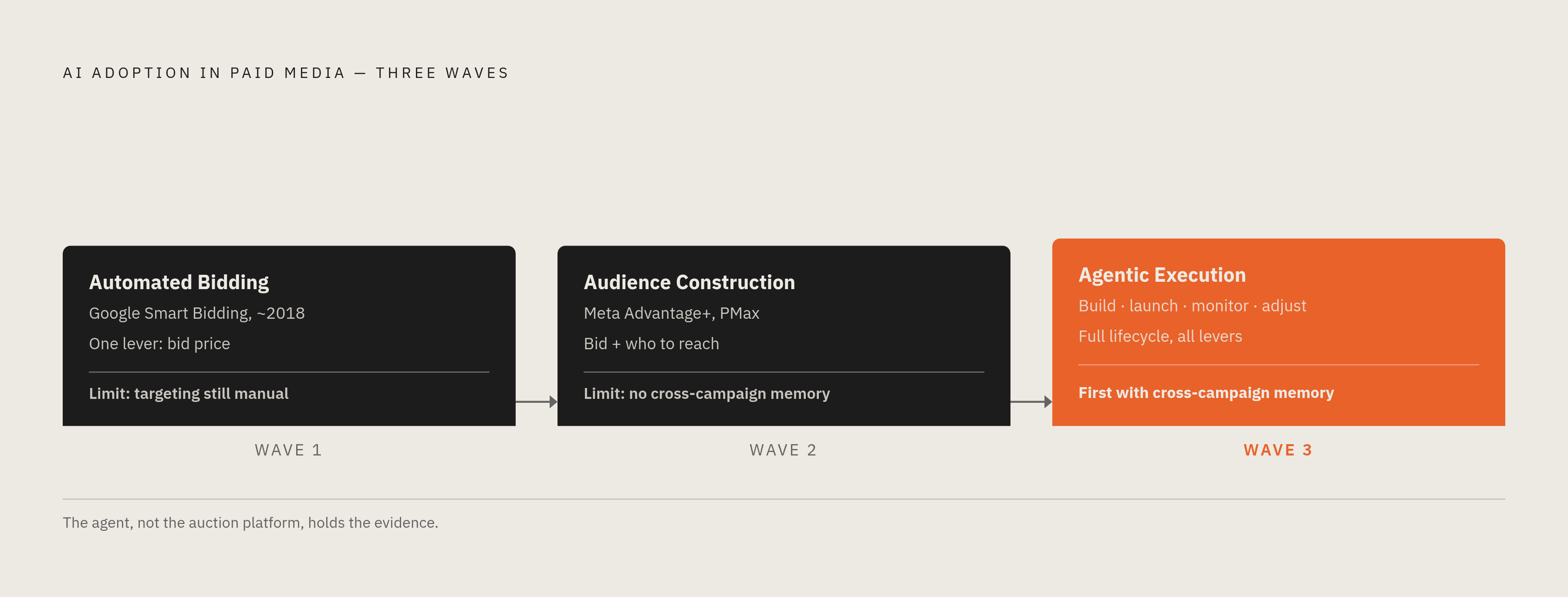
To see why this moment is different, look at how AI actually entered paid media, in three distinct waves, not one smooth upgrade.
Wave one, starting around 2018, was automated bidding. Google Smart Bidding, for instance, weighs device, location, time of day, remarketing list membership, browser, operating system, and dozens of other signals at the moment of the auction. Fast, precise, but narrow. It optimized largely one lever: the bid.
Wave two expanded that into audience construction. Meta's Advantage+ and Google's Performance Max pushed AI beyond bidding into targeting itself. The system started deciding who to show the ad to, not just what to pay for the privilege.
Wave three, underway right now, is largely autonomous campaign execution through agentic systems. The agent doesn't just bid or target. It builds the campaign, launches it, watches it, adjusts it, and learns from it across the entire lifecycle.
Here's the part that actually matters for this conversation: waves one and two optimized within a single campaign. Neither one could accumulate much across campaigns, because the platform, not the marketer, held the memory. Wave three is the first one where cross-campaign accumulation becomes possible, because the agent is the one holding the evidence, not the auction system.
Gartner projects AI-driven automation of marketing work will more than double, from 16% in 2026 to 36% by 2028. That's close, not speculative. And yet only 30% of CMOs report mature AI readiness, even as CMOs allocate 15.3% of marketing budgets to AI initiatives. Budget is running ahead of readiness. Whoever closes that gap first builds a lead that gets harder to erase the longer everyone else waits.
What Google and LinkedIn each contribute to the evidence base, and why they require different learning loops
Google and LinkedIn aren't doing the same job, so treating them as interchangeable line items in a media plan is a mistake that shows up later as a diagnosis problem.
Google catches buyers who are already looking. LinkedIn builds the awareness and buying-committee alignment that makes those searches happen in the first place. Two different jobs. Two different kinds of evidence.
On the Google side:
- Intent signals reveal which search terms actually surface buyers who convert downstream, not just click through.
- AI-driven campaign tools increasingly reward rich, topic-level context about the business over tight keyword match-type control. The system learns more from what you tell it about your business than from how you bid.
- Google traffic also seeds LinkedIn remarketing audiences. What one channel learns feeds targeting on the other. That's compounding across channels, not just within one.
On the LinkedIn side:
- Buying committee coverage matters enormously here. The 2025 6sense Buyer Experience Report found B2B buying groups average more than 10 members, on purchases averaging around $250,000. LinkedIn's firmographic targeting is one of the few channels built to accumulate evidence across an entire committee, not just one contact who happened to fill out a form.
- Format carries its own signal, and the gap is not subtle. LinkedIn's own data on thought leadership ads shows a 2.68% median click-through rate compared to 0.42% for single-image ads, a six-fold difference that says something about what actually registers as credible to a B2B buyer versus what reads as an ad to scroll past.
- LinkedIn Accelerate delivers up to 42% lower cost per action than standard campaigns, per LinkedIn's own analysis. Good result. But that optimization stays inside LinkedIn's system unless the marketer's own system captures what it implies about audience and creative and carries it forward.
There's also what might be called the 95% problem, and it's worth sitting with because it undercuts a lot of conventional wisdom about where paid media budget should go. The LinkedIn B2B Institute has argued that roughly 95% of potential category buyers are out of market at any given moment. And 6sense's 2025 Buyer Experience Report found the winning vendor was already on the buyer's Day One shortlist 95% of the time. Put those two numbers together and the conclusion is uncomfortable for anyone who only funds the bottom of the funnel: the evidence built during the long stretch when nobody's actively searching matters just as much as the conversion data collected once someone finally raises a hand. Fund only the search-intent channel, and the shortlist tends to get built by someone else.
The real compounding happens when one system holds evidence from both channels at once, connecting creative signals to pipeline signals to attribution patterns. A system optimizing each channel in its own silo tends to learn at roughly half the rate, at best.
What the evidence base actually enables: diagnosing the real constraint on growth
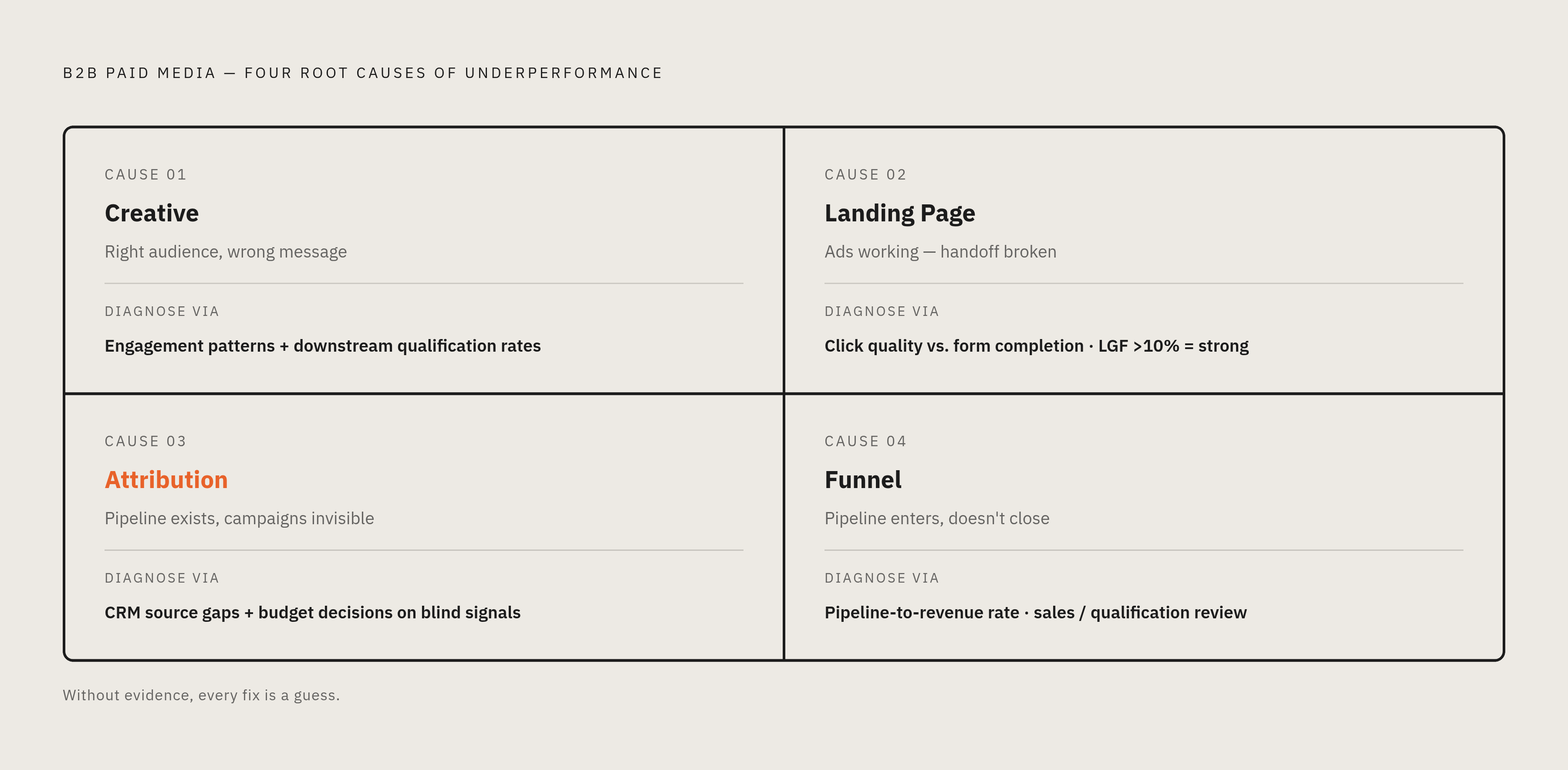
When a paid media program underperforms, how does anyone actually know why?
Most programs don't know, and that's the actual problem, not a footnote to it. They just start pulling the nearest lever. Adjust the bids. Rotate the creative. Tweak the audience. None of that requires figuring out whether the channel is even the real constraint on growth. That's optimizing blind, and it's the default state of most paid media programs, agentic or not.
There are four different things that can be going wrong, and each needs a different kind of evidence to spot:
- A creative problem. The right people are seeing the ads, but the message isn't landing. This shows up in engagement patterns and downstream qualification rates, not in click-through rate alone.
- A landing page problem. The ads are doing their job, but the handoff to the website breaks the conversion. This shows up as a gap between click quality and form completion. LinkedIn's own Lead Gen Form benchmarks put a completion rate above 10% as strong performance, which says a lot about how much conversion most programs are leaving between the click and the form.
- An attribution problem. Pipeline is actually being generated, but the system can't trace it back to which campaigns and sequences caused it. Budget decisions then get made off signals that are, quietly, misleading.
- A funnel problem. Pipeline comes in but doesn't turn into revenue. The paid media program takes the blame for a sales or qualification issue it had little to do with.
An accumulated evidence base is what lets a program figure out which of these four is actually happening, instead of defaulting to whichever lever is easiest to reach. That's much of the point of the exercise. Without it, every fix risks being a guess dressed up as a strategy.
That's the real line between optimization and diagnosis. Optimization, tuning what's already running, is possible from day one. Diagnosis, figuring out what's actually limiting growth, requires evidence built up across multiple cycles. A pattern seen once isn't a pattern. It's an anecdote.
It's worth noting that 76% of B2B marketers who measure ROI say account-based marketing delivers the highest returns. That's not a coincidence. ABM is, at its core, an accumulated-evidence strategy: it targets accounts based on historical signal rather than casting a broad net and hoping something sticks.
What iteration velocity has to do with how fast intelligence compounds
Intelligence only compounds if the iterations happen fast enough to generate evidence before the market moves on. Slow campaigns don't just underperform. They tend to compound slowly, regardless of how sophisticated the AI running them is, which is the part vendors selling "smart" tools tend to leave out.
The bottleneck in most traditional programs isn't the AI at all. It's the human process wrapped around it: campaign changes need review, approval, creative production, and platform resubmission. A cycle that should take days ends up taking weeks. The AI was rarely the slow part.
Early agentic deployments make the contrast concrete. In one set of deployments, campaign iteration velocity increased 3x, and time spent on platform administration dropped from roughly 60% to under 20%. That freed-up time didn't evaporate. It went toward judgment calls, the decisions that still need a human, instead of toward busywork. Those same deployments generated more than $2 million in total pipeline, including over $1 million in enterprise pipeline, which ties the speed gain directly to a revenue outcome rather than an efficiency metric that sounds nice in a slide deck and means little on a P&L.
The math behind this isn't linear, and that's the point. A program running three times as many iterations in the same window doesn't just collect three times the data. It tends to reach diagnostic conclusions faster, which means budget gets redirected toward what's actually working sooner, which means the next campaign starts from a further-along evidence base than it otherwise would. Speed isn't just a side benefit here. It's the rate at which the intelligence itself grows.
Why the organizational model determines whether intelligence actually accumulates
Here's the uncomfortable part: intelligence tends to accumulate in systems, not in people. Most B2B paid media programs are built close to backward, with the evidence living in someone's head instead of in any persistent system, and that's a structural flaw, not a staffing problem.
Look at where this breaks down in each common model:
- Agencies. Institutional knowledge often turns over every time an account manager leaves. The new team re-learns the audience, re-learns the creative angles, re-learns the attribution patterns from close to scratch. The client pays, again, for re-learning that arguably should never have needed to happen twice.
- In-house teams. When the person who owns paid media leaves, much of the evidence walks out the door with them. The program resets, quietly, without anyone officially declaring it did.
- Dashboards and software. The tool holds the data, sure. But it still needs a skilled person to interpret it and act on it. The interpretation layer is human, and just as volatile as any other human dependency.
For intelligence to actually compound, the model underneath it has to provide a few things: evidence storage that belongs to the program itself, not to whichever vendor happens to be running it that quarter; continuous execution, so evidence keeps building between human check-ins; named, accountable expertise for the decisions too consequential for an agent to make alone; and a fee structure that isn't tied to media spend. That last point is worth pausing on, because it's the one most people wave past. When a management fee scales with how much budget runs through it, the incentive points toward spending more, not toward making the existing budget work harder. That's a conflict of interest, not a quirk of billing.
Recent benchmarks put the figure at 75% of B2B marketing leaders actively integrating generative AI into their workflows. That's real progress on the tool side. But integrating a tool into a workflow isn't the same as building a system that accumulates evidence and acts on it deliberately. The technology is only part of the story. The organizational wrapper around it decides whether any of that intelligence sticks or leaks out the door with the next departure.
What a program looks like after several compounding cycles versus at launch
At launch, a program is running largely on best guesses. The ICP is a hypothesis. The creative angles are assumptions. The attribution model is probably borrowed from an industry benchmark, because there's no company-specific data yet to build one from.
After the first cycle, that starts to change. There's now live evidence on which audience segments actually engaged, which creative angles produced qualified pipeline (not just clicks), and which attribution paths actually held up once matched against revenue.
After several cycles, the picture looks noticeably different:
- Audience targeting reflects this company's actual buyer behavior, not generic firmographic guesswork.
- Creative decisions follow what the evidence shows about which messages move which segments, rather than instinct or whatever the industry happens to be doing this year.
- Attribution is calibrated to this company's real buying cycle, including the messy, multi-touch reality of a buying committee that averages more than 10 people.
- The system can point to which constraint is likely limiting pipeline right now, and has enough history to say whether a proposed change is likely to help or whether it's about to repeat something that already failed.
So the real question isn't whether AI can run paid media. It clearly can, and the platforms have been proving that since 2018. The question that actually separates programs is whether the program is built so that what it learns sticks around, builds on itself, and stays governed by people accountable for it, rather than getting wiped clean the next time a vendor contract changes hands.
Pipeline and revenue are close to the only scoreboard that counts. An accumulated evidence base is what lets a program get judged on those terms, instead of on proxy metrics that make the channel look good without ever connecting back to growth, which is the structural problem Thunder, an applied-AI company whose agents run Google and LinkedIn Ads end to end for sales-led B2B companies with a named Forward Deployed Marketer holding accountability for outcomes, is built around.