Media Buying Platforms for B2B LinkedIn Ad Management
LinkedIn's complexity demands integration depth that platform choice alone won't deliver.

Choosing a media buying platform for B2B LinkedIn ad management isn't just a software decision, it's a choice about who owns execution, optimization, and accountability across a complex, long-cycle buyer journey, and the right framework forces that question to the surface.
Why LinkedIn has become the default channel for B2B pipeline, and why that raises the stakes for how you manage it
LinkedIn now delivers a 121% ROAS in B2B, beating Google Search and Meta on revenue impact, according to Dreamdata's LinkedIn Ads Benchmarks Report 2026 McKinsey G2 survey research. That single number explains a lot about where budgets have gone. LinkedIn now pulls in 41% of B2B paid social spend, more than any other platform, making it the channel most companies bet on rather than just one they use learn.g2.com.
The same research shows the B2B buyer journey has stretched to 272 days, up from 211 the year before. Buyers are spending something like seven months forming opinions before they ever show up in a pipeline report. The ad functions as one piece of a long, slow argument being made to a buyer who isn't ready to talk to sales yet.
Put those two facts together and a different picture forms. Good performance on LinkedIn is the product of execution that stays sharp and consistent over time. It's what happens when execution stays sharp and consistent across a stretch of time most other channels don't have to survive. A campaign that looks fine in month one can quietly rot by month five if nobody's tending it.
Which raises the real question this piece is built around: when a channel is this expensive, this slow-burning, and this dependent on creative, targeting, attribution, and CRM data all talking to each other, who actually owns getting it right? Not which tool has the nicest dashboard. That question doesn't get asked enough before teams sign a contract or spin up a new platform. It should be the first one.
What "media buying platform" means in B2B LinkedIn, a working taxonomy before evaluation begins
The phrase "media buying platform" gets used so loosely now that sorting out what it's even asking requires pausing first. At minimum, four different categories hide under that one label.
There's LinkedIn's own Campaign Manager, the native tool built into the platform. There are programmatic DSPs like StackAdapt and The Trade Desk, which buy ad inventory across many sites and platforms, not just LinkedIn. There are ABM platforms, like 6sense, Demandbase, AdRoll ABM, and Influ2, that layer account-level intelligence on top of LinkedIn's targeting. And there are managed-service providers, technology-plus-people hybrids like Metadata.io, or LinkedIn ad agencies like Remotion, Impactable, and B2Linked, that combine software with a team actually running the campaigns.
Each category also targets differently, and that difference matters more than it sounds. Influ2 works at the contact level, so it can target a specific named person. AdRoll ABM, 6sense, and Demandbase work at the account level, targeting a company, with multiple people inside it. Google and Meta stay at the audience level, broad demographic and interest groups McKinsey G2 survey research. LinkedIn's Campaign Manager sits in between, offering both account and audience targeting.
Why does that matter? Because the right targeting precision depends on how well-defined your ideal customer profile is. A team with a scrappy, half-built ICP doesn't need contact-level precision yet. It needs to figure out who it's even trying to reach.
LinkedIn's own Campaign Manager isn't a stripped-down starter tool, either. It runs on first-party data, offers job title, company size, and industry targeting, and includes Predictive Audiences, which uses company growth signals, hiring patterns, and technology stack data to build lookalike audiences. It also has built-in forecasting before a campaign even launches. Add in the Conversions API and expanded revenue attribution capabilities, which now connect campaign engagement to CRM outcomes, and you start to see why any management layer needs to integrate with this.
Teams that treat these four categories as interchangeable end up confused. Some are software you operate yourself. Some are services where someone else operates the software for you. Sign up for the wrong one, thinking you're getting the other, and you end up with a scope gap nobody owns. And in a channel this expensive, an unowned gap is where budget quietly leaks out.
How budget maturity and program stage should shape which category you're even considering
There's a natural progression teams tend to follow, whether they plan it that way or not. Start on LinkedIn Campaign Manager. As targeting needs grow more sophisticated, teams spending in the $50,000 to $250,000 range often graduate to a programmatic DSP like StackAdapt https://getadlib.com/blog/stackadapt-vs-dv360/. Past $250,000, teams start looking at The Trade Desk or Demandbase, where enterprise-grade attribution and broader inventory access start to earn their cost.
That progression sounds tidy on paper. It is not free to execute. Migrating platforms takes real time, something like an 8 to 10 week window covering data export, rebuilding audiences from scratch, reconnecting CRM integrations, and running both platforms in parallel to check nothing breaks in the handoff improvado.io. Choose a platform a size too big, and the migration cost alone can eat a quarter's worth of program momentum.
Before any of that, there's a more basic question that has nothing to do with which platform to buy. Without that list, no platform, however sophisticated its targeting engine, can deliver on its promise. It's a bit like buying a scalpel before you've decided what you're operating on.
Budget allocation carries its own discipline, too, one that holds regardless of platform. At least 20 to 30% of paid budget should go toward brand building, with another 15 to 20% set aside for testing McKinsey medium.com. That's not a nice-to-have. A platform needs to structurally support that kind of split, not just make it possible in theory while every default setting nudges spend toward direct response.
The mistake most teams make is picking a platform as though capability alone is the deciding factor, without asking whether that platform matches the stage the program is actually in and the internal capacity available to run it. The foundational program question before any platform choice is whether the team has a defined target account list of 100–500 named accounts with multiple stakeholders each.
The seven integration layers a LinkedIn ad program requires, and what breaks when one is missing
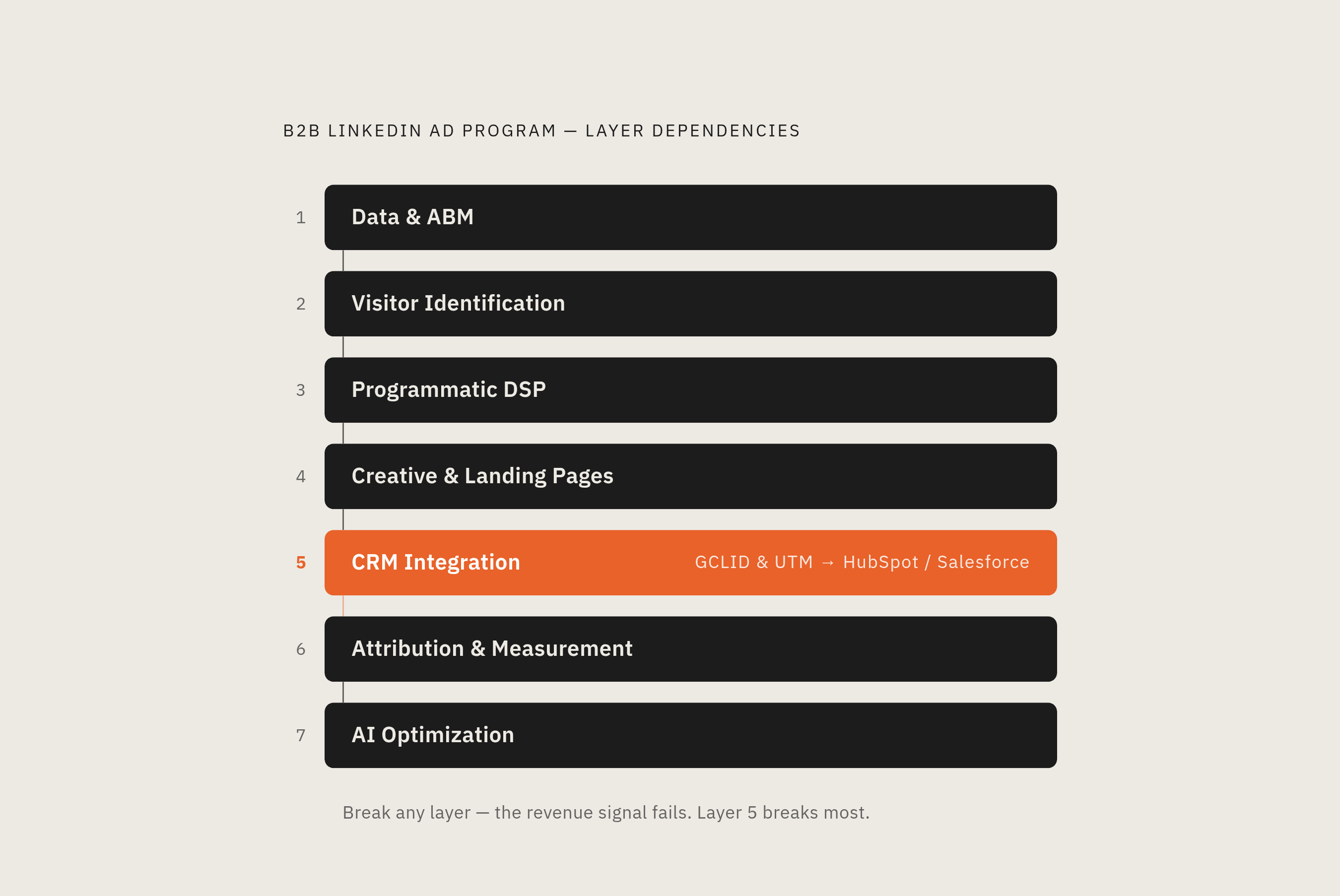
Strip a full B2B ad program down to its parts and there are seven layers that all have to work: Data and ABM, Visitor Identification, Programmatic DSP, Creative and Landing Pages, CRM Integration, Attribution and Measurement, and AI Optimization. Miss one, and the revenue signal doesn't just get weaker, it can break entirely.
CRM integration is the layer that trips people up most often. It requires GCLID and UTM parameters to travel cleanly from the ad, through the landing page form, into HubSpot or Salesforce, so every lead can be traced back to the exact ad that produced it. When that thread breaks somewhere in the middle, which happens more often than teams admit, pipeline attribution collapses. Suddenly nobody can say which campaign actually drove which deal.
LinkedIn's Conversions API helps here by connecting online and offline conversion data back to the campaign, including actions that happen well after someone leaves the website. That capability used to be a nice extra. Now it's closer to table stakes.
Most platforms only cover two or three of these layers natively. The rest require integration work, and that work has to belong to somebody. If it doesn't, it doesn't get done, or it gets done halfway, which is often worse than not at all.
This is where the diagnostic test gets useful. When a campaign underperforms, is the problem the creative? The landing page? The audience? The attribution model itself? A platform that only touches one layer literally cannot answer that question. Neither can a team that lacks visibility across all seven. So the platform decision comes down to who ends up accountable for diagnosing the real constraint on growth, and that person or system needs the access required to do it.
What AI-native campaign management does versus what agencies and dashboards do
"AI agent" gets thrown around loosely. Gartner's framing draws a clear line: an AI agent plans, executes, and optimizes multi-step workflows without needing continuous human input. That's different from a chatbot, which only responds within a single session, and different from an AI assistant, which still needs a human to kick off each task.
Gartner also predicts that by 2026, 80% of advanced marketing teams will use AI to optimize multichannel campaigns in real time, and that task-specific AI agents will appear in 40% of enterprise applications, up from under 5% in 2025 McKinsey learn.g2.com Gartner Gartner. That's a fast curve. But adoption and impact are not the same thing. G2's Spring 2026 Report found only 53% of B2B marketers say their AI use is actually having meaningful impact McKinsey 2026 B2B Pulse Survey McKinsey G2 survey research. Everyone's using the tools. Fewer than half are getting something real out of them. That gap isn't about access to AI. It's about infrastructure, and about whether the workflow around the tool was ever rebuilt to use it properly McKinsey 2026 B2B Pulse Survey McKinsey G2 survey research.
So what does AI-native management actually do, in practical terms? It handles PPC bid management, watches audience signals, reallocates budget, rotates creative, and assembles reporting, continuously. Agencies staff people to do versions of these same tasks, on a schedule. Dashboards present the same data but leave the acting part to whoever remembers to log in and look.
What it doesn't do is replace judgment. Deciding whether a stalled campaign is a creative problem or an attribution problem still takes a human call. So does deciding when to change strategy, or handling a weird anomaly nobody's seen before, or setting the guardrails the system operates inside. In ABM contexts specifically, coordinated agents can identify who's on a buying committee, research signals about the company, personalize outreach, and track engagement, all at once, mirroring how a human team might divide the work, except it runs continuously instead of in bursts.
None of this works without standardized data pipelines in place first, either. Improvado's 2026 analysis found that 83% of AI-enabled teams who saw real revenue growth had standardized data pipelines in place before they ever deployed AI tools McKinsey G2 survey research improvado.io. Whether the team is buying an AI tool or hiring a managed service, this is the precondition. McKinsey's 2026 B2B Pulse Survey, drawing on nearly 4,000 buyers and sellers across 13 countries, found that growth champions were three times more likely to have ramped AI investment by double digits year over year, 71% versus 25% McKinsey 2026 B2B Pulse Survey G2 survey research Gartner. What separated them wasn't more AI. It was rewiring the whole workflow end to end, instead of bolting AI onto a process that was already fragmented McKinsey McKinsey 2026 B2B Pulse Survey G2 survey research Gartner.
The six providers and platforms the market has organized around for B2B LinkedIn management
LinkedIn Campaign Manager remains the self-serve foundation everything else either builds on or has to connect to. It targets by job title, company size, and industry, and its Predictive Audiences layer in growth signals, hiring patterns, and tech stack data. Its strength is depth of native data, offline attribution through the Conversions API, and forecasting before launch. Its gap is this: no cross-channel orchestration, no CRM-linked pipeline reporting out of the box, no automated execution. Someone still has to build that scaffolding.
Metadata.io sits at the intersection of software and service, a technology platform with managed-service elements layered in. Its strength is automation for audience testing, iteration, and budget optimization at scale, which suits RevOps-mature teams running high campaign volume. Metadata's own 2026 dataset puts LinkedIn's average cost per lead at $202, CTR at 0.67%, and CPC at $9.39, useful context for what "normal" looks like on this channel McKinsey G2 survey research. The fit here is teams with the internal capacity to configure and govern the tooling themselves.
Remotion is a LinkedIn-only ads agency, founded in 2016, serving B2B SaaS and tech companies from early startup through unicorn stage McKinsey. Its specialty is depth on one platform rather than breadth across many. The tradeoff to weigh: agency staffing means human staffing with periodic optimization cycles, not continuous execution, and the scope stays limited to LinkedIn, not integrated with cross-channel attribution or Google Ads.
Impactable follows a similar shape, a LinkedIn-first agency offering different management tiers for different team sizes, with deep expertise on the one platform. The same structural tradeoff applies here too: people-led execution, LinkedIn-first scope.
B2Linked and other LinkedIn Ads agencies occupy the same broad category, covering targeting, bidding, creative, optimization, and reporting, distinct from LinkedIn outreach or automation tools that do something narrower.
On the ABM side, 6sense, Demandbase, and AdRoll ABM extend LinkedIn targeting with intent data and account-level signal. Their targeting sits above audience-level, below the contact-level precision Influ2 offers. Their strength is connecting intent signals and CRM account lists directly to LinkedIn audiences, which suits programs at $250,000 and up, where enterprise attribution and inventory access start to matter. What they don't do is manage execution. They're platforms, still waiting for an operator, and they don't natively touch creative, landing pages, or reporting.
It isn't LinkedIn-specific, it's multi-channel programmatic, and LinkedIn inventory access through it varies.
And then there's the full-delegation model: AI agents that execute continuously across research, campaign building, launch, monitoring, optimization, and learning, with a named expert, not a rotating account team, governing the consequential decisions and standing accountable for outcomes. This is a different shape entirely from an agency (continuous execution instead of a staffing cadence) and different from software (delegating the work instead of operating a dashboard yourself). It fits sales-led B2B companies where the paid media program has grown large enough that accountability for actual pipeline, not just platform metrics, is the fair standard to hold it to. The formats relevant to pipeline include Lead Gen Forms (recommended default for pipeline), Document Ads (highest CTR at 0.62% for content-led offers), Message Ads (50%+ open rates), Thought Leader Ads (1.7x higher CTR than standard company ads per Metadata 2026 dataset), and multi-image carousels (6.60% engagement rate) McKinsey learn.g2.com medium.com thesmarketers.com. The category is Programmatic DSP with B2B targeting capabilities. The natural fit is a $50–250K annual spend range, serving as a graduation step from Campaign Manager as targeting sophistication grows.
The evaluation criteria that separate these options, and the questions to force accountability to the surface
Strip away the marketing language from any of these options and seven questions do most of the real work of telling them apart.
Start with attribution reach. Does the option connect ad engagement all the way to pipeline and revenue, or does it stop at CTR and platform-reported conversions? A fair test: pick a deal sitting in the CRM right now and ask whoever runs the program to trace it back to the LinkedIn campaign that influenced it. If they can't, the attribution story stops being useful the moment sales gets involved.
Next, stack coverage. Of the seven layers laid out earlier, which ones does this option actually own, and who's responsible for the rest? A platform that nails targeting but ignores landing pages and CRM integration is quietly shifting execution risk onto the internal team, whether or not that's stated in the contract.
Then execution continuity. How often does optimization actually happen, on what trigger, and who's doing it? Agencies tend to work on a human schedule, weekly check-ins, monthly reports. AI-native systems adjust continuously. Dashboards do neither on their own, they just wait for someone to open them.
Fourth, diagnosis capability. When a campaign's numbers drop, can the option tell you whether the problem sits in the creative, the landing page, the audience, or the attribution setup, or does it just hand back the same platform metrics? That distinction separates a reporting tool from something that actually functions as a growth partner.
Fifth, accountability structure. Is there one named person responsible for pipeline outcomes? This needs to be named before any contract gets signed, not after.
Sixth, fee alignment. Is the management fee tied to how much media gets spent? If it is, growing spend and growing pipeline stop being the same incentive, even if they sound like they should be. A flat fee, decoupled from spend, removes that tension entirely.
And finally, compounding intelligence. Does the system carry forward what it learns from one campaign into the next, or does every new engagement start over from nothing? Given a 272-day buyer journey, that difference isn't cosmetic. A program that remembers what worked six months ago has a real edge over one that's re-learning the same lesson every quarter. Ask any option under consideration these seven questions and the answers tend to be more revealing than any feature list or pitch deck could ever be.
Sources
- How agentic AI transforms B2B sales growth | McKinsey
- AI in B2B Marketing: Where the Real Advantage Lies in 2026
- The End of Traditional B2B Marketing: How AI Agents Are Becoming Your New Sales Team in 2026 | by lucaskasha | Medium
- 5 Ways AI Agents Change B2B Marketing 2026
- Future of AI in Marketing: B2B Strategy Guide 2026
- AI Marketing Agencies for B2B in 2026: Ranking Guide
- AI Agents for B2B Marketing (2026): How Teams Drive Pipeline
- demandgenreport.com