Multi-Touch Attribution Model Selection for B2B Paid Media
Picking the wrong model rewires your budget toward what tracks easiest, not what converts.

Picking a multi-touch attribution model for B2B paid media is a math problem dressed up as a marketing decision. Get the math wrong, and the model doesn't just misreport last quarter's numbers. It tells the team to spend more on channels that happen to be easy to track and less on the ones that actually built the pipeline. That's the whole game here, and it's worth taking seriously before anyone touches a dropdown menu in an analytics tool.
Why B2B attribution breaks before you even choose a model
Start with the buyer, not the tool. A B2B purchase usually runs through 15 to 20 touchpoints before anyone signs anything, spread across ads, email, search, events, referrals, and a dozen browser tabs nobody logged. Boiling that down to one moment of credit, first click or last click, throws out most of the story. It's a bit like judging a movie by its final scene.
Then there's time. Sales cycles in B2B commonly run 60 to 180 days. Any attribution window shorter than that cycle is going to shortchange the channels that show up early, the ones doing awareness and education work, long before a prospect fills out a form. Ask yourself: if the tracking window closes at 30 days but the buyer took five months to decide, what happened in months one through four? It didn't get counted. That's not a rounding error, that's a structural bias baked into the setup.
And underneath all of it sits the harder problem: signal loss. Since Apple's iOS 14.5 changes and the ongoing retreat from third-party cookies, multi-touch attribution coverage has dropped to somewhere between 30% and 60% of where it stood back in 2020. Paid social is hit especially hard. Platforms report 40% to 60% fewer conversions than actually happened, simply because consent prompts turned tracking off for a huge slice of users. Server-side tracking claws back some of that, maybe 15% to 25% of the lost signal, but it doesn't erase the gap. So before anyone even opens a dropdown menu to pick "linear" or "time-decay," the data feeding that model is already missing a third to two-thirds of what actually happened.
How to estimate your actual attribution coverage before committing to any model
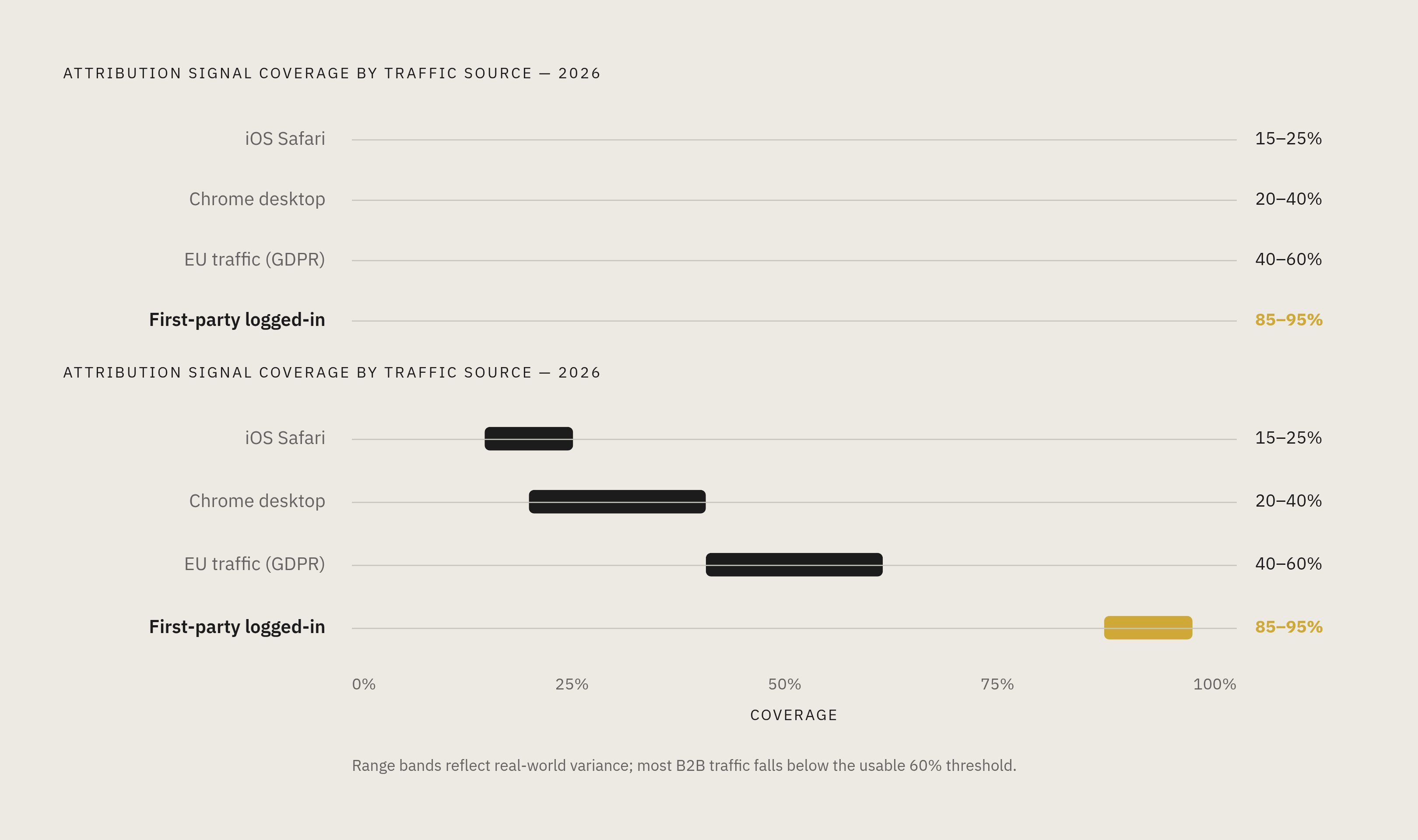
Coverage isn't one number for the whole account. It swings wildly by traffic source, and knowing those swings before picking a model saves a lot of wasted analysis later.
A few benchmarks, as of early 2026:
iOS Safari traffic: Apple's opt-in rates for tracking have settled around 15% to 25% globally. That means the vast majority of iOS visits carry no reliable attribution signal. Chrome desktop: third-party cookie deprecation is about 80% complete, with full removal still in progress. Coverage on this traffic is in the 20% to 40% range. EU traffic under GDPR: marketing cookie consent runs 40% to 60%, depending on the audience. First-party, logged-in traffic: this is the one bright spot, with deterministic IDs hitting 85% to 95% coverage. If a prospect is logged into a portal or authenticated some other way, tracking is close to solid.
So how do you tell if the data is already broken before running a single report? Watch for these warning signs:
Direct traffic makes up more than 30% of conversions, usually dark social and broken tracking wearing a disguise rather than people typing a URL from memory. That's rarely people typing a URL from memory. It's usually dark social and broken tracking wearing a disguise.
- Branded search pulling more than 40% of multi-touch credit. That usually means the attribution window is too short and it's missing the demand-generation work that happened earlier.
- Upper-funnel channels getting less than 15% of total credit while eating 40% or more of the budget. That's a sign of identity fragmentation, a misconfigured window, or both.
If estimated coverage falls below 50%, rule-based multi-touch models start rewarding whatever is easiest to track, not whatever actually moved the deal. That's the point where the model stops measuring influence and starts measuring visibility. Two very different things, and only one of them should decide where budget goes.
What each model class actually measures, and what it distorts
Every attribution model is really just a set of assumptions wearing a formula. Knowing what each one assumes tells you what it's going to get wrong.
First-touch hands all the credit to the very first interaction. It's a decent lens for measuring awareness, but as a primary model it over-credits discovery channels and ignores every bit of nurture work that came after. Use it as a side dish.
Last-touch gives 100% of the credit to whatever happened right before conversion. In B2B, that's usually a bottom-funnel action, like a demo request, that captured demand other channels spent months creating. Lean on last-touch as your main model and top-of-funnel spend slowly starves, because nothing upstream ever gets credit for its work.
Linear spreads credit evenly across every touchpoint. Good for understanding how wide a journey ran, but it treats a low-intent email open the same as a high-intent demo request. That flattens the signal exactly where you need it sharpest.
Time-decay weights recent touchpoints more heavily. That's a fine fit for short sales cycles, but stretch it across a 60 to 180 day B2B cycle and it quietly erases the early touchpoints that may have been the actual source of intent.
Position-based, also called U-shaped, splits credit 40% to the first touch, 40% to the last touch, and 20% across everything in between. It acknowledges both the discovery moment and the conversion moment, which makes it a reasonable default for mid-market B2B with moderate conversion volume.
W-shaped adds a third checkpoint, usually lead creation, splitting the majority of credit across first touch, lead creation, and last touch, with the remainder spread across the middle. For B2B teams where hitting SQL status is a real milestone (not just a box to check), this captures a stage the other models miss.
Beyond the rule-based tier sit probabilistic models, like Markov chains and Shapley values. These distribute credit with more nuance than any fixed rule, while staying more interpretable than a full black-box machine learning model. This is its own middle tier, for teams that have outgrown position-based logic but don't yet have the conversion volume to justify data-driven attribution.
Which brings up data-driven attribution (DDA), GA4's default setting. Google removed first-click, linear, time-decay, and position-based as primary models back in November 2023. They only survive now in comparison reports. DDA needs 300 to 400 monthly conversions to function properly. Fall below that, and GA4 silently reverts to last-click. No warning. No flag. No note on the dashboard. The label still says "data-driven," but the math underneath is last-touch wearing a nicer name.
One useful gut check, regardless of which model you land on: run the same data through two different models. If one channel gets 60% of the credit in one model and 18% in the other, that gap isn't really about the models. It's a sign the attribution window is too short or identity resolution is fragmenting the customer journey. Fix the data quality issue first. Trusting either number before that is a mistake.
Matching model to deal structure: the decision logic by sales cycle and volume
There's no universal "best" model. The right fit depends on how long the deal takes to close, how many people are involved in buying, and how many conversions flow through the account each month.
B2B SaaS, short cycle (30 to 90 days, 8 to 15 touchpoints, demo-driven conversion): position-based, either the standard 40-20-40 split or a custom weighting by touchpoint type, tends to fit best. The first touch and the final touch both matter here; everything in the middle adds context but rarely swings the decision on its own. Last-touch distorts this picture by handing all credit to the final demo request and ignoring the thought leadership content that built category awareness two months earlier. Linear distorts it the other way, treating a passive email open the same as an active demo signup.
B2B enterprise, long cycle (at the upper end of the 60-to-180-day range and beyond, many touchpoints, committee buying): this calls for something closer to custom account-based attribution, with credit weighted by contact role, supplemented by first-touch data for awareness measurement. Why? Because the earliest touchpoints often happen 6 to 12 months before close, well outside any default attribution window. Time-decay with a 30-day window is a particularly bad fit here, since it dumps most of the credit into the final month and erases the field event or whitepaper that introduced the brand to the economic buyer a year earlier. DDA doesn't work either, since enterprise sellers often close fewer than 300 deals in an entire year. B2B buying groups for large purchases involve multiple stakeholders across roles. Attribution built around a single lead record is structurally incomplete before it even starts, because the deal was never a single person's decision.
Low-volume B2B (fewer than 300 to 400 monthly conversions across all channels): DDA isn't viable here, full stop. It'll quietly default to last-click, as covered above. The honest move is to commit to a rule-based model on purpose, configure the window deliberately, and run sensitivity checks. Running two models side by side and comparing the gap between them tells you more than obsessing over optimizing a single model that might be built on shaky assumptions anyway.
One configuration detail changes outcomes more than most people expect: attribution window configuration alone can move channel credit by 20 percentage points or more. Given that B2B cycles run 60 to 180 days, any window under 90 days is going to shortchange upper-funnel spend, and that's a fixable configuration error, not a flaw in the model itself. Model choice and window configuration have to be decided together. Picking the "right" model but leaving a 30-day default window in place still produces a wrong answer.
Why GA4's defaults are misconfigured for most B2B teams and what to do instead
Google pulled first-click, linear, time-decay, and position-based out of GA4 as primary options in November 2023. They were removed as primary model options, and most B2B teams never went back in to reconfigure anything after that change. The account just quietly runs on DDA now, whether or not that's actually the right call.
And DDA, as covered above, needs 300 to 400 monthly conversions to work as intended. Below that, GA4's data-driven model no longer has sufficient volume to function as intended. Picture a B2B team running Google Ads and LinkedIn ads, generating 80 conversions a month. The dashboard says "data-driven attribution." What it's actually running is last-click with a fancier label. Nobody told them, because nothing tells you.
A short list of fixes, in order:
- Check actual monthly conversion volume, broken out by channel, not lumped into one aggregate number.
- If volume sits below the threshold, switch deliberately to a rule-based model, position-based or W-shaped, so the method in use is known and can be audited, rather than silently wrong.
- Reset attribution windows to match the real sales cycle. Any window shorter than the real sales cycle is almost certainly the wrong setting for a B2B sales motion.
Put server-side tracking in place before touching the model. Recovering that 15% to 25% of signal lost to iOS and cookie changes improves the accuracy of whatever model comes next.
- Use GA4's comparison reports, since that's where the older rule-based models still live, to run the validation test described earlier: compare last-touch against position-based. A big gap between them points to a window or identity problem, not a model problem.
Platform options for B2B attribution in 2026 and where each fits
Adoption of multi-touch attribution has climbed to 75% of companies as of 2026, up from 58% in 2024. That sounds like progress, and it is, but adoption isn't the same as a working setup. Many of these implementations run into trouble, usually because conversion volume is too thin, data is scattered across systems that don't talk to each other, or there simply aren't enough analysts to keep the model honest.
Tool choice generally sorts into three tiers:
Native ad-platform attribution (built into Google Ads, LinkedIn, etc.): free and siloed. Fine for accounts with low spend, fewer than five channels, and where Google Ads carries most of the weight. SaaS multi-touch attribution platforms: cross-channel, aimed at mid-market teams that need one unified view without building out a full data warehouse. CDP-based enterprise attribution: custom-built, deeply integrated, suited to enterprise deal structures with real account-based measurement needs.
A few named platforms worth knowing for 2026:
HockeyStack focuses specifically on B2B go-to-market attribution, tracking complex sales cycles across marketing, sales, and customer success touchpoints. It maps the full journey from an anonymous website visit through a closed deal, and extends into post-sale revenue too, tying upsells, churn, and expansion back to specific user behavior. It connects with LinkedIn, Google Ads, HubSpot, Salesforce, and various marketing automation tools, and offers several attribution models including a proprietary predictive one the vendor doesn't fully disclose. That's a real trade-off: simpler to use, harder to audit under the hood. Dreamdata specializes in B2B revenue attribution, tying marketing touchpoints directly to pipeline. It connects marketing touchpoints directly to pipeline and revenue. SegmentStream offers full-funnel measurement with a focus on predictive modeling approaches. Ruler Analytics puts particular weight on offline conversion tracking, which matters for B2B teams where a meaningful chunk of pipeline activity happens off-platform, in calls, events, and conversations no pixel ever sees.
Whichever tier or platform a team lands on, the deciding factor isn't the feature list or the price tag. It's identity-graph quality. If match rates fall below 60%, attribution scatters across ghost users and phantom sessions, and every model built on top of that data, no matter how sophisticated, is guessing. Get the identity resolution right first. Everything downstream depends on it.