Manual CPC vs Maximum Delivery on LinkedIn
Manual CPC gives you cost control; Maximum Delivery spends your budget faster.

Two bidding strategies sit atop the same auction, and they pull in opposite directions. One hands LinkedIn your budget and asks it to spend. The other keeps a ceiling on every click, so you decide what a qualified impression is worth. The choice is not cosmetic. It determines whether you can forecast pipeline at all.
How LinkedIn's auction actually determines what you pay
LinkedIn runs a second-price auction. Your ad rank equals your bid multiplied by your ad relevance score. The highest-ranked ad wins, but the winner pays just enough to beat the next-highest competing bid, not the full amount they offered. That mechanic changes what a bid actually is. A Manual CPC bid is a ceiling, a worst case, not a forecast of what you will pay. If the next competitor bid low, your actual charge lands well below your stated maximum.
Maximum Delivery removes that ceiling entirely. LinkedIn calculates whatever bid is necessary to exhaust your daily budget, auction by auction, with no advertiser input on individual amounts. So the strategy choice determines not just cost level but cost predictability. And predictability is what makes pipeline forecasting possible in the first place.
Why Maximum Delivery is the default, and why that matters
Maximum Delivery is the default because it aligns with LinkedIn's revenue goal of spending your full budget. That goal does not line up with yours, which is acquiring pipeline efficiently. Maximillian Herczeg, a former LinkedIn employee, put it plainly: "Maximum delivery… most people don't like it, myself included. It's most likely costing you more money than manual bidding… you will always be charged for impressions." The same insider calls Manual CPC something LinkedIn "hides" from advertisers, describing it as a strategy that "basically covers most cases."
The design goal is full budget utilization, not cost efficiency. When LinkedIn optimizes for "maximum results," it defines results as volume of the campaign objective, not cost per qualified outcome. The consequence plays out when you raise budget. Gabriel Ehrlich of Remotion, quoted in ZenABM's 2026 guide, framed it as a diagnostic: if you just doubled budget and your CPM went up because of that, the bidding strategy is the likely culprit. LinkedIn chases the same audience members at higher cost once the easy inventory is exhausted. More budget, more spend, not meaningfully more people.
When Manual CPC fits, and how to set it without stalling delivery
Manual CPC is the right default for ABM campaigns and any situation where audience precision matters more than raw volume. New campaigns are the clearest case. In the first one to two weeks, automated bidding can spend aggressively before LinkedIn's algorithm understands your conversion economics. Manual CPC keeps acquisition cost controlled while the algorithm gathers data on your audience and creative.
High-precision targeting is the second case. When you are going after CXOs at specific companies, bid control ensures you are competing for those specific impressions, not just cheaper inventory elsewhere. A/B testing is the third. Manual CPC isolates creative or audience variables without bidding-strategy noise contaminating your results. And the second-price auction works in your favor here. Your actual CPC typically lands below your maximum bid when your relevance score is strong. The ceiling protects against overpaying, but relevance determines how efficiently you win.
The ZenABM case makes the switch concrete. A campaign on Maximum Delivery exhausted its budget early in the day while CPC ran well above what manual bidding would produce. After switching to Manual CPC, the campaign started below LinkedIn's suggested range and settled at a materially lower actual CPC through second-price mechanics, then reached substantially more target accounts on the same budget. For senior decision-makers, you need to bid above the suggested range to win auctions. The audience premium is real.
The genuine limitation is active management. Manual CPC set and left unmonitored leads to underdelivery. Teams without bandwidth to check and adjust bids regularly will not get the benefit. This is a constraint that delegation can eliminate. An end-to-end agent system handling bid monitoring and auction-by-auction adjustments can maintain the cost efficiency Manual CPC offers while removing the operational burden that otherwise locks smaller teams out of the strategy entirely.
When Maximum Delivery earns its place
Maximum Delivery is not a mistake in every context. It is the right choice for proven campaigns with established performance baselines, broad awareness objectives, and warm retargeting audiences. The error is deploying it before those conditions exist.
High-volume awareness campaigns benefit first. Brand Awareness and Video Views objectives care about reach, not cost-per-click precision. Thought Leader Ads with a brand awareness objective, where median CPCs are low, are a case where spending the full budget quickly is the point. Retargeting warm audiences is another fit. These audiences have already signaled intent and convert reliably, so volume matters more than precision. Maximum Delivery's full-budget utilization serves that goal without much risk.
Campaigns that consistently produce enough monthly conversions for LinkedIn's algorithm to learn from can also justify Maximum Delivery, but only on the other side of that consistency. The algorithm needs conversion data to optimize. Without it, Maximum Delivery is optimizing for impressions without understanding what a valuable result looks like. The same logic applies to campaigns that need consistent daily pacing. Maximum Delivery produces more predictable daily spend than Manual CPC, which can pause when bids are not competitive. For time-sensitive campaigns like event promotion, that predictability has real value.
The structural limitation does not disappear even in favorable conditions. Maximum Delivery gives you no guardrail against rising CPMs during competitive windows. A product launch or major industry event, when many advertisers are bidding on the same audience, can spike costs with no mechanism to cap them. And debugging is harder. When CPL spikes on Maximum Delivery, you cannot tell whether the cause is bidding, audience, or creative. Manual CPC preserves that diagnostic visibility.
A practical decision framework for choosing between the two
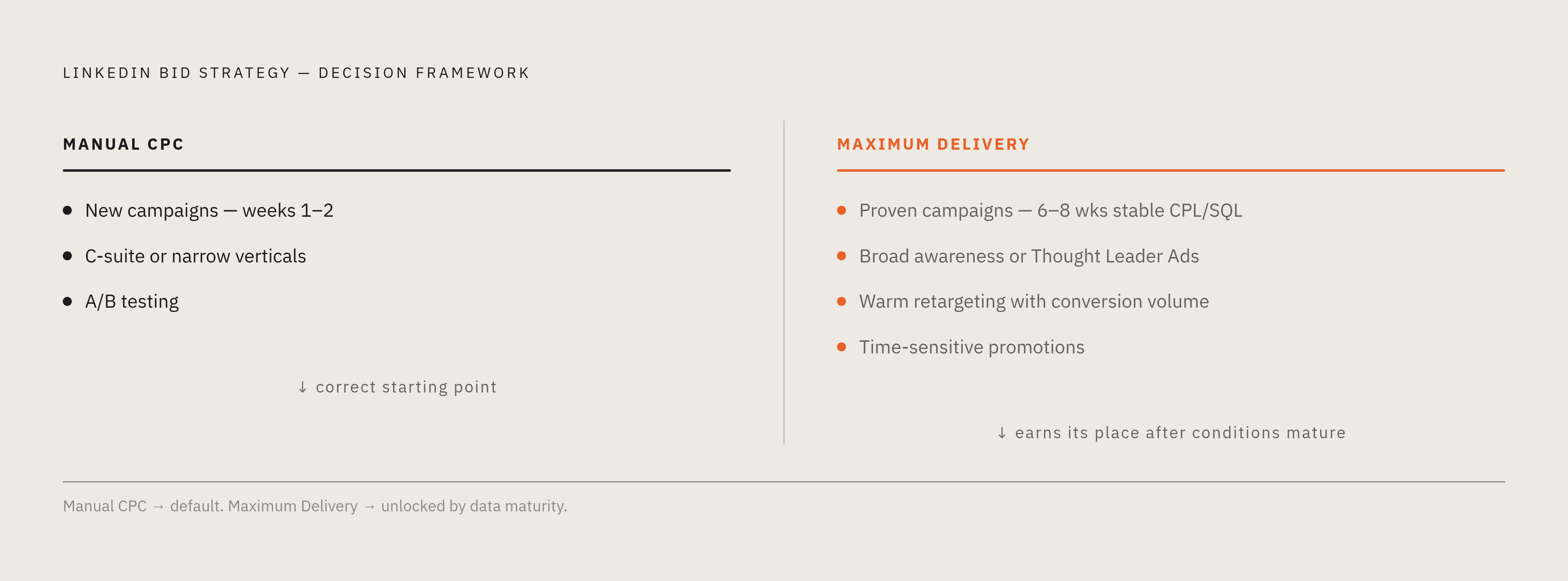
The right bid strategy follows from campaign stage, audience size, and whether you have enough performance history for automation to work. It does not follow from platform defaults or personal preference. New campaigns with no conversion history should start on Manual CPC and learn before you automate. High-precision targeting, the C-suite and narrow verticals, also calls for Manual CPC, because you need to control which impressions you win, not just how many. A/B testing creative or audience variables belongs on Manual CPC too, because bidding-strategy noise contaminates the test.
The other side of the ledger kicks in once conditions mature. A proven campaign with six to eight weeks of stable CPL and SQL data can consider Maximum Delivery for volume expansion. Broad awareness or Thought Leader Ads with a brand awareness objective should use Maximum Delivery, because reach is the goal. Retargeting warm audiences with sufficient conversion volume can also switch, since the algorithm has enough signal to optimize. And time-sensitive promotions where consistent daily pacing matters earn Maximum Delivery for that predictability.
The sequencing principle ties it together. Manual CPC is the correct starting point for most B2B campaigns. It preserves cost control during the learning phase, reveals the auction floor, and generates the performance history that makes Maximum Delivery viable later. The wrong strategy at the wrong stage inflates CPL materially, even when audience and creative are identical. This choice is not a secondary variable. Cost Cap deserves a brief mention for completeness, since it sits between the two as a semi-automated option where you set a target average cost per result. Even LinkedIn insiders do not recommend it for most ABM use cases. It requires large audiences and extended learning periods, and it is rarely the right choice for precision B2B targeting.
Why bidding strategy is inseparable from attribution, and what that means for measuring results
The bid strategy you choose shapes which signals flow back into LinkedIn's algorithm. If your attribution infrastructure cannot connect those signals to pipeline, you cannot tell whether the strategy is working or which constraint is actually limiting growth. Manual CPC reveals the auction floor and forces LinkedIn to prioritize audience quality. It shows you what high-intent inventory actually costs. But that transparency is only useful if you can connect clicks to qualified outcomes downstream.
Maximum Delivery on proven campaigns can expand volume efficiently, but it optimizes on whatever conversion signal you feed it. If you are optimizing for form fills rather than SQL-accepted or opportunity-opened events, the algorithm learns to find people who fill forms, not people who buy. The default attribution window makes this worse: LinkedIn's default is seven days. For B2B deals with longer sales cycles, one 2026 analysis found that this window misses 30 to 60 percent of LinkedIn-influenced pipeline, making the bid strategy appear less effective than it is.
The correct performance metrics for sales-led B2B are cost per SQL, pipeline ROAS, and CAC payback, not CPL or platform-reported conversions. Evaluate any bid strategy against qualified pipeline, not the volume of results LinkedIn reports in Campaign Manager. LinkedIn's Conversions API matters here because it allows CRM lifecycle events, MQL created, SQL accepted, opportunity opened, closed-won, to flow back to LinkedIn so the bidding algorithm learns from qualified outcomes rather than form submissions. That becomes critical on Maximum Delivery campaigns, where the algorithm is choosing its own bids based on whatever signal it receives. The structural misalignment between LinkedIn's revenue goal and a sales-led B2B company's goal is precisely why delegation models matter. A governance layer directing bid strategy can override platform defaults in favor of cost-per-outcome, but a team operating ad-platform software alone often inherits the platform's optimization direction by default.
Split attribution compounds the problem. When LinkedIn is judged on last-click demo requests and Google takes credit for branded searches that LinkedIn created, both channels are being measured incorrectly. Bid strategy decisions made on that data will optimize for the wrong things.
What managing bid strategy well actually requires, and where most teams get stuck
Manual CPC's advantages only materialize with active monitoring and adjustment. Maximum Delivery's advantages only hold if the campaign has the conversion history and attribution infrastructure to support automation. Most B2B teams lack the bandwidth to maintain both consistently, and that gap is where the strategy choice stops mattering in practice.
Manual CPC set and left unmonitored underdelivers when bids become uncompetitive. Teams that set a bid at launch and revisit it monthly are not getting the benefit of manual control. Maximum Delivery on a campaign without sufficient conversion history optimizes for impressions, not outcomes. The algorithm needs qualified signal to learn. Without it, full budget utilization is not an advantage. It is a way to spend faster on the wrong audience.
The bid strategy decision is not a one-time configuration. It should change as campaigns mature, as audience data accumulates, and as competitive conditions shift. Treating it as a launch checklist item rather than an ongoing judgment call is where the CPL inflation happens. Bid management is also a diagnostic layer. When CPL rises on Manual CPC, you can isolate whether the cause is bid competitiveness, audience fatigue, or creative underperformance. On Maximum Delivery, that signal is obscured. The choice of strategy affects not just what you pay but what you can learn.
Bid-level predictability is foundational to forecasting qualified pipeline reliably. When Maximum Delivery removes the ceiling and bids whatever is necessary to exhaust budget, forecasting becomes guesswork. Applied-AI systems running LinkedIn Ads end to end, like Thunder, which optimizes toward qualified pipeline rather than platform-reported volume, depend on that predictability to coordinate bid strategy with pipeline targets. The compounding benefit of managing bid strategy alongside creative testing, landing page performance, and attribution in a single system is that each campaign generates audience insights, engagement signals, and conversion data that should inform the next bid decision. Programs that treat each campaign as a fresh start lose that accumulated evidence. The ones that retain it make every campaign a little smarter than the one before.