Personalized LinkedIn Ads for B2B Account Segments
LinkedIn's native targeting and account lists reach decision-makers already in buying mode.

LinkedIn lets advertisers filter directly by job title, industry, seniority, and specific company name. That's a different kind of targeting than guessing at buying power from browsing habits or purchase history on a consumer platform. The people reaching those filters are the people with the authority to buy.
Matched Audiences pushes this further. Upload a list of target accounts, and LinkedIn serves ads to people who work at those specific companies. The account list itself becomes the targeting unit. No demographic approximation standing in for it, no cookie trail, no lookalike model guessing who resembles a customer. And the setting changes how a message lands, too: people on LinkedIn are there in a working frame of mind, researching vendors and comparing options, not scrolling between personal errands. The same ad copy reads differently in that context than it would anywhere else. That combination, the account-level targeting mechanism and the professional headspace of the people seeing it, is what makes personalization by account segment something a team can actually build, rather than something they approximate and hope works.
Why most LinkedIn personalization fails before targeting is even set up
The mistake most B2B teams make is treating personalization as a writing problem. Someone decides the logistics prospects need one headline and the financial services prospects need another, and that gets called personalization. If every account on the list is still being targeted the same way underneath those headlines, the headlines are the only thing that changed, not who gets reached or how.
When the account list isn't segmented, the targeting unit is too broad. A mid-market logistics company and an enterprise financial services firm end up getting the same message because no one decided to separate them. Swapping in different headlines for different personas doesn't fix that. It changes the words on the page without touching the underlying logic of who gets reached, with what budget, and at what level of investment. That's decoration, not segmentation.
The campaign that results is broken in two directions at once. It's too generic for the high-value accounts that actually warrant custom treatment, and too expensive per impression for the low-fit accounts where broad, efficient reach would have done the job just fine. And that reveals a measurement problem affecting both: if every account gets the same treatment, the results can't show whether the message was wrong, the account fit was wrong, or the targeting logic itself needs to change. Nothing in the results points back to a cause.
The rest of this piece makes one argument: getting the account segmentation architecture right is what makes LinkedIn personalization something a team can actually execute, instead of something that sounds good in a strategy deck. Creative follows from segments. Segments don't follow from creative.
Account tiering and the resource allocation logic personalization requires
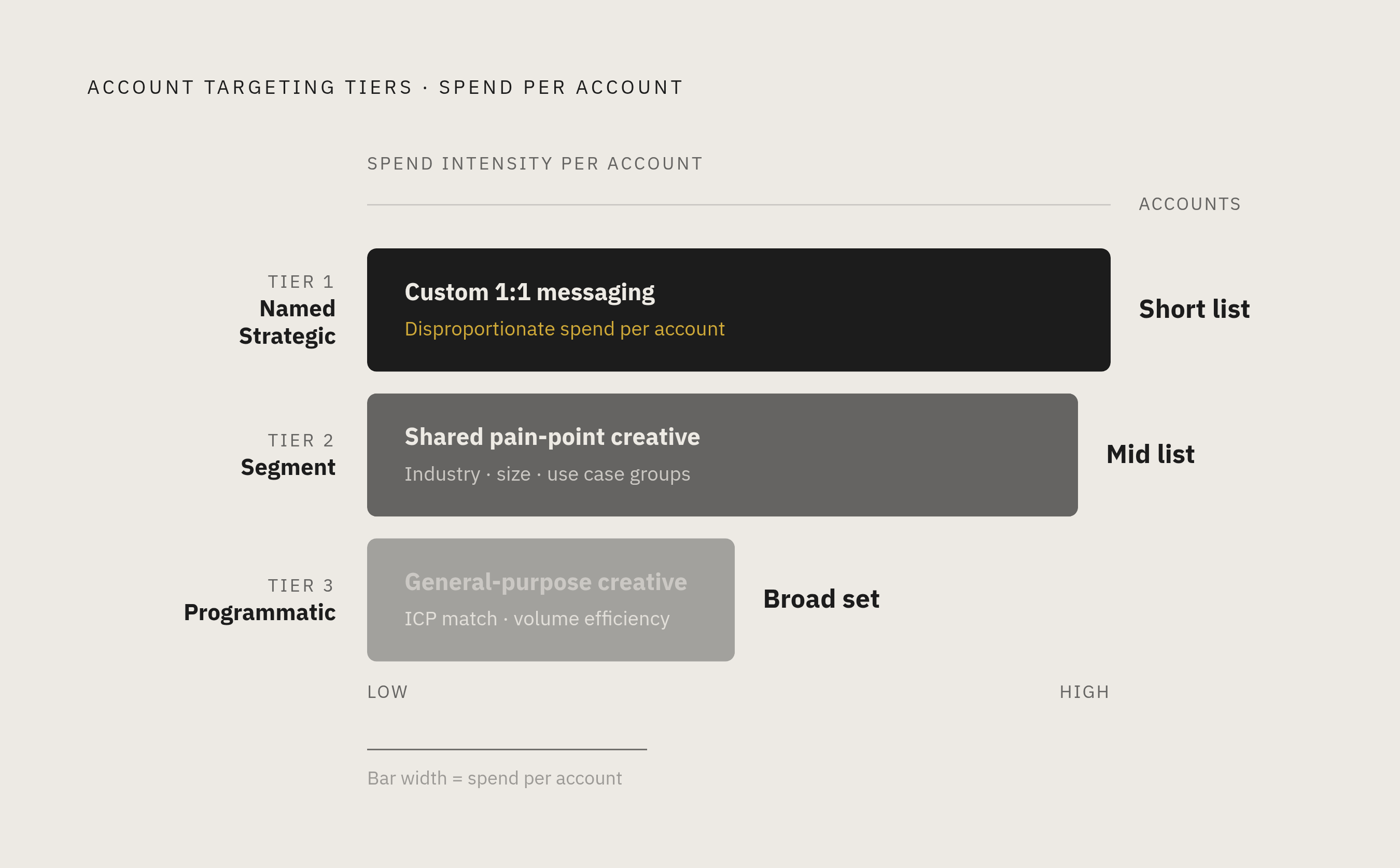
Before a single ad gets written, a B2B team has to make a decision that has nothing to do with copywriting: which accounts warrant custom, one-to-one treatment, which warrant group-level treatment, and which just need broad, efficient reach. Those three answers call for three different LinkedIn campaign structures, and skipping this decision is what leaves teams improvising later.
Tier 1 covers named strategic accounts, a short list with the highest revenue potential per account. These justify custom messaging written for the specific company, deliberate coverage of everyone on the buying committee, and a higher cost per impression, because the value of landing even one of these accounts covers it many times over.
Tier 2 covers segment accounts, a mid-size list grouped by something they share, maybe an industry vertical, a company size band, a growth stage, or a common use case. These get segment-level creative that speaks to a shared pain point without naming individual companies.
Tier 3 covers programmatic accounts, a broad set that fits the ideal customer profile but doesn't individually justify custom attention. These run on efficient, general-purpose creative built for volume and low cost.
The tiers aren't just a sorting exercise. They set the budget logic. Tier 1 gets a disproportionate share of spend per account, because each one matters enough to justify it. Tier 3 gets spend optimized for efficiency, because scale is the point. Skipping this structure flattens budgets evenly across every account on the list, which quietly starves the accounts that mattered most.
The obvious objection: tiering takes upkeep. Account lists go stale. Companies merge, grow, shrink, or sign with a competitor. That's a fair complaint, but it doesn't require a perfect system, just a regular one. A quarterly refresh beats an undifferentiated account list that never gets touched again.
The firmographic and situational signals that make segments coherent
A segment only earns its keep if the companies in it share something real: a problem, a context, or a buying situation that makes one message land for all of them. Grouping by industry alone usually isn't enough to clear that bar.
Start with firmographic signals. Industry vertical matters because regulatory pressure, vocabulary, and competitive dynamics differ by sector. Company size band matters because buying process complexity, budget authority, and the number of people involved in a decision all scale with headcount. Geography matters where it touches compliance rules or market maturity.
Then layer on situational signals, which sharpen a segment from a rough category into something a message can actually speak to. Growth stage is one: a Series B company moves with different urgency than a mature enterprise. Recent trigger events are another: a hiring surge in a specific department, a new funding round, an acquisition, a leadership change. Technology stack is a third: a company already running a particular platform has integration needs a competitor without that platform doesn't share.
A behavioral layer sits on top of all of this. Accounts actively researching a category, comparing vendors, or downloading competitive content belong in a different segment than otherwise identical companies showing no such signal, because their buying timeline is different even if their firmographics are identical.
LinkedIn makes most of this executable without bringing in outside data. Company size, industry, job function, and seniority are all native filters. Matched Audiences handles the account-list upload for the named segments, the Tier 1 and Tier 2 lists built from a company's own account-based marketing work.
A usable segment is specific; a vague one is just a label. "Financial services companies" isn't a segment, it's a label. "Mid-market financial services firms, a few hundred to a thousand employees, currently running manual compliance workflows" is a segment, because every company in it shares a real pain that a message can speak directly to. The output of this whole step should be a written segment definition: a name, the firmographic criteria, the situational qualifier that holds it together, and the LinkedIn mechanism that reaches it. All of that gets settled before anyone writes a creative brief.
Buying committee structure and targeting logic within each segment
Reaching a target account on LinkedIn without a plan for the buying committee means reaching one person at that account. One person isn't the same as influencing a decision that, in most B2B deals, runs through several people with different concerns and different veto power.
A typical buying committee includes an economic buyer, often a CFO or VP of Finance, a champion or end-user who's the function that will actually use the product day to day, a technical evaluator from IT, security, or engineering, and frequently a procurement gatekeeper. Each one cares about something different. The economic buyer wants ROI and risk framing. The champion wants proof the thing works in practice and that it's easy to adopt. The technical evaluator wants answers on integration and security. A message built for one of these roles usually falls flat with the others, because the concerns don't overlap much.
LinkedIn's job function and seniority filters make it possible to handle all of this inside a single campaign. The same account segment can run multiple ad sets, each one filtered to a specific function and seniority band, each one carrying a message built for that role. A campaign that only reaches the VP of Marketing at a target account has reached one voice in a room full of them, and the targeting architecture needs to account for the rest of that room from the start, not patch it in later.
Ad format follows the same logic. A technical evaluator tends to respond better to a document ad or a whitepaper offer, something with enough depth to answer the integration and security questions they actually have. An economic buyer responds better to something short, a single image ad with a tight ROI argument. The format is a downstream decision that falls out of the committee role, not something chosen first and then stretched to fit.
The objection here is budget: more ad sets per segment means more to manage. True enough, but the alternative is serving the same message to every function at an account, which produces plenty of impressions against people the message was never built for. Splitting the committee into targeted ad sets costs more to run, but converts better, because each person is getting something built for the question they actually have.
LinkedIn's AI targeting features and the segmentation framework
LinkedIn's AI tools work best inside a segmentation structure a team has already built. They optimize execution. They don't make the account-tier and buying-committee decisions that need to happen first, and treating them as though they do is where things go wrong.
Predictive Audiences uses machine learning to build out high-performing audience segments. It starts from a seed audience, conversion data, Lead Gen Form submissions, a contact list, finds patterns among the people who converted, and predicts which other LinkedIn members look likely to take the same action. It works best once a campaign has built up a meaningful amount of conversion data to learn from. That makes it a strong fit for Tier 3, where the goal is efficient expansion past a named account list. It's a poor fit for Tier 1, where the whole point is that the segment is deliberate and controlled, not discovered by a model.
Accelerate works differently. It generates campaign suggestions tied to a stated business objective: audiences, creative directions, bidding strategy, optimization approach. That's genuinely useful for a small team without a dedicated specialist on staff, but it works best when the person using it already knows which tier and which segment they're targeting. Accelerate fills in the execution. It shouldn't be the thing deciding who the account universe is.
The risk sits in that last point. Handing Predictive Audiences the job of defining the account universe puts the segmentation architecture in the hands of a model optimizing for platform-level conversion patterns, not the advertiser's actual ideal customer profile or tier structure. Those two things can diverge quietly, and that drift becomes visible in results only once the account list has already moved away from what the business actually meant to target.
The split that works: human judgment sets the tiers, defines the segment criteria, and builds the buying-committee targeting logic. Platform AI optimizes execution inside the boundaries that judgment has already drawn.
Message architecture, segment definition, and personalization at each tier
Once a segment is well defined, the message for it stops being a creative puzzle to solve from scratch. It becomes a fairly direct consequence of what the companies in that segment actually share, in terms of context, problem, and buying stage.
For Tier 1 named accounts, the message can reference the account's specific situation directly, its industry context, a known pain point, a recent trigger event. The targeting is precise enough, down to the individual company, to justify that level of specificity, and this is exactly where one-to-one or one-to-few creative earns its cost.
For Tier 2 segment accounts, the message speaks to the shared situational reality the segment holds in common, the regulatory pressure a financial services segment is under, the scaling challenge a Series B segment is working through, without naming any single company. It's specific enough to feel relevant and broad enough to run efficiently across the whole segment.
For Tier 3 programmatic accounts, the message addresses the category-level problem that anyone fitting the ideal customer profile is likely to have. The goal here is clarity and conversion efficiency at scale, not individual specificity.
Buying committee role then sets the frame within each tier. The economic buyer gets ROI and risk framing. The champion gets use-case proof and an easy path to adoption. The technical evaluator gets integration and security answers. The segment decides which account gets reached. The committee role decides the angle the message takes once it gets there.
LinkedIn's generative AI tools can help at this stage, producing headlines and intro text quickly and cutting down time spent drafting. The brief that feeds those tools has to come from the segment definition and the committee role already established. Letting the tool guess at the brief means it's guessing at exactly the thing the whole framework was built to pin down.
There's a competitive reason this matters more now than it used to. AI-generated creative is flooding major ad auctions, making it harder for competitors to tell which formats are actually working amid all the low-signal filler. That makes a well-built segmentation architecture a more durable advantage than any single ad execution, because creative is easy to copy and getting easier to drown out, while the underlying account logic isn't something a competitor can see or replicate from the outside.
The teams that win on LinkedIn generally run tighter segmentation, not more creative variations, which makes every message relevant by default instead of by effort.
Why segmentation quality degrades over time
A segmentation framework built once and never revisited will drift out of date. Account lists go stale, buying signals shift, and segment definitions that were accurate at launch stop matching market reality within a matter of months.
This happens through ordinary business change. Companies grow or shrink past the size band they were sorted into. Industry classifications shift as companies pivot. Technology stacks get replaced. Leadership turns over. A Tier 1 account that closes a deal isn't a target anymore and shouldn't still be absorbing a disproportionate share of budget. A Tier 3 account that just raised a funding round may have moved into Tier 2 without anyone noticing.
Without a refresh cadence, the targeting structure keeps running against a version of the market that no longer exists, spending against accounts that have already converted, missed, or changed shape. The fix isn't complicated: a regular review, quarterly at minimum, where tiers get reassigned and segment definitions get checked against what's actually true of the accounts inside them now. The architecture doesn't need to be perfect to hold up. It needs to be checked often enough that it never drifts too far from the accounts it's supposed to describe.