Intent Data in B2B LinkedIn Demand Generation Programs
Matching intent signals to buying stages separates LinkedIn pipeline growth from wasted ad spend.
Intent data is only as useful as the layer of the buying journey it maps to, and in LinkedIn demand generation, knowing which intent type (first-, second-, or third-party) to apply at which funnel stage is what separates wasted spend from qualified pipeline.
Misreading intent data before a single ad runs in most LinkedIn demand gen programs
Buyers now finish most of their homework before a vendor ever hears from them Hey Sid - B2B Demand Generation: The Complete Guide for 2026. So when someone finally does reach out, that's not really a starting gun. It's often a formality, confirming a decision that got made weeks or months earlier Hey Sid - B2B Demand Generation: The Complete Guide for 2026.
That timing shift changes what intent data is even for. Most teams apply intent data only to that smaller slice, the accounts already deciding, and treat the other 95% as unreachable or untrackable Hey Sid - B2B Demand Generation: The Complete Guide for 2026.
But what if that 95% isn't unreachable, just misread Hey Sid - B2B Demand Generation: The Complete Guide for 2026? The deeper problem isn't which slice gets ignored. It's that "intent data" gets treated as one thing, a single dial marked hot or cold, when the buying journey it's supposed to track stretches across months of quiet research nobody's watching. That mismatch is visible in the media plan directly: expensive LinkedIn impressions land on accounts at the wrong stage, carrying a message built for a different moment entirely. Fixing that starts with a simple discipline: match the intent signal to the exact layer of the journey it can actually see, and nothing more.
The non-interchangeability of the three types of intent data
Strip away the marketing language and intent data is just evidence that somebody's researching a purchase. Where that evidence comes from, though, changes everything about how much to trust it.
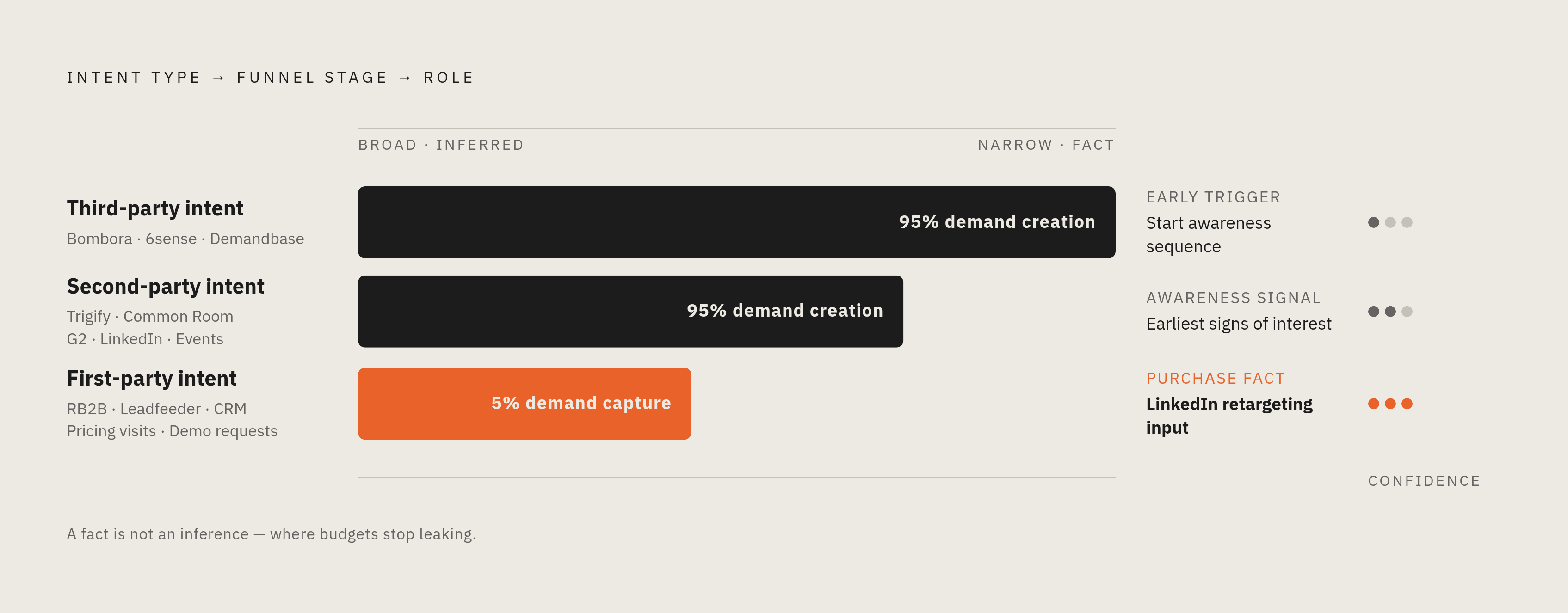
First-party intent is behavior on a company's own turf: pricing page visits, demo requests, product clicks, email opens. It's the most current and the most specific signal available, because a second visit to a pricing page isn't a guess about what someone's thinking. A second visit to a pricing page is a fact, not a guess about what someone's thinking. The tradeoff is coverage. First-party data only sees accounts already aware of and engaging with the brand, and tools that capture it, RB2B and Leadfeeder among them, mostly start free or run at modest monthly cost.
Second-party intent lives one step removed: behavior on a platform someone else runs but a marketer can still watch. Think G2 reviews, a competitor's LinkedIn post getting engagement, event attendance lists, community activity. It's public, it's timely, and it's specific enough to act on, which makes it strange that most outbound teams barely touch it, especially given how naturally it fits LinkedIn's social, public-by-default environment. Tools like Trigify and Common Room work this layer.
Third-party intent is the broadest and the blurriest. It's modeled research behavior, licensed from publisher networks, the kind of thing Bombora aggregates through its own Data Co-op, or that 6sense and Demandbase turn into predictive buying-stage scores. It can flag that a company is showing research activity around a topic. It usually can't say who at that company, and it's rarely current. Pricing across this category is opaque by design: Bombora, 6sense, and Demandbase all decline to publish rates, and the spread across the wider market runs from free tools up to a serious annual line item.
First-party intent is a fact. Third-party intent is an inference. Marketers routinely act on the inference with the confidence that should be reserved for the fact, and that's where budgets start leaking. All three types are evidence of purchase research (the source, specificity, timeliness, and reliability differ dramatically). Knowing a company is in a buying cycle is one thing. Knowing which of the six to ten people inside that buying group is actually driving it is another, and on LinkedIn, where campaigns target people, not just logos, that gap decides whether the spend lands anywhere useful.
LinkedIn's audience structure and its effect on the value and difficulty of intent-matching compared to other channels
LinkedIn's scale is the reason the effort pays off. The platform has crossed 1 billion members, including 65 million senior-level influencers and 10 million people sitting in the C-suite.
None of that comes cheap. That's a real number to defend in a budget meeting. The offsetting case: when targeting is genuinely precise, LinkedIn produces a 28% lower cost-per-qualified-lead than Google Ads for B2B. Notice the condition attached to that number, though. It only holds when targeting is precise. Sloppy targeting doesn't just underperform, it actively erases the advantage that justified the higher sticker price.
Why is precision so much harder to pull off here than elsewhere? Because LinkedIn deals aren't single-player. Most of the stakeholders involved are watching quietly for months before any sales conversation starts, which means the platform is doing work far earlier in the journey than most teams give it credit for. Click-through rate, the metric everyone defaults to, actively misleads in this context. Average CTR is between 0.4% and 0.6%, and a campaign that's tightly matched to real intent, reaching a smaller, better-chosen set of accounts, can show a lower CTR while generating meaningfully more pipeline LinkedIn Ads for B2B in 2026: Formats, Costs & Best Practices - Intentsify. Judging the campaign by the wrong number is its own kind of misread.
Get the intent match right, though, and the upside is substantial: marketers who apply intent data to LinkedIn targeting see revenue growth gains up to 62%. Get it wrong, and the platform's core advantage, that 28% cost edge, gets spent right back on impressions the wrong accounts never asked to see. 80% of B2B leads from social media come from LinkedIn, and the platform delivers 277% more leads than Facebook and Twitter combined B2B LinkedIn Marketing: The Complete Guide for 2026. LinkedIn CPC runs 3–9x higher than competing platforms LinkedIn Statistics 2026: 140+ B2B Marketing Data Points. Cross-industry average CPC hit $5.74 in 2026, up 9% year over year, while average cost per lead reached $94 B2B LinkedIn Marketing: The Complete Guide for 2026.
Demand creation (the 95%) and demand capture (the 5%) and their different intent grade requirements
The 95% / 5% split is the organizing principle for every budget and sequencing decision in a LinkedIn demand gen program.
Demand creation covers that 95% of the market not yet researching a solution. The job here is awareness and problem recognition, which means the intent grade that fits is second-party: social engagement, community chatter, event sign-ups, review-site browsing. These earliest observable signs of interest appear before an account ever enters active research. Third-party topic-surge data can help here too, flagging accounts worth watching earlier, but its lag and lack of specificity mean it's better used as a trigger to start an awareness sequence than as proof anyone's ready to buy.
The formats match the goal. Single image ads carry account-level awareness. Video handles category education across a whole buying group. Newsletters build sustained presence, and LinkedIn's newsletter subscriber base has grown 150% year over year, now past 500 million subscribers. Individuals outperform brands at this stage. Executives and subject matter experts, not the company page, are the right vehicle for demand creation content.
Demand capture covers the 5% already deep in vendor evaluation. The intent grade that fits here is first-party: pricing page visits, demo requests, product actions. These are facts about accounts already engaging directly, and they justify higher-confidence, higher-bid targeting. Third-party competitive-research signals can widen the pool a bit beyond a company's own first-party data, but only if treated as a hint, not a guarantee.
Formats shift accordingly: document ads for buyers doing serious evaluation-stage research, retargeting sequences built from accounts that already touched a first-party property, Lead Gen Forms for converting confirmed intent with minimal friction. The mistake that undoes both sides: pointing broad, lagged, account-level third-party data at demand capture decisions that need first-party precision, and pointing narrow first-party retargeting at the 95% who've never heard of the brand. Swap the tools between the two stages, and both stages fail quietly. Personal profiles matter here: individuals generate 8x more engagement than company pages, and LinkedIn users are 3x more likely to trust content from an individual than a brand, making executive and SME voices the right vehicle for demand creation content LinkedIn Marketing Strategy 2026: Complete B2B Guide.
Building the intent signal stack: which tools feed which stage
No single vendor covers the whole funnel. The stack gets built stage by stage, not by finding one platform that claims to do it all.
For demand creation, the signal layer runs on second- and third-party data. Tools watching public LinkedIn engagement, community activity, and event turnout identify accounts showing early category interest, and this remains the most underused grade despite being both timely and specific. Bombora-style topic-surge data sits alongside it, useful for flagging accounts to bring into an awareness sequence, but it was never built to serve as a purchase-readiness score, and using it that way is asking more of the data than it can give. The limitation running through this whole layer: everything here is account-level. None of it says which individual inside the buying group is actually doing the research.
For demand capture, the signal layer runs on first-party data. Website visitor identification tools, RB2B, Leadfeeder (also known as Dealfront), Koala, turn anonymous site traffic into named accounts, and pricing-page or solution-page visits from this layer are the strongest first-party signals available. CRM behavioral data adds to it: demo requests, trial activity, chains of email engagement. These are facts that make the highest-confidence inputs for building LinkedIn retargeting audiences. Champion and job-change tracking, the category UserGems works in, adds a further layer, surfacing accounts where a former buyer has moved to a new company, a second-party signal carrying almost first-party specificity.
The gap that runs under this entire stack is account versus contact. Most intent tools tell a marketer which company is in motion. LinkedIn campaigns need the actual people inside that company. Closing that gap means pairing account-level intent with contact enrichment or LinkedIn's own Matched Audiences feature, since without that pairing, the company-level signal has nowhere to land.
Half the major providers in the category, 6sense, Bombora, Demandbase, Lead Forensics, Pocus, publish no pricing at all, which is worth factoring in before building out a budget for any of this. Quote-based pricing is itself something to factor into the buying decision. The absence of a public number doesn't mean the tool is expensive, and it doesn't mean it's affordable either. It just means the conversation happens on a call, not a pricing page.
A well-sequenced intent-driven LinkedIn program in practice
None of this works as one campaign launched and left running. It works as a three-phase account progression, each phase handing off to the next.
Phase one is account selection and signal-triggered entry. Third-party topic signals or second-party social engagement flag accounts showing early category interest. Before any spend gets activated, though, ICP filters, company size, industry, geography, get layered on top, because intent without a fit check just produces noise in the pipeline. The entry rule is simple: an account only moves forward when it shows an intent signal and matches ICP criteria.
Phase two is multi-stakeholder demand creation. The target isn't one persona, it's the whole buying group, since the average B2B deal now runs six to ten stakeholders deep. And this phase doesn't run on LinkedIn alone. Email, display, and BDR outreach get coordinated to hit the same accounts with the same message, because omnichannel sequences that include LinkedIn produce noticeably higher purchase rates than single-channel efforts.
Phase three is intent escalation and demand capture. The moment someone inside a tracked buying group hits a first-party trigger, a pricing page, a demo request, a product action, that account graduates into a higher-confidence, higher-bid campaign. Retargeting audiences get built from first-party CRM and website data, with Lead Gen Forms ready for the moment intent is confirmed. BDR outreach lines up on the same accounts at the same time, and AI-assisted LinkedIn outreach is landing 10.3% response rates against 5.1% for cold email.
Timing matters too. Q3 delivers the strongest pipeline ROI on LinkedIn ad spend at 6.01x, with Q4 showing 2.46x revenue ROI. That points toward a rhythm: build awareness through Q2, convert in Q3, which lines up with how the platform's own performance data behaves across the calendar.
None of this means anything without a way to check whether it worked. The measurement framework asks whether engagement is translating to outcomes, looking at SQL rate, opportunity creation, and pipeline contribution. Skip past whether engagement is translating to outcomes and every earlier phase is just activity, not proof. Personal profiles of executives and subject matter experts carry this phase (8x the engagement of company page content).
Where intent-driven LinkedIn programs break down
Two failure modes account for most of the wasted spend, and both come down to mismatching confidence level to signal type.
The first is acting on third-party intent with first-party confidence. A Bombora topic spike gets treated like a pricing-page visit, and the campaign bids accordingly, high-cost LinkedIn impressions get thrown at accounts that might be months from any decision, or might never be in-market for this particular solution at all. The fix isn't complicated, even if it takes discipline to hold to: third-party signals earn an account entry into a long nurture sequence. They don't earn a high-bid conversion push.
The second failure mode is targeting accounts without covering the buying group. Account-level intent says a company is researching something. It says nothing about who inside that company is doing it. Aim a LinkedIn campaign at a single persona, and the people who actually control budget may never see an impression, no matter how well the account itself was chosen.
Both failures trace back to the same root: treating intent data as one signal instead of three distinct grades, each suited to a different stage of a buying journey most of which happens in the dark. Match the grade to the stage, first-party for capture, second-party for creation, third-party as an early trigger rather than a verdict, and LinkedIn's cost premium starts buying precision instead of expensive guesswork.