Account-Based Marketing Platforms Compared for LinkedIn Execution
Which ABM platform actually connects your account list to LinkedIn campaigns without manual exports.

I ran ad accounts for B2B companies for years before I started paying attention to why some ABM setups just work and others turn into six-figure paperweights. Here's the pattern I kept seeing: LinkedIn is the one platform where you can actually target a person by job title, seniority, and company size, using data people typed into their own profile instead of guesses cobbled together from cookies. For anyone selling through a sales team, that matters more than reach. You'd rather hit the twelve people on a buying committee than blast an ad to ten thousand strangers who scroll past it.
That's the whole reason LinkedIn and account-based marketing go together like they do. Both are built around named accounts, not anonymous traffic. An account list. A matched audience. A buying group. These map onto LinkedIn's campaign structure almost exactly, which is probably why most ABM platforms treat LinkedIn as the first channel they build toward, not an afterthought.
So the question isn't whether you should run ABM on LinkedIn. Of course you should. The question is which platform actually connects your intent signals, your account list, and your LinkedIn campaigns, instead of leaving you with three tools that don't talk to each other and a lot of manual exporting.
How the ABM platform market has sorted into three functionally different categories
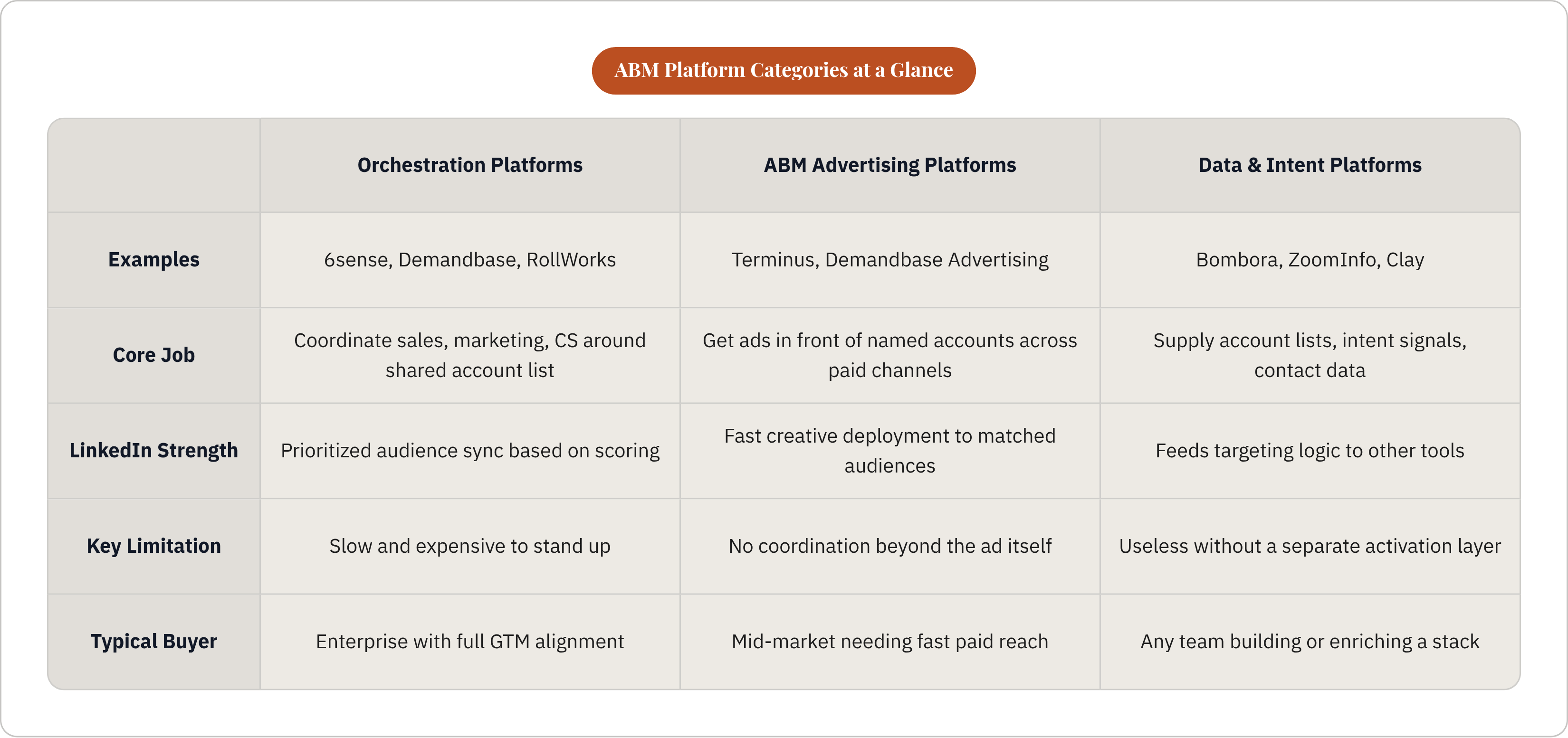
I've watched this mistake happen more times than I can count: a company buys a platform built for one job and expects it to do a different one. Someone needs help running ads, so they buy a tool built to score and rank accounts company-wide. Someone else needs account intelligence, so they buy an ad platform instead. Neither one gets what they actually needed, and both end up blaming the tool.
The market really breaks into three buckets:
- Orchestration platforms (6sense, Demandbase, RollWorks) coordinate sales, marketing, and customer success around one shared account list. They score accounts, track intent, sequence outreach, handle attribution. Good at the full picture. Slow and expensive to stand up.
- ABM advertising platforms (Terminus, Demandbase Advertising) exist to get ads in front of named accounts across display, social, and other paid channels. Good at reach. Not built to coordinate anything beyond the ad itself.
- Data and intent platforms (Bombora, ZoomInfo, Clay) supply the account lists, the intent signals, the contact data. Necessary. Useless on their own. Somebody still has to act on what the data says.
A few platforms don't stay in their lane. 6sense and Demandbase both stretch across all three buckets to some degree, which is exactly why comparing them head-to-head gets confusing fast.
Here's what actually matters for you: whichever category a platform started in tells you what it's good at on LinkedIn today. An orchestration-first platform is great at telling you which accounts deserve budget and when, but it might hand off the actual campaign to LinkedIn's own tools or a separate ad platform. An ad-first platform gets creative live in front of the right companies fast, but it might have no idea which of those companies are worth the money in the first place.
Price tells the same story, honestly. Enterprise orchestration suites can run six figures a year. Ad-focused, mid-market tools start well under that. A five-person marketing team and a 200-person enterprise org are not having the same conversation, no matter what the pricing page implies.
What LinkedIn execution actually requires from an ABM platform, before comparing specific tools
Before you compare tools, it helps to know what "works on LinkedIn" actually means. It comes down to four things.
- Account list sync. Can the platform push your target list into LinkedIn Matched Audiences and keep it current as accounts move in and out of your target segment?
- Contact-level targeting. Does it find the actual people inside those accounts, so your ads hit the buying committee instead of every employee at the company?
- Intent signal integration. Does it flag which accounts are showing real buying behavior right now, so budget goes where it matters?
- A feedback loop. Does engagement on LinkedIn (clicks, form fills, impressions) flow back into scoring, or does it just sit in a dashboard nobody opens after week two?
A platform that clears all four gives you a closed loop: intent triggers spend, spend drives engagement, engagement updates the score, the new score redirects the next round of spend. Most platforms only clear two or three. Knowing which two you're missing is the difference between a manageable gap and needing to bolt on another tool six months from now.
One thing worth saying plainly: no platform builds your target account list for you. ABM tools sharpen targeting logic you already have. They don't invent it. Skip the work of defining your ideal customer profile, with real reasons behind each account, and you'll just activate the wrong accounts faster, with nicer creative.
6sense: predictive scoring and intent depth, with LinkedIn execution as a downstream output
6sense is built first as an intelligence platform. Activation comes second. Its main job is predicting which accounts are already mid-buying-cycle before anyone fills out a form, using its own intent engine that processes signal at real scale. Forrester has named it a leader in intent data, which tracks with how the company talks about itself relative to competitors.
On LinkedIn, 6sense pushes prioritized account lists into Matched Audiences directly, and the scoring model decides who gets budget rather than leaving that decision to the ad platform. Because it identifies specific people inside a buying committee, LinkedIn campaigns can target actual personas within a priority account instead of blasting everyone at the domain. Engagement from those campaigns flows back into 6sense's account journey model, closing the loop.
Where it earns its cost: long sales cycles, messy buying committees, deals where knowing when an account is ready matters as much as who's on it. Timing is 6sense's real edge.
Where it gets hard: running it well takes real analytical horsepower. Ramp time is measured in months, not weeks. Pricing matches the enterprise positioning. There's a free Sales Intelligence tier that lets smaller teams try account identification and intent data before committing to the full platform, and that's a genuinely fair way to test fit.
One gap worth calling out directly: 6sense tells you which accounts are hot. It doesn't always tell you, with full confidence, exactly which person to call. Some teams end up pairing it with a separate contact-level tool to close that last step.
Demandbase: unified account intelligence and advertising under one roof, with corresponding complexity
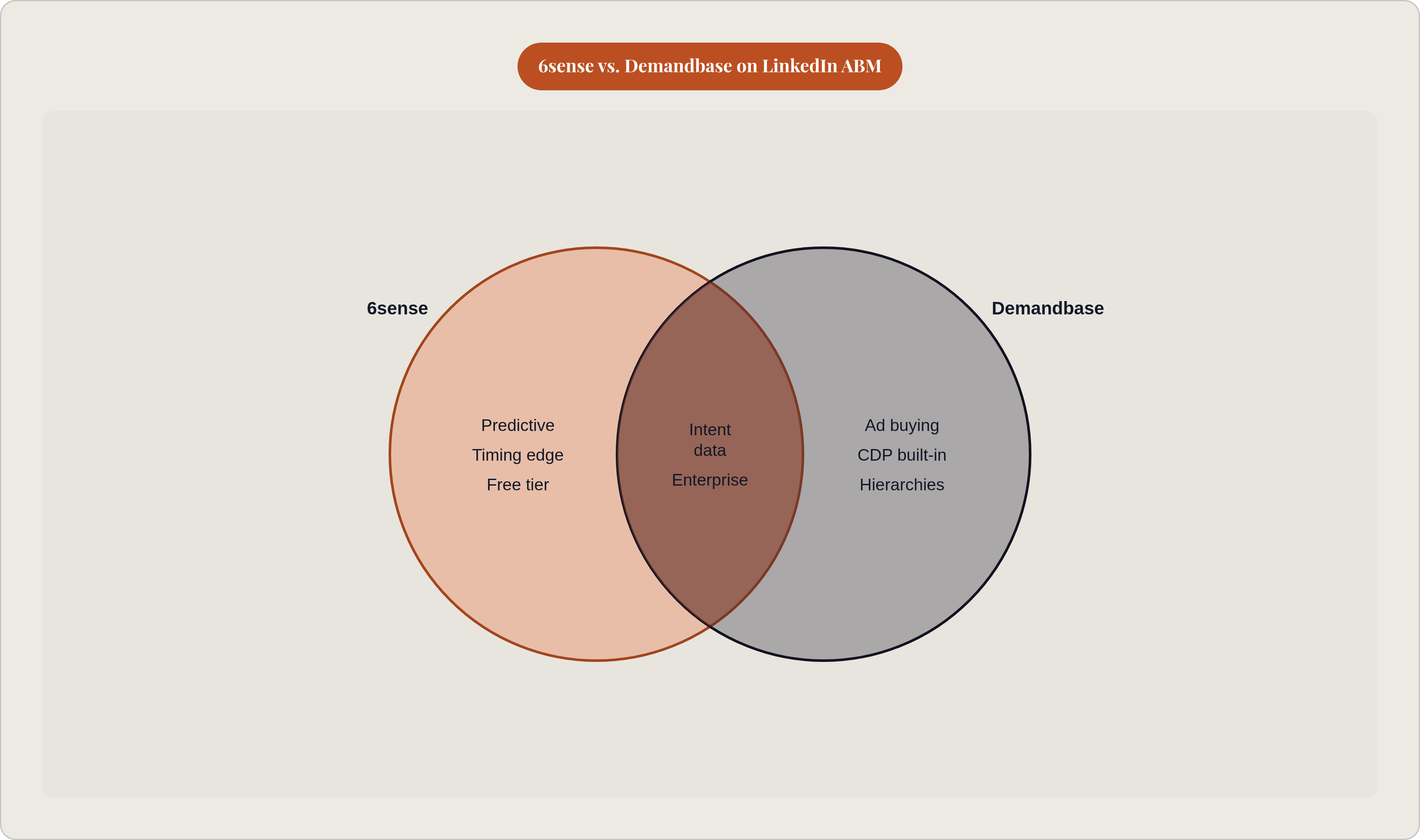
Demandbase One covers account intelligence, ABM advertising, sales intelligence, and a built-in customer data platform. It's the widest footprint of anything in this comparison, by a good margin.
On LinkedIn, it manages large-scale ad buying alongside display and other paid channels from one dashboard. Its person-based intent data (not just account-level) supports buying-group targeting that lines up with how LinkedIn structures audiences. Its Salesforce integration runs deep enough that a CRM status change can update LinkedIn audience membership close to real time. And its handling of account hierarchies makes it a real option for enterprise companies with subsidiaries or several buying committees spread across business units.
G2 reviews show broad satisfaction, but with nearly two thousand reviews on the platform, that number also tells you there's a large group of teams still working through implementation somewhere. Demandbase's own recommendation is to staff the platform with a dedicated analytics engineer and data analyst. Most organizations need more than three months to fully ramp up.
The best fit: enterprise teams with the headcount to run it, an existing investment in Salesforce, and account structures too complicated for simpler tools. The risk for anyone else: a platform this capable, run by a lean team without dedicated support, will underdeliver. That's where the budget quietly disappears, into the gap between what you're paying for and what you're actually using.
Terminus: the marketer-friendly execution layer, with a shallower data foundation
Terminus is built for marketers, on purpose. No analytics engineer required. The pitch is campaigns live in weeks, not months, and for a lot of teams that's true.
On LinkedIn, it handles the operational work (syncing contacts, enriching data, coordinating campaigns) with a lot less setup than the enterprise platforms above. LinkedIn sits as a primary channel in its multi-channel workflows, alongside email and display. Terminus Chat (formerly Ramble) can route a website visitor from a target account straight to the right sales rep in real time, which gives you a direct line from LinkedIn traffic to an actual conversation.
The trade-off shows up in the data underneath. Terminus leans on Bombora for intent signals instead of building its own. Bombora works fine for most mid-market needs, but it doesn't match the depth or volume of signal that 6sense or Demandbase builds in-house. If you need precise timing predictions or contact-level resolution, you'll run into that ceiling eventually.
Best fit: mid-market teams that want multi-channel ABM running fast, don't have a data engineer on staff, and don't need enterprise-grade prediction. Terminus coordinates and executes well. It doesn't predict. Teams that need to know exactly which accounts are in-market, and when, will need something else sitting next to it.
RollWorks (now AdRoll ABM): the ad-buying infrastructure approach to account-based targeting
RollWorks got rebranded under the AdRoll name in August 2025. The product is now called AdRoll ABM, but the architecture underneath is the same one RollWorks built.
Its real edge is structural: AdRoll's own demand-side platform, BidIQ, gives it stronger ad-buying mechanics than most mid-market ABM tools, including native reach into connected TV and digital out-of-home alongside LinkedIn.
On LinkedIn, account scoring, display ads, and sales alerts come bundled into one simple package, aimed at teams new to ABM. Its strength is getting the right accounts into LinkedIn audiences fast and tracking account-level engagement across channels in one view. The most common thing I hear from teams using it: setup to live campaign happens fast, faster than the orchestration platforms above.
Like Terminus, AdRoll ABM leans on third-party intent data rather than building its own engine, so its intelligence layer sits at roughly the same depth as Terminus. The real differentiator is the ad infrastructure underneath, not the scoring on top of it.
Best fit: teams that already know who they're targeting and mainly need a solid execution layer to get ads live, not a platform to help them build the list in the first place.
Contact-level intent tools and the emerging unbundled alternative to all-in-one suites
Here's a gap every account-level platform shares: knowing a company is in-market doesn't tell your sales team which person to call. That's where traditional ABM intent data runs out of road.
A newer batch of tools goes straight after that gap. Platforms like Influ2 gather buying signals at the individual level, pinpointing specific people inside a target account who are actively researching, and serve ads directly to those named people across LinkedIn, Facebook, Bing, and Amazon, without leaning on cookies or IP matching. The output is a short, prioritized list of actual humans, not a company-level heat map. That's something a sales team can pick up the phone and use.
That's opened up a different way to build a stack entirely. Instead of one all-in-one suite running six figures, some teams put together a focused intent data source, a lightweight activation tool, and a CRM to tie it together. Something like Buyerfeeds for person-level intent, paired with ContactLevel for activation and a CRM for orchestration, is one version of that model. You pay for what you use. You skip the months-long implementation of an enterprise suite. You can swap a piece out when it stops working without renegotiating a whole contract.
The catch: somebody has to own keeping that stack connected. Nobody's shipping you a unified dashboard. That job falls to whoever runs marketing ops, and if nobody owns it, the stack falls apart quietly, one broken sync at a time.
There's also a newer category worth knowing about: AI agent operators, tools like Synter Media, that sit between the intelligence layer (6sense or Demandbase supplying intent) and the execution channels (LinkedIn, Google, Microsoft), running the campaigns across those platforms so nobody has to operate each one by hand.
Before you shop for an all-in-one platform, ask a smaller question first: where's the actual gap in what you're doing today, and what's the least amount of new infrastructure that closes it?
How campaign execution quality on LinkedIn depends on what happens outside the ad platform
LinkedIn's ad auction rewards relevance, but relevance isn't only about who you're targeting. It's also about whether your creative and landing page actually match that audience. A campaign aimed at exactly the right accounts, running generic creative, will lose to a narrower campaign with messaging built for the specific stage and persona it's talking to. The ABM platform gets you in front of the right accounts. What happens after the click is what turns that reach into pipeline.
Then there's attribution, which trips up almost everyone. LinkedIn generates impressions and engagement at the account level, but most teams struggle to connect that activity back to actual pipeline and revenue sitting in their CRM. Without that closed loop, there's no way to tell if your targeting is generating real interest or just racking up views nobody acts on. This is exactly why the feedback loop from earlier (engagement flowing back into account scoring) matters in practice, not just as a bullet point in a sales deck.
LinkedIn's ad formats each play a different role in that sequence. Sponsored Content, whether it's a single image, video, or carousel, builds awareness and gets accounts engaging before anyone reaches out directly. Lead Gen Forms cut friction on higher-intent offers and tend to convert noticeably better than sending someone off to a landing page. Knowing which format fits which stage of the account's journey matters just as much as which platform is powering the targeting behind it.