LinkedIn Auction Dynamics for Low-Volume B2B Audiences
Strong engagement, not high bids, wins LinkedIn's narrow-audience auctions.
LinkedIn's auction looks like a standard ad auction, but it is not. Most advertisers treat it like a standard search or social ad platform, where the highest bid mostly wins. LinkedIn weighs other things too, and that difference is the source of almost every surprise narrow-audience B2B campaigns run into.
How LinkedIn's auction actually works and why it behaves differently than Google or Meta
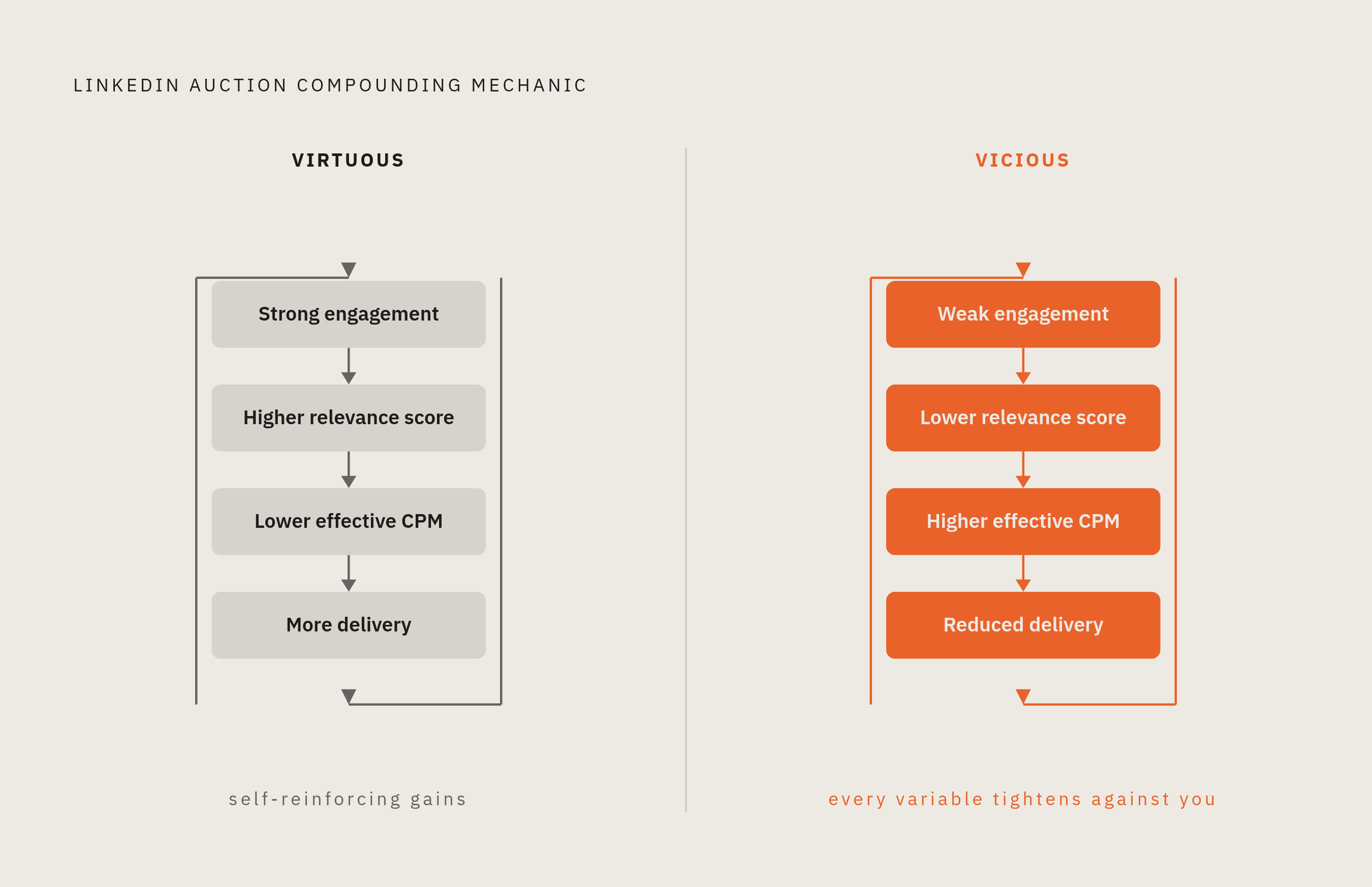
LinkedIn's auction weighs bid amount, predicted engagement rate, and ad relevance at the same time. The highest bid does not automatically win. A lower bid with a strong engagement history can beat a higher bid from an advertiser whose ads people scroll past. This creates a feedback loop that cuts both ways. Strong engagement raises your relevance score. That lowers your effective CPM. That gets you more delivery. Weak engagement does the reverse, and the decline compounds.
Campaign objective is not a label. It changes which signal the algorithm optimizes for. A conversion objective on a cold audience asks the algorithm to optimize for an event it has almost no data on. Delivery becomes erratic from the first day, not because the algorithm is broken, but because it is chasing a signal that barely exists in that audience.
The bid strategy itself also changes what the algorithm optimizes for. Factors.ai's 2026 LinkedIn report covers more than 850 B2B companies and substantial LinkedIn ad spend, and it draws the contrast directly. Maximum Delivery charges by impression, so at average CTRs it usually costs more per click. Manual CPC gives you control. Target cost bidding only works once enough conversion data exists. Bid strategy is not cosmetic. It determines what the algorithm is trying to do on your behalf, and narrow B2B audiences push against every one of these levers at once.
Why narrow B2B targeting creates an inventory problem the algorithm cannot solve on its own
Audience size is not just a targeting decision. Below a certain threshold it becomes a structural constraint that breaks delivery. The algorithm can only bid on auctions where your audience is eligible. When that pool is too small, there simply are not enough eligible auctions at any given moment to spend your budget smoothly.
Improvado's LinkedIn advertising guide lays out the core trade-off. Very large audiences deliver lots of impressions, but relevance scores drop. CPCs climb and CTRs fall. Most B2B campaigns hit their sweet spot in a bounded range that balances reach against relevance. Below that range, inventory scarcity takes over. Delivery becomes sporadic and CPM spikes because the algorithm is competing for a tiny number of auctions that arrive unpredictably.
The scarcity problem gets worse when you add bid caps to an already-narrow audience. The algorithm may produce zero impressions rather than throttling gracefully. It does not have enough auctions to win within your cap, so it stops bidding altogether. That looks like a broken campaign, but it is really the algorithm optimizing within constraints you set.
Above the upper end of the sweet spot, a different failure mode appears. Reach expands but relevance decays. Budget bleeds toward profiles that will never be buyers. The targeting precision that justifies LinkedIn's premium CPM disappears, and you end up paying a premium for reach you did not want.
Frequency is the other side of the scarcity coin. A small pool means the same people see the same ad repeatedly. And the algorithm does not provide a meaningful auto-cap frequency for most campaign types, though a limited frequency capping feature exists for brand awareness campaigns. Frequency-driven CTR decay becomes your problem to manage. The algorithm is doing exactly what it was designed to do. It optimizes within constraints. Narrow audiences create constraints it cannot compensate for.
What CPM and CPL actually look like for narrow enterprise audiences, and what drives the difference
The cost gap between a broad B2B audience and an ultra-narrow enterprise segment is large enough to change whether LinkedIn is a viable channel at all for a given business. This is not a marginal difference. It is the difference between a channel that works and a channel that burns budget.
CPL follows the same gradient. Mid-market ICP campaigns run materially lower CPL and cost per SQL than enterprise ICP campaigns. Tighter targeting and longer cycles push both figures significantly higher. You are paying more per lead for audiences that take longer to close.
But raw CPL is the wrong frame. The right frame is pipeline-weighted cost. A higher CPL against a large ACV and a solid SQL-to-close rate can easily outperform a low CPL against a small ACV and a marginally better close rate. The arithmetic makes this explicit.
That is where the ACV disqualification threshold matters. When ACV is low, LinkedIn's CPLs will rarely produce positive ROAS unless conversion rates across the entire funnel are unusually strong. At a sufficiently high ACV, the math typically works. The goal is not to reduce CPM. It is to earn it, which requires understanding what the algorithm rewards and building campaigns around that.
The specific failure modes that punish narrow-audience campaigns and how they compound
Most narrow-audience LinkedIn campaigns fail in ways that are structurally predictable, not random. And the failures compound each other. Once you see them as mechanical consequences of the auction logic, they stop looking like mysteries and start looking like design results.
Bid cap traps are the most visible failure. An ultra-narrow audience combined with an aggressive bid cap can produce zero impressions. The algorithm finds no auction where it can win within the cap at sufficient volume, so it stops bidding. This is not throttling. It is the algorithm refusing to participate in a market where your constraints make winning impossible.
Objective mismatch is a quieter failure. Video ads paired with a conversion objective consistently underspend budget. The algorithm optimizes for a signal that almost never occurs on a first video view. Conversion events are rare on cold video impressions, so the algorithm holds back spend waiting for data that does not arrive.
These failures do not stay separate. Frequency decay lowers CTR. Lower CTR lowers relevance score. Lower relevance score raises effective CPM. When effective CPM rises, your bid caps tighten even more against the clearing price. Tighter caps further reduce delivery. A single mismanaged variable cascades through the whole system. Improvado's guide frames the discipline simply: scale gradually rather than in large jumps, because LinkedIn advertising rewards precision and patience over scale and speed.
What the algorithm actually rewards: the signals that produce delivery and lower effective CPM
If you want efficient delivery in narrow audiences, you earn it through engagement signals, not bid inflation. You cannot buy your way out of a relevance problem. You can only improve the signal.
The virtuous cycle is the core mechanic. Higher engagement raises your relevance score. A higher relevance score lowers your effective CPM. Lower CPM produces more delivery. Creative quality becomes a direct cost lever, not just a brand consideration. A better ad is cheaper to run, and a worse ad is more expensive. That is not a metaphor. It is how the auction clears.
Thought Leader Ads earn higher engagement because they read like native peer content, not brand advertising. The creative requirement is genuine member posts from employees, experts, customers, or creators, pulled from actual post history, not rebranded brand creative. That requirement is also the quality signal the algorithm rewards with lower CPM and more delivery. The format works because it looks like content people already engage with on LinkedIn.
Targeting quality compounds the effect. The Smarketers' benchmark found a 20% rise in sales-accepted lead rate for teams using Matched Audiences and Lookalike targeting correctly versus teams using broad targeting. Targeting quality can outrun cost inflation. Every creative and targeting choice is also a bid efficiency decision. The algorithm does not reward style. It rewards the signals that predict a person will act.
How to structure campaigns around auction mechanics rather than against them
The campaign structures that survive narrow-audience LinkedIn auctions share a logic. They segment by engagement temperature, match objectives to evidence, and protect the relevance signal at every layer. You build around the auction's mechanics instead of fighting them.
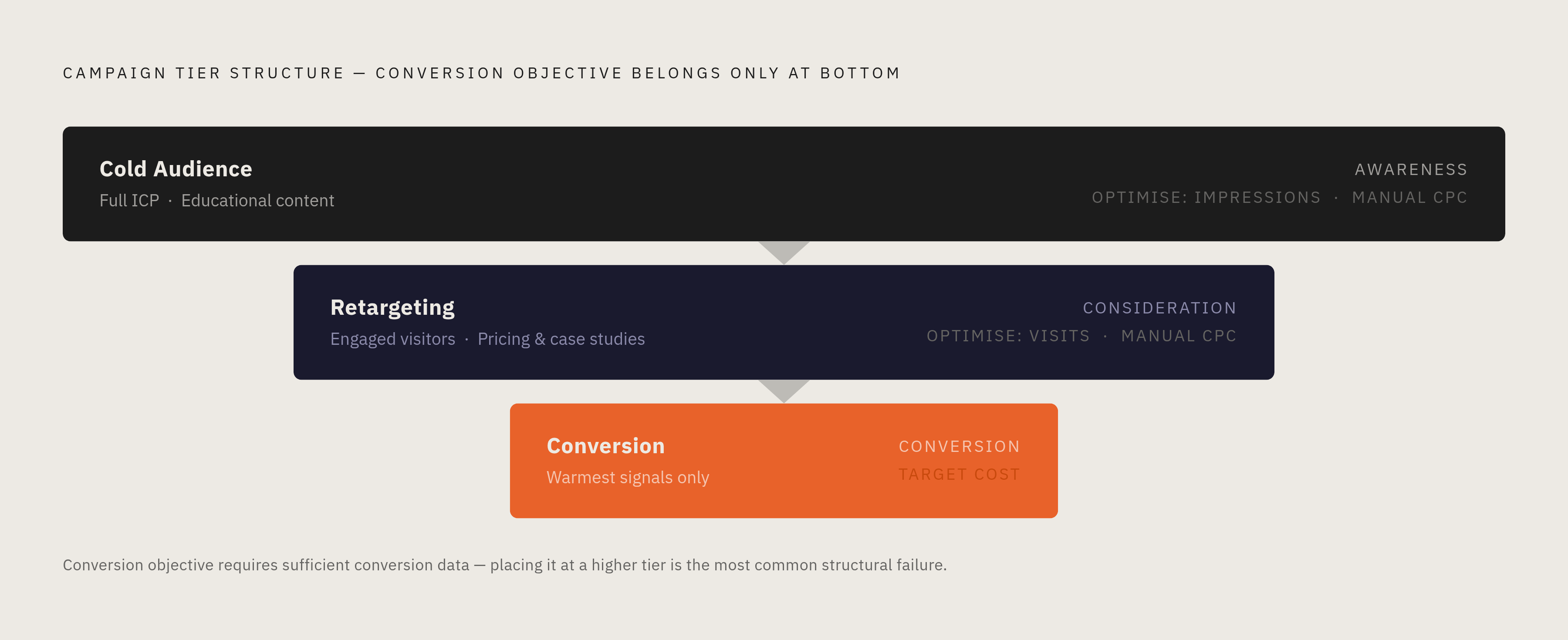
Tiered audience structure is the foundation. A cold-audience awareness tier targets the full ICP with educational content. A retargeting tier reaches people who have engaged or visited high-intent pages like pricing, case studies, and product pages. A conversion tier targets only the warmest signals. This sequencing prevents the most common structural failure: trying to convert cold audiences who have no prior engagement. That approach produces poor conversion rates, low relevance scores, and CPM inflation on the most expensive inventory.
Objective selection must match audience temperature and evidence. Awareness objectives for cold audiences optimize for impressions. Consideration objectives for warm audiences optimize for engagement or visits. Conversion objectives only make sense where there is enough conversion data for the algorithm to optimize meaningfully. Matching objective to evidence means the algorithm is optimizing for a signal that actually exists in that audience.
Budget distribution follows the same logic. The largest share goes toward demand capture and retargeting, where intent signals are strongest. A smaller allocation supports thought leadership and cold awareness. These tiers are not interchangeable. They serve different algorithm states and need different treatment.
Bid strategy should match the evidence tier. Manual CPC works for campaigns with limited conversion data. Target cost bidding only works when enough conversion events give the algorithm a reliable optimization signal. Maximum Delivery should be reserved for awareness campaigns where CPM efficiency is the primary goal. Audience size, objective, creative, bid strategy, and budget all interact with the same auction logic. Getting one wrong undermines the others.
Creative rotation cadence is a structural decision, not a production afterthought. For narrow audiences, single image ads need rotation on a faster cycle than video. Video's view-through engagement sustains relevance scores longer. Failing to rotate systematically guarantees frequency decay and relevance score decline. And scaling discipline matters too. Increase budgets incrementally rather than in large jumps. A large sudden budget increase forces the algorithm into auctions it previously avoided, at clearing prices it has no history on.
Why LinkedIn's default attribution window systematically undercounts what narrow-audience campaigns actually produce
LinkedIn's default attribution window was not designed for B2B buying cycles. Campaigns that look inefficient under that window are often generating influence that appears in pipeline months later. The measurement frame is the problem, not the channel.
Dreamdata's benchmarks show a lengthy average B2B buying journey that can run for many months, and most of it happens before sales enters the picture. An average deal has multiple stakeholders and many touchpoints across several channels. If a person clicks a LinkedIn ad today, they may research internally for months, share content with colleagues, and return through branded search before requesting a demo. LinkedIn's default 30-day click and 7-day view attribution window captures almost none of this journey.
Last-touch attribution systematically overweights paid search and email. Those channels appear at the moment of conversion. LinkedIn operates earlier in the cycle, so it gets credit for almost none of the deals it influenced. The practical fix is to track account engagement, marketing-qualified progression, sales acceptance, and opportunity creation in the CRM alongside lead volume. Optimize toward qualified pipeline rather than the cheapest visible lead.
Pipeline velocity is a leading metric that raw CPL misses. A channel that generates fewer leads but shortens the sales cycle has real economic value that only appears when velocity is tracked. Multi-touch or position-based attribution models should replace single-touch for any channel investment decision. Which model matters less than abandoning last-touch entirely for a channel that operates at the top and middle of a 272-day cycle. And the connection back to the ACV threshold is direct: campaigns that clear that threshold will often look unprofitable under last-touch attribution even when they are not.
How LinkedIn fits into a paired paid-media system and what that means for budget allocation
LinkedIn's narrow-audience auction mechanics make the most sense when LinkedIn is one layer in a coordinated system rather than a standalone channel. The economics improve when you stop asking LinkedIn to do everything. The most durable B2B paid-media structure layers LinkedIn and Google to serve different audience states. Google Search captures high-intent demand from people already researching solutions. LinkedIn builds preference and surfaces demand among people who match the ICP but have not yet self-identified as buyers. Both channels matter. They matter at different points in the cycle.
Factors.ai's 2026 report found that LinkedIn returns more on ad spend against Google in their dataset, but the comparison only holds when LinkedIn campaigns are targeted correctly. Broad LinkedIn targeting erases the advantage. The channel's edge comes from precision, and you lose that edge the moment you trade precision for reach.
Retargeting across channels ties the two together. Prospects who visit pricing or case study pages through Google Search become the highest-intent retargeting audience on LinkedIn. They convert at substantially higher rates than cold LinkedIn audiences. LinkedIn's Thought Leader Ads and Document Ads function as the demand-creation layer. They build brand preference and category credibility among senior decision-makers before they enter an active buying cycle. Those same people are more likely to click a branded search result on Google when intent crystallizes months later.
To coordinate this architecture, you monitor performance on both platforms and reallocate budget to where the strongest signals appear. Run manually, this creates the exact kind of execution lag that lets frequency problems and relevance score decay go unaddressed. Delegating execution to a system that monitors and adjusts continuously, with human judgment governing the consequential decisions like audience strategy, offer design, and attribution model selection, and agents handling the continuous execution, is the structural answer. LinkedIn's auction mechanics are unforgiving in narrow-audience environments. The penalty for slow response is paid in CPM inflation and delivery collapse.