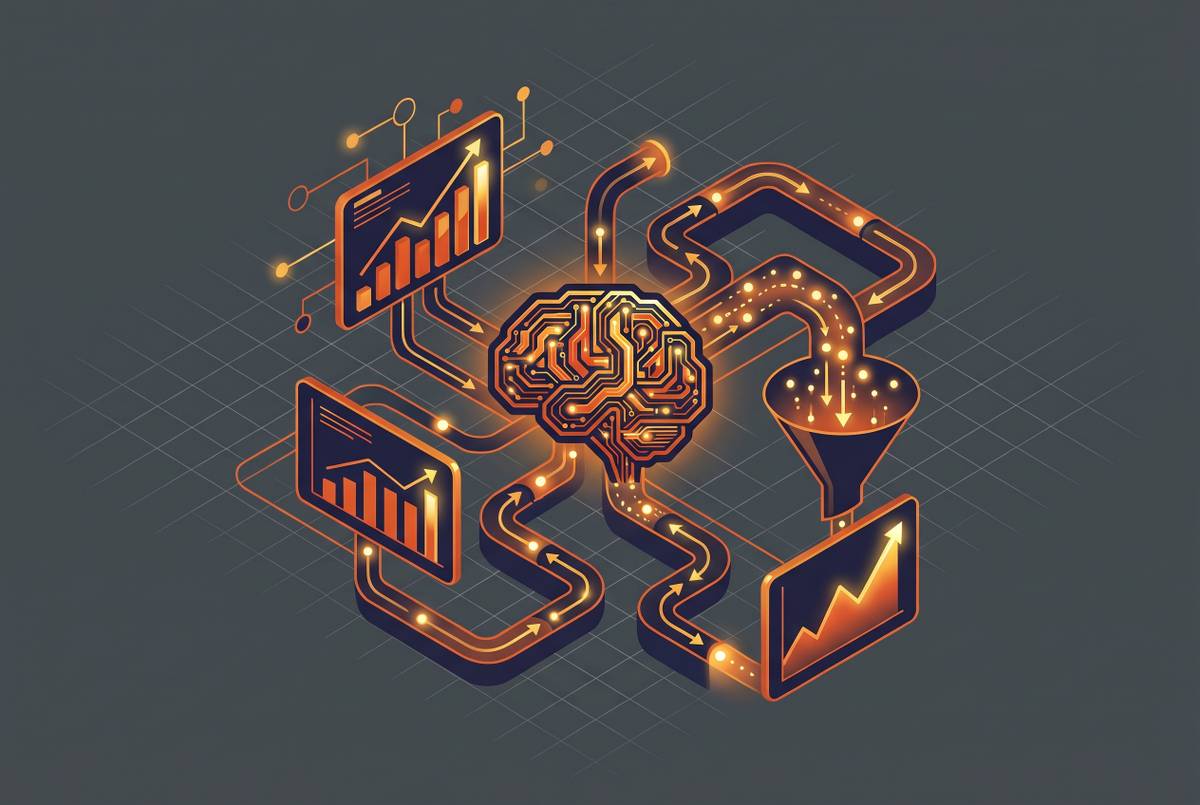
What Full Autonomy Actually Looks Like When an AI Agent Runs Your LinkedIn and Google Ads Stack
True autonomy means agents executing research, bids, creative.
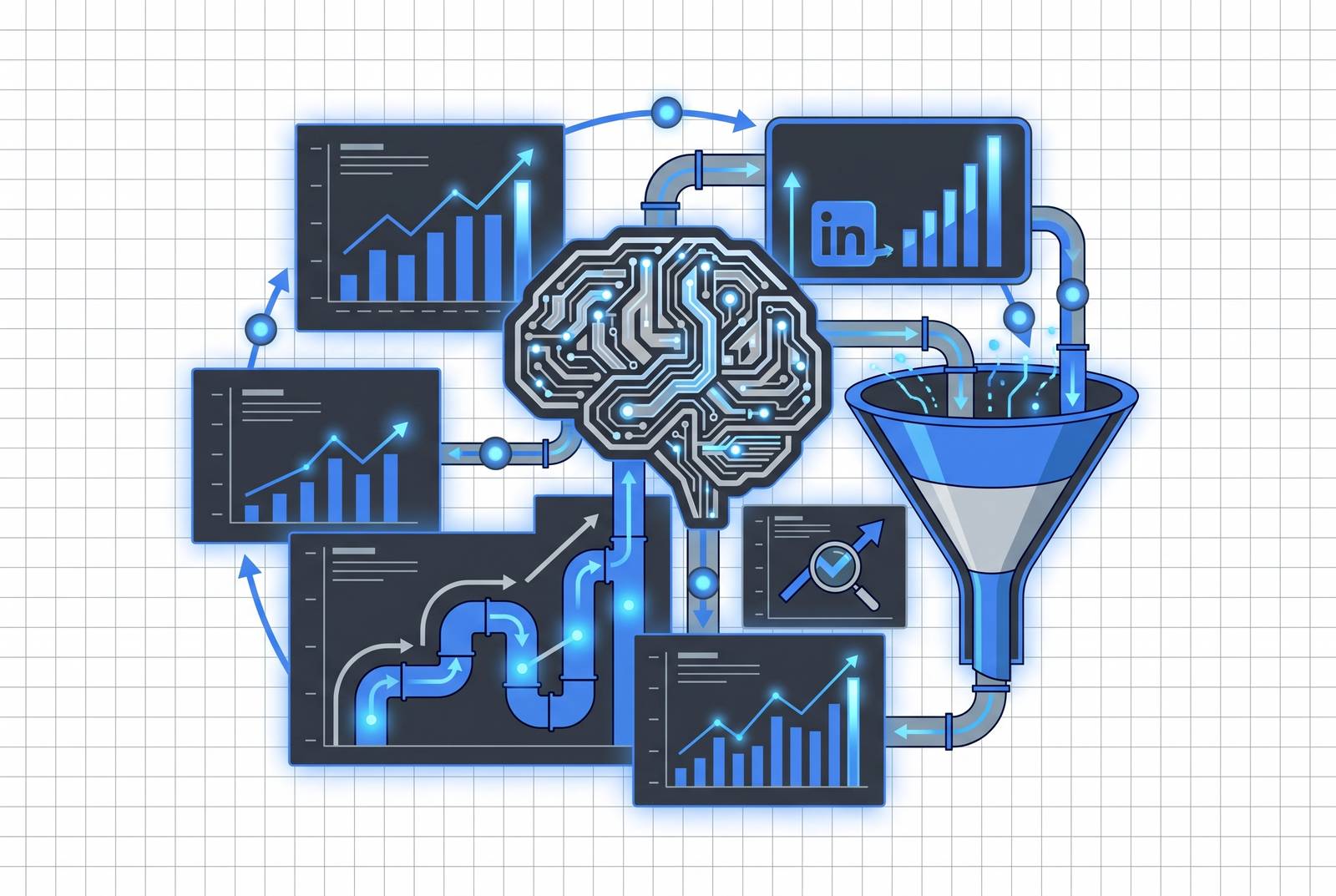
Full autonomy in an AI agent for B2B Google and LinkedIn Ads management means continuous execution across research, bidding, creative, landing pages, attribution, and learning. It requires a connected architecture that extends beyond an “autonomous” setting on a bidding tool. This article maps that architecture and its central distinction. Humans own the goals and consequential judgments, while the agent does the mechanical work without waiting for the next review meeting.
Why "autonomy" in paid media has meant something different every year until now
Rules-based automation handled if/then bid changes and dayparting, but a human still wrote the conditions. Smart bidding handed bid-level decisions to Google’s systems without handing over research, positioning, or the post-click experience. AI-assisted drafting took on more of the work by writing copy and making recommendations. Yet humans still approved and acted on them.
Each version automated real work, but none owned it from end to end. A recommendation is not an executed campaign change. Google Marketing Live 2026 described agents handling more campaign setup, creative iteration, and optimization, with marketers supplying goals, briefs, and business constraints. That direction is broader than automated bidding, but it is not full continuous operation across the stack. A product’s architecture therefore needs to be examined layer by layer.
What an AI marketing agent actually is at a technical level — and why the architecture matters
An AI marketing agent receives a goal and determines the actions needed to pursue it. Traditional automation follows a set of steps, such as sending an email three days after a lead downloads a PDF. An agent might instead receive the goal of generating 15 qualified demos from mid-market SaaS accounts this quarter. It then determines channels, content, targeting, and when to change course.
That choice runs through a recurring loop. The agent perceives by reading live marketing data, reasons by comparing the current state with its goal, acts by changing campaigns, and learns by updating its understanding of what works. It does not wait for a human to supply every next instruction. However, independence is not the same as good judgment. Bad data or the wrong conversion goal can make a loop good at getting things wrong.
Tool access adds another architectural distinction. Synter’s use of the open Agent Skills framework shows how plain-text instructions can describe available actions, expected inputs, API patterns, and operating constraints for tools including Google Ads, LinkedIn, GA4, and HubSpot. These skills explain how to use a tool. They do not themselves provide live account access or permission to execute changes. A separate execution layer must grant that authority, because an agent that understands the controls but cannot touch them remains an adviser.
How the execution layers stack: research, bidding, creative, landing pages, and attribution as one connected system
Research and audience targeting form the first layer. The agent reads performance across platforms and takes into account day-of-week patterns, how competitors bid, and outside events that affect conversion rates. Audience quality is not a permanent property. PaidSync describes a LinkedIn workflow in which targeting by job title and company size produces strong initial cost per lead, then deteriorates as the audience saturates. Tracking the trend by segment lets the system flag an audience that needs refreshing before more spend follows the old result.
Bidding and budget allocation turn that reading into action. Rather than merely adjusting bids inside one platform, the agent monitors Google and LinkedIn together and reallocates budget toward stronger combinations. This requires authority over both platforms. The research layer supplies the changing picture of opportunity, while the bidding layer changes where money goes. Without that link, what the system learns about an audience can stay trapped in a report while the budget keeps its old appointment.
Creative generation and testing provide the next lever. The agent tracks conversion drop-offs, creates copy and layout variations, runs multivariate tests, and promotes winning variants without a human having to write every test hypothesis. Fatigue must lead to action. Synter describes creative fatigue across LinkedIn and Google as a problem whose diagnosis and correction can be agent-executable. Humans supply the positioning, audience definition, and core offer, while the system handles the mechanics of testing how that argument is expressed.
Agents monitor page-level conversion drop-offs and generate copy and layout variations within the same optimization cycle as the ads. The click is not the finish line. A system that changes delivery and creative but hands visitors to an untouched page leaves a major part of the conversion path outside its control.
Attribution shows whether any of those changes have helped. An agent rewarded for platform-reported form fills can spend more on leads that never close, so the shared data layer must link what happens in advertising to CRM pipeline outcomes. Deal quality then guides the agent in place of click volume. PaidSync describes how it links Google Ads conversions to GA4 behavior in the same session, using pricing-page time, docs visits, and demo-request behavior as lead-quality proxies while long sales cycles play out. Those proxies help fill the waiting period, but they do not become closed revenue by wearing a more serious label.
Together, these layers need one optimization goal and a shared view of the evidence. Otherwise, creative can chase clicks while bidding chases cheap forms and the business waits for pipeline.
Why Google and LinkedIn must run as one integrated system for B2B, not as parallel campaigns
LinkedIn and Google Search perform different jobs in the B2B buying journey. LinkedIn reaches accounts through company size, job title, industry, and seniority, helping create awareness and demand among the intended buyers. Google Search captures expressed intent. A VP of Engineering searching “API monitoring tool pricing” three days after seeing a LinkedIn ad represents a journey connecting the two channels. An agent reading only one platform cannot evaluate that sequence.
B2B journeys from first impression to closed business take months rather than days, so a short attribution window can miss LinkedIn’s contribution. Cheap leads can then draw money away from what works. Cost per SQL, pipeline ROAS, and CAC payback describe the business objective more closely than cost per lead. The agent also needs the account’s economic context, because LinkedIn-sourced deals can have higher average contract values while other channels may be more cost-effective below a certain ACV threshold.
Neither platform supplies the other’s full picture. Cross-platform execution must read both through a connected measurement system so it can spot patterns such as a LinkedIn impression followed by a branded Google search. Humans can reconcile those patterns periodically, but agents make continuous reconciliation practical. The requirement is to let evidence from either channel change decisions about the whole journey, rather than award all the credit to whichever platform happened to be standing nearest the form.
How continuous execution compounds over time — and what that means for programs that run on weekly human review cycles
A weekly review creates a gap between a change in performance and a response to it. During that gap, the campaign runs on decisions made from an earlier picture. Continuous execution changes the starting point for the next decision. An agent can already have shifted budget toward stronger combinations, paused underperformers, and queued creative variants before the next human review. When those changes improve performance, the following optimization begins from a better baseline.
That is the first compounding mechanism. More activity alone proves very little. The gain depends on the agent reading useful signals and pursuing the right goal, because continuous execution can also repeat bad decisions. With those conditions in place, shrinking the insight-to-action cycle from weeks to hours changes how many opportunities the system has to improve a campaign.
Learning supplies the second mechanism. Each campaign leaves a structured record of what it found about audiences, creative angles at different funnel stages, landing-page variants, and attribution patterns. The next campaign can inherit that history. Accumulated knowledge belongs to the system, preserving context when an account manager leaves.
A connected history also improves the scope of diagnosis. A shortfall in pipeline might come from weak creative, a poor landing page, an attribution gap, or money going to the wrong channels. A bidding-only tool has a narrower set of responses. An agent that can reason across the stack can identify which layer constrains growth instead of treating every problem as an invitation to adjust bids. Compounding intelligence turns the agent into a growth function.
What human judgment must own in a genuinely autonomous system — and why this isn't a limitation
Compounding raises a more consequential question than speed. What has the system been told to compound toward? Humans must set the ideal customer profile and the campaign objective, including which conversion signal the agent should follow. Choosing form fills rather than qualified pipeline is not merely a technical setting. It says what the business counts as success, and an agent can chase the wrong answer with enough zeal to wear people out.
Humans must also own positioning and the quality of the offer. An agent can test headline variants, but deciding what the ad should argue is different from deciding which version performed better. The offer itself requires judgment about the target account. So humans still set creative direction, while the system can keep generating, testing, and promoting variants.
Does that make autonomy just another name for AI assistance? The distinction lies in what happens after the decision. In an assisted model, humans approve recommendations and manually execute changes across platforms. In an autonomous model, humans set direction and the agent executes, monitors, and adjusts across the stack without recurring mechanical handoffs.
An agent can report pipeline ROAS, but it cannot be held responsible for a business outcome. The operating model needs an expert whose responsibility extends beyond campaign metrics to qualified pipeline and revenue. That responsibility gives the delegation a human owner. A named expert accountable for outcomes is not a concession to the old agency model, but what makes delegation credible.
How to evaluate an AI agent for B2B Google and LinkedIn Ads management
For a buyer, the first diagnostic question concerns the optimization signal. What outcome actually changes the agent’s decisions? Platform-reported conversions do not establish pipeline optimization, even when the interface calls them results. The distinction is whether CRM outcomes inform the loop and whether deal quality influences allocation.
A recommendation queue is not autonomous execution. The evaluation should establish which actions the system takes, what evidence triggers them, and when it escalates to a human. Synter distinguishes genuine execution authority from read-only access and describes pre-flight spend constraints as part of a production architecture. Knowing the account’s state and being authorized to change it are separate capabilities.
Audience insights, creative history, and attribution patterns should inform the next round of decisions. The evaluation should also establish who owns pipeline outcomes and how that person is measured. These questions connect software architecture to the operating model. A system may execute continuously and still fall short if it forgets its history or leaves business accountability unnamed.
The agency and in-house comparisons sharpen those distinctions. A traditional agency supplies people, often assisted by AI, while a single in-house owner remains bounded by one person’s capacity and continuity. An agent-run model instead keeps execution and accumulated learning in the system. Commercial incentives deserve the same scrutiny, because a fee tied to media spend rewards a different thing from a fee decoupled from spend and aligned with pipeline. The buying decision is therefore about execution authority, retained learning, outcome ownership, and incentives (not which interface makes a bidding tool look most like a colleague).